No products in the cart.


In the evolving field of peptide research, few combinations have generated as much interest as the Klow peptide stack. This innovative blend combines four distinct peptides into a single, powerful formulation: GHK-Cu, KPV, BPC-157, and TB-500. Created specifically for laboratory investigation, this stack allows scientists to explore multiple biological pathways simultaneously, particularly those related to tissue repair, inflammation control, and cellular regeneration. This guide will provide an in-depth look at what the Klow peptide stack is, how its components work synergistically, and its primary applications in a research setting.
The Klow peptide stack was deliberately designed to study the synergistic potential of its components. By bringing these four compounds together, researchers are equipped with a dynamic tool to investigate complex biological processes far more efficiently than studying each peptide in isolation.
Think of it as a comprehensive toolkit for a complex project. Instead of examining one mechanism at a time, the Klow stack enables researchers to observe how structural repair (supported by BPC-157 and TB-500), tissue remodeling (GHK-Cu), and environmental control (KPV) interact in a unified model.
The logic behind the Klow stack lies in the unique yet complementary functions of each peptide. To truly appreciate the research potential of this blend, it’s essential to understand what each component contributes.
Important Note for Researchers: The Klow peptide stack is intended strictly for in-vitro research and laboratory experimentation. It is not a drug, supplement, or medical product and is not approved for human or veterinary use. All information provided here is for educational and research purposes only.
To fully grasp the benefits of the Klow peptide stack in a research setting, we must examine its individual components. Each of the four peptides performs a unique role, and their combination creates a powerful, multi-faceted tool for scientific investigation. Let’s break them down one by one to see why this specific formulation is generating so much excitement among researchers.
It is this synergy that makes the Klow peptide stack so compelling. Researchers are not just observing a single biological pathway; they are investigating how multiple, distinct mechanisms can cooperate to influence complex processes like tissue repair and inflammation.
GHK-Cu, a copper-binding tripeptide, is the foundational element of this blend. It has been studied extensively for its significant effect on the proteins that constitute the extracellular matrix. In laboratory settings, it consistently demonstrates the ability to increase the production of both collagen and elastin, making it a key focus for research into skin renewal, wound healing, and general tissue repair.
Think of it as the project foreman on a construction site, signaling for the delivery of essential building materials. By including GHK-Cu, the Klow stack provides the foundational element needed to study the rebuilding phase of cellular recovery.
Body Protection Compound-157, more commonly known as BPC-157, is a synthetic peptide based on a protein found in human gastric juices. Its primary area of study is angiogenesis—the creation of new blood vessels. This is a non-negotiable step in any tissue repair model, as new tissue requires a fresh blood supply to receive nutrients and thrive.
What makes BPC-157 particularly interesting to researchers is its systemic effect. It doesn’t just work at the site of application in lab models; it appears to trigger repair mechanisms throughout an entire system. This makes it a potent compound for studying widespread recovery from injury.
TB-500 is the synthetic version of Thymosin Beta-4, a protein that plays a crucial role in cell structure and movement. Its main mechanism of interest is its regulation of actin, a protein that acts as the scaffolding within our cells. By influencing actin, TB-500 can affect how cells move, differentiate, and proliferate.
In the context of the Klow stack, TB-500 is the mobility expert. Researchers study it for its ability to help repair cells migrate to where they are needed most.
This cooperative action is a prime example of peptide synergy. TB-500 helps the cells move, while BPC-157 helps build the vascular “roadways” for them to travel on.
The final component, KPV, is what truly distinguishes the Klow stack from other regenerative blends. This small tripeptide is studied for one primary reason: its potent anti-inflammatory properties. The working theory is that it reduces inflammation by inhibiting key signaling pathways, such as NF-κB.
By adding KPV to the mix, the Klow peptide stack becomes a tool for investigating how a controlled inflammatory environment can enhance the effectiveness of the regenerative process. It acts like a site manager, keeping the “construction site” clear so the repair crew can work without interference.
This four-peptide combination is often sold as a standardized blend. KLOW is typically defined as a research blend of GHK-Cu, KPV, BPC-157, and TB-500, often in an 80 mg vial with a 50/10/10/10 mg ratio. This fixed composition is critical for researchers, ensuring consistency from one experiment to the next. You can learn more about the logic behind this multi-pathway design.
While each peptide in the Klow stack has a specific research function, the real intrigue lies in how they are theorized to work together. Think of it as a comprehensive model for studying cellular repair and inflammation. Instead of isolating a single biological process, the stack allows researchers to observe how different repair mechanisms might interact synergistically.
It’s helpful to use the analogy of a construction crew. BPC-157 and TB-500 are your ground crew, laying the foundation for tissue repair. BPC-157 is studied for building new “roadways” (angiogenesis), while TB-500 gets the “workers” (repair cells) to the site quickly. Together, they form the core of the physical rebuilding process.
The inclusion of KPV is what truly expands the research potential of the Klow peptide stack. In our analogy, KPV acts as the efficient site manager. Its primary role in preclinical models is to manage the environment by controlling inflammation. By potentially inhibiting key inflammatory pathways, KPV is thought to create a more stable and conducive setting for tissue regeneration.
This is a critical piece of the puzzle. Unchecked inflammation can disrupt the very repair processes that BPC-157 and TB-500 are meant to support. By studying KPV’s effects, researchers can investigate whether a managed inflammatory response leads to a more efficient and organized recovery model.
In short, KPV doesn’t build the structure itself. It ensures the construction site is clear and orderly, allowing the other peptides to do their jobs more effectively. This makes the stack a powerful tool for exploring the delicate balance between inflammation and healing.
Finally, GHK-Cu joins the project as the finishing team. This team handles the crucial final steps of the project. Its association with collagen and elastin synthesis makes it a key target for studying the long-term structural integrity and appearance of newly formed tissue. After the initial repair framework is laid down, GHK-Cu’s mechanisms are studied for their role in remodeling the extracellular matrix.
This peptide’s function is the perfect complement to the others:
By combining these four distinct but complementary actions, the Klow peptide stack provides a complete, holistic model for researchers. It allows for the simultaneous investigation of angiogenesis, cell migration, inflammation modulation, and tissue remodeling—all within a single, standardized framework. This comprehensive approach is what makes it such a compelling subject for advanced lab studies on complex recovery processes.
When researchers explore peptide stacks for regenerative studies, two names frequently appear: Klow and Glow. While they sound similar, the difference between them is straightforward and crucial for designing a study. It all comes down to the number of peptides. The Glow stack contains three peptides, whereas the Klow peptide stack includes four.
That fourth peptide in the Klow stack is KPV, and its inclusion is a game-changer. The Glow stack—which combines GHK-Cu, BPC-157, and TB-500—is the ideal choice for research focused purely on structural repair and regeneration. Adding KPV shifts the Klow stack’s potential, broadening its application to include inflammation control as a key variable.
Think of the Glow stack as the foundational toolkit for tissue repair. It provides GHK-Cu for collagen synthesis, BPC-157 for its angiogenic properties, and TB-500 for promoting cell migration. But when you add KPV to create the Klow stack, you are introducing a potent anti-inflammatory agent into your research model.
This makes the Klow stack the superior choice for any laboratory work where inflammation is a significant factor. While the Glow stack focuses on the “build” phase of recovery, the Klow stack is engineered to investigate both “shield and build” processes simultaneously—managing the inflammatory environment while supporting repair.
To help clarify the differences in their composition and research applications, here’s a simple table comparing the two stacks side-by-side.
| Feature | Glow Stack | Klow Stack |
|---|---|---|
| Peptide Count | 3 Peptides | 4 Peptides |
| Composition | GHK-Cu, BPC-157, TB-500 | GHK-Cu, BPC-157, TB-500, KPV |
| Primary Focus | Structural Repair & Regeneration | Inflammation Control & Structural Repair |
| Mechanism | “Build” | “Shield and Build” |
This table clearly illustrates how the addition of KPV expands the Klow stack’s utility from just repair to a more comprehensive model that includes inflammation management.
The chart below offers another visual breakdown of how these two popular stacks are composed and where their research focus lies.
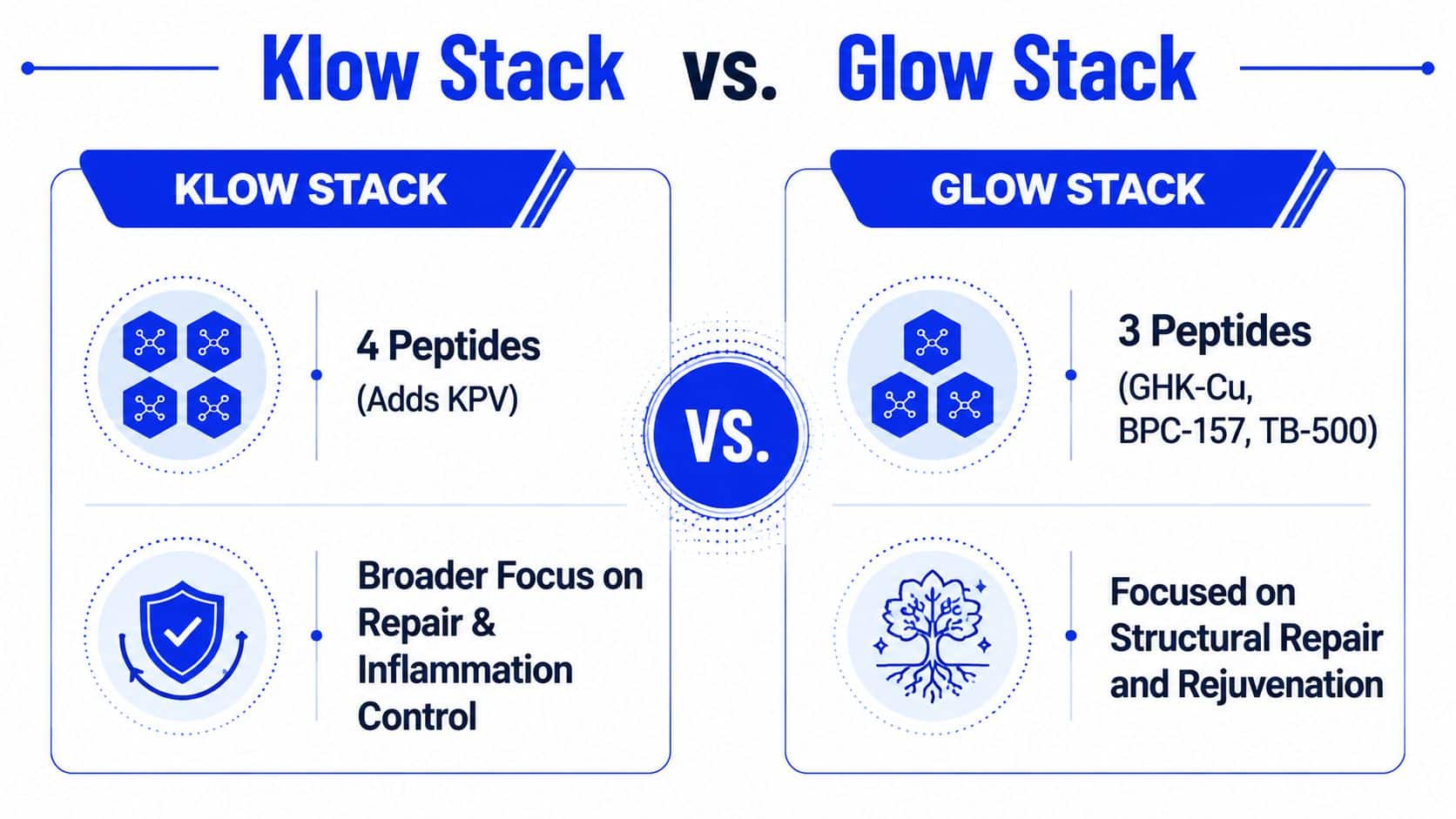
Much of the buzz around the Klow stack stems from it being seen as the next evolution of the well-known Glow stack. With KPV believed to inhibit inflammatory pathways like NF-κB and MAPK, this four-peptide blend allows researchers to study multiple biological systems from a single, standardized research compound. You can explore more on the key differences between the Glow and Klow stacks to determine which is a better fit for your lab’s objectives.
The integrity of any research study depends on the quality of the materials used. When working with a specific formulation like the Klow peptide stack, sourcing from a trusted supplier is not just good practice—it is essential for obtaining valid, reproducible data.
Unreliable sources may deliver products with incorrect dosages, contaminants, or even the wrong substance entirely. Any of these issues will invalidate your experiment from the outset. That is why it is crucial to partner with US-based suppliers who are transparent about their quality control processes. It is the only way to build your study on a solid foundation.
The single most critical document a researcher can obtain is a Certificate of Analysis (COA). A COA is an official report from an independent, third-party laboratory that verifies the quality of a specific batch of peptides. It is your proof that what is on the label is exactly what is in the vial.
A comprehensive COA for your Klow peptide stack should confirm several key details:
Sourcing peptides without a current, batch-specific COA is a significant risk. You introduce uncontrolled variables that can compromise your entire research project and lead to unreliable data. Always insist on this documentation before purchasing.
Furthermore, consistency is paramount. Reputable suppliers provide COAs for every new batch, which ensures that the results you obtain today will be comparable to those you get six months from now. For any serious, long-term research, this batch-to-batch consistency is non-negotiable. Choosing the right source for your materials is the first critical step toward a successful experiment.
Maximizing the research potential of your Klow peptide stack begins long before the experiment starts. It begins with meticulous handling from the moment the vials arrive. Peptides are sensitive biomolecules, and how you prepare them directly impacts their stability, biological activity, and, ultimately, the reliability of your data.
When you are ready to work, ensure you are in a clean, controlled laboratory environment. Always use appropriate personal protective equipment (PPE)—gloves and a lab coat are mandatory. This standard practice protects your samples from contamination and yourself from accidental exposure.

Reconstitution is the process of dissolving the lyophilized (freeze-dried) peptide powder in a sterile liquid. In essence, you are “waking up” the peptides for your study. Precision during this step is crucial.
The gold standard diluent for this purpose is bacteriostatic water. It contains 0.9% benzyl alcohol, which acts as a preservative to prevent bacterial growth in your solution. This is a critical detail for maintaining the purity of your sample throughout its research lifespan.
Researcher’s Tip: Never shake the vial. Vigorous shaking can shear the delicate peptide chains, destroying their structure and rendering them useless. Instead, gently roll the vial between your palms or give it a slow swirl. Patience is key.
Here is a straightforward protocol for a perfect reconstitution every time:
Storage is just as important as reconstitution. Once mixed, your Klow peptide stack solution must be kept refrigerated, ideally between 2°C to 8°C (36°F to 46°F).
For your unopened, lyophilized vials, store them in a refrigerator or freezer away from light. This ensures they remain stable and potent for the long term, ready for whenever you need them for your research.
Let’s conclude by addressing some of the most frequent questions researchers have about the Klow peptide stack. These answers should clarify any remaining points and help you get started in the lab with confidence.
The Klow stack was formulated for a specific purpose: to study the intricate relationship between tissue repair and inflammation. Its four-peptide design gives scientists a powerful tool to investigate several related biological pathways simultaneously.
The blend includes:
This unique combination makes it a premier choice for investigating complex recovery processes where both healing and inflammation are key factors.
No. This is a critical point that cannot be overstated. The Klow peptide stack and its individual components are sold strictly for laboratory and research use only.
These compounds are not drugs, dietary supplements, or medical treatments. They have not been evaluated or approved by the FDA for any human or veterinary use. All information in this guide is for investigational purposes within a controlled lab setting.
Sourcing is everything in research. To ensure your work is built on a solid foundation, you must partner with a reputable supplier that provides transparent, third-party lab reports for every batch. The key document you need is a current Certificate of Analysis (COA).
A proper COA will confirm:
A trustworthy U.S.-based supplier will have this documentation readily available, as it is the only way to prove the quality, consistency, and traceability of their products.
While mixing individual peptides is an option, researchers often prefer a pre-mixed blend like the Klow stack for several practical reasons. A professionally formulated blend offers convenience and, more importantly, consistency. It eliminates the risk of human error during measurement, which can easily compromise an entire experiment.
Most critically, a pre-mixed stack ensures a standardized, unchanging ratio of peptides from one experiment to the next. This is essential for generating reproducible results—the bedrock of all valid scientific research.
At Peptide Warehouse USA, we understand that quality and consistency are non-negotiable for your research. We provide high-purity, US-made peptides backed by transparent, third-party COAs for every batch. Explore our catalog to find the exact compounds you need for your next project.