No products in the cart.



A procurement officer has two peptide quotes open on the same screen. One supplier offers 99% purity at half the price. The other costs more, but includes a batch-specific Certificate of Analysis, chromatograms, mass-spectrometry results, microbial data, and endotoxin testing. The cheaper quote looks efficient until you ask the question that matters: what exactly has been verified?
That question defines how experienced labs buy lab source peptides. A purity percentage is useful, but it doesn't establish identity, contamination status, or lot traceability by itself. This guide shows how to evaluate research peptides through four connected checks, identity confirmation, purity verification, contamination screening, and documentation that ties every result to the material in your vial.
The first quote deserves more than a quick comparison of price per milligram. A low price can reflect efficient synthesis, but it can also reflect missing analytical work, relabeled material, weak shipping controls, or documentation that isn't specific to the lot being offered.
Before replying to either supplier, an experienced buyer asks:
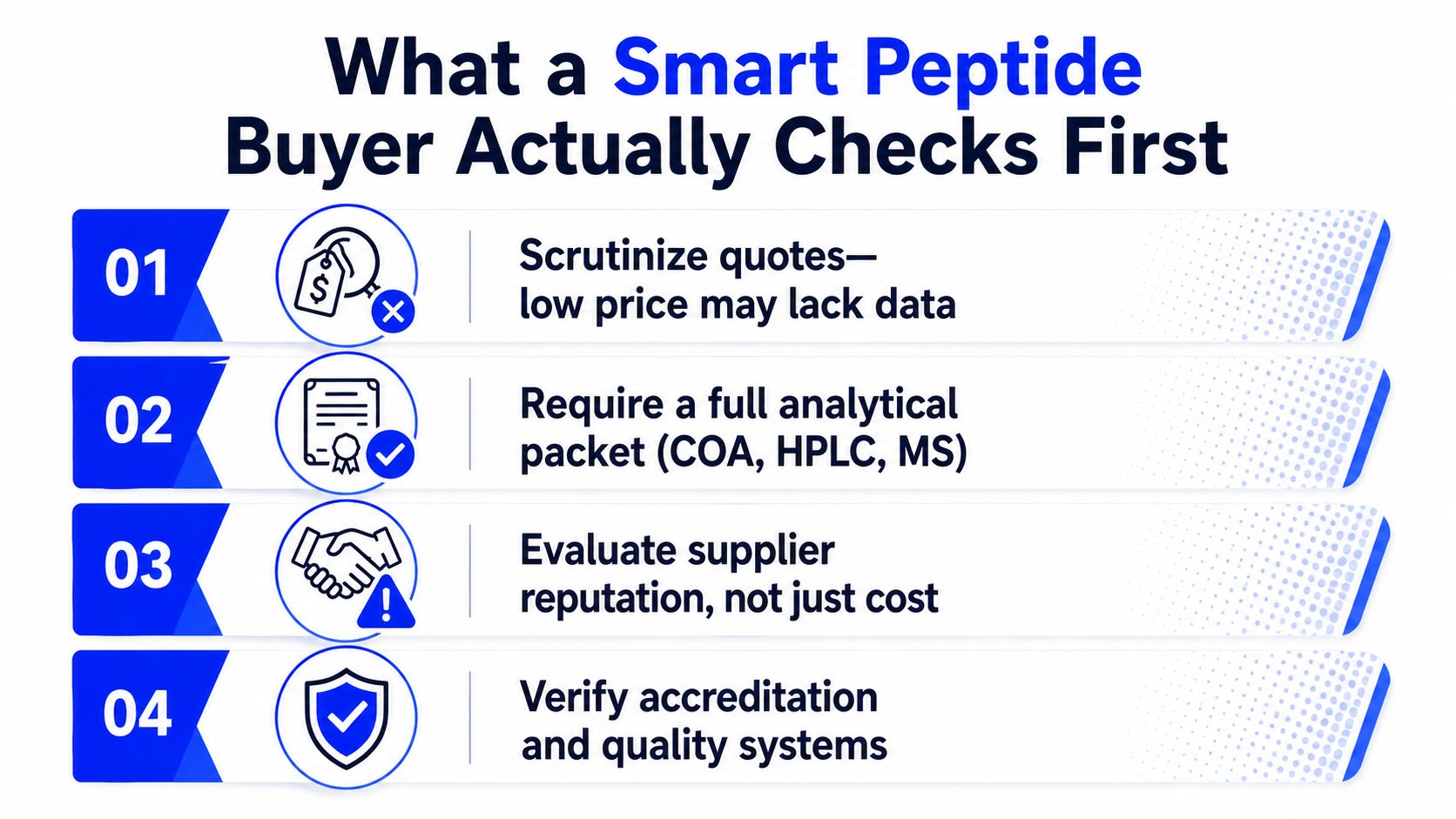
Price, a headline purity value, and a familiar brand name are weak filters. They may help you shortlist vendors, but none answers whether the material is the intended peptide or whether it suits your assay. A serious purchasing process treats the supplier package as evidence, then checks whether the evidence is complete and internally consistent.
Practical rule: Don't approve a peptide because the number looks familiar. Approve the lot because the identity, purity, contamination controls, and records agree.
The sections that follow apply this workflow to real buying decisions. Identity testing addresses whether the compound is what the label says. Purity testing shows the composition reported by the method. Contamination screening addresses risks that a chromatogram may not reveal. Traceability connects those results to a specific batch, shipment, and storage history.
Lab source peptides are materials purchased for controlled laboratory work, not products marketed for self-administration or general wellness use. In practice, a research team may use them in in vitro binding assays, receptor characterization, analytical method development, biochemical experiments, or preclinical research models, provided the work follows the laboratory's own safety, ethics, and regulatory requirements.
The phrase research use only, or RUO, needs careful handling. FDA guidance describes RUO and IUO labeling categories in the context of in vitro diagnostic products, explaining when those products may properly carry those designations rather than being represented as clinical diagnostics. That labeling language shouldn't be treated as a universal permission slip for every peptide product or every intended use. The FDA guidance on RUO and IUO products is the appropriate starting point for understanding the category.
A lab manager also needs to distinguish research material from a pharmaceutical-grade active ingredient. The latter belongs to a different manufacturing and regulatory framework. At the other extreme, gray-market consumer products may use scientific terminology while providing limited batch evidence and making implied human-use claims. Those categories can look similar in an online catalog, but their documentation and intended-use controls may differ sharply.
Peptides are commonly supplied as lyophilized powders, which can support practical storage and shipping, or as prepared solutions when the method requires a liquid format. A synthesis request may also specify structural details such as an amidated C-terminus, an acetylated N-terminus, a salt form, or another modification. Those details affect molecular mass, reconstitution calculations, assay preparation, and the identity result you expect to see.
Ask suppliers early about:
A supplier that answers these questions clearly is easier to qualify than one that only repeats a purity claim.
Reverse-phase HPLC is a standard release test for peptide purity, often using UV detection around 210–220 nm. The reported purity is calculated from the area of the principal chromatographic peak divided by the total area of detected peaks, so it is a compositional measurement from that method, not an absolute declaration that the vial contains the correct peptide. The Bachem guide to peptide quality control explains why HPLC and mass spectrometry serve different roles.
A clean-looking trace can still leave important questions unanswered. Components with similar retention behavior may co-elute, and poor resolution can make the main peak appear more complete than it is. A high result also doesn't prove that the sequence is correct, that a truncated fragment is absent, or that the labeled compound wasn't substituted with a related material.
| Analytical method | What it confirms | What it misses |
|---|---|---|
| Reversed-phase HPLC with UV detection | The chromatographic composition resolved by that method | Wrong sequence, co-eluting compounds, some nonchromophoric contaminants, and unresolved related species |
| Mass spectrometry | Whether observed molecular mass is consistent with the intended molecular formula | Complete sequence certainty when mass differences are not unique |
| MS/MS fragmentation | Fragment evidence that can support sequence confirmation | Every possible structural feature, especially where fragmentation coverage is incomplete |
| Orthogonal testing | Agreement between independent analytical principles | It still depends on suitable methods, controls, and batch-specific records |
Mass spectrometry should sit beside HPLC, not behind it. The buyer should compare the theoretical molecular mass with the observed result and ask which ionization method was used. MALDI and ESI can produce different ion patterns and adduct behavior, so the report should identify the method and explain the result in a way the laboratory can interpret.
Where the material is critical to an assay, MS/MS fragmentation provides stronger sequence evidence than a mass value alone. A peptide can share a nominal or closely related mass with another compound, while fragmentation data may reveal whether the expected sequence is present.
Independent testing has exposed the practical consequence of relying on purity alone. A 2026 analysis reported that 41.6% to 71.1% of samples failed basic quality criteria, while measurable endotoxin contamination appeared in 15% of samples. Those findings are discussed in the independent analysis of research-peptide quality. The procurement lesson is direct: a high HPLC percentage can't compensate for missing identity evidence or contamination testing.
A COA should let a second person reconstruct what was tested, when it was tested, how it was tested, and which lot the result belongs to. If it only displays a product name and a large purity number, it functions more like a sales sheet than a quality record.
Use this checklist before approval:
The Polypeptide peptide API control strategy identifies counterion content and residual water as broadly applicable controls, while wider quality panels may include residual solvents, endotoxin, and microbiological checks. These tests matter because synthesis residues, salt content, and moisture can vary between lots even when the vial looks unchanged.
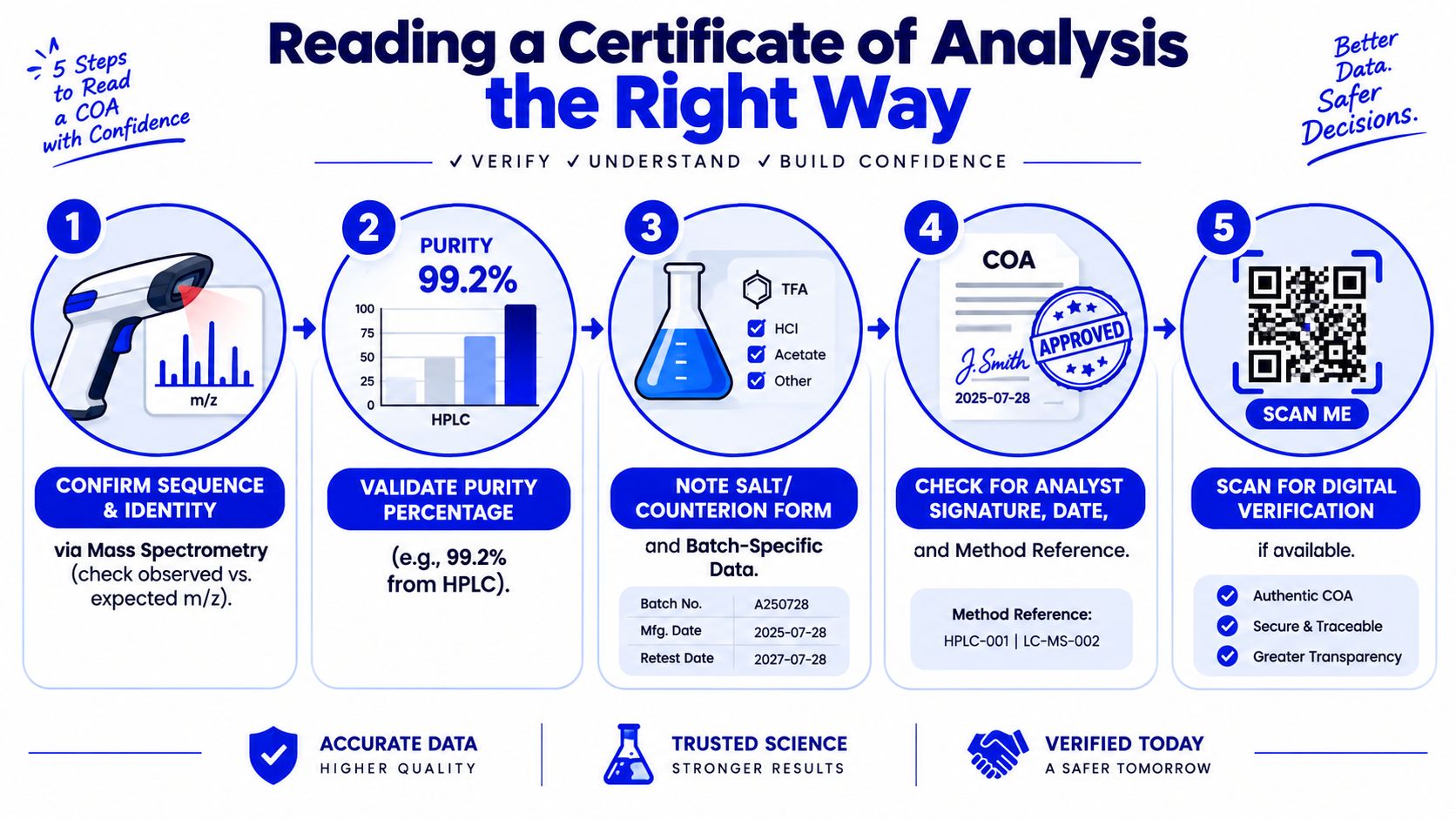
No endotoxin result should make you cautious about work involving cells or sensitive biological systems. No counterion disclosure can distort mass-based calculations, especially when a protocol assumes a particular salt form. No lot number means you can't establish that the document belongs to the vial you received.
Also check the administrative details:
A peptide claiming 99% purity but offering no identity data should raise questions, not confidence. The same applies to a COA that uses identical results across multiple lots, omits chromatograms, or refuses to provide method details.
A “research use only” statement or “not for human consumption” disclaimer doesn't, by itself, establish that a supplier is legitimate. FDA intended-use analysis considers objective intent shown through labeling, advertising, written statements, and distribution circumstances. The FDA intended-use doctrine discussion explains why a disclaimer alone may not control how a product is treated.
That distinction matters for buyers because the label addresses intended use, not analytical truth. A supplier can print RUO on a vial and still provide incomplete identity evidence, weak contamination controls, or records that don't connect to a real production lot. Your lab then carries the practical risk if an assay fails or a result becomes difficult to defend.
Regulatory scrutiny has also focused on sellers that pair research-only language with implied human-use benefits. Coverage of FDA scrutiny of GLP-1 and peptide advertising describes warning-letter activity from 2024 through 2026, including letters involving sellers whose marketing claims were inconsistent with their RUO labeling. A separate 2026 summary of peptide warning letters and classification issues notes seven FDA warning letters issued in April 2026 and broader attention to peptide classification and compounding boundaries.
A responsible buyer evaluates the whole record:
The legal status of a purchase depends on more than a peptide's name. Claims, labeling, intended use, and documentation all matter, so a buyer should involve the laboratory's compliance or legal function when the planned work raises a regulatory question.
Vendor evaluation works better as a side-by-side review than as a search for the lowest quote. The supplier that appears cheaper may require extra internal testing, replacement orders, or troubleshooting after a failed delivery. A vendor with higher upfront pricing may provide enough evidence to reduce those downstream uncertainties.
Use a framework like this for two or three candidates:
| Criterion | What to verify | Red flag |
|---|---|---|
| Manufacturing location | Named facility, stated synthesis responsibility, and whether production occurs in-house or through a contract producer | “In-house” language without a facility identity or clear production record |
| Batch testing | Tests performed on every lot, including identity, HPLC, water, solvents, endotoxin, and microbial controls where relevant | A generic “greater than 98%” statement with tests available only after repeated requests |
| Third-party verification | Independent laboratory reports that identify the same product and lot | A report with no laboratory identity, no lot number, or no separation between manufacturer and verifier |
| Documentation transparency | COA access, chromatograms, methods, signatures, dates, and change-control information | A polished PDF that omits methods or appears reusable across batches |
| Shipping reliability | Vial format, packaging, storage instructions, shipment tracking, and temperature controls where needed | Unclear handling instructions, damaged packaging, or no process for transit deviations |
“ISO-certified” may refer to a registration that the buyer can't verify, or to a quality system that doesn't cover the specific peptide being purchased. Ask for the certificate scope, issuing body, facility address, and relevant validity information rather than accepting the phrase at face value.
“In-house synthesis” also needs clarification. Does the supplier perform synthesis, cleavage, purification, lyophilization, and release testing at the named site, or does a contract producer complete some of those steps? Neither model is automatically unacceptable, but the documentation should identify responsibilities and preserve lot traceability.
A practical comparison includes the shipping experience, not just the downloadable COA. Check whether the vial arrives intact, whether the label matches the paperwork, and whether the supplier responds promptly when a document is incomplete. Those operational details often reveal more about process maturity than a badge on a homepage.
Supplier qualification shouldn't end after a clean first order. Treat every lot as a controlled receipt with a defined review.
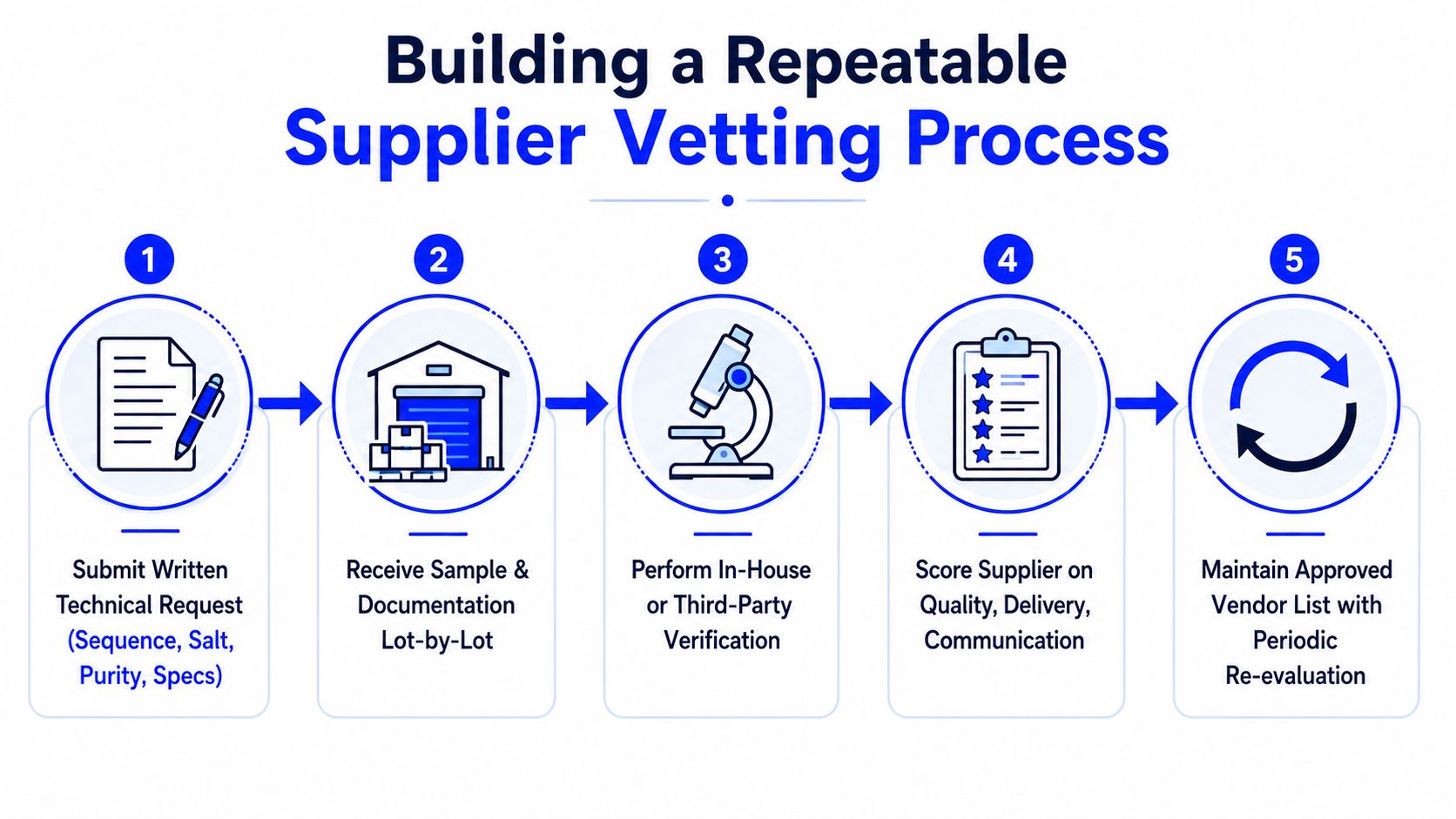
Don't accept a generic statement such as “>98% pure” when a required test is missing. Record deviations, substitutions, unavailable assays, and any mismatch between the quote and the delivered material. For every new lot, repeat the checks rather than treating the first successful delivery as permanent proof.
This process creates an auditable record and exposes recurring problems early. It also gives the lab a defensible reason for selecting one supplier over another when price, speed, and documentation quality point in different directions.
Review each lot for identity, purity, contamination, and traceability, rather than relying on one percentage. A credible COA, independent evidence, clear methods, and consistent fulfillment give your lab a stronger basis for selecting lab source peptides. Before ordering, request current batch records and confirm that the supplier can meet your documentation and quality requirements.
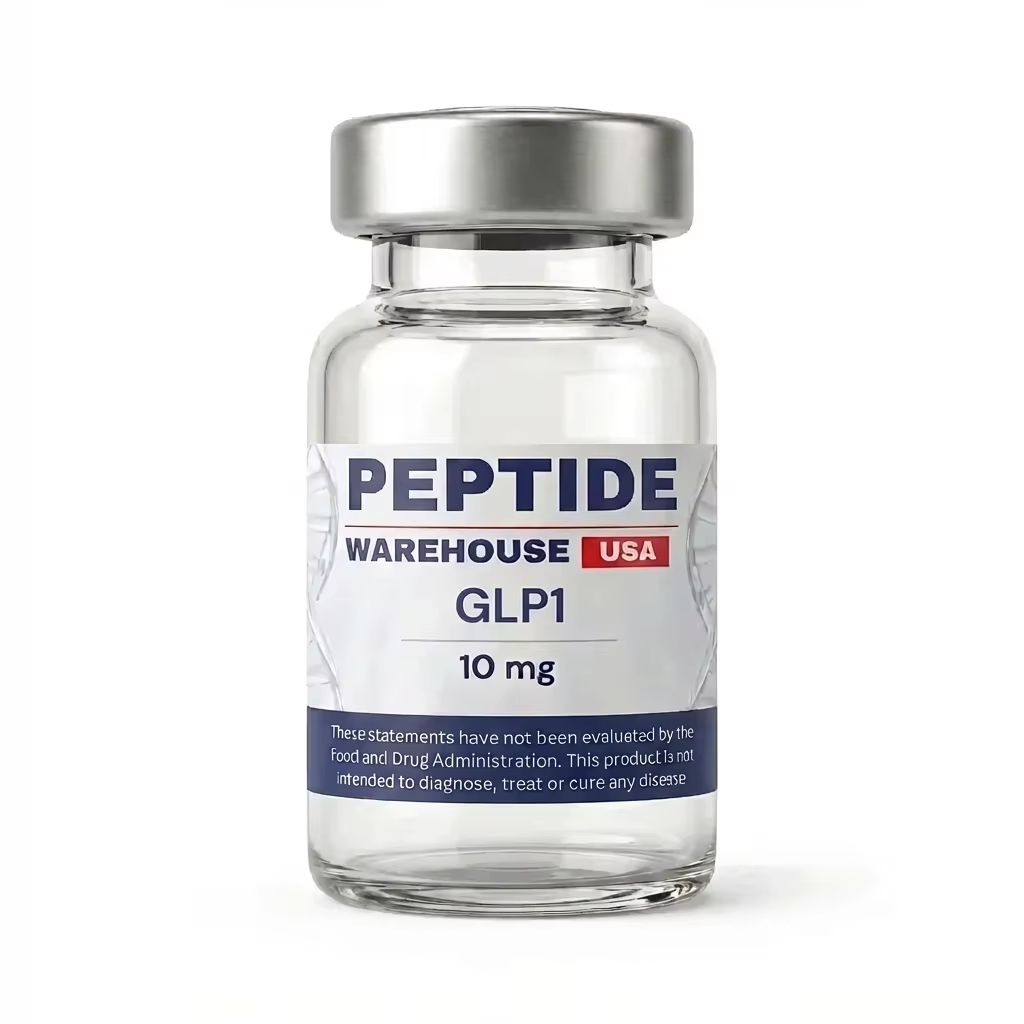
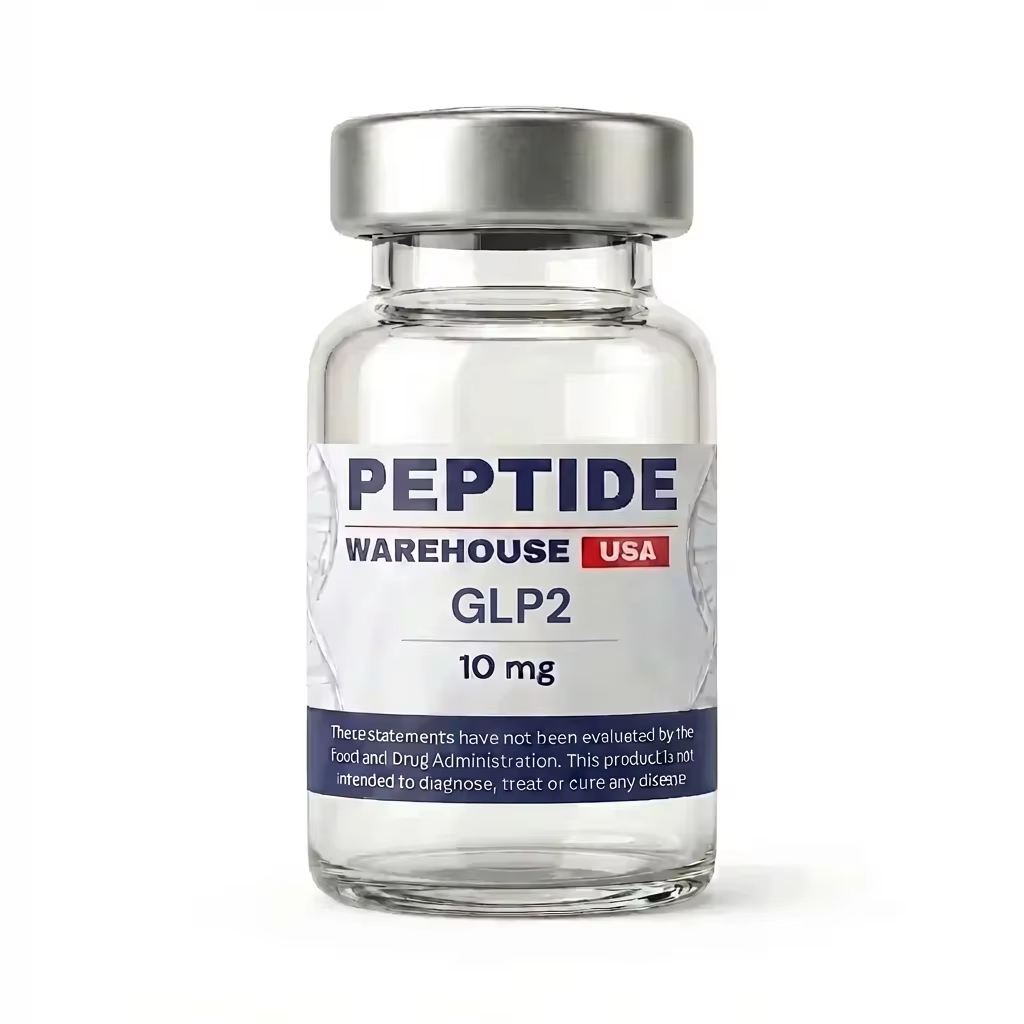
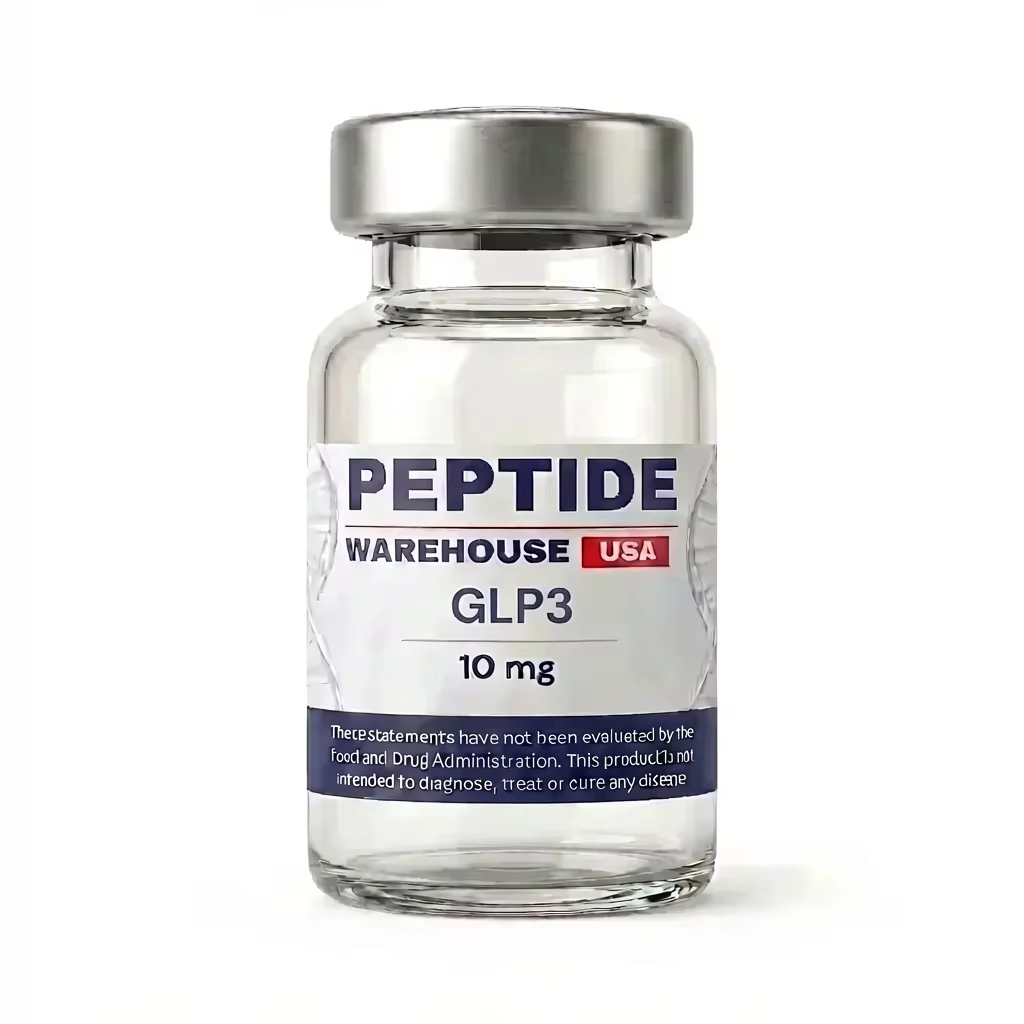
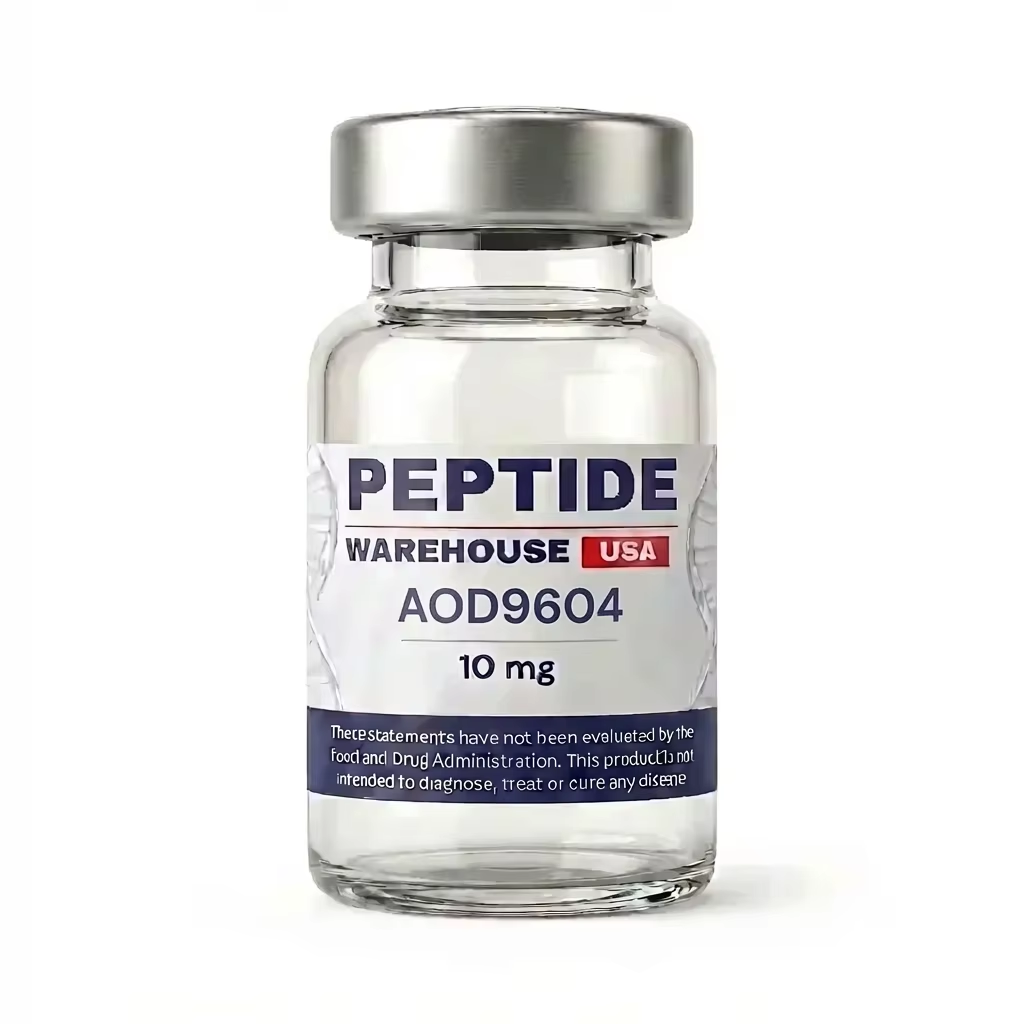
Peptide Warehouse USA offers USA-manufactured research peptides with batch documentation that includes COAs, microbial reports, and endotoxin reports for its laboratory and analytical catalog. Review the available documentation and visit Peptide Warehouse USA to explore options that fit your lab's verification and procurement process.