No products in the cart.


A researcher opens two vials labeled with the same peptide, uses the same protocol, and gets different results. The equipment checks out, the controls behave as expected, and the discrepancy seems mysterious. Often, the missing variable is the material itself. A purity percentage printed on a label can't tell you whether both batches contain the intended sequence, carry the same contaminant burden, or were tested recently.
Lab tested peptides are research materials supported by analytical evidence, not just a marketing phrase. This guide explains what testing can confirm, what it can miss, and how to read a Certificate of Analysis, or COA, with enough care to make a more informed sourcing decision. It also covers HPLC, LC-MS, endotoxin testing, microbial screening, third-party verification, and batch traceability.
The central lesson is straightforward: reliable peptide quality is a system, not a single number. A strong document should help you answer four practical questions. Is this the intended peptide? How much of the sample is that peptide? Could contamination affect the experiment? Can the result be connected to the exact lot in your hands?
A peptide vial can look professional while leaving important questions unanswered. The label may show a compound name, a claimed purity level, and a storage instruction, yet none of those details independently proves that the material matches the expected molecular identity or that the batch is free from biologically disruptive contaminants.
Peptide research often depends on controlled comparisons. If one batch contains sequence-related impurities, degradation products, endotoxin, or a different amount of active material than expected, the resulting cell-culture or analytical data may be difficult to interpret. The experiment hasn't necessarily failed. The input may be less defined than the protocol assumes.
A lab tested peptide should therefore mean more than “someone tested it.” It should refer to documented analytical checks that address different quality questions:
A 2023 peer-reviewed analysis of commercially sourced peptides reported that about 14% of samples showed purity deviations greater than 5% from supplier claims, while 3.7% showed evidence of sequence errors or truncation products. The findings illustrate why independent verification can uncover meaningful batch-to-batch gaps, even when a supplier has provided a stated specification. The analysis and its relevance to COA-tested peptides are discussed here.
Practical rule: Treat the COA as an analytical record to verify, not as a decorative certificate attached to a product page.
The rest of this guide translates the science into practical checks. You'll learn why HPLC and mass spectrometry answer different questions, why endotoxin testing deserves separate attention, how to identify a batch-specific COA, and which gaps remain when a document reports only “99% pure.” The aim isn't to make clinical claims or replace laboratory judgment. It's to help researchers reduce avoidable uncertainty before a vial enters a workflow.
Think of buying a research peptide like receiving a shipment of calibrated glassware. You wouldn't confirm only that the box arrived. You'd check the item, compare it with the order, inspect it for defects, and review the calibration record tied to that specific piece. Peptide quality control follows the same logic.
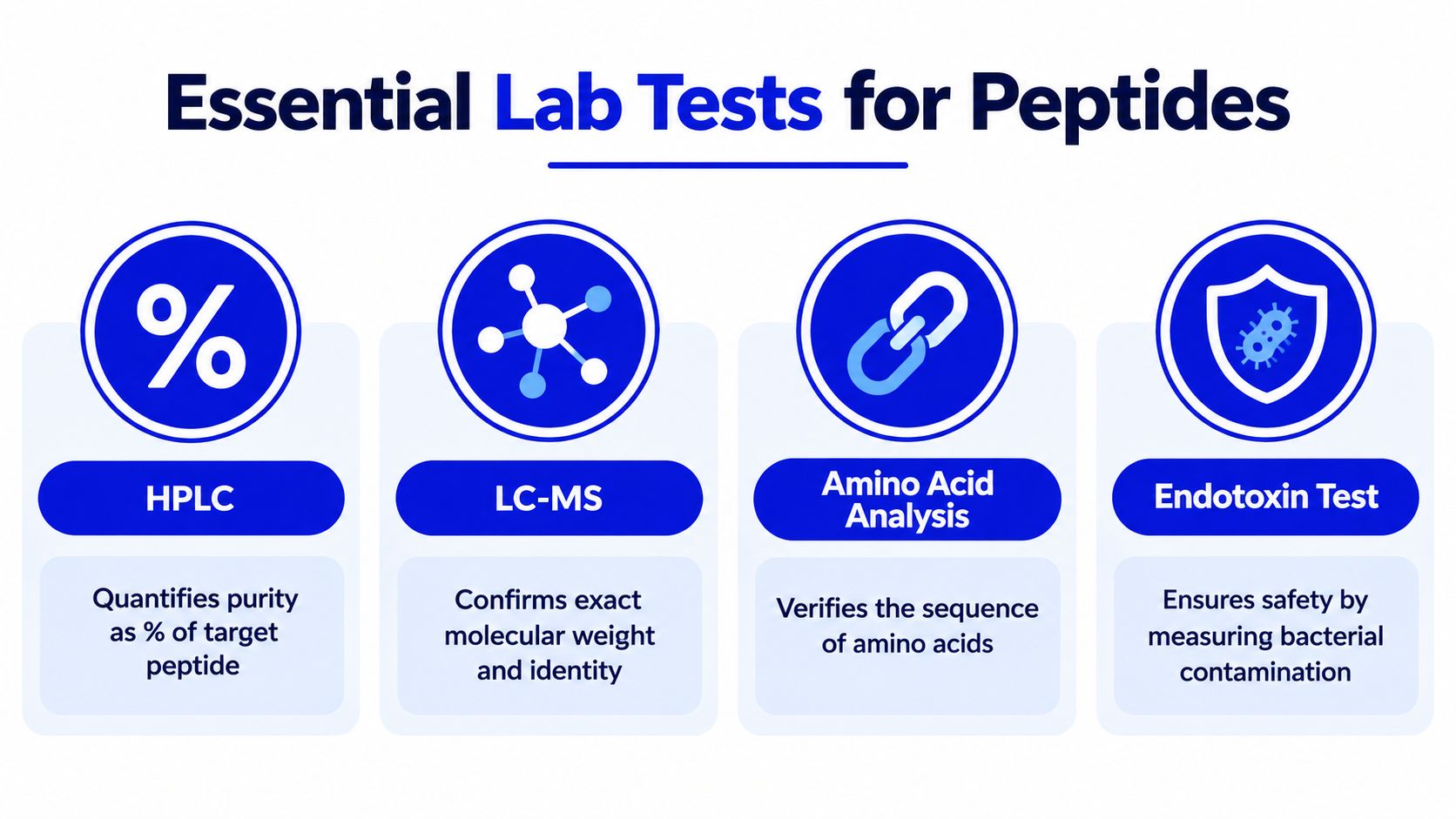
“Lab tested” isn't one universal test. It describes a set of analytical checks that may examine identity, purity, sequence, water content, endotoxin, microbial contamination, or other characteristics relevant to the intended research use. The exact panel can vary, so the useful question isn't whether testing exists. It's which tests were performed, by whom, on which batch, and using which methods.
A practical testing panel may include:
A generic statement such as “third-party tested” is weaker than a report that names the laboratory, identifies the lot, shows the test date, and lists the methods. A template reused across several batches may describe a product category, but it doesn't establish what happened to the vial you received.
US manufacturing and strict batch protocols can support a more controlled procurement process, but origin alone isn't proof of quality. A US-made product still needs batch-specific documentation, appropriate analytical methods, and traceable records. Conversely, a country-of-origin statement can't substitute for identity, purity, or contamination data.
The phrase research use only also needs careful interpretation. It describes intended use and regulatory positioning, not a quality grade. The COA remains the more useful document for evaluating the material's analytical characteristics.
“Lab tested” is meaningful only when the test record is specific enough for another researcher to examine and verify.
The main analytical methods are complementary. Reverse-phase HPLC separates chemical components and estimates relative purity. LC-MS or HRMS checks molecular mass and supports identity confirmation. Endotoxin and microbial tests address biological contamination that those chemical methods may not reveal.
Reverse-phase HPLC is the primary quantitative purity method used in many peptide workflows. It separates compounds as they move through a column, then records peaks in a chromatogram. The reported purity generally reflects the area of the main target peak compared with the total integrated peak area.
HPLC can show whether a sample contains additional detectable peaks and can help compare lots. It can't, by itself, prove that the dominant peak is the peptide ordered. Two related compounds may behave similarly in the column, and a wrong peptide could theoretically produce a prominent peak.
Mass spectrometry measures mass-to-charge ratio. In a peptide COA, the observed molecular mass is compared with the theoretical mass for the intended sequence. HRMS can provide higher mass accuracy, while tandem approaches may provide more detailed structural information.
Mass spectrometry helps identify sequence-related products, oxidation, deamidation, and other variants. It doesn't provide the same relative purity estimate as HPLC, and it may not fully characterize non-ionizing materials, salts, buffers, or every form of structural variation without an appropriate method.
A peptide can show strong chromatographic purity while still carrying endotoxin. Endotoxin is a bacterial component that can influence immune-related readouts, so it deserves separate measurement rather than being inferred from HPLC or mass spectrometry.
Third-party quality documentation increasingly combines purity and identity testing with endotoxin screening using LAL or recombinant Factor C methods. Practical benchmarks cited for cell-culture and in vivo work are often below 1 EU/mg, with stricter targets such as 0.5 EU/mg or below 0.1 EU/mg used for assays sensitive to cytokine or innate-immune activation. These testing considerations are outlined in this peptide quality-control guide.
Microbial testing addresses a different concern. It can help identify viable contamination, but the report should state the method, sample type, and result. A purity figure isn't a sterility certificate.
| Test Type | What It Confirms | What It Misses |
|---|---|---|
| Reverse-phase HPLC | Relative chromatographic purity and detectable secondary peaks | Definitive molecular identity, some co-eluting compounds, endotoxin |
| LC-MS or HRMS | Molecular mass consistent with the expected peptide | Full purity percentage, every non-ionizing contaminant |
| Amino acid analysis | Composition-related information | Complete contamination profile and all structural details |
| Endotoxin test | Bacterial endotoxin burden | Peptide identity, chromatographic purity, all microbial risks |
| Microbial analysis | Evidence relevant to microbial contamination | Molecular identity and relative peptide purity |
The methods work as a system because each closes a different information gap. HPLC asks how much appears to be the main species. Mass spectrometry asks whether that species has the expected mass. Endotoxin and microbial tests ask whether biological contaminants could confound the work.
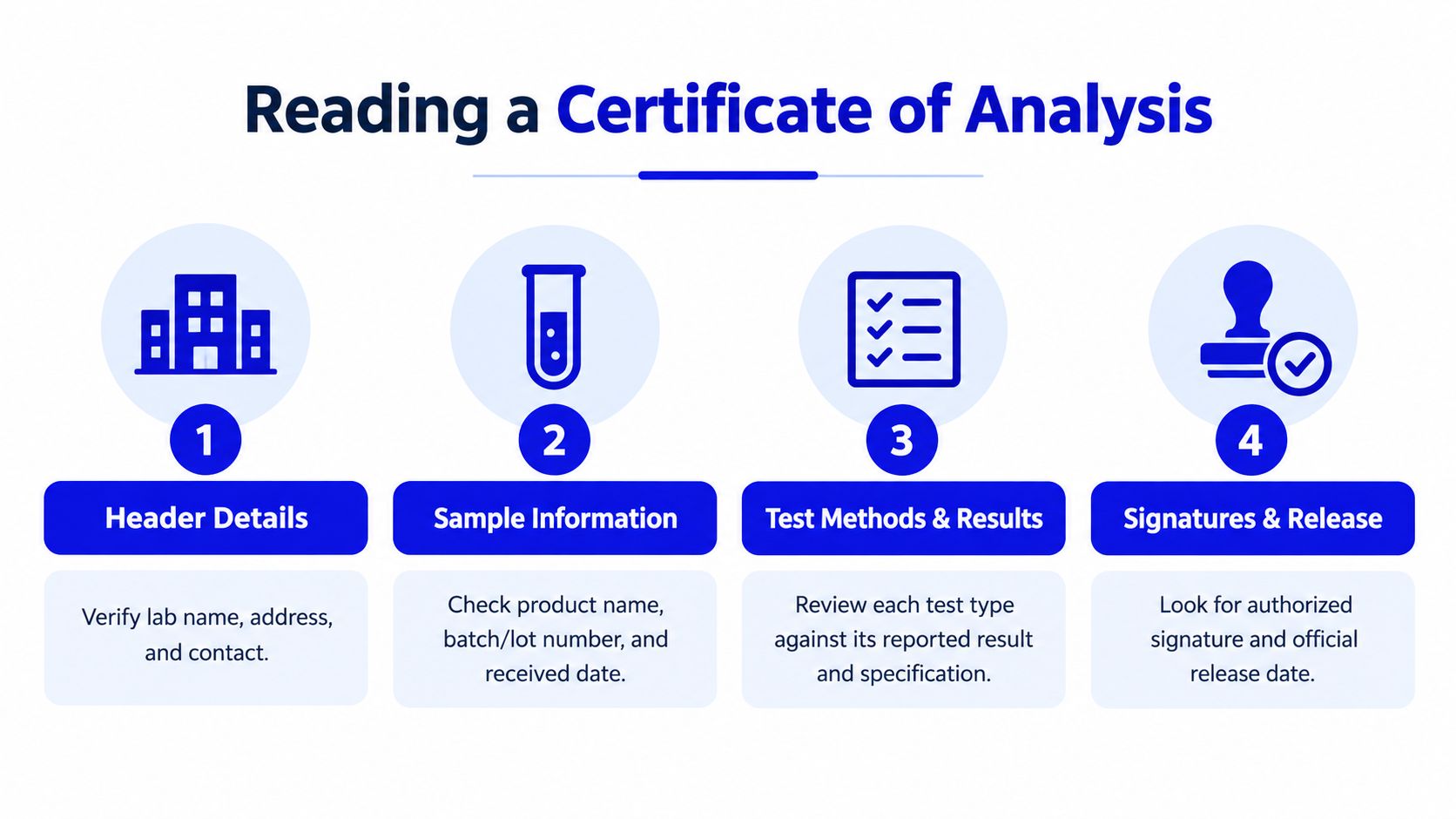
Start at the top of the COA, not at the largest purity number. A reliable review follows the document's chain of custody from supplier and sample identification to laboratory method and final authorization.
Check the product name, peptide sequence where available, batch or lot number, sample description, test date, and laboratory name. The lot number should match the vial, package, or purchase record. A COA without a matching lot may still describe the same product family, but it doesn't establish that the report belongs to your material.
A strong COA should also identify the testing laboratory and the methods used. Batch-level documentation should include the test date, named laboratory, and enough method information for independent verification. This quality-documentation guide explains why lot traceability matters.
Look for the HPLC purity result and, ideally, the chromatogram. A percentage without underlying data gives you less ability to inspect peak shape, secondary peaks, integration, and sample labeling. For mass spectrometry, look for the observed and theoretical mass, spectrum, and a clear identity conclusion.
Then look for separate endotoxin and microbial results when the planned work is contamination-sensitive. A COA that reports purity and mass alone doesn't establish a low endotoxin burden or sterility. Some guidance uses thresholds such as below 5 EU/kg body weight per hour or below 0.25 EU/mL for injectable research contexts, but the appropriate specification depends on the application and protocol. This COA safety guide discusses endotoxin as a separate metric.
For readers who evaluate documentation beyond peptide materials, this resource on how to verify CBD test results offers a useful comparison of COA verification habits.
A COA can look polished and still be incomplete. Common warning signs include a generic lot number, an unnamed laboratory, a percentage-only result, missing test methods, or one document reused for multiple batches. A supplier that can't explain those gaps may not provide the level of traceability your project requires.
The following video offers a visual introduction to COA review and laboratory documentation:
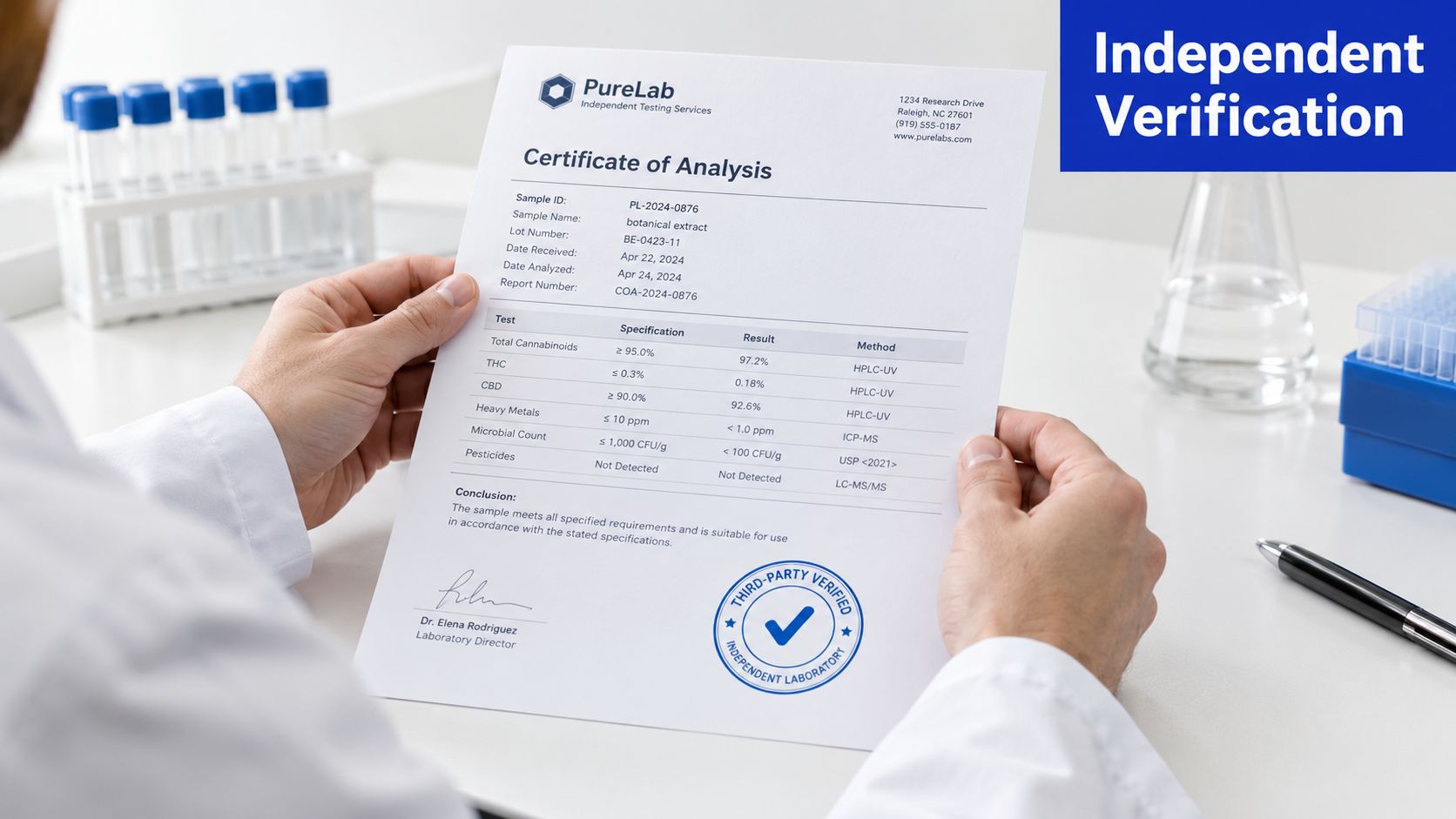
In-house testing and independent testing aren't interchangeable. An internal laboratory may have appropriate equipment and qualified staff, but the buyer has less distance from the supplier's own quality claim. A named third-party laboratory creates an additional verification point, especially when the lab can confirm that it performed the test for the stated lot.
The most useful record creates a direct link between four items:
If one link breaks, confidence becomes harder to assess. A report with no lot number can't be confidently assigned to a batch. A lot number with no laboratory identity can't be independently checked. A named lab with no underlying results provides little more than an assertion.
Public COA availability has improved, but verification remains uneven. One 2026 industry review found that 16 of 20 active research-peptide vendors published COAs, while only 6 of 20 published COAs that could be verified at the testing lab. A separate 2026 transparency index reported 22 of 53 vendors published COAs fully and openly, and 32 of 53 named the laboratory that performed the test. These transparency figures and their limitations are summarized in this industry review.
Those figures don't prove that every unpublished or unverifiable product is defective. They show why publication alone shouldn't end the buyer's review. Ask whether the document is batch-specific, whether the laboratory is named, and whether the laboratory can confirm the record.
Peptide Warehouse USA presents its research products with batch-specific COAs and documentation that includes HPLC, mass spectrometry, microbial analysis, and endotoxin reports. That approach gives a purchaser more than a general product claim, because the documentation can be evaluated against the lot selected for research.
Purity is important, but it doesn't describe every variable that can alter a biological experiment. A peptide with a strong HPLC result may still have an identity problem, an endotoxin burden, microbial contamination, an incorrect amount of material, or a storage-related degradation issue that the selected test panel doesn't fully capture.
The cause and effect can be subtle. Endotoxin may activate cells or influence inflammatory readouts, creating a response that appears to come from the peptide. A sequence error or truncation product may change binding or activity in an assay. An incorrect content value can make two nominally identical experimental conditions meaningfully different.
That is why endotoxin specifications should be connected to the assay rather than treated as a generic checkbox. For sensitive cell-culture and in vivo work, documentation citing below 1 EU/mg as a practical benchmark can be relevant, while some workflows use tighter targets. This independent guide to certified lab testing provides broader context for evaluating testing claims.
Before ordering, define the quality questions your experiment needs answered:
This model protects reproducibility because it separates “the sample looks pure” from “the sample is suitable for this specific research question.” It also helps teams avoid paying attention to a single attractive number while overlooking missing evidence.
A sensible purchase decision starts with the intended use, then works backward to the required documentation. Analytical standards may prioritize identity and purity evidence. Cell-culture or preclinical workflows may require additional endotoxin and microbial information. No COA can answer questions that the laboratory never tested.
Use this short framework when comparing suppliers:
Peptide Warehouse USA is one supplier that offers US-manufactured research peptides and related compounds with third-party documentation, including batch-specific COAs, HPLC and mass spectrometry results, microbial analysis, and endotoxin reports. Researchers can use that information to compare available options against their own laboratory requirements rather than relying on a purity percentage alone.
The best sourcing question isn't “Does this say lab tested?” Ask instead: What was tested, on which lot, by which laboratory, using which method, and can I verify the record? That question turns a broad marketing phrase into a practical quality-control decision.
Peptide Warehouse USA offers US-manufactured research peptides and related compounds supported by batch-specific third-party documentation, including COAs, HPLC and mass spectrometry results, microbial analysis, and endotoxin reports. Review the available materials against your protocol and visit Peptide Warehouse USA to explore research-use-only options with transparent lot traceability.