No products in the cart.



What makes Long R3 IGF-1 worth studying as a research molecule, and where do people overread the data? If you've seen it described as a growth tool, a signaling analog, and a performance compound all in the same breath, the confusion starts there. The safer way to approach it is to treat long r3 igf 1 as a modified IGF-1 research standard, then separate what its structure can tell you from what human claims can't yet support.
The original problem was simple. Native IGF-1 disappears quickly and gets tied up by IGF-binding proteins, or IGFBPs, which makes signaling hard to control in experiments. LR3 IGF-1, also called Long R3 IGF-1 or Long-Arg3-IGF-1, was built in the early 1990s to solve that limitation, and its design still shapes how researchers read assays today. Verified background on the analog's origin and binding-protein resistance makes the contrast clear.
The first thing to understand about Long R3 IGF-1 is that it was built for a laboratory setting, not to sound stronger in a marketing sense. The aim was to keep the signal available long enough for researchers to measure it cleanly in a model system. Native IGF-1 has a plasma half-life measured in minutes, often around 10 to 15 minutes, while LR3 is reported to remain active for 20 to 30 hours in rodent models.
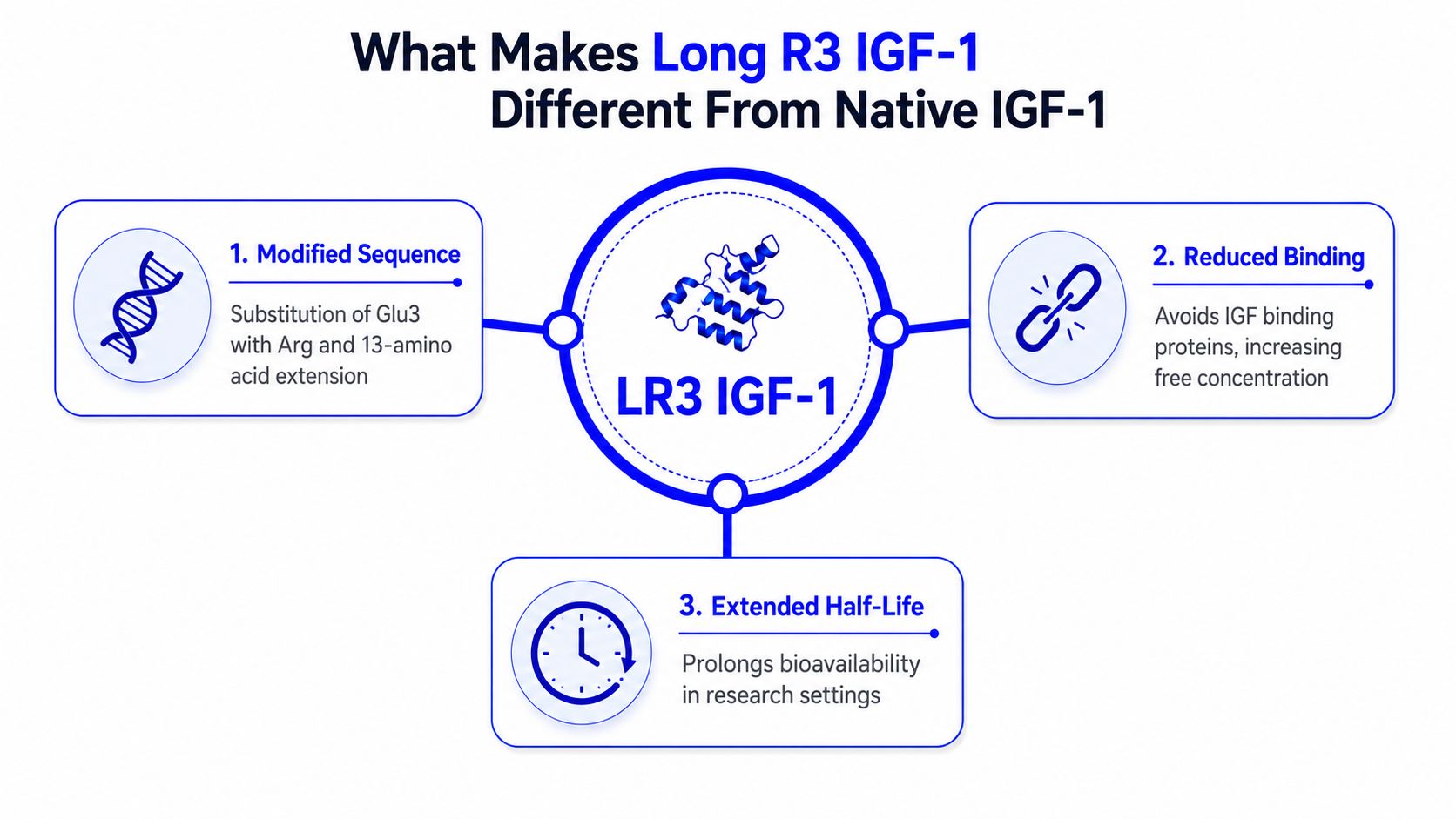
Native IGF-1 works like a message that is constantly being handed between chaperones, the IGFBPs. Those binding proteins help control where the signal goes, but they also make receptor activity harder to isolate in a controlled assay. LR3 shifts that balance by reducing binding-protein sequestration, so more of the molecule stays available to interact with the receptor system researchers are trying to observe.
That is why the analog matters as a research tool rather than a clinical story. It gives a longer exposure window and a cleaner signal, which helps when the question is receptor activity, tissue bioavailability, or downstream response under defined conditions. It does not tell researchers what will happen in humans, and that separation is the point of reading the molecule carefully instead of chasing a protocol.
The early-1990s origin is not trivia. It explains why modern assay design often uses LR3 when a lab needs a stable, sustained signal instead of the short pulse native IGF-1 provides. In practice, that means the molecule is read less like a therapeutic promise and more like a calibrated instrument for specific binding and signaling questions.
A practical rule follows from that difference. If an experiment depends on timing, LR3 and native IGF-1 are not interchangeable. The difference is not cosmetic, it changes how long the receptor sees the ligand and how the result should be interpreted.
The sequence changes in LR3 IGF-1 are small on paper and large in function. The analog is built as an 83-amino-acid molecule with a 13-amino-acid N-terminal extension and an arginine substitution at position 3. Those edits define how the molecule behaves in binding and activity studies, and they are the reason researchers treat it as a distinct construct rather than a simple copy of native IGF-1.
The easiest way to read the structure is to follow what happens before the receptor ever sees the ligand. Native IGF-1 is more readily held and released by IGFBPs, the binding proteins that act like traffic controllers in the extracellular space. LR3 has altered sequence features at the front end, so it binds those proteins far less tightly, which reduces sequestration and leaves more free molecule available for receptor engagement.
That change in binding is the structural reason the analog behaves differently in assays. When fewer binding proteins can trap the ligand, more of it remains accessible for the receptor system under study, so the signal is easier to maintain and measure. The receptor itself is not transformed, the access pattern is.
The reported molecular mass for LONG®R3 IGF-I is near 9,110 ± 2 Da according to the product datasheet. That figure is useful because it reinforces a basic point for anyone reviewing a certificate of analysis or vendor sheet. LR3 is not a loose mixture or a vague “modified IGF,” it is a defined recombinant construct with a specified sequence and composition.
For a junior researcher, the practical lesson is straightforward. The Arg3 substitution and the N-terminal extension are not cosmetic edits. They are the molecular features that reduce IGFBP capture and let LR3 behave as a longer-lived experimental ligand, which is why sequence verification matters before any assay interpretation.
What happens after LR3 reaches the receptor? The signaling path is the familiar IGF-1 receptor, or IGF-1R, route, and the main readouts in cell systems are protein synthesis, DNA synthesis, and reduced protein degradation. In practical terms, the analog stays in play long enough for researchers to watch those outputs without constantly reapplying the ligand.
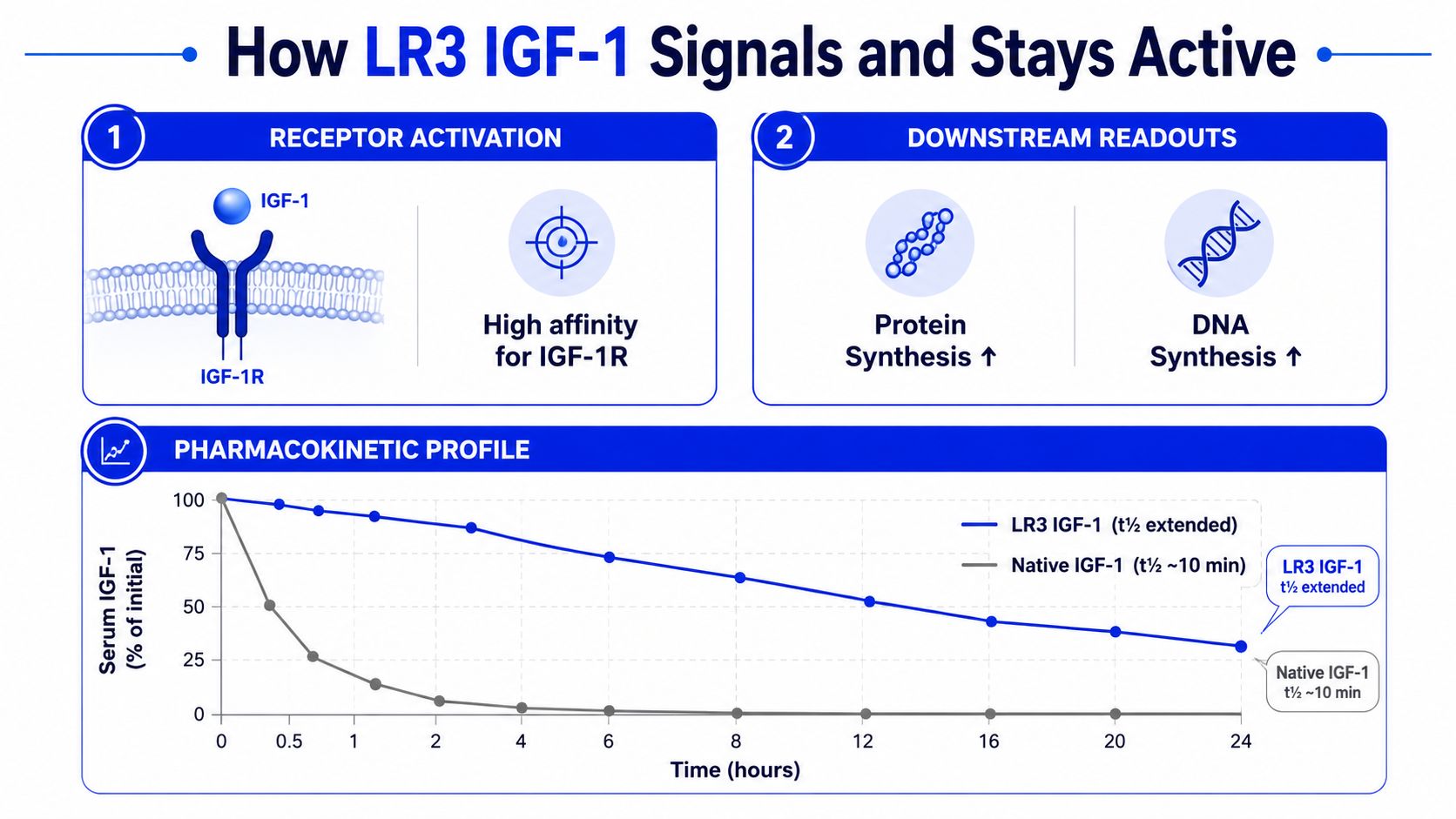
Manufacturer documentation reports that LR3 shows about 3× greater potency than native IGF-1 in some research settings. The same product data lists EC50 values of 0.19 nM for protein synthesis, 1.8 nM for DNA synthesis, and 0.53 nM for inhibition of protein degradation in vitro (Cayman Chemical product data). Those figures help define how the molecule behaves in a controlled assay, but they do not say anything about human dosing.
A useful way to read those values is to separate potency from duration. EC50 describes how much material is needed to produce half of the measured response in that test system, while an activity window measured in rodents reflects how long the signal can remain available in that model. LR3 is therefore best understood as a sustained experimental ligand, not as a clinical dosing template.
In cell culture, the longer activity window changes the tempo of the experiment. You are not looking at a brief pulse that disappears before downstream measurements can settle. You are choosing a reagent that can keep IGF-1R engaged long enough for the response to accumulate and be read cleanly.
The LONG®R3 IGF-I specification also reports activity in L6 myoblasts with an ED50 of ≤10 ng/mL and specific activity around 100,000 units/mg. That gives researchers a defined assay reference for bioactivity, and it is the kind of detail that belongs on a certificate of analysis or vendor sheet rather than in a dose claim.
A good mental model is simple. Native IGF-1 behaves more like a short command, while LR3 behaves like a longer instruction set that remains available to the cell machinery for longer.
LR3 earns its place in assays that need a steady growth-factor context. Researchers use it as a serum-free or low-serum culture supplement, in myoblast and protein synthesis studies, and in experiments that ask how long a ligand remains functionally available at the receptor surface. The value is practical. It helps separate a brief trigger from a signal that stays present long enough for downstream readouts to develop.
The assay question should drive the choice. If you need to see how cells respond to sustained IGF-1R engagement, LR3 is often the better fit. If you need a short, native-like pulse for comparison, native IGF-1 is the cleaner reagent. That distinction matters because the same receptor can produce different readouts depending on whether the stimulus fades quickly or remains available across the assay window.
| Attribute | Native IGF-1 | Long R3 IGF-1 |
|---|---|---|
| Assay behavior | Better suited to short exposure studies and pulse-like signaling | Better suited to sustained exposure studies and repeated measurements |
| Binding-protein context | More likely to be influenced by endogenous binding proteins | Useful where researchers want to reduce binding-protein interference |
| Readout selection | Clear comparator for native signaling behavior | Useful for serum-free supplementation, longer incubations, and persistent signaling studies |
| Experimental question | How does a native ligand behave in the chosen system? | How does a modified ligand change the duration and availability of the signal? |
That comparison is more useful than a simple potency ranking. In practice, the best choice depends on what the assay is trying to isolate. A short stimulation protocol and a longer incubation do not answer the same question, even if they use the same receptor family.
In L6 myoblasts, LONG®R3 IGF-I is used as a reference reagent for protein synthesis and anabolic-readout work. The broader point is methodological. It gives researchers a defined ligand for systems where exposure time, receptor access, and background serum conditions all shape the final signal. That makes it useful in experiments on ligand availability, receptor persistence, and binding-protein effects, especially when the goal is to compare how modified and native ligands behave under the same culture conditions.
A good procurement mindset starts with the assay, not the headline claim. If a protocol needs a longer exposure window and tighter control over receptor access, LR3 is a reasonable choice. If the study depends on native regulation and closer physiological mimicry, a native IGF-1 reagent is the better comparator.
Handling LR3 correctly matters because a good peptide can still give sloppy data if it's mistreated at the bench. The workflow is simple, but each step serves a purpose. If you treat storage and reconstitution as afterthoughts, you can't trust the assay outcome as much.
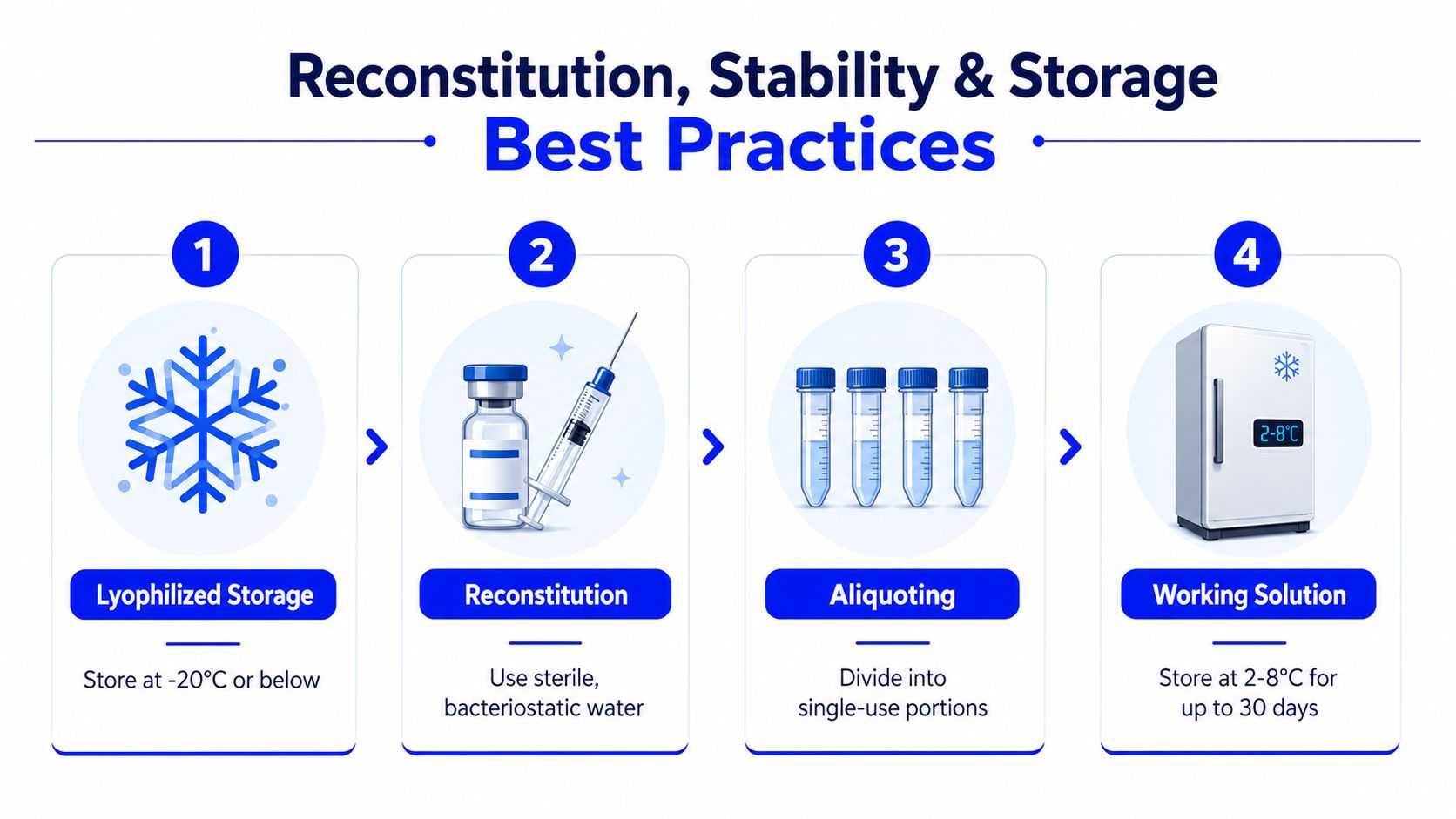
Aliquoting isn't just neat housekeeping. It reduces freeze-thaw cycles, which is one of the easiest ways to introduce variability into a peptide workflow. Light and excess moisture are also avoidable risks, so a dark, dry storage setup is the simplest way to preserve consistency.
Bench rule: if you'd hesitate to rerun the assay because the stock sat around too long, the stock was handled too loosely.
The handling logic is straightforward. Stable input gives you stable readouts, and stable readouts are what let you compare LR3 against native IGF-1 without wondering whether the peptide, not the biology, caused the variation.
A Certificate of Analysis, or COA, is where buyers separate a real research material from a vague label. For LR3, the important part isn't just whether the sheet looks polished. It's whether the documentation shows the right methods, the right lot traceability, and a believable quality story across batches.
Start with purity analysis. One GMP-style datasheet reported >95% purity by SDS-PAGE, while a separate product specification reported ≥99% by HPLC, and another GMP material listed endotoxin as low as <0.01 EU per 1 µg of protein (quality-control summary). Those are the kinds of details that tell you whether the vendor is documenting the lot or just marketing it.
The method matters as much as the number. HPLC and SDS-PAGE answer different questions, so a COA that includes both gives you a better view of composition and integrity. For readers who want a broader framework for documentation, why peptide COA is important is a useful reference for understanding why lot-level paperwork should never be skipped.
Look for a few practical markers:
Mass and sequence confirmation also matter, but they should support, not replace, the bigger picture. A strong supplier doesn't just hand you a number, it gives you a lot-specific paper trail that you can compare across shipments. That's how you buy for reproducibility instead of for appearance.
A lot of public content blurs the line between preclinical mechanism and human use. That's where confusion starts, because LR3 has a clear lab rationale but no solid human evidence base to stand on. Independent summaries describe it as a research-only molecule with no FDA-approved human use, and at least one review says there are no published clinical trials specific to IGF-1 LR3 in the peer-reviewed literature (neutral review summary).
That absence of human data explains why dosing guides conflict so much. One research summary lists 20 to 50 mcg once daily subcutaneously, while another gives a very different range, from a starting dose of 100 mcg once daily to a standard dose of 200 mcg twice daily and a maximum dose of 300 mcg three times daily (dosing guide summary). Those ranges do not show consensus, they show that the evidence base is not standardized.
The right interpretation is not to average the numbers. It's to recognize that non-peer-reviewed dosing advice is not the same thing as validated human pharmacology. For planning purposes, shorter and better-controlled research protocols are easier to defend than long, loosely justified cycles.
Neutral reviews also flag glucose control, because IGF-1 LR3 can increase glucose uptake and hypoglycemia risk becomes more relevant when carbohydrate intake is insufficient (risk summary). They also note caution around pre-existing malignancy and long-term growth-factor elevation, while distinguishing that concern from short-term research use in subjects without known cancer history.
That doesn't mean everyone should panic. It means the molecule deserves the same respect you'd give any strong signaling reagent with a limited human evidence base. The safer mindset is to ask what can be inferred from preclinical work, and what still can't be claimed with confidence.
If you're sourcing Long R3 IGF-1 for a lab, the purchase decision should be boring in the best way possible. You want a supplier that makes the chain of custody easy to audit, not one that relies on vague language. The best filter is simple, ask whether the product is USA-manufactured, backed by a per-batch COA, supported by purity, endotoxin, and microbial testing, and labeled clearly for research use only.
That framework keeps the focus on reproducibility. It also helps you avoid overpaying for marketing copy that doesn't improve the actual experiment. For researchers who want a supplier aligned with those expectations, Peptide Warehouse USA is positioned as a research-only source with transparent documentation and US-based manufacturing, so it's a sensible place to learn more and explore options for lab use.
If you're building a research workflow around Long R3 IGF-1, review the documentation before you order and match the compound to the assay, not the marketing language. Peptide Warehouse USA offers research-use peptides with batch-level support, transparent COAs, and US-made sourcing that fits a laboratory procurement mindset. Visit Peptide Warehouse USA to explore product-level options and see whether their documentation fits your next study.