No products in the cart.



Most advice about N-Acetyl Selank starts in the wrong place. It starts with marketing language about a “stronger” or “better” analog, when the actual first question is simpler: what molecule are we even talking about?
That confusion matters. In peptide research, a small terminal modification can change how a compound behaves in solution, how quickly enzymes break it down, and how confidently you can compare one study to another. If you’re trying to understand N-Acetyl Selank, the useful path isn’t hype. It’s chemistry first, then mechanism, then quality control.
This guide takes that route. You’ll see where Selank provides the research foundation, what “N-acetyl” means at the molecular level, why the stability story is still a hypothesis for the modified analog, and how to think clearly about sourcing and handling for laboratory work.
A surprising amount of confusion around N-Acetyl Selank starts one step earlier. Researchers often debate the modified analog before they have fixed the identity of the parent peptide in view.
Selank is a synthetic heptapeptide with the sequence Thr-Lys-Pro-Arg-Pro-Gly-Pro. That short sequence is the reference scaffold. Any analog is judged against it, much the way a substituted aromatic ring is still interpreted by first identifying the parent ring system and then asking what the substitution changes.
That framing matters because peptide analogs are not created in a vacuum. A terminally modified version may retain the same core sequence while altering how the molecule behaves at its exposed ends. In practice, that means the discussion is often less about inventing a new biological identity and more about changing the peptide’s chemical handling, susceptibility to enzymatic cleavage, or persistence under use conditions.
Market terminology is less precise than peptide chemistry. The label “N-Acetyl Selank” may refer to native Selank, an N-terminally acetylated analog, or a doubly modified form that also carries C-terminal amidation.
Those are not interchangeable descriptions. They identify different molecular species.
For a chemist, the distinction is straightforward. The sequence core may remain familiar, but the termini are part of the structure, not decorative add-ons. Changing a terminal functional group can influence charge distribution, enzyme recognition, and degradation pathways. That is why naming errors here create more than catalog confusion. They blur the boundary between what has been studied directly and what is being inferred from structural similarity.
A useful way to sort the terminology is to separate three categories:
Practical rule: If a vendor does not specify the terminal modifications, the product cannot be compared cleanly with published Selank work or with other modified analogs.
The public literature is centered on Selank, not on the acetylated analogs now common in product listings. That gap is where much of the market confusion comes from. A newer label can sound more advanced, but the stronger evidence base still belongs to the parent peptide unless a study names and characterizes the modified form directly.
Published Selank research is still useful for orientation. It establishes the scaffold that later analog design tries to preserve. From a medicinal chemistry perspective, that is the starting point for a stability hypothesis. First identify the parent sequence and its studied behavior. Then ask whether modifying the N-terminus, the C-terminus, or both could reduce terminal vulnerability without disrupting the sequence features thought to matter biologically.
That is the right level of caution. Evidence for Selank supports Selank. Evidence for N-acetylated or amidated variants has to be demonstrated for those variants, not assumed from the name alone.
N-Acetyl Selank is a Selank analog in which an acetyl group is added to the N-terminus of the peptide chain. If you’re used to small-molecule medicinal chemistry, that may sound routine. In peptide work, it’s still a meaningful design choice because the molecular ends are common points of enzymatic attack.
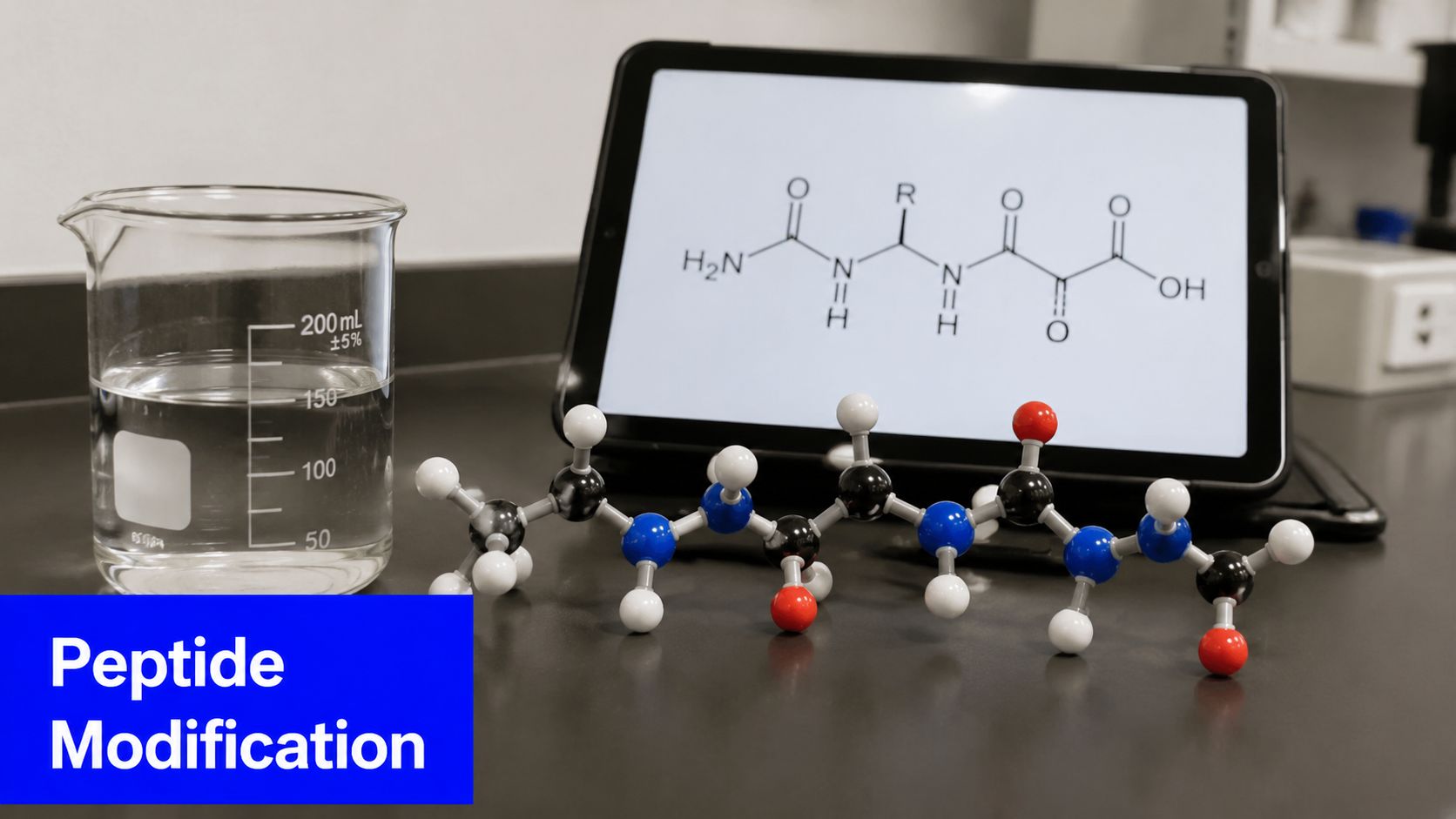
Think of a peptide as a short cord with two exposed ends. Enzymes often begin cutting at those ends because they’re chemically accessible. N-acetylation places a small protective cap on the front end of the cord, the N-terminus.
A simpler analogy is a pen with a capped tip. The cap doesn’t change the whole pen into a different object, but it can reduce unwanted contact at the most exposed end. In peptide design, that same logic is used to make terminal cleavage less favorable.
The key point is precision. N-acetylation is not a magical upgrade. It is a specific structural modification with a specific design rationale.
For N-Acetyl Selank amidate, the reported technical rationale is structural persistence engineering. The molecule adds N-terminal acetylation and C-terminal amidation, modifications intended to reduce cleavage by aminopeptidases and carboxypeptidases, respectively.
That’s the chemistry story in one line. You protect the front end from one class of enzymes and the back end from another.
What’s easy to miss is the level of certainty. The same source frames the stability advantage for this specific analog as hypothesized, not definitively proven. That distinction matters. In the peptide market, “designed for greater stability” often gets rewritten as “proven to last longer,” and those are not the same statement.
Here’s the practical interpretation for researchers:
Existing coverage often collapses Selank, N-Acetyl Selank, and N-Acetyl Selank amidate into one bucket. Chemically, that’s sloppy.
If you’re evaluating product descriptions, the buyer-aware question isn’t “Is N-Acetyl Selank good?” It’s “Which modified version is this, and what evidence belongs to it?”
The common market story treats N-Acetyl Selank as if the acetyl group creates a new pharmacology. The research basis for that claim is thin. A more defensible starting point is simpler: the acetylated analog is usually discussed as a version of the Selank scaffold that may persist longer under biological conditions, while its functional behavior is still inferred largely from Selank itself.
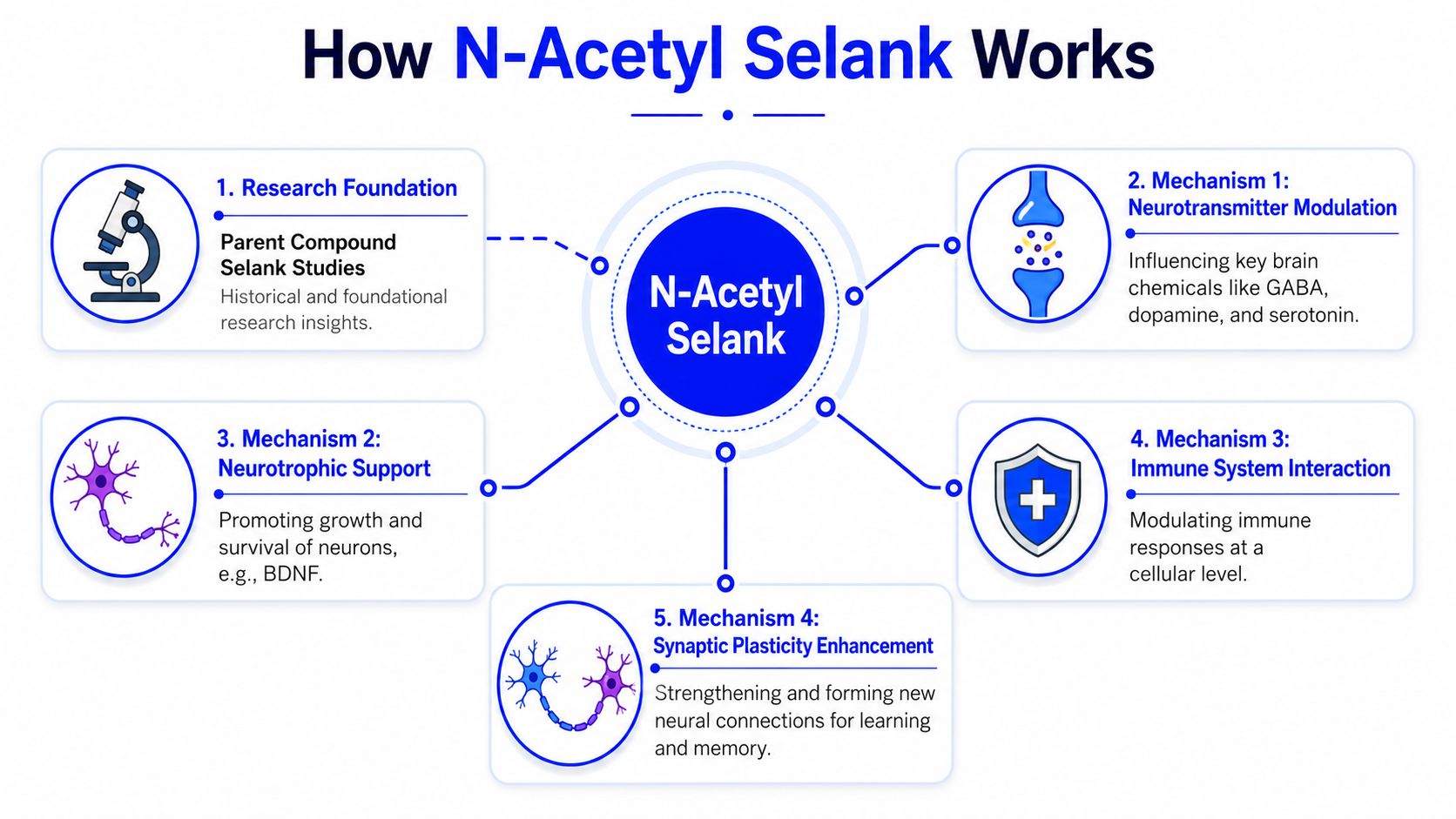
Selank is not well described by a one-receptor model. In a mouse study, Selank altered expression across dozens of genes over the first few hours after administration. The authors proposed involvement of allosteric modulation of the GABAergic system and possible contributions from dopaminergic and serotonergic pathways, according to this PMC paper on Selank-induced gene expression changes.
That matters because mechanism and stability are different layers of the same problem. Mechanism asks what signaling systems the peptide may influence. Stability asks how long enough intact peptide remains available to engage those systems. In peptide chemistry, N-terminal acetylation works like placing a cap on one exposed end of the molecule. It does not automatically change the message carried by the peptide sequence, but it can change how easily enzymes recognize and trim that end.
For readers building a broader foundation in stress physiology, behavioral models, and anxiety-related concepts, these anxiety learning resources provide useful background.
A short visual summary helps organize those pathways:
The same mouse paper reported an early phase with many decreased mRNA signals, followed later by a pattern dominated by increased mRNA signals. That time-dependent shift is more informative than a simple receptor occupancy picture. It suggests a cascade. Initial peptide-receptor interactions may be brief, while downstream transcriptional responses continue to develop after the first contact event.
This is the point where market confusion often starts. Those transcriptional findings belong to Selank research. They do not by themselves prove that N-Acetyl Selank produces the same magnitude, duration, or tissue distribution of effect. The analog is commonly treated as operating in the same functional neighborhood, but that is still an inference unless direct head-to-head data is available.
A careful interpretation keeps three ideas separate:
That distinction sounds narrow, but it is the difference between chemistry and marketing.
The clearest way to describe N-Acetyl Selank is as a stability-oriented analog built on Selank’s mechanistic foundation, with direct evidence for the modified form still more limited than for the parent peptide.
A cleaner answer than the market usually gives them is often what most readers need. The right comparison isn’t “old versus new.” It’s well-characterized parent peptide versus modified analog with a thinner direct evidence base.
Here’s a practical side-by-side view.
| Attribute | Selank (Parent Compound) | N-Acetyl Selank |
|---|---|---|
| Core identity | Parent peptide with the established public research baseline | Modified analog based on the Selank scaffold |
| Terminal chemistry | Native termini | N-terminal acetylation, and in some marketed variants additional C-terminal amidation may also be present |
| Main rationale | Baseline biological activity and historical research context | Hypothesized improvement in structural persistence through terminal protection |
| Best-supported mechanism | Multi-target neuromodulatory profile discussed in the earlier section | Generally inferred from the parent compound rather than deeply established on its own |
| Human research footing | Stronger public baseline for dosing context and historical use | Direct human data remains sparse in public discussion |
| Typical buyer confusion | Often assumed to be the same as the modified analog | Often marketed without clear distinction from native Selank or amidated variants |
A subtle but important issue sits in the third row. Some vendors present “N-Acetyl Selank” as if it always means the same molecule. It doesn’t. Product naming can blur the line between an acetylated analog and an acetylated-plus-amidated analog.
If you need a protocol anchor, the parent compound remains the cleaner reference point. The earlier-cited Selank dosing material gives a usable baseline because it describes a defined intranasal formulation and a concrete upper clinical study range. That makes Selank the more grounded comparator when researchers design exploratory work with an acetylated analog.
In plain terms, choose your reference based on the question:
A modified peptide can be chemically smarter on paper and still be less validated in practice. Those two facts often coexist.
The practical implication for absorption or solubility claims is similar. Terminal modification may influence handling characteristics, but unless a supplier gives clear analytical support, it’s better to describe those changes as possible consequences of the chemistry rather than proven product-level facts.
A peptide discussion that stops at mechanism is incomplete. In actual lab work, identity and purity decide whether the science means anything.
That’s especially true for N-Acetyl Selank because naming confusion already raises the risk of buying one variant while thinking you purchased another. A clean label isn’t enough. You need documentation that ties the name to an analyzable material.
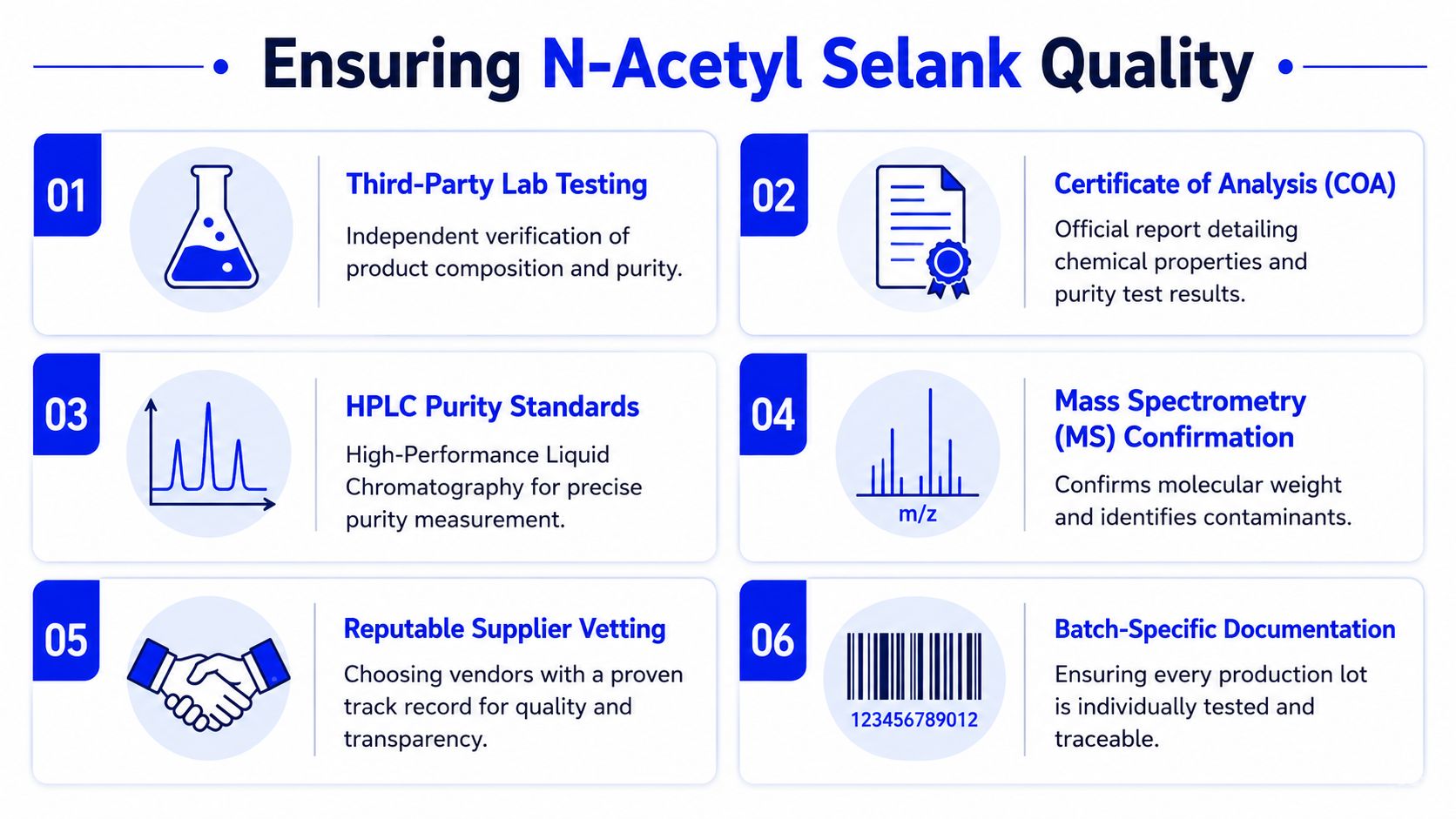
A Certificate of Analysis, or COA, should help you answer three separate questions.
For peptide materials, researchers usually want to see:
A polished website doesn’t validate a peptide. Transparent documentation does.
If a seller offers a strong story about stability but can’t show batch-specific analytical support, the chemistry narrative remains ungrounded. That’s especially risky with modified peptides, because a terminally altered sequence may still look familiar enough in marketing copy to pass casual inspection.
Here’s a simple screening mindset:
Quality control isn’t a bonus feature in peptide research. It’s the boundary between interpretable data and noise.
If your experiment depends on a hypothesized stability benefit, quality documentation becomes even more important. Otherwise, you can’t tell whether a weak result came from the analog concept itself or from poor material quality.
Once a peptide arrives in good condition, the next job is not to damage it yourself. That sounds obvious, but handling errors are one of the easiest ways to lose material integrity before a study even starts.
Everything in this section applies to research, laboratory, and analytical use only. It is not medical advice and not guidance for human consumption.
Lyophilized peptide is generally more stable than a prepared solution, which is why many research compounds are shipped in powder form. Keep the vial sealed until use, minimize unnecessary exposure to room conditions, and protect it from light during routine handling.
A careful workflow helps:
Once reconstituted, a peptide solution is generally more vulnerable than the dry material. Researchers commonly use bacteriostatic water when an assay plan calls for a preserved aqueous solution, but the exact diluent should still match the needs of the protocol and the compound’s chemistry.
A few practical habits reduce avoidable problems:
For graduate students, the easiest mental model is this: the dry vial is your archive copy, and the reconstituted solution is your working copy. Treat the working copy as perishable.
Use clear internal SOPs, document every reconstitution event, and discard any solution that shows unexpected appearance changes or questionable handling history. In peptide research, uncertainty compounds fast once chain-of-custody gets messy.
If you’re looking for research-grade peptide options supported by transparent documentation, Peptide Warehouse USA offers USA-made materials for laboratory and analytical use, with batch testing and COA-focused sourcing. Learn more, explore options, and review product documentation carefully before purchasing.