No products in the cart.

NAD+ research has moved from theory into human testing, but the evidence is still small and uneven. For buyers seeking nad peptide for sale, the right reading is simple: NAD+ is a redox coenzyme, not a conventional peptide, and the question is whether the supplier can document the exact laboratory material you need.
A search for nad peptide for sale usually lands on pages that mix chemistry, wellness language, and research use in the same paragraph. That creates a procurement problem before it becomes a product problem, because you're not choosing between slogans, you're choosing between materials with different identities, documentation, and intended uses.
The first mental shift is to treat the listing as a lab purchase. You want to know what the seller has on the shelf, how it was tested, and whether the documentation matches the label. If a page skips those basics, price comparison is premature.
NAD+ is sold and discussed in ways that often blur into peptide language, but the buying decision should stay grounded in the exact chemical form and the paperwork that supports it. That's especially important when the same search phrase can lead to research-use powder, supplement-style claims, or even language that sounds medical.
Practical rule: If the page can't tell you what the material is, the rest of the claims don't matter yet.
For a new researcher, the safest frame is this, “I'm sourcing a biochemical research material with verifiable batch documentation.” That mindset keeps the conversation on identity, purity, storage, and intended use instead of speculative outcomes. It also helps you explain the request to a PI, purchasing manager, or compliance reviewer.
In practice, that means you should expect the seller to separate research-use materials from approved medicines and to show traceable batch information. The best listings make that distinction obvious. The weaker ones leave you guessing, which is exactly where procurement errors start.
A procurement page can use peptide language and still be offering a different molecule. NAD+ is a redox coenzyme that supports energy metabolism, cellular redox control, and signaling pathways (NIH-indexed review). A peptide, by contrast, is a short chain of amino acids. That distinction matters because the buyer is not comparing similar products, the buyer is comparing different chemical classes.
NAD+ works like an internal electron carrier in the cell. It helps move electrons, supports metabolic reactions, and participates in pathways linked to cellular maintenance. For those interested in nad peptide for sale, the chemistry should come first, because the label alone does not tell you what the material can do.
NAD+ and NADH are chemically different. That difference changes assay behavior, storage considerations, and how results should be read. A supplier that treats them as the same material is not giving enough detail for enzymatic, redox, or metabolomics work. In lab terms, oxidation state is part of the identity, not an optional note.
The same review also notes that NAD+ availability declines with age and that oral precursors can increase NAD-related measurements in blood and some tissues, while clinical pharmacology and tissue distribution remain incompletely understood (NIH-indexed review). That is another reason to treat a product page as a starting point, not proof of effect.
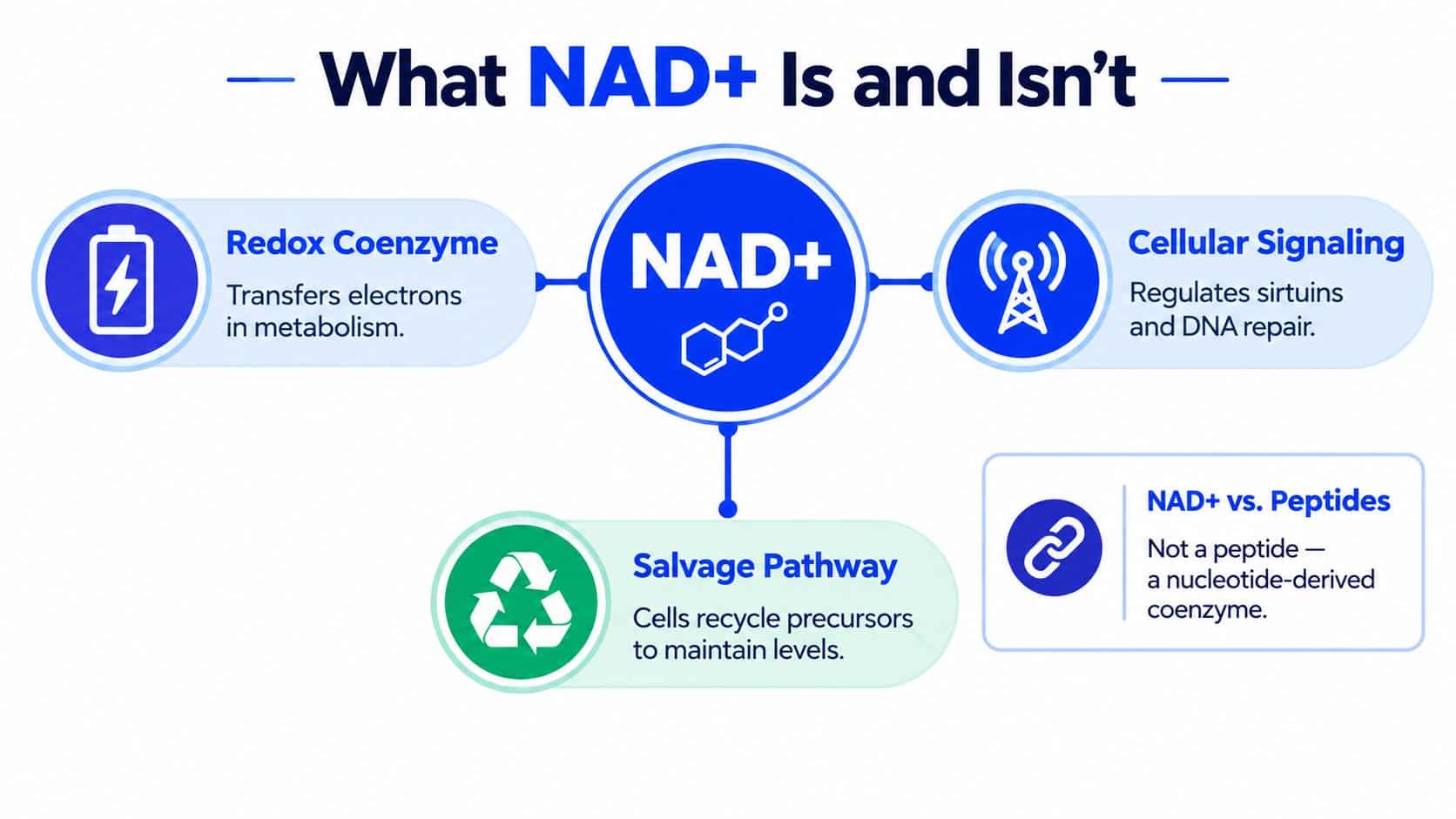
For purchasing and analytical checks, ask for CAS 53-84-9, molecular formula C21H27N7O14P2, and molecular weight of approximately 663.43 g/mol (PubChem entry for NAD+ (CAS 53-84-9)). Those references do not replace a lot-specific COA, but they help you confirm that the vendor is naming the material correctly.
A real NAD+ listing should read like a document trail, not a wellness pitch. If a page says “NAD peptide,” treat that as marketing language that still needs verification.
The research picture is more promising than many skeptics assume, but far less conclusive than many sales pages imply. A 2026 systematic review evaluated 113 NAD-related intervention studies conducted between January 2010 and October 2025, including 33 human studies and 80 rodent studies (systematic review). In humans, oral nicotinamide riboside and nicotinamide mononucleotide generally increased NAD-related metabolites in blood or cells and were usually tolerated over weeks to months.
That biological shift matters, but it does not settle the larger question buyers often care about. The same review found that functional and healthspan outcomes were inconsistent, with many results endpoint-specific or null (systematic review). It also found no eligible anti-aging or wellness outcomes trials testing intravenous or intramuscular NAD+ itself, which matters when a product page implies that route or format as a shortcut to proof.
A 2024 systematic review in the American Journal of Physiology–Endocrinology and Metabolism identified 10 studies involving 489 participants and concluded that the evidence base is still relatively small and uneven (AJP-Endocrinology review). It also noted that age-related declines in physiological NAD/NADH levels may reflect reduced activity in salvage and synthesis pathways.
For procurement, the useful takeaway is narrow and practical.
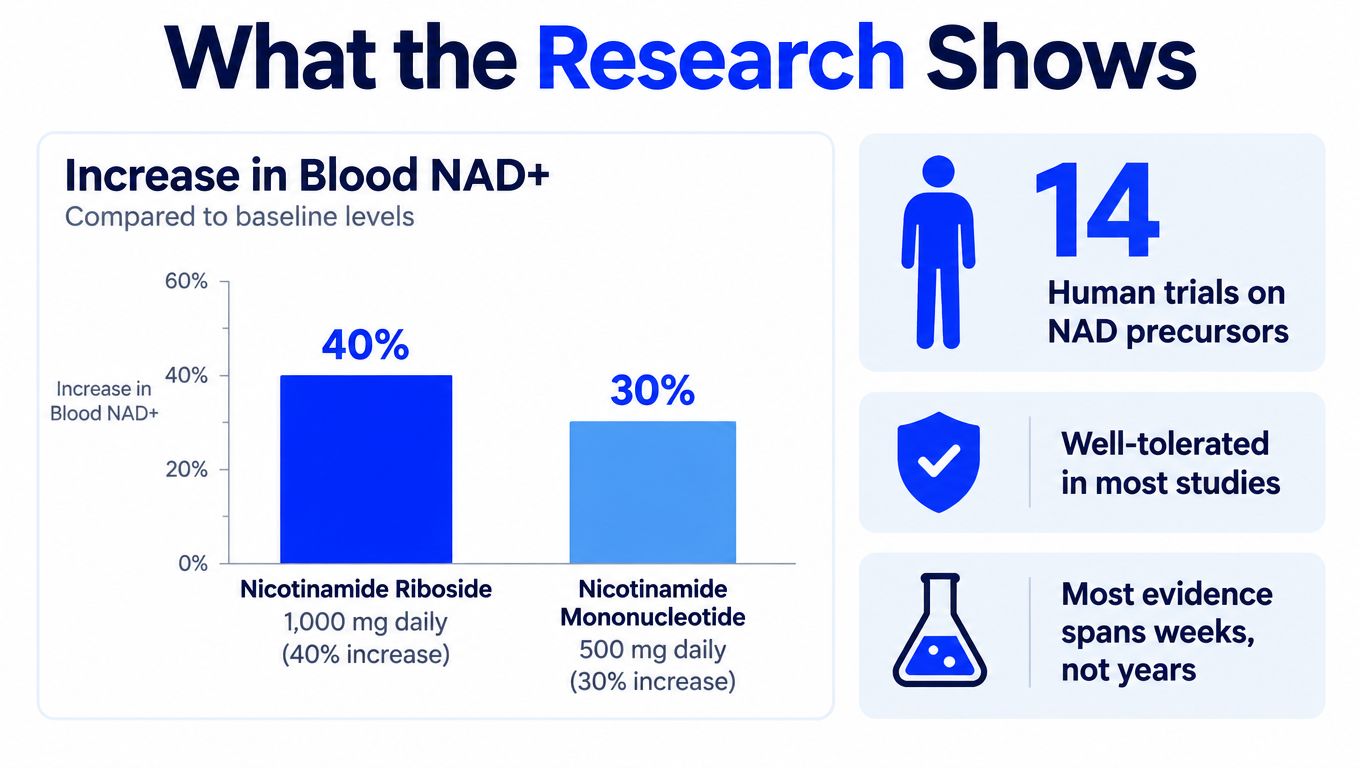
A cautious reading is the safest one for research procurement. The biology justifies attention, while the documentation still has to do the heavy lifting.
A COA is only as useful as its least specific field. For nad peptide for sale procurement, ask for the details that show whether the material is chemically correct, stable enough for your work, and labeled for the exact research context you plan to use.
Request HPLC conditions and chromatogram, assay result, mass spectrometry identity confirmation, residual moisture or loss-on-drying data, and a clear NAD+ versus NADH distinction. For cell-based or biochemical work, ask for microbial and endotoxin testing too, since contamination can distort results even when the material looks clean on paper.
A useful COA is lot-specific. If a seller sends the same document for multiple batches, that is a weak quality signal. You want proof that the exact lot you will receive was tested, not a template with your product name inserted.
| COA Fields to Request Before Ordering | Why It Matters |
|---|---|
| HPLC conditions and chromatogram | Shows how the material was separated and whether the main peak is clean |
| Assay result | Gives the reported amount of active material in the lot |
| Mass spectrometry identity | Confirms the molecule by an orthogonal method |
| Residual moisture or loss-on-drying data | Helps you judge stability and real delivered content |
| NAD+ versus NADH distinction | Prevents confusion between chemically different materials |
| Microbial and endotoxin data | Reduces contamination risk in sensitive work |
| Storage conditions | Protects the material before and after shipment |
A certificate reporting only “99% purity” leaves out the details that matter in real lab work. A single percentage can hide impurities, salt forms, or handling issues that affect enzyme assays, redox experiments, or metabolomics readouts.
A 2026 systematic review at PubMed reinforces a practical point for procurement. The research question may be biological, but the buying decision still depends on documentation that identifies the exact material in the vial.
FDA guidance also warns that food-grade NAD+ is not automatically suitable for sterile compounding and cites adverse events linked to contaminated injectable preparations (FDA guidance). That does not make research material unsafe by default. It means sterile, injectable, and human-use claims require separate regulatory and quality controls.
Once the COA checks out, the next question is whether the vendor operates like a lab supplier or like a storefront that borrows scientific language. For nad peptide for sale searches, that difference matters because the purchase should identify exact chemical identity, lot traceability, and research-use intent before any money changes hands.
A vendor that understands research procurement usually makes the boundaries visible. Look for an age gate, an FDA disclaimer, a page marked research use only, and labeling that says the product is not for human or veterinary consumption (legal overview). Those cues are not decoration. They show how the seller frames the transaction.
A practical review should also cover:
A label that says “high purity” still leaves key questions open. What matters is whether the vendor can connect that claim to lot-specific data, so you can see what was tested, what was accepted, and what was left out.
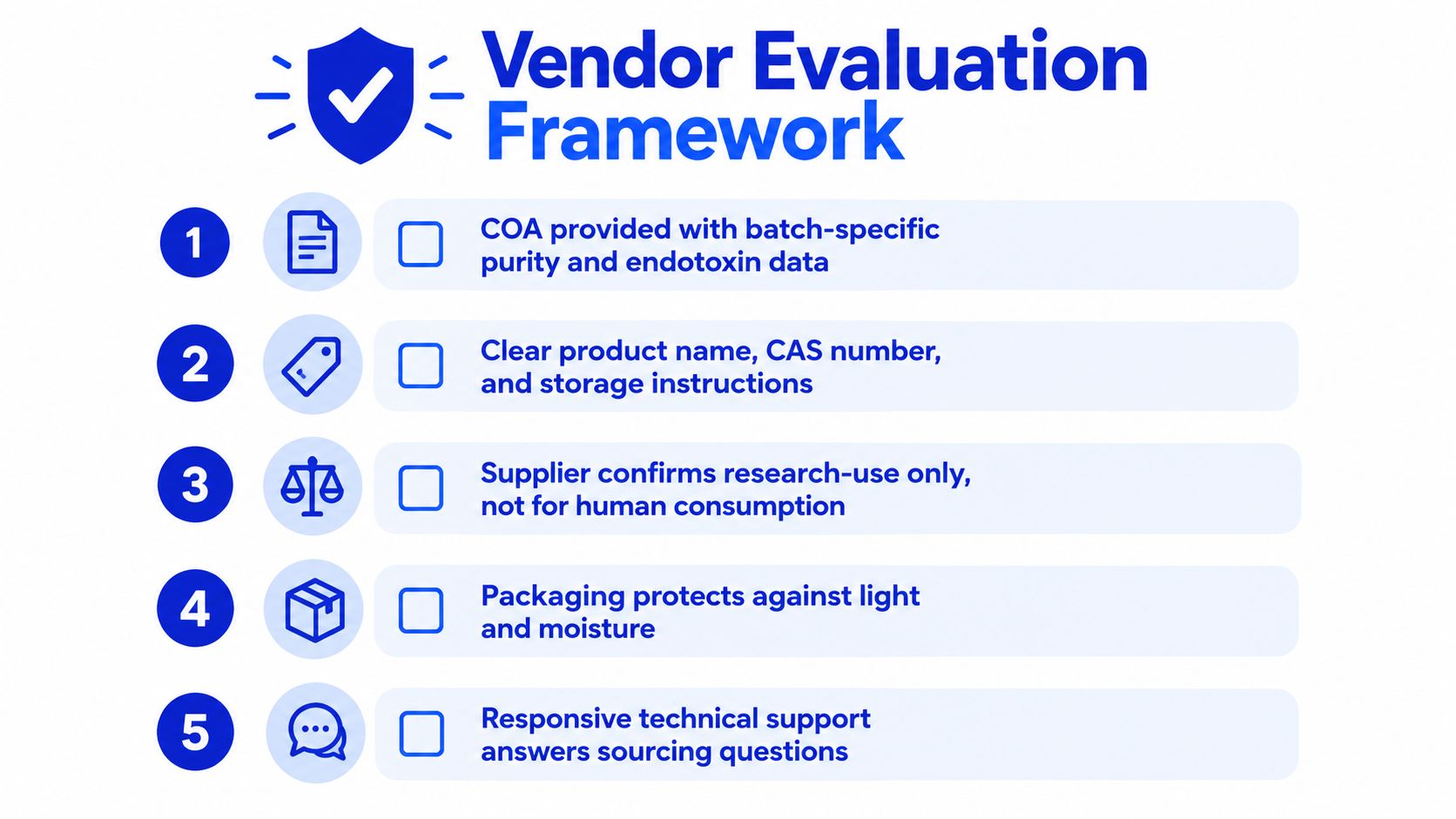
Vendor test: If support cannot answer documentation questions quickly, the purchase is probably not ready.
Packaging and account records matter too. Light and moisture protection help preserve the material during transit and storage, while traceable ordering records make it easier to match each vial to its batch history later. If the site leaves procurement feeling vague, the batch record usually ends up vague as well.
A label can look confident and still leave questions unanswered. For nad peptide for sale searches, the recurring mistake is treating purity claims, marketing copy, and research-use wording as if they prove the same thing.
High purity does not mean clinical safety. A material can be chemically clean and still be unsuitable for sterile compounding or human use. As noted earlier in the FDA guidance, those are separate questions.
NAD products do not behave the same in every assay. NAD+ and NADH are different molecules, and the difference can affect the readout. In absorbance-based work at 340 nm, NADH can interfere with what looks like an NAD+ measurement, so the assay design matters as much as the label.
Research-grade material is not automatically injectable. Sterility, compounding controls, and regulatory status sit in different buckets. A vial marked for laboratory use does not become a clinical product because the packaging changes.
Marketing about anti-aging or fat loss is not proof of lab utility. The human evidence remains limited and inconsistent, and the review literature supports caution rather than broad claims, as noted earlier in the systematic review.
Ask whether the seller separates research-use only from any medical framing, whether the COA is batch-specific, and whether the material is labeled clearly as NAD+ rather than NADH. If any answer feels vague, the page is giving you branding instead of documentation.
The safest procurement mindset is simple. Confirm the chemical identity first, then confirm the paperwork, then decide whether the product matches the experiment.
Before you place an order, verify CAS 53-84-9, ask for the molecular formula and molecular weight, and request the lot-specific COA. Confirm that the document includes HPLC, mass spectrometry, and any microbial or endotoxin testing available.
Ask how the material is stored, packed, and shipped. Light-sensitive or moisture-sensitive materials need handling details you can use once the box arrives, not just a generic “keep cool” note.
Also confirm the product's intended use statement and record it in your procurement file. That way, if a PI or procurement officer asks why you chose a particular supplier, you can point to the documentation instead of trying to reconstruct the decision later.
A helpful way to organize the process is to keep three files together, the COA, the SDS, and the order confirmation. If you ever need to repeat the purchase, or explain the batch in a lab notebook or inventory record, those documents are the proof trail.
For teams managing recurring research supplies, tools like the best supplement subscription apps for Shopify can also be useful as a workflow reference when you're thinking about repeat ordering, documentation, and subscription-style replenishment in a controlled environment.
A procurement request for nad peptide for sale should end with a paper trail, not a slogan. NAD+ is a redox coenzyme, not a conventional peptide, so the final check is whether the vendor can show exact identity, lot-specific testing, and research-use labeling before payment.
The AJP-Endocrinology review, noted earlier, supports NAD as a research target with clear limits on broader claims. That is the right frame for purchasing too. If the chemistry is clear and the documents are complete, the order is easier to defend, easier to reproduce, and easier to use in the lab.
Keep the three files together: the COA, the SDS, and the order confirmation. That trail matters when a PI, buyer, or auditor asks what was ordered and why.