No products in the cart.


You've got a peptide on the bench, the buffer looks right, and the vial still won't cooperate. It's a familiar lab problem, especially when a net charge of peptide calculator gives you a clean number that doesn't match what the material does in water, saline, or a formulation buffer. The gap usually isn't the math itself, it's the assumptions hiding behind the math.
That's why charge calculation matters beyond classroom chemistry. A peptide's net charge shapes how it dissolves, how it aggregates, how it behaves in buffers, and whether it stays usable long enough to finish the experiment. When the inputs are right, the calculator is a useful diagnostic. When the inputs are wrong, the output can be misleading in exactly the way that wastes time at the bench.
A dry peptide pellet can look simple until the first reconstitution attempt tells a different story. One tube clears quickly, another stays cloudy, and a third forms a film on the glass even though the sequence seems similar on paper. In practice, that mismatch often traces back to the charge state of the peptide at the working pH.

The core idea is straightforward. A peptide carries positive and negative contributions from its termini and side chains, and the balance shifts as pH changes. A net charge of peptide calculator turns that balance into a usable estimate, which is useful when you're deciding whether a peptide is likely to stay soluble, bind a surface, or behave predictably in a buffer.
The number matters because it influences what the molecule does next. A positively charged peptide can behave very differently from a neutral or negatively charged one in the same solvent system. That difference shows up in dissolution, purification, storage, and even in whether you can get a clean analytical readout.
Practical rule: treat the calculator result as a working estimate, not a property that exists independently of the experimental setup.
The best use of the tool is to connect the estimate to a concrete lab decision. If the peptide is stubborn, the charge estimate helps you decide whether to adjust pH, change buffer composition, or reevaluate the sequence and modifications before burning more material. That turns a trial-and-error reconstitution problem into a controlled troubleshooting step.
A good charge estimate helps you think through:
The key is to remember that the tool estimates behavior under a model. It does not replace observation, but it does help explain why a seemingly reasonable formulation fails. That's the genuine value of a peptide charge calculator in a research workflow.
A peptide's charge is not one number frozen in place. It changes with pH because ionizable groups gain or lose protons depending on the environment. The calculator is just a compact way of applying that chemistry across the sequence.
The total charge usually comes from three places, the N-terminus, the C-terminus, and the ionizable side chains. Basic groups tend to contribute positive charge when protonated, while acidic groups contribute negative charge when deprotonated. The calculator adds those contributions together at the pH you care about.
The underlying logic comes from the Henderson-Hasselbalch equation, which describes how protonation shifts around a pKa. Near that point, a group is often only partially protonated, so the charge is fractional rather than perfectly integer. That's why a peptide's net charge can land between whole numbers.
Side chains are where many users get surprised. Aspartic acid and glutamic acid tend to push charge negative as pH rises, while lysine and arginine tend to hold positive charge longer. Histidine often matters in the middle ground because its behavior changes closer to neutral pH.
| Group | Typical role in charge balance | Practical effect |
|---|---|---|
| N-terminus | Usually positive when protonated | Contributes strongly in short peptides |
| C-terminus | Usually negative when deprotonated | Can be a major driver in small sequences |
| Basic side chains | Positive contribution | Raise the net charge at lower pH |
| Acidic side chains | Negative contribution | Lower the net charge as pH increases |
A useful mental model is to think of charge as a moving average, not a fixed label. If a peptide sits near one of its pKa values, the calculator is summarizing an equilibrium, not reading out a hard yes-or-no state. That's why the same sequence can behave differently when the pH shifts only a little.
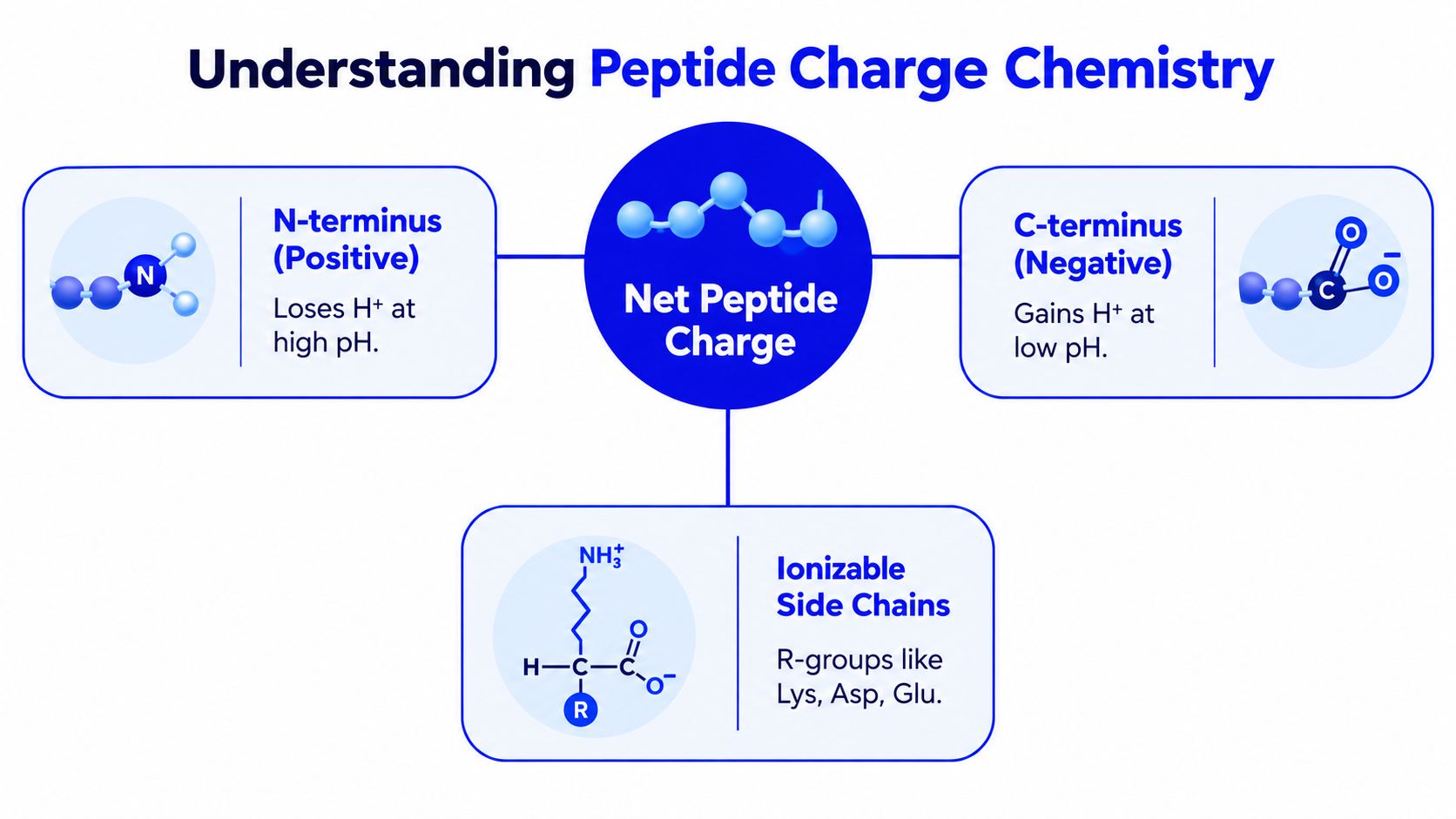
The takeaway is simple. If you know which groups can ionize, you can read the calculator output with much more confidence. If you don't, the number can look precise while still hiding the chemistry that actually matters.
A peptide calculator is only as useful as the assumptions behind it. It estimates charge from ionizable groups, but it does not measure the peptide directly, and that distinction matters when the sequence is modified or tightly packed.
Two tools can produce different values for the same sequence because they may rely on different pKa sets and different views of the peptide environment. Electrostatic interactions, conformation, solvent composition, and local hydrogen bonding can all shift the effective pKa of a group, especially in modified peptides or when charged residues sit close together. The result is that two answers can both be defensible, just under different assumptions.
Terminal chemistry creates another source of error. A free N-terminus and a free C-terminus contribute to charge, while acetylation, amidation, cyclization, or other capping strategies can remove or alter those contributions. If the calculator assumes a free linear peptide but your sample is capped, the output is not just slightly off, it is based on the wrong structure.
A better calculator makes those assumptions visible. It should state which termini are present, which pKa set it uses, what ionic conditions it assumes, and whether the peptide is treated as linear or modified. It should also show how sensitive the estimate is to small pKa shifts, because that is often where interpretation goes wrong.
A number without its assumptions is just a guess in a lab coat.
That sensitivity matters in short peptides, where the termini can dominate the charge balance and a small pKa shift can change how the peptide behaves in formulation. A peptide-specific model may therefore give a different result from a generic calculator, not because one is broken, but because one accounts for more of the chemistry that is present.
Use the calculator as an approximation with boundaries. If the peptide is modified, tightly packed, or unusually short, the output is a starting point. The structure, the caps, and the surrounding conditions still have to be checked before you trust the number in the lab.
A manual calculation is still worth doing, even when software is available. It forces you to identify every ionizable group and exposes the exact reason the calculator returns the number it does. That matters when you need to explain the result to someone else, or when the output doesn't match the experiment.

For a simple linear peptide, the workflow is direct. List the termini, identify any ionizable side chains, assign the relevant pKa values, and estimate each group's charge at the target pH. The point is not to produce perfect precision by hand, it's to understand which group is driving the answer.
Take a short peptide with one acidic residue, one basic residue, and free termini. At a pH near neutral, the N-terminus may still contribute positive charge, the C-terminus usually contributes negative charge, and the side chains can push the balance either way. You then sum those fractional contributions to get the net value.
The process is simple enough to inspect line by line:
A manual pass is especially useful when one residue changes the behavior more than expected. Swap a histidine for an alanine, and the charge profile can shift in a way that affects solubility or interaction with a buffer. That kind of insight is harder to internalize when you only stare at a final output.
The result of the hand calculation doesn't need to be elegant. It needs to show you where the charge is coming from and why the software landed where it did. If you can trace the logic by hand, you're much less likely to misread the calculator in a real lab decision.
Terminal chemistry can change the answer more than many users expect. A peptide that looks straightforward on paper may be chemically capped, cyclized, or tagged in a way that changes its charge behavior before it ever reaches your buffer. That's why the modification state has to be part of the calculation, not an afterthought.
A free N-terminus and a free C-terminus contribute charge independently. Once you acetylate the N-terminus or amidate the C-terminus, those contributions are altered or removed, which changes the overall balance. For short peptides, that difference can be decisive.
| Modification | N-terminus Charge | C-terminus Charge | Net Change |
|---|---|---|---|
| Free linear peptide | Present | Present | Baseline charge profile |
| N-terminal acetylation | Removed or reduced | Present | Lower positive contribution |
| C-terminal amidation | Present | Removed or reduced | Lower negative contribution |
| Both termini capped | Removed or altered | Removed or altered | Charge shifts away from the free-peptide model |
Many formula assumptions break down here. A calculator built for unmodified linear peptides will overstate or understate the charge if the termini are chemically blocked. The effect isn't subtle when the molecule is short enough that the termini account for a meaningful share of the total charge.
Tags and structural changes can matter too. A His-tag brings in extra ionizable behavior, while PEGylation can alter how the peptide sits in solution and how accessible certain groups are to the solvent. Cyclization can be even more disruptive because the peptide no longer behaves like a simple open chain.
The practical habit is to verify the exact chemical form, not just the nominal sequence. If the sequence record doesn't match the delivered material, the charge prediction won't match either. That's true even before you consider how the modification changes folding or local microenvironments around charged residues.
A peptide does not behave as if it were sitting in distilled water just because a calculator assumes that setting. In the lab, phosphate, salt, additives, and mixed assay media all reshape electrostatic behavior. The intrinsic charge is still there, but the apparent charge in solution can shift enough to change how the material behaves at the bench.
Salt and buffer alter that behavior in a straightforward way. Higher ionic strength screens electrostatic interactions, so charged groups still exist but attract or repel each other less strongly than they would in an idealized model. A peptide that appears strongly charged on paper can act as if that charge is partially muted in a salt-rich buffer.
Charge plots usually make the simplifying assumptions visible. A current tool notes absent salt effects, a fully unfolded chain, and a single pKa per residue type as model simplifications Proteiniq charge plot. Those caveats matter because compact or folded molecules can show shifted pKa values when dielectric environment, hydrogen bonding, and nearby charges change the local chemistry.
The practical question is how much confidence to place in the number.
Use the calculator as a starting point, then compare it with the actual formulation. If the peptide is moved from water into PBS and the behavior changes, the buffer is part of the result, not background noise. That matters for buffer selection when reconstitution is weak, purification strategy when ionic conditions change binding and elution, solubility troubleshooting when a sample clouds over despite a favorable charge estimate, and assay interpretation when the same sequence behaves differently in one matrix than another.
Practical rule: if the peptide behaves differently in PBS than in water, trust the experiment first, then revisit the charge model with the buffer in mind.
For documenting those conditions clearly, Pure Write's methodology guide is useful because it shows how to describe methods without burying the key variables. That clarity matters here, since charge interpretation only helps when the buffer state is stated plainly.
The main point is simple. Charge calculations are only as useful as the conditions they assume. If salt, buffer, or structural state differs from the model, treat the calculator as one input among several, not as the final word.
A peptide that refuses to dissolve usually points to a mismatch between the charge profile and the formulation conditions. A vial can be fine and still give a cloudy sample if the pH, salt, or terminal chemistry pushes the molecule toward aggregation. In practice, that pattern is often predictable once you compare the calculator output with the actual buffer.
Start with the pH window. Peptides are often least soluble near their charge-neutral point, because the electrostatic repulsion that helps keep molecules apart is reduced. If precipitation appears near that region, shift the pH away from the balance point and see whether the solution clears.
That comparison only works if the sequence behavior is already understood. When a calculator predicts a positive net charge but the peptide still crashes out, the cause is often something the model does not fully capture, such as terminal capping, amidation, acetylation, or a structural constraint that changes how charges present in solution. The useful question is the effective charge in your system, not just the theoretical one.
If pH adjustment is not enough, move to the formulation itself. Co-solvents and surfactants can help with sticky or aggregation-prone peptides, but they should be treated as variables to test, not automatic fixes.
A practical troubleshooting order is simpler than most protocols make it sound. First, confirm the sequence and modifications, since a capped or cyclized peptide does not behave like a free linear one. Then check the buffer pH against the likely charge-balance region. Review ionic strength, because salt can blunt electrostatic effects and hide a charge-related solubility shift. Test a second formulation condition instead of forcing the first one to work. Record what changed so the same failure does not repeat in the next batch.
The goal is not a neat theoretical result. It is a peptide solution that stays usable across runs. The calculator helps, but only when it is one input in a broader troubleshooting sequence and not a substitute for what the sample is doing at the bench.
Charge calculations only help if the material in the tube matches the sequence you think you're handling. Truncations, impurities, and inconsistent lot quality can distort behavior even when the math is sound. For lab work that depends on charge profiling, the source material has to be reliable enough to trust the result.
High-purity research peptides are useful because they reduce ambiguity at the bench. When a supplier provides Certificates of Analysis, microbial and endotoxin documentation, and consistent batch testing, it becomes much easier to interpret whether a solubility problem comes from the peptide itself or from the way it was prepared. That kind of traceability matters when you're comparing batches or repeating a formulation.
For labs that want a dependable supply chain, Peptide Warehouse USA offers research peptides and related compounds with clear sourcing and documentation. Their catalog and quality controls are built for laboratory use, which makes them a practical option when you need material that matches the charge model you're working from.
If you're working through a difficult formulation or comparing charge behavior across batches, start with material you can trust. Explore the catalog at Peptide Warehouse USA to review research-grade peptides, documentation, and batch consistency for your next lab run.