No products in the cart.



Pancragen peptide benefits get talked about like they belong in the same conversation as fat-loss injectables, longevity stacks, and broad wellness compounds. That framing misses the point. The actual literature centers on a short pancreatic bioregulator, KEDW, that was studied for glucose regulation and pancreatic endocrine support, not as a GLP-1-style appetite drug or a general anti-aging shortcut.
That distinction matters because readers often arrive with the wrong benchmark in mind. If you want a clear read on Pancragen peptide benefits, you need to separate what the evidence shows from what the peptide-fitness market likes to imply. Pancragen's published story is narrower, more interesting, and much easier to misread if you skip the primary data.
Pancragen gets searched in the same breath as fat-loss peptides and longevity compounds, but that's not how the literature reads. The strongest published work points to a pancreas-focused research compound with a history in endocrine support, especially glucose handling after a challenge, rather than a broad wellness peptide. That's the first filter to apply before you treat any claim as serious.
Practical rule: if a peptide is being sold as everything at once, the evidence is probably doing less work than the marketing copy.
The reader confusion usually starts with category drift. A short peptide, a metabolic result, and a public appetite for “optimization” can be enough to make a compound sound like a universal tool. Pancragen is narrower than that. Its most defensible identity is as a tetrapeptide that was investigated in animal models for pancreatic function and related vascular support, with the best signal coming from glucose regulation rather than body recomposition.
That is why this guide takes a slower path. First, it defines what Pancragen is. Then it walks through the strongest animal findings, including the primate data and the rodent diabetes model, so the evidence stays anchored. After that, it draws a clean line between published benefit and popular overreach, especially in the GLP-1 era where many readers expect appetite suppression or visible fat loss from any metabolic peptide.
A final guardrail matters here. Every benefit discussed below sits in the preclinical research frame. This is a research compound, not a substitute for established medical care, and not a shortcut for clinical decisions. That framing doesn't weaken the peptide. It makes the signal easier to read.
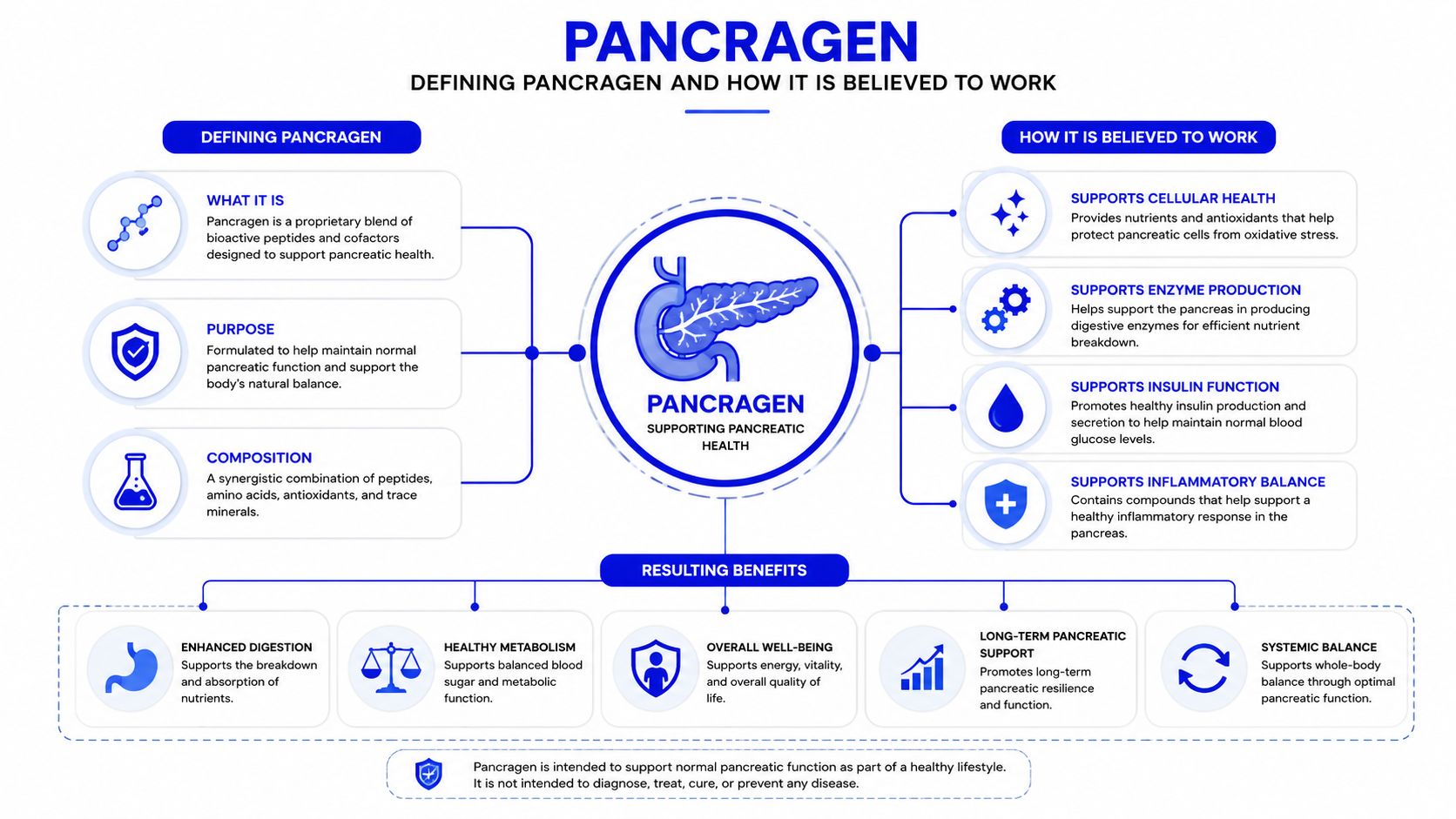
Pancragen is described in the literature as a tetrapeptide, with the amino-acid sequence Lys-Glu-Asp-Trp, often written as KEDW. It's identified as a synthetic analog derived from a peptide originally isolated from bovine pancreatic cells (core peptide overview). That origin matters because it ties the compound to pancreatic biology from the start, instead of positioning it as a generic metabolic agent.
The simplest way to think about Pancragen is as a short instruction slip, not a replacement hormone. It doesn't behave like insulin, and it isn't being framed in the literature as a blunt fuel-switch for the whole body. Instead, the peptide is associated with pancreatic function, which means researchers have looked at whether it nudges the organ toward healthier response patterns under stress or metabolic challenge.
That's why the KEDW sequence gets so much attention. In peptide work, length and sequence are not trivia. They shape how a molecule interacts with tissue, how it's discussed in the literature, and what sort of effects researchers bother to measure. With Pancragen, the conversation stays tied to pancreatic cells and downstream metabolic readouts.
The proposed mechanism is best kept in two layers. First, there are the observed animal effects, such as changes in insulin and C-peptide dynamics after glucose exposure. Second, there is the broader interpretation that Pancragen may support islet function and, in some models, show endothelioprotective behavior. Those are not the same thing, and the distinction matters.
Here's the cleanest way to read it. The peptide seems to have been explored as a short molecular signal that helps pancreatic tissue respond more normally to a glucose challenge. That is very different from saying it replaces pancreatic output or cures metabolic disease. The literature you're working from points to support, modulation, and functional normalization in models, not to a human treatment claim.
For a broader peptide context, a useful comparison is the way some educational resources frame peptide selection for other tissue targets, such as the PRP For HairLoss peptide guide. The target organ, the readout, and the biological logic all need to match before a peptide claim makes sense.
Pancragen is easier to understand if you keep asking one question, what tissue was it actually studied for?
The strongest published signal for Pancragen comes from a 10-day intramuscular primate study in old monkeys, where the dose was 50 μg per animal per day. This study matters because it does not present Pancragen as a broad wellness peptide. It looks at a pancreas-focused compound through a glucose challenge, which is the right frame for separating KEDW literature from the later GLP-1 era hype around peptides.
Researchers reported a marked increase in the glucose “disappearance” rate after treatment. In plain terms, glucose left the bloodstream more efficiently during the challenge period. They also reported normalization of plasma insulin and C-peptide dynamics after glucose administration, the sort of pattern a pancreatic support compound would be expected to influence if it had a meaningful effect in this setting.
The timing is the part that gives the study its weight. The recovery effect persisted for 3 weeks after treatment stopped. That lingering tail matters because it suggests more than a short-lived pharmacological push. In peptide research, a persistent functional shift can point to a change in tissue behavior, even when the study is small and limited to animals.
A short-lived change is easy to over-read. A longer tail asks a different question, whether the peptide was nudging pancreatic function rather than briefly masking a problem. The primate data do not prove regeneration in a clinical sense, but they do give the literature its clearest historical reason to treat Pancragen as an age-related pancreatic endocrine support peptide.
Reading rule: a strong animal signal is not a human result, but it can still show where the molecule was aimed.
That is the right lens here. The primate work is the anchor, not the whole map. It is the best single piece of evidence in the Pancragen story, and it points toward glucose handling, insulin dynamics, and a recovery pattern that lasted beyond the dosing window. It does not support turning the peptide into a generalized anti-aging claim.
The rodent evidence widens the picture without changing the center of it. In streptozotocin-induced diabetes, tetrapeptide Pancragen, Lys-Glu-Asp-Trp-NH2, showed a pronounced hypoglycemic effect during oral treatment. In the same study, intramuscular dosing normalized the adhesion of mesenteric capillary endothelium (PubMed). Those are different routes, different readouts, and different biological implications.
The oral result speaks to glucose control during treatment. The intramuscular result points to vascular behavior, specifically how capillary endothelial cells adhere under diabetic stress. A bench scientist should not flatten those into one generic “better health” headline. The route matters, the model matters, and the readout matters.
That separation is exactly why this study is useful. It suggests Pancragen was not being explored only as a sugar-related compound. It also had an endothelial angle, which is why the authors described homeostatic and endoprotective effects in early diabetes models, as noted in the rodent diabetes study. In practical terms, the peptide appeared to support both metabolic balance and vascular tissue behavior in a stressed system.
The primate study gave the clearest evidence of improved glucose handling and insulin dynamics. The rodent work adds an adjacent layer, vascular support in a diabetic context. Put together, they outline a research profile that is more interesting than a simple “blood sugar peptide” label, but still much narrower than the commercial wellness pitch surrounding it.
A careful reader keeps the hierarchy straight. The rodent study supports the primate signal, but it does not outrank it. Neither study proves human benefit. They do, however, make the historical research focus easier to see. Pancragen was investigated as a compound with pancreatic and vascular relevance in diabetes models, not as a body-composition product.
A lot of the commercial interest around Pancragen comes from a GLP-1-shaped expectation. Readers see a peptide and assume it should help with appetite, fat loss, or broad rejuvenation. That assumption doesn't hold up against the available material. One recent explainer explicitly says Pancragen is not a fat-burning peptide, and the broader content around it keeps circling back to blood sugar and pancreatic function instead of body recomposition (Peptide Intel overview).
GLP-1-era drugs are discussed in terms of appetite suppression and weight loss because that's their clinical lane. Pancragen isn't in that lane. Any metabolic effect appears to be indirect, through glucose regulation, not a direct fat-loss mechanism. That difference is easy to miss if you're scanning headlines, but it's the difference between a pancreas-focused research peptide and an incretin-style therapy.
The same caution applies to anti-aging language. The published evidence doesn't show broad rejuvenation, muscle gain, or a general “healing” effect in the way those claims are used in the peptide market. What it does show is more specific, more limited, and more defensible. Pancragen belongs in the category of research compounds tied to pancreatic function, not in the category of universal wellness agents.
Useful shortcut: if a claim sounds larger than the biology, it probably is.
A fair reading says Pancragen may be worth researching for its relation to glucose handling and pancreatic support. It does not say it's a shortcut for fat loss. It does not say it replaces standard diabetes care. It does not say it can be slotted into the same conversation as incretin drugs just because both touch metabolism.
That honesty matters because overclaiming clouds the actual signal. The more realistic your frame, the easier it is to see what the peptide is and what it is not. Pancragen is a niche research compound with a pancreas-centered literature, and that's exactly how it should be discussed.
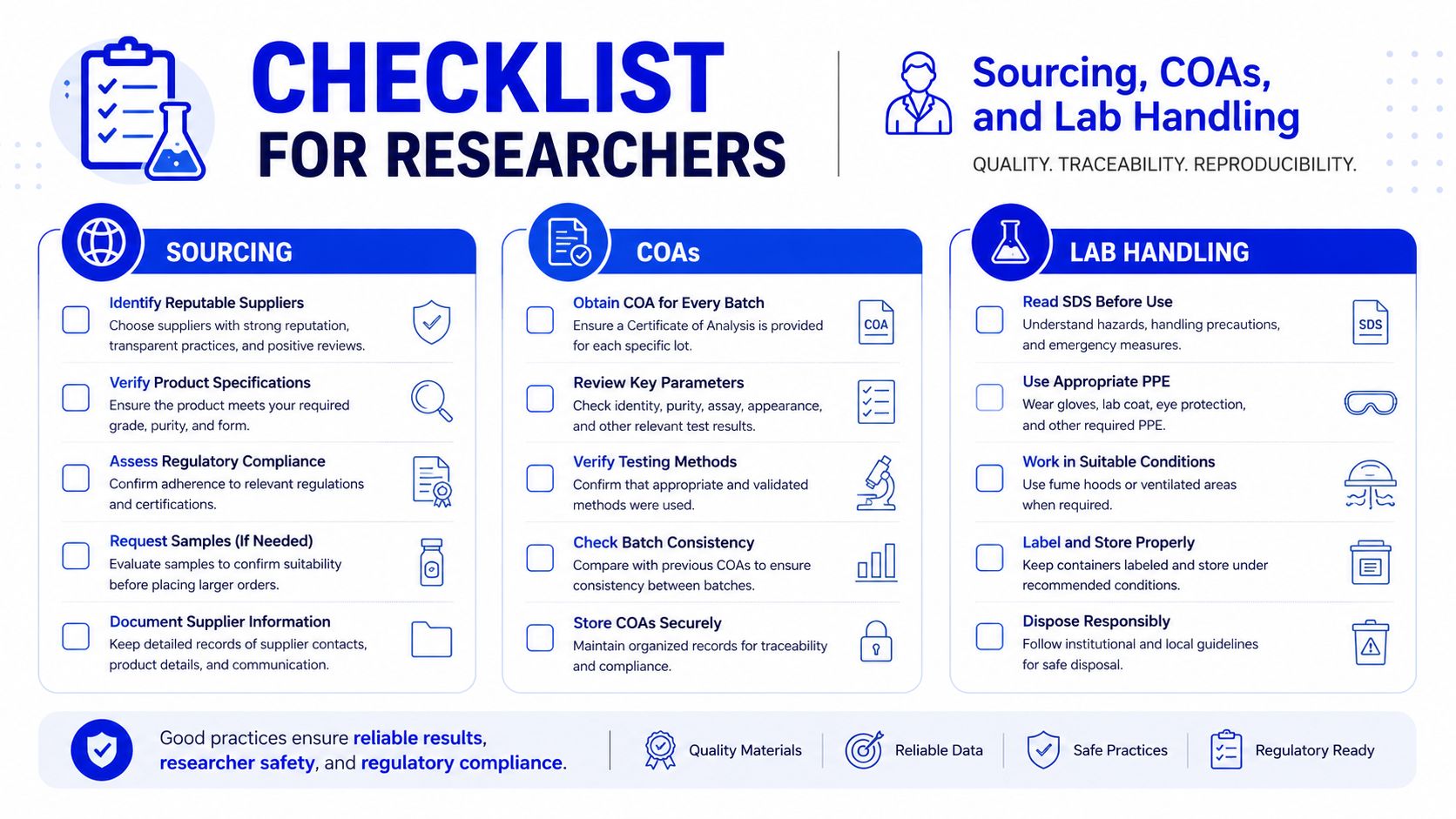
Once you move from literature to bench work, sourcing discipline becomes the filter. For Pancragen, the minimum starting point is a current Certificate of Analysis tied to the lot, plus third-party microbial and endotoxin testing. You also want clear batch traceability and documentation of USA-based manufacturing, because consistency matters when the compound is being used for analytical or preclinical work.
A serious supplier should be able to show you the lot-specific paperwork, not just a generic product page. The COA should match the exact batch you received, and the testing package should make it easy to verify identity and cleanliness. In this space, documentation is part of the product.
Pancragen is typically handled as a lyophilized powder, so the priorities are simple. Keep it cool, dry, and protected from light. Reconstitution should be done with lab discipline, since sloppy handling creates avoidable variability in analytical work and can compromise the sample before you ever get a result.
Lab rule: if storage and reconstitution aren't documented, the experiment starts with a blind spot.
For researchers, the compliance piece is just as important as the handling piece. This is for laboratory, analytical, and preclinical use only, not human use. Keeping that line clean protects the work and keeps the sourcing process aligned with the category the compound belongs to.
Pancragen is a KEDW tetrapeptide with a pancreas-centered research record, so the cleanest way to read the literature is as a glucose-regulation compound first, not as a broad wellness peptide. The strongest Pancragen peptide benefits reported so far are tied to glucose disappearance, insulin and C-peptide normalization, and a residual effect lasting 3 weeks after treatment in old primates, as noted earlier. Rodent diabetes work adds a vascular angle, especially the mesenteric capillary adhesion finding discussed above.
That matters because the commercial story has drifted far beyond the evidence. Claims about fat loss, muscle gain, or sweeping anti-aging effects go past what the published work supports, so they belong in the marketing column, not the evidence column. The GLP-1 comparison is useful only as a caution flag, since Pancragen is not an incretin-style appetite drug and does not fit that category.
For researchers, the next step is quality control, not hype. Look for a supplier that publishes COAs, includes endotoxin and microbial testing, and labels the material clearly for research use only. If you are comparing options, use the same care you would apply to any niche peptide, and examine what is documented before you move ahead.
A CTA for Peptide Warehouse USA.