No products in the cart.

A fresh peptide vial arrives, the label looks clean, and the supplier's product page promises high purity. The experiment is scheduled, the cells are ready, and someone in the lab assumes the material is fit for purpose. Then the assay behaves differently from the previous run, and the team discovers that the certificate of analysis belongs to a generic catalog specification rather than the lot on the bench.
That's the core problem with peptide research supply. Buying a vial is easy. Buying a material that remains identifiable, traceable, stable, and suitable for a defined laboratory purpose requires a procurement system. This guide shows you what to check in the manufacturing record, how to read a COA beyond the headline purity number, how to qualify a supplier, and how to keep regulatory and handling mistakes from undermining otherwise careful research.
A peptide becomes a research material through a chain of decisions. A university lab may order a known sequence for assay development. A contract research organization may need repeatable lots for client work. An analytical chemist may require a reference standard, while a preclinical team may screen modified sequences, analogs, or lipidated compounds.
The vial is only the visible end of that process. Before it reaches the bench, someone has selected a supplier, reviewed specifications, approved a purchase order, checked the intended use, and decided what evidence must accompany the lot. After delivery, the lab still has to inspect the package, record the lot, store the material correctly, and preserve the documentation.
Practical rule: Treat every peptide lot as a traceable research input, not as a generic catalog item.
A low advertised price can become expensive when a failed assay forces a repeat order, when a replacement lot behaves differently, or when nobody can determine which material produced an earlier result. The more sensitive the experiment, the less sense it makes to optimize only for unit price. Batch identity, analytical evidence, storage requirements, and supplier responsiveness usually matter more than a small difference in the invoice.
Use these lenses before approving an order:
A good peptide research supply program also anticipates the next quarter. The question isn't only whether a vial works today. It's whether another researcher can reorder the material, compare lots, and reproduce the work later using records that still make sense.
A vial can carry a polished catalog name and still fail to match the material your experiment requires. The manufacturing route explains why. Synthetic peptide production became practical in the mid-1950s after Vincent du Vigneaud sequenced and synthesized oxytocin. Synthetic oxytocin entered the market in 1962, establishing a commercial model for producing biologically active peptides at scale instead of relying only on extraction from animal or human tissues. A history of commercial peptide manufacturing connects that milestone with current manufacturing systems.
During the 1960s, Bruce Merrifield developed solid-phase peptide synthesis, or SPPS. He received the 1984 Nobel Prize in Chemistry for this work. SPPS remains central to modern peptide chemistry and enables suppliers to produce custom sequences and chemically modified analogs. Its history and laboratory method are summarized in this educational reference on solid-phase peptide synthesis.
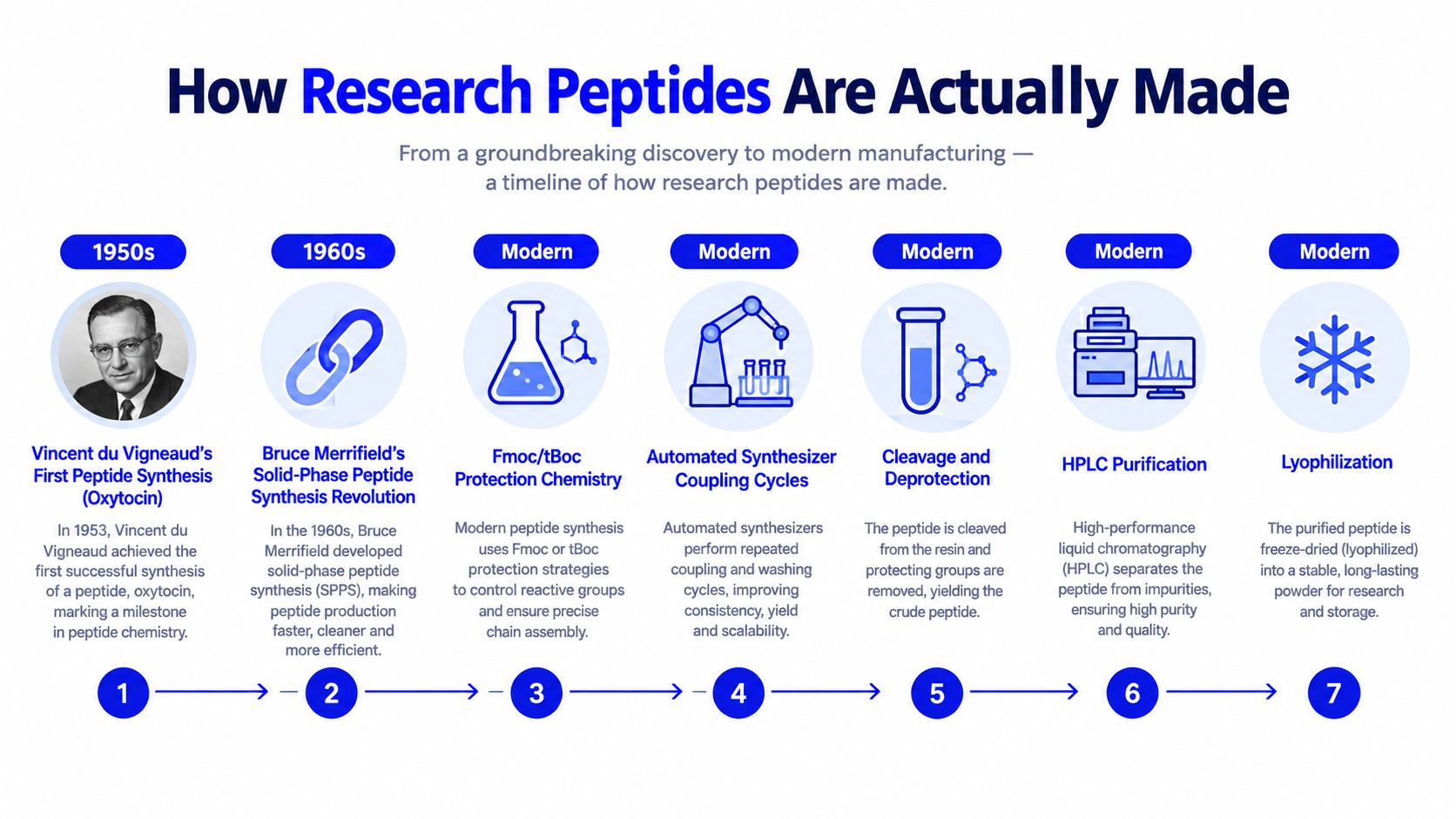
SPPS builds a peptide chain while the first amino acid remains attached to a solid support. The manufacturer adds amino acids one at a time. Each cycle involves coupling, removing a temporary protecting group, and washing away unwanted reagents before the next addition.
The finished chain is then cleaved from the support and deprotected. That crude mixture still needs purification and characterization. Longer sequences, unusual amino acids, oxidation-sensitive residues, terminal modifications, lipidation, and other structural changes increase the analytical and purification burden.
“Synthetic peptide” describes the production category, not the quality of the vial. Ask how the supplier controls the sequence, which purification method it uses, how the final batch is isolated, and which tests confirm identity and impurities. A catalog listing states the intended molecule. It does not prove that the shipped material matches it.
A supplier that controls synthesis and testing in the United States may provide a clearer qualification path than a reseller repackaging imported crude material. Geography alone proves little. Require the company to identify the manufacturing site, connect the COA to the shipped lot, explain its test methods, and answer technical questions without directing you to generic marketing copy.
Peptide supply now serves regulated pharmaceutical development as well as non-clinical research. Commercial demand for peptide medicines has expanded over roughly seven decades since oxytocin entered the market, supporting production of custom sequences, analogs, and modified research peptides.
For procurement, route transparency and batch records are practical requirements. They let your lab judge whether a supplier can produce the stated molecule consistently, investigate unexpected assay results, and reorder material with a defensible record of what changed between lots.
A certificate of analysis should help you decide whether a specific lot is suitable for a defined experiment. It shouldn't function as a polished sales sheet with one large purity number and no supporting evidence.
Start by separating three concepts that suppliers sometimes present too close together:
A high HPLC result doesn't automatically establish correct identity, correct sequence, suitable peptide content, low aggregation, or acceptable biological cleanliness. Peer-reviewed quality guidance identifies primary sequence, secondary structure, aggregation or oligomerization state, impurities, and degradation products as critical quality attributes.
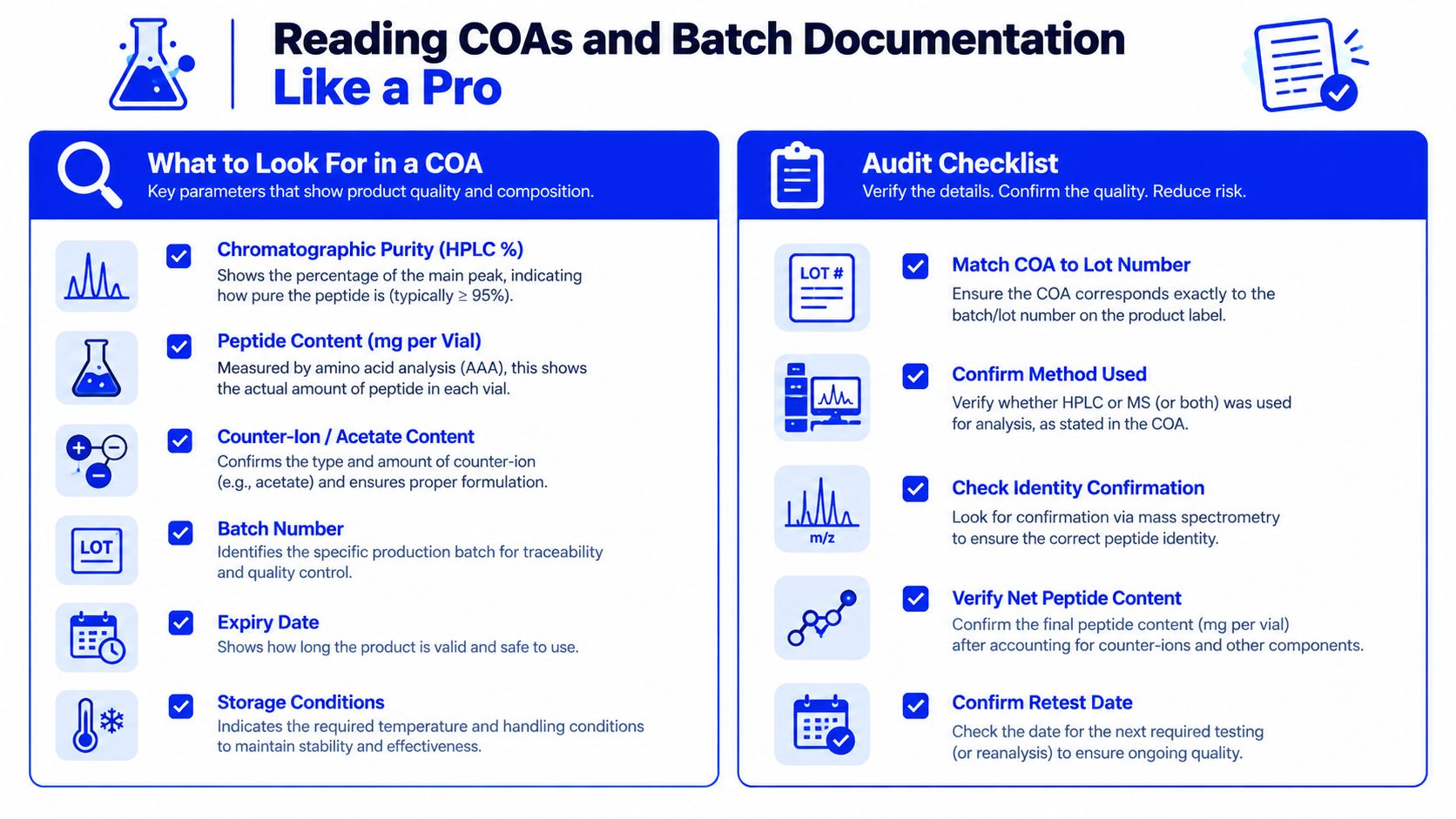
For a peptide research supply lot, I want the following information before approving use:
A weak COA often has a generic lot field, no test date, no named method, no chromatogram, or no explanation of what the percentage represents. “Third-party tested” also isn't a standardized quality designation. Recent analytical guidance emphasizes accuracy, precision, and reinjection reproducibility, so ask whether the laboratory tested the exact material shipped and whether the report is batch-specific.
A COA proves only what it documents. Everything else remains an assumption.
For cell-based work or other sensitive biological systems, distinguish chemical purity from sterility and endotoxin control. A chemically pure peptide can still be unsuitable for a particular experiment if the supplier provides no microbial or endotoxin information and your protocol depends on those controls.
A polished website cannot qualify a supplier. Before a large order, request documentation from a representative lot and compare it with the product page. The supplier should identify where the material was made, which laboratory tested it, what methods were used, and how each reported result was calculated.
Start with a small qualification order. Use it to assess the material, paperwork, packaging, response time, and technical support. Do not assign a critical study to a vendor you have not tested just because the catalog price is attractive. A supplier that cannot answer basic questions before purchase will be harder to work with during a deviation investigation.
| Criterion | What to Look For | Red Flag |
|---|---|---|
| Batch documentation | Lot-specific COA, analytical methods, chromatogram, mass spectrum | Generic certificate or missing lot number |
| Manufacturing origin | Clearly stated production location and supply-chain responsibility | Repackaging language with no source details |
| Identity testing | LC-MS or LC-MS/MS linked to the exact lot | Purity percentage with no identity result |
| Purity method | Named reversed-phase HPLC method and assay basis | “High purity” without method details |
| Biological risk controls | Microbial or endotoxin reports when relevant to the experiment | No explanation of testing scope |
| Technical support | Direct answers from knowledgeable staff | Pressure to order before qualification |
| Logistics | Defined storage, shipping, and replacement procedures | Unclear temperature handling or delivery terms |
Use the supplier's documents to judge batch behavior, not marketing language or a single high purity number. The analytical guidance on method performance and reproducibility supports checking accuracy, precision, method reliability, and reinjection reproducibility. Ask whether the laboratory tested the exact material shipped and whether the report belongs to that lot. A supplier earns trust by making those answers easy to verify.
A peptide can leave the supplier in good condition and arrive compromised through poor packaging, temperature exposure, moisture ingress, or careless reconstitution. Start receiving inspection before you put the vial into inventory.
Check the shipping container, seal, vial, label, and paperwork. Look for a collapsed or damaged lyophilized cake, unexpected discoloration, a broken closure, moisture inside the vial, or evidence that the package lost its intended temperature control. Photograph unusual conditions before discarding packaging.
Lyophilized material generally offers a practical solid-state format for storage, but opening the vial introduces moisture and handling risk. After reconstitution, use the solvent and buffer specified for the application, calculate concentration from the documented peptide content, and prepare aliquots when the protocol allows. Avoid repeated freeze-thaw cycles, and don't shake aggressively when gentle mixing is sufficient.
A small laboratory may also need simple protective packaging during internal movement. For general handling and packing materials, Bubble Wrap Rolls can help protect secondary containers from impact, although cushioning material doesn't replace validated temperature control or the supplier's storage instructions.
Shipping stability also needs analytical evidence. FDA synthetic-peptide guidance recommends high-resolution procedures such as UHPLC-HRMS for detecting peptide-related impurities and describes evaluating multiple batches near release and again at the end of shelf life. Storage and handling can produce degradation products that affect measured potency or aggregation behavior even when nominal identity remains unchanged.
Use this short visual reference when training staff:
“Research use only” describes intended laboratory use. It doesn't transform an unapproved material into a medicine, and it doesn't excuse human-use marketing.
That distinction matters because regulators assess the surrounding evidence, not only a disclaimer printed on a product page. FDA enforcement guidance summarized in this regulatory discussion states that phrases such as “not for human consumption” and “laboratory use only” don't protect sellers when websites or other evidence indicate an intended human use. The same source reports forensic findings from seized counterfeit peptide products containing as little as 5% of the labeled compound, a material-integrity risk as serious as the compliance risk.
A research-grade peptide, a compounded preparation, and an approved peptide drug are different categories with different controls and intended uses. Don't let similar names or familiar sequences blur those boundaries in purchase records, internal communications, or public content.
Responsible procurement should leave a clear paper trail:
Age gates and FDA disclaimers can support responsible online purchasing, but they're only part of the control system. A credible supplier should avoid weight-loss, healing, antiaging, muscle-growth, or other human outcome claims for research compounds unless the specific claim has appropriate support.
The Federal Trade Commission's health products compliance guidance states that objective product claims require adequate substantiation, and health-related claims require competent and reliable scientific evidence. Describe verifiable attributes such as research-use status, batch documentation, analytical testing, and stated purity. Don't present laboratory compounds as treatments or imply that research materials deliver benefits of peptides in people.
A reliable workflow turns individual purchasing judgment into institutional memory. That matters because researchers change roles, projects expand, and a supplier that performs well for one sequence may not perform equally well for another.
The FDA authorized 208 new drugs between 2015 and 2019, including 15 peptide or peptide-containing molecules, representing roughly 7% of approvals during that period, according to the peer-reviewed review of peptide drug approvals. That development activity supports sustained demand for dependable peptide materials in analytical development, assay validation, structure-activity studies, formulation research, and preclinical work.
Write the rules before the next urgent order:
Keep the workflow proportionate. A stable, familiar reference material may need a different review depth from a complex modified sequence used in a sensitive cell assay. The documentation standard should rise with experimental consequence, not fall because a vendor offers a discount.
The right partner reduces friction without weakening controls. Look for suppliers that publish batch-specific COAs, state manufacturing origin, explain testing methods, and maintain a clear research-only posture. Peptide Warehouse USA offers research peptides and related compounds for laboratory, analytical, and preclinical applications, with stated USA manufacturing, batch testing, third-party COAs, and microbial and endotoxin documentation. Those are the types of records a lab should evaluate, not accept blindly.
Peptide Warehouse USA supplies research-use materials with batch documentation, analytical records, microbial and endotoxin reports, and a catalog covering peptides and related compounds. Visit Peptide Warehouse USA to review available options and assess whether its sourcing and documentation fit your lab's qualification workflow.