
No products in the cart.


You're standing at the freezer, vial in hand, and the question is simple: did the peptide survive the week, or did the storage habits ruin it? In real labs, peptide storage temperature isn't an afterthought, it's the difference between a clean run and a waste bin full of compromised material. The fix usually isn't complicated, but it does require treating lyophilized and reconstituted peptides as two different storage problems.
A peptide can look unchanged and still be compromised. I've seen vials sit in the wrong conditions long enough for oxidation, bond cleavage, and other degradation pathways to build up with no visible clue, then the assay fails later and the result is hard to trust. That is why temperature sits at the center of peptide stability.
Practical rule: if storage runs warmer than planned, the problem usually shows up at the next prep, the next assay, or the next comparison that stops matching.
Technical guidance notes that a 10°C increase can roughly double degradation rates Formblends peptide storage guide. That is why a peptide left too long on the bench, in a warm rack, or near a freezer door can underperform even when it never looks obviously spoiled.
Cold storage slows several reactions at once. Lower temperatures reduce oxidation pressure, suppress bond cleavage, and slow the chemical drift that turns a clean research material into a noisier sample PMC review on peptide storage and degradation. In practice, the steadier the temperature, the more likely you are to keep the original lot's behavior intact.
For routine lab work, 2–8°C is the usual refrigeration range, while −20°C is the common frozen reference point Formblends peptide storage guide. That ladder matters because it reflects how peptides behave during storage, not just what is convenient for the freezer shelf.
The cost shows up in reruns and bad decisions. A compromised peptide does not just waste material once. It can send a project through repeat prep, confusing readouts, and hours spent questioning the biology when the storage history is the problem. When a result looks inconsistent, check how the peptide was handled before you blame the assay.
A lyophilized peptide vial can sit on a shelf and still lose quality if the storage conditions are sloppy. The usual setup is a sealed vial in a dry, dark environment, with −20°C or colder as the long-term baseline. For peptides that are especially sensitive or need archival storage, −80°C is the safer colder option PMC review on peptide storage and degradation, Sigma-Aldrich storage guidance, Peptra Labs protocol.
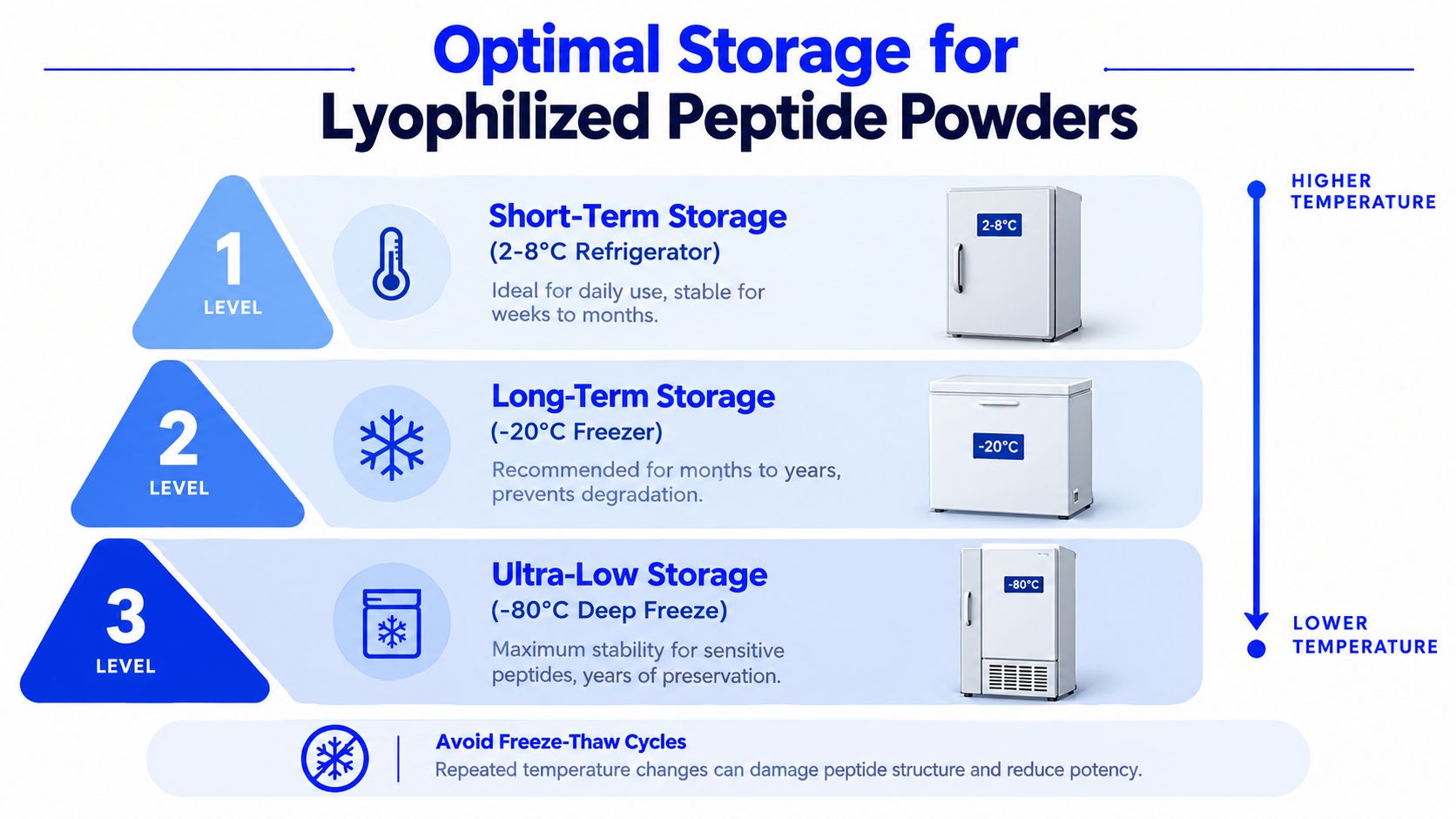
For short-term use, refrigeration at 2–8°C is generally acceptable. Sealed lyophilized material can often stay there for a practical working window, but that only helps if the vial stays closed and dry Peptide Nerds guide. For longer storage, −20°C is the standard frozen condition, and −80°C gives more headroom when you want to protect a difficult sequence or keep stock in reserve Peptide Nerds guide. Those timeframes are useful, but sequence chemistry still sets the ceiling.
Dry peptide is not invincible, it's simply easier to protect. Moisture and heat remain the primary threats to stability.
That is where many new researchers slip. The freezer setting does not matter much if the stopper is compromised, the vial is opened repeatedly in humid air, or the tube spends time on a rack where temperature swings are routine.
Cold slows the chemistry, but moisture exclusion protects the material itself. Water creates the conditions that favor oxidation and hydrolytic change, so dryness is part of storage, not a nice extra PMC review on peptide storage and degradation. Keep the vial tightly sealed, keep it away from light, and avoid leaving it uncapped while you organize other reagents.
Room temperature is only reasonable for shipping or brief bench handling. It is not a storage plan. If a powder sits out while someone plans to deal with it later, that is unnecessary exposure, not harmless convenience.
Once a peptide is mixed, the storage rule changes right away. A reconstituted solution should go into 2–8°C refrigeration immediately after mixing, and most practical guidance treats the use window as limited Real Peptides guide. Some reviews tighten that further, pointing to shorter stability in sterile water and a longer window in bacteriostatic water Peptide Journal review.
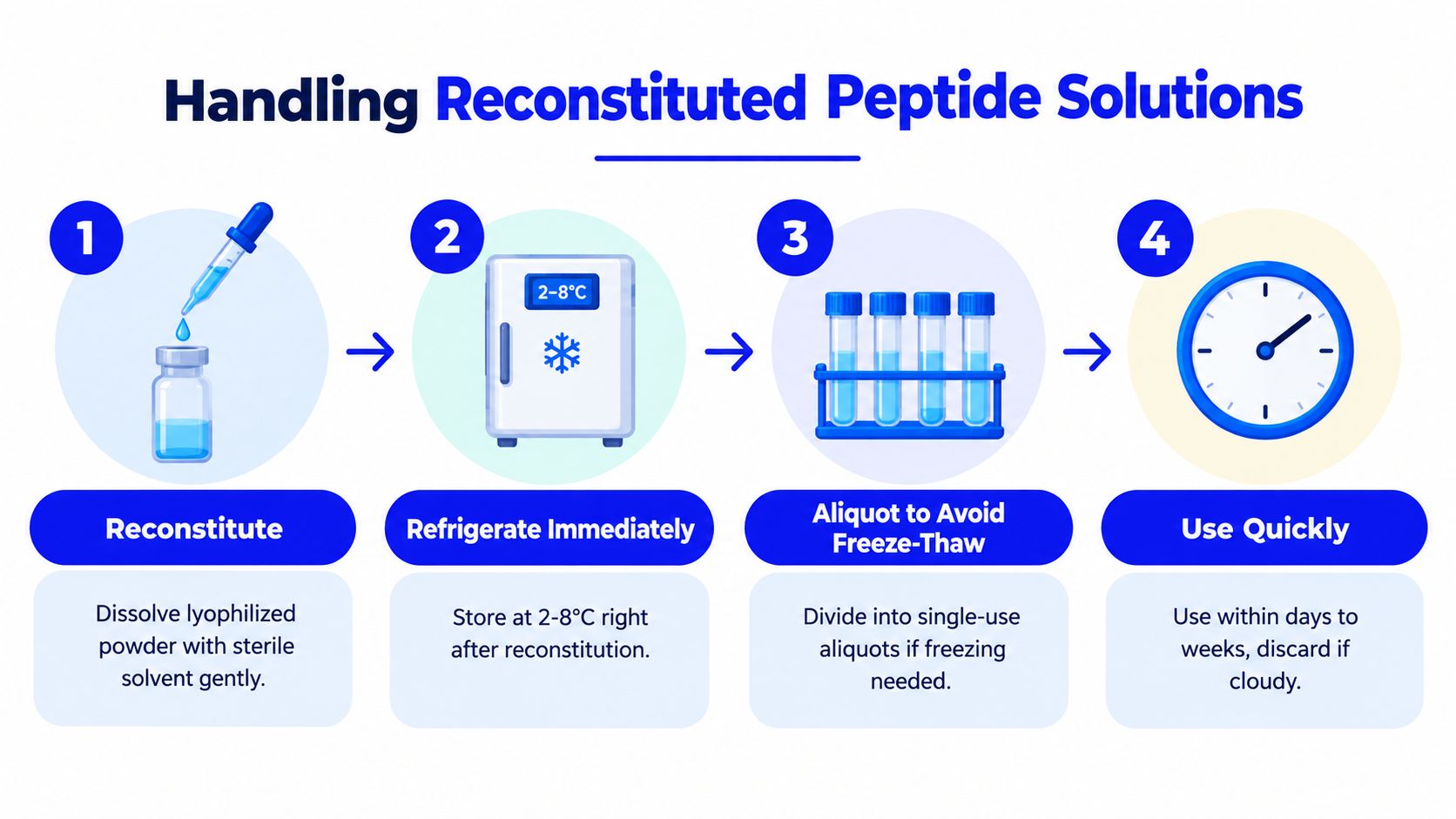
The common error after reconstitution is treating the tube like dry stock. Repeated freeze-thaw cycling stresses the solution during ice formation and thaw, which increases the chance of degradation ScienceDirect peptide stability topic. A vial that turns cloudy after a few cycles is already telling you the handling has gone too far.
Use single-use aliquots as soon as the peptide is reconstituted. Freeze once, thaw once, use once. That is the cleanest way to limit warming, refreezing, and the handling mistakes that usually shorten usable life.
The solvent matters too. Sterile water and bacteriostatic water do not hold up the same way in storage, so the practical window is often shorter in sterile water and longer in bacteriostatic water Peptide Journal review. That does not make the solution stable for long, it only changes how quickly you need to use it.
If a mixed solution must be frozen, keep it in aliquots and treat freezing as a holding step, not a replacement for the original lyophilized form ScienceDirect peptide stability topic. The dry cake is easier to protect. Once it is in solution, every extra thaw raises the risk of loss.
A vial sitting in the fridge and a vial already mixed are not handled the same way. Generic advice causes mistakes because lyophilized powder and reconstituted solution follow different storage rules, and the wrong rule usually shortens usable life.
| Peptide Form | Short-Term Storage | Long-Term Storage | Expected Shelf Life | Key Handling Notes |
|---|---|---|---|---|
| Lyophilized powder | 2–8°C for short-term use | −20°C standard, −80°C for archival or labile sequences | 6–12 months at 2–8°C, 1–3 years at −20°C in one practical guide | Keep sealed, dry, dark, and avoid moisture exposure |
| Reconstituted solution | 2–8°C immediately after mixing | Freeze only in single-use aliquots if longer holding is needed | Roughly 28 days in one guide, shorter windows are also cited depending on solvent | Don't refreeze the same tube repeatedly, and don't trust cloudiness |
For dry peptide, cold storage protects the material without forcing repeated freeze-thaw cycles. For solution, the clock starts running as soon as it is mixed, and every extra warm-up, thaw, or transfer adds risk. A cloudy vial is usually a sign that handling has already gone too far.
The practical trade-off is simple. Lyophilized stock tolerates storage far better because the peptide is still protected in dry form. Once reconstituted, the sample is exposed to solvent, air, and repeated handling, so single-use aliquots are the cleaner choice. Freeze once, thaw once, use once.
Temperature still matters in both forms. Degradation reactions can roughly double for every 10°C rise in temperature ScienceDirect peptide stability topic. That is why a tube held at 25°C behaves very differently from the same tube kept at 4°C.
The main point is straightforward. Refrigeration can slow loss in solution, but it does not restore the stability of the dry powder. Once a peptide is reconstituted, the storage window is tighter, and aliquoting becomes part of the protocol, not an optional extra.
A shipment can fail before the vial ever reaches your freezer. If it warms in transit, sits too long in receiving, or stays on the bench during intake, the cold chain is already compromised. Verify the package immediately, move it to the correct storage condition fast, and handle it carefully from the first touch.
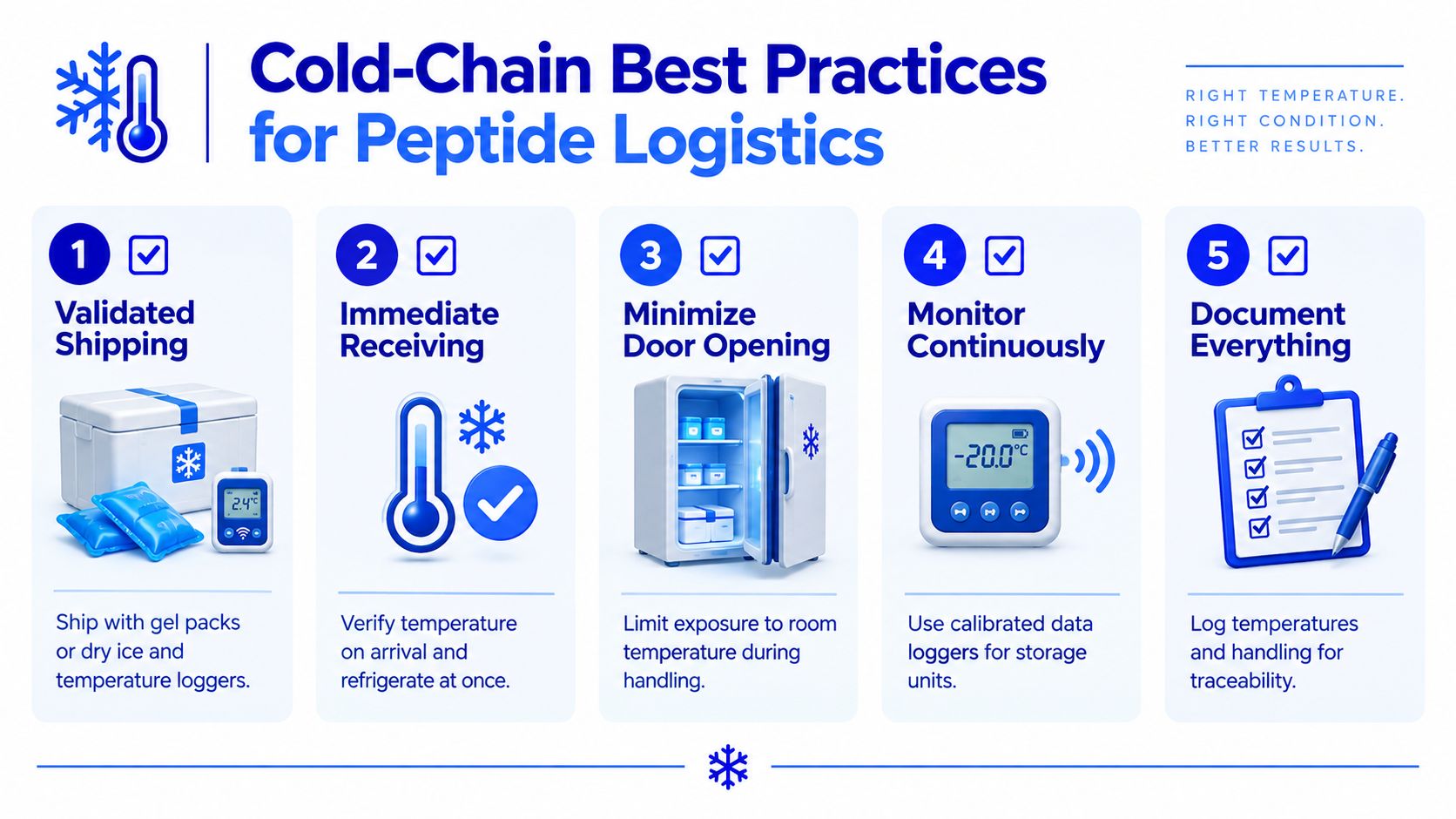
For labs that want a broader quality mindset, AUSFF quality standards are a useful external reference for process control, traceability, and consistency without treating peptide handling as guesswork.
Temperature is not the only variable to control. Light protection matters more for solutions than for dry vials, and moisture control matters whenever a container is opened or moved. Desiccant, foil wrap, and dark secondary containers all help buffer the sample against the demands of a busy shared lab.
That secondary container also softens the impact of frequent freezer access. If people are opening the same unit all day, the vial lives a harder life than the freezer spec suggests.
The expensive mistakes are usually the ordinary ones. A vial sits on the bench longer than planned, a reconstituted tube goes through repeated freeze-thaw cycles, or someone treats a frost-free freezer like an archival unit. None of those choices looks serious in the moment, yet each one can chip away at peptide integrity.
Room-temperature storage is the biggest misconception. Brief handling windows are one thing. Routine ambient storage lets heat, moisture, and light work on the sample faster than many researchers expect. Once the peptide has been mixed, that exposure costs more because the solution form is less forgiving.
Repeated thawing is the other common failure point. Each freeze-thaw cycle raises the risk of aggregation and makes the material behave less like the original stock. The fix is straightforward, aliquot before you need to use it, not after the first thaw.
Lyophilized powders and reconstituted solutions need different habits, and that distinction is where many labs slip. Dry material can usually tolerate tighter cold storage discipline, while mixed material needs faster decision-making and cleaner aliquot practice. The storage rule changes with the form, and treating them the same is how avoidable losses start.
A simple audit catches most problems. Check whether freezer access is causing repeated warming, whether aliquots are sized for single use, and whether staff can tell at a glance which tubes are still dry and which are already mixed. Keep the routine written down, keep the shelf assignment obvious, and keep handling time short.
A workable protocol is plain and consistent. Write it down, assign responsibility, and make sure every person handling stock follows the same steps. Dry material belongs in lyophilized peptide form, sealed, dry, dark, and stored at −20°C or colder. Once a peptide is reconstituted, it should go to 2–8°C immediately, then be used within the practical window for that solvent and sequence.
The split between these two forms matters. Dry powder tolerates colder, longer storage far better than solution. A mixed tube does not. Once you reconstitute, repeated freeze-thaw cycles and sloppy aliquoting are what usually ruin the sample, so make single-use portions before long-term freezing is needed.
A simple lab checklist keeps people honest:
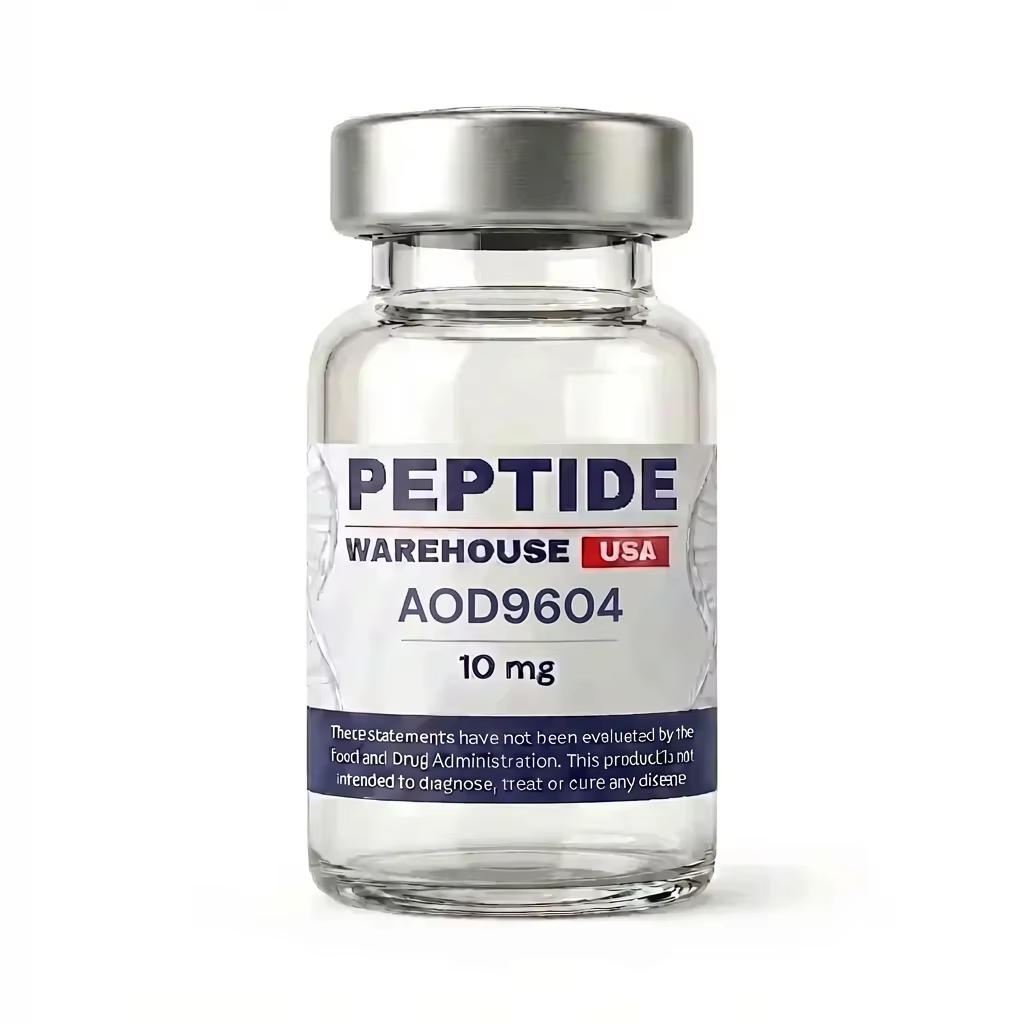
If you are buying new material, choose suppliers that provide COAs, batch records, and clear storage guidance. Peptide Warehouse USA is one example of a research supplier that offers COA-backed, USA-manufactured peptides with documented lot information, which can help when inventory tracking matters.
Leave a comment