No products in the cart.

You're probably staring at a vendor shortlist right now, trying to separate real wholesale peptide suppliers from storefronts that know how to say “99% pure” and little else. That's the trap in peptide wholesale USA buying, the headline number looks clean, but the paperwork behind it tells you whether the lot is worth your time.
If you buy for a lab, clinic, or private label operation, the wrong supplier burns more than budget. It costs you rework, delays, and internal trust. The buyers who stay out of trouble treat peptides as a documentation and supply-chain problem, not a bargain hunt.
You're on a procurement call, the rep is pushing purity, and the price looks decent. That's exactly when buyers get lazy and skip the hard questions. In peptide wholesale USA, the right move is to slow down and demand the documents that prove the lot exists, was tested, and can be traced back to a real batch.
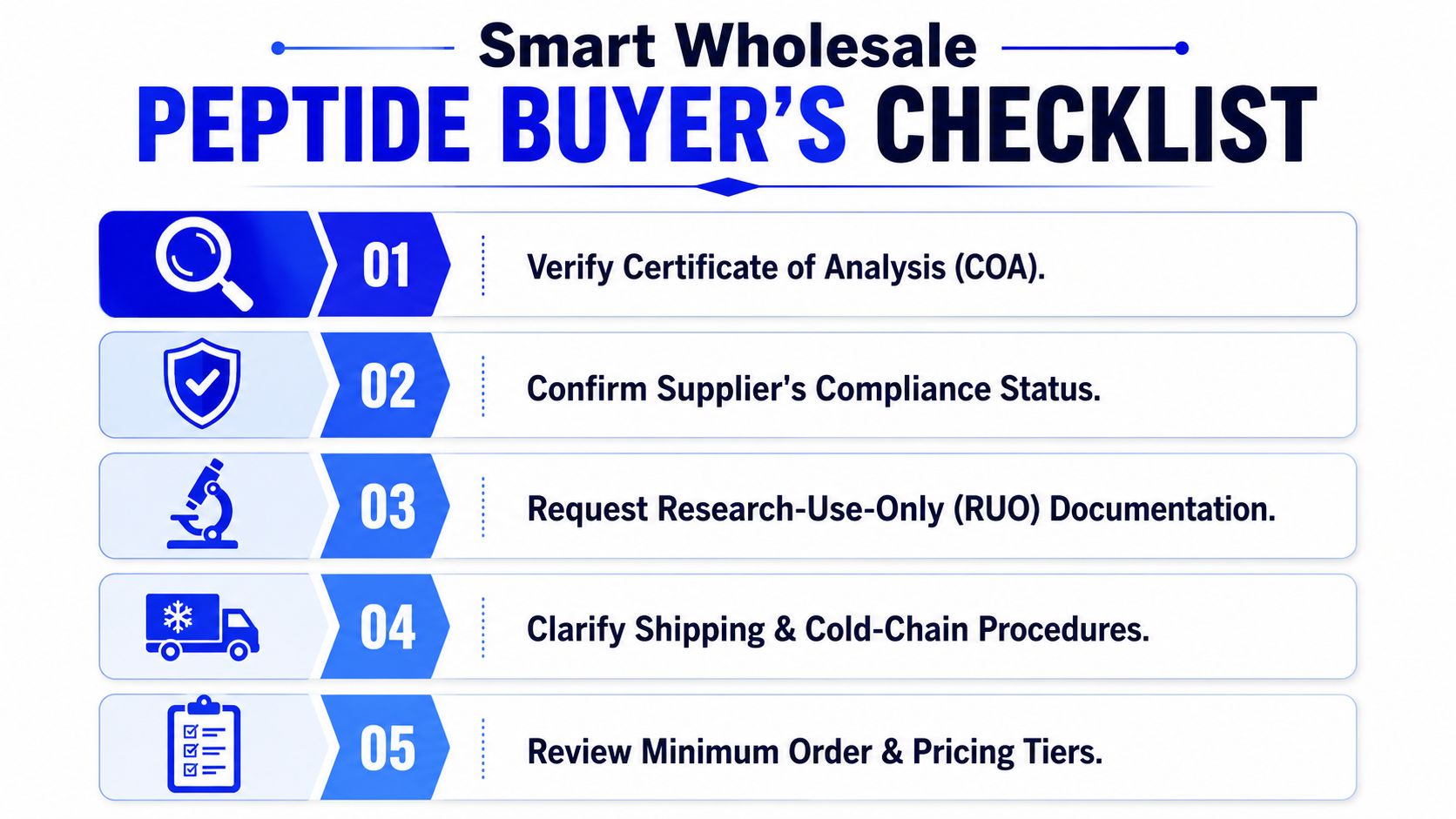
A serious supplier should give you batch-specific COAs, not a polished product page and a promise. The supplier directory and industry guidance in the brief point in the same direction, quality is tied to HPLC purity data, mass spectrometry identity confirmation, and lot-level certificates, not just a big purity claim on the listing. The better the records, the easier it is to judge whether the product is suitable for research use. State of Peptides directory
Practical rule: if the vendor can't point you to the batch record in one email thread, don't treat the lot as qualified.
A good wholesale file should include more than a COA. I want to see batch traceability, a clear research-use-only statement, and testing breadth that goes beyond a single purity line. If the seller only talks about headline purity and doesn't discuss verification depth, that's usually a sign the procurement process is thin.
Here's the buyer mindset that saves time:
That's the right filter because wholesale peptide quality is rarely obvious from a product tile. It shows up in the paperwork, the traceability, and how fast the supplier can answer a document request without hand-waving.
A large U.S. peptide market changes how wholesale buying works. Grand View Research estimated the global peptide therapeutics market at USD 140.9 billion in 2025, with North America accounting for 61.9% of revenue that same year, and projected growth to USD 294.6 billion by 2033 at an 8.7% CAGR. A separate industry report also says the U.S. is the dominant market at roughly 60% of global therapeutic revenue, which is why domestic wholesale buyers keep running into stricter supplier paperwork and more formal review steps. Grand View Research market analysis
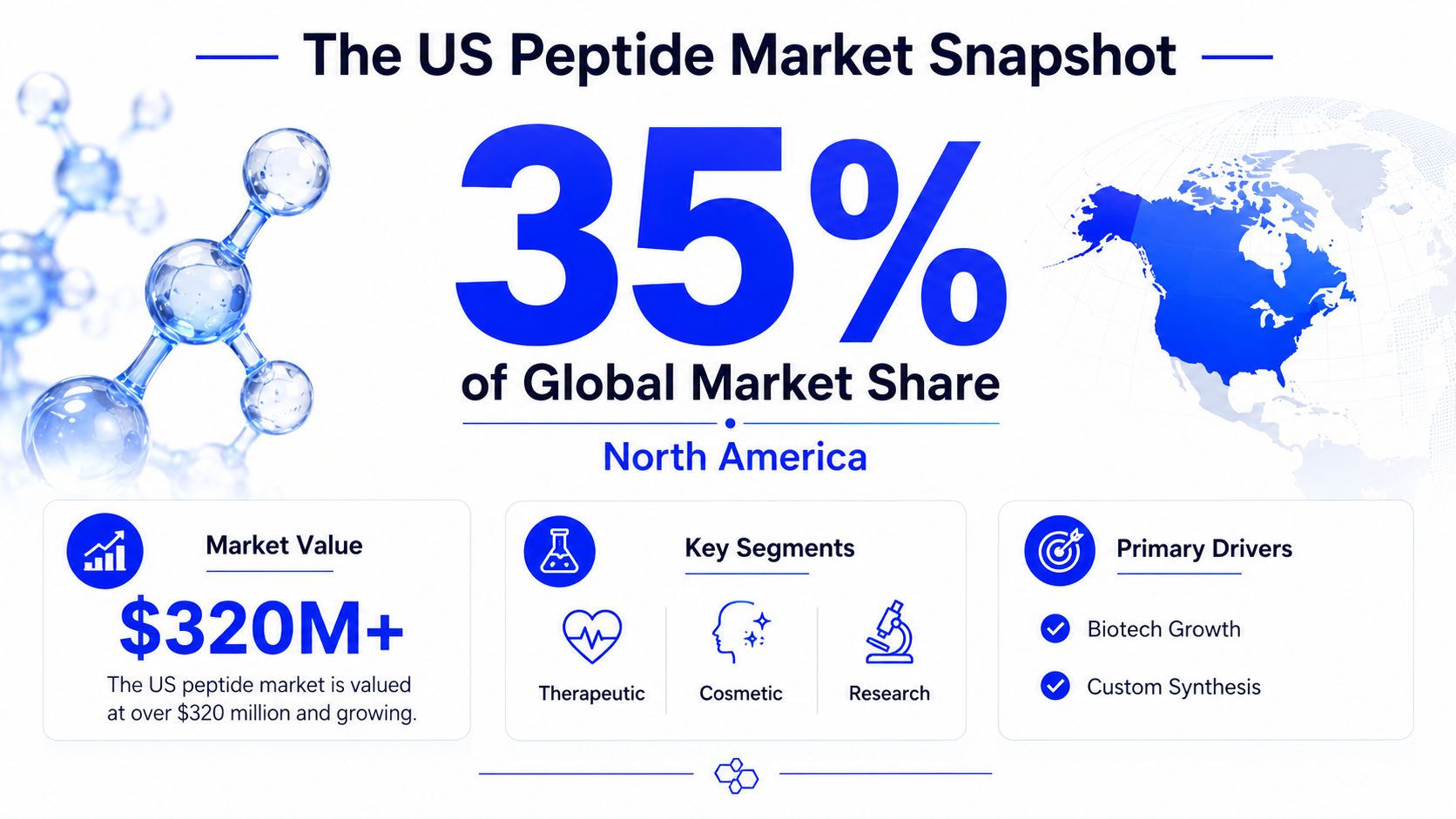
A concentrated market makes supplier comparison easier and fake claims easier to spot. Buyers who do the work benefit from that, because a larger market usually pushes vendors toward more standard documentation and clearer differences in how they handle orders. It also exposes weak operators faster, because thin records and loose claims stand out when customers expect research-grade paperwork.
For wholesale buyers, the practical conclusion is plain. A supplier serving the center of global demand has to handle batch consistency, documentation requests, and reproducibility pressure better than a casual storefront. Lot-level evidence matters more than discounts, because price does not tell you whether the material will hold up under review.
Market scale also explains why peptide wholesale pages start to look alike. Everyone talks about purity, everyone promises fast shipping, and everyone says quality. The difference sits in the process behind the listing, whether the vendor can support procurement with real documents, stable inventory, and clear labeling.
Buyer takeaway: market scale does not make sourcing easier, it makes sloppy sourcing easier to spot.
That is the frame I would use when comparing domestic suppliers. Bigger demand attracts more formal operations, but it also attracts louder marketing. Your job is to ignore the noise and look for the paper trail that would satisfy a cautious lab manager, not a casual browser.
A clean certificate of analysis only matters if the supplier can tie it to the exact lot you are buying. For teams that issue or format internal certificates, a clean certificate design and issuing platform can help standardize how records are stored and shared across vendors. The point is not presentation, it is retrieval. If the batch file is easy to find, easy to forward, and easy to match to the invoice and vial label, procurement moves faster and mistakes get caught earlier.
A good wholesale file should still include more than a COA. I want to see batch traceability, a clear research-use-only statement, and testing breadth that goes beyond a single purity line. If the seller only talks about headline purity and does not discuss verification depth, that is usually a sign the procurement process is thin.
Here is the buyer mindset that saves time:
That is the right filter because wholesale peptide quality is rarely obvious from a product tile. It shows up in the paperwork, the traceability, and how fast the supplier can answer a document request without hand-waving.
A COA is either a procurement document or a marketing prop. You can tell the difference in about a minute if you know what to look for. The useful version tells you exactly what was tested, by whom, and against which batch.
A real peptide COA should show HPLC chromatogram data, mass spectrometry identity confirmation, a purity percentage, and the batch number that ties the result to the vial you're buying. Stronger documentation also includes residual solvent information, heavy-metal screening aligned to USP or ICH Q3D guidance, and, where relevant, endotoxin and microbial limits. That broader testing picture is what separates real vendor qualification from marketing copy.
The easiest red flag is a one-page “certificate” that only repeats a purity number. If there's no lab name, no method detail, no batch reference, or no sign of independent verification, the document isn't doing enough work for a wholesale purchase. A missing batch number is especially bad, because it breaks traceability right at the point procurement needs it most.
Use this quick filter:
For teams that issue or format internal certificates, a clean certificate design and issuing platform can help standardize how records are stored and shared across vendors, but it still doesn't replace the underlying test data. The form matters less than the substance, and the substance is the batch record.
If the COA looks polished but doesn't answer those basic questions, it's not a strong wholesale document. It's a sales sheet with a lab badge on top.
Before you send a first purchase order, build a short qualification file and treat it like a gate, not a formality. That's where many first-time buyers get burned, they focus on price, then try to reconstruct vendor credibility after the order ships. The better approach is to document the decision up front, the same way a lab would defend any other critical supplier.
Vendor onboarding strategies from Doczen is a useful model here because it reinforces a simple truth, onboarding is a control process, not an administrative chore.
| Checkpoint | What to Verify | Why It Matters |
|---|---|---|
| COA depth | Batch-specific COA, test method, identity data, and lab details | Tells you whether the lot is traceable |
| Lab independence | Third-party or clearly separated testing source | Reduces the chance of self-serving results |
| U.S. manufacturing | Verifiable domestic presence and facility information | Supports continuity and faster issue resolution |
| Labeling | Research-use-only wording and no therapeutic claims | Protects you from compliance drift |
| Support process | Clear contact path for reorders, questions, and returns | Shows the supplier can handle procurement problems |
| Recordkeeping | Stored COAs, invoices, and shipment records | Makes internal review and audits easier |
Do not accept a vendor just because the product page looks mature. Ask for the exact batch record, confirm that the testing source is credible, and save the reply with your approval notes. If the supplier is vague about its U.S. operation or won't give a clean paper trail, that's a signal to move on.
Procurement rule: a higher stated purity is not a reliable proxy for quality if the documentation is weak.
That last point matters. Document quality, batch traceability, and testing breadth tell you more about supplier quality than a shiny purity number ever will. If you need to justify the vendor later, your internal log should show why the supplier passed qualification, not just that someone liked the quote.
Cheap wholesale peptides can get expensive fast when a supplier runs out of stock, changes testing standards, or drifts into compliance trouble. That's why domestic sourcing keeps winning attention in the U.S. wholesale market. Buyers are trying to reduce avoidable friction, and verified U.S. presence is one of the easiest ways to do that.
The market structure has gotten more consolidated and more scrutinized, which pushes buyers toward vendors that can demonstrate lot segregation, per-batch documentation, and stable payment and fulfillment practices. That shift is visible in how procurement teams talk about risk now, they're less interested in one-time price wins and more interested in whether the next reorder will arrive with the same documentation and the same testing standard.
Domestic suppliers usually have an advantage on document turnaround and issue resolution. If a batch record is missing or a shipment needs review, the buyer can push for a quick correction without navigating a long cross-border chain.
Overseas sourcing can still work for some buyers, but the burden shifts heavily onto procurement. You'll need more diligence on customs handling, batch separation, chain-of-custody, and the supplier's ability to answer when a lot is delayed or reclassified. That's not automatically disqualifying, but it does mean the buyer needs stronger internal controls.
The most stable wholesale programs usually have three things in common:
That's why I keep calling peptide wholesale a supply-chain problem. The best vendor isn't just the one with the product in stock, it's the one that can still support the same lot with the same paperwork when the order has to be repeated.
Wholesale peptide buying has a rhythm, and buyers who understand it waste less time. You usually start with minimum order terms, move into tiered pricing, and then work through fulfillment and storage. The companies that do this well make the process boring, which is exactly what procurement wants.
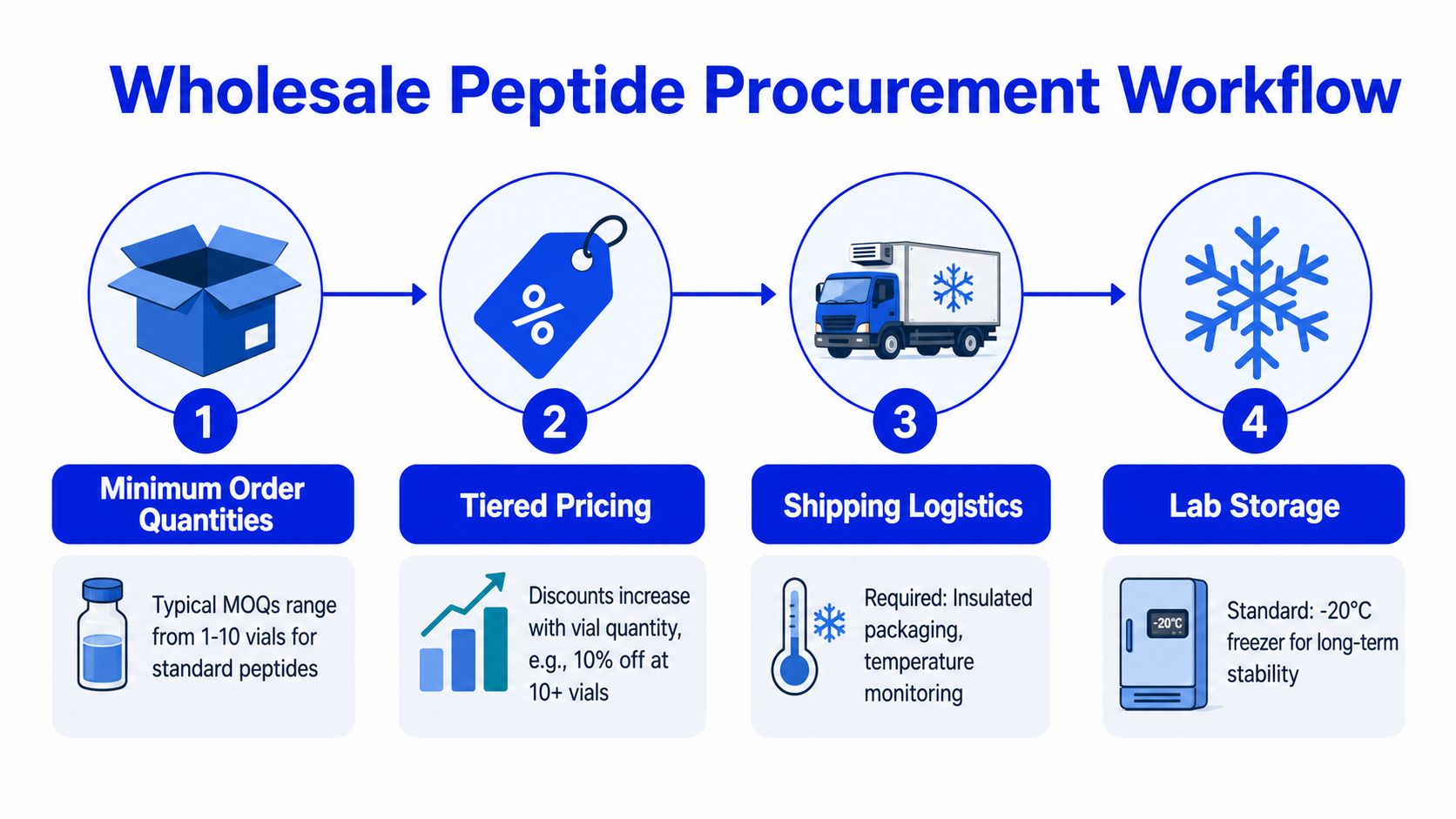
Minimum order quantities are how suppliers protect margin and plan inventory. For buyers, the question is whether the MOQ fits the reorder pattern, not whether it sounds low. Tiered pricing then rewards larger or repeated orders, but it only matters if the underlying lot quality stays consistent.
Shipping should be treated as part of quality control. Insulated packaging, protected transit, and clear delivery timing matter because a bad arrival can erase the value of a good batch. Once the product lands, storage discipline matters just as much, lyophilized peptides should be kept cool, dry, and protected from light, with long-term storage commonly handled in a -20°C freezer if the material and lab SOP support it.
Peptide Warehouse USA is one domestic option that fits this kind of workflow because it pairs research-use-only selling with batch documentation and account handling, which is the baseline wholesale buyers should expect. I'd still compare it against other qualified vendors, but the operational model is the right one to look for.
A documented help desk matters here. If the vendor can't explain shipping, storage, or reorder handling clearly, the wholesale relationship is thinner than it looks.
A lot of peptide buying mistakes come from pretending the compliance line is somewhere else. It isn't. Under U.S. federal law, sellers may need a license or FDA registration if they manufacture or repackage peptides for distribution, compound peptide drugs for human or veterinary use, import peptides for commercial sale, or market peptides with therapeutic or performance-enhancing claims. Legal overview of peptide selling requirements
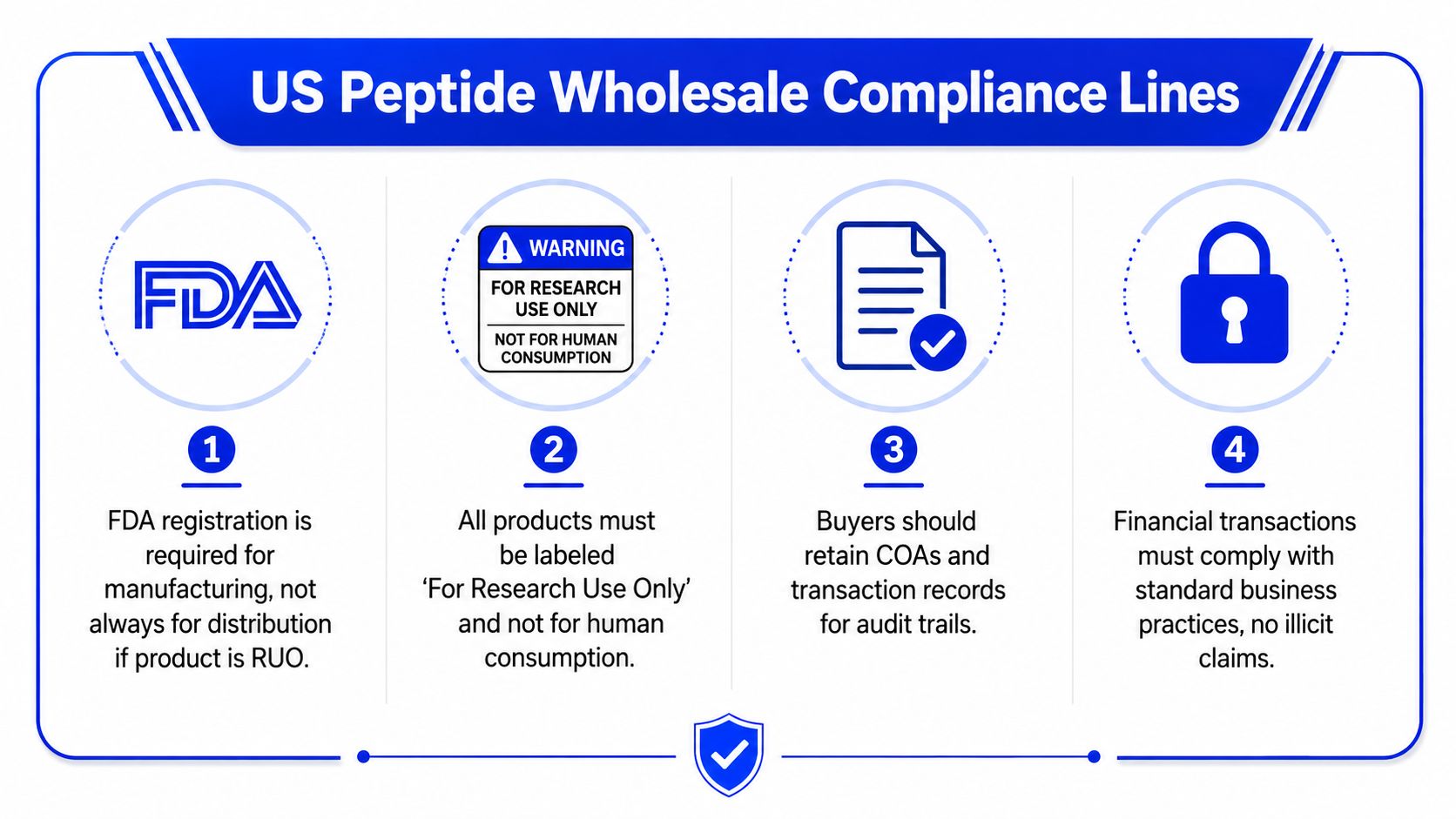
Research-use-only selling depends on the product label and the words around it. Compliant products carry “Research Use Only” and “Not for human or animal consumption” warnings, and they avoid therapeutic claims in the website copy, inserts, and promotional material. Peptide legal status guidance
That matters to buyers because the supplier's wording can spill onto your own records. If the product page reads like a performance claim, you're already in a messy place.
The current compounding framework is tighter than many buyers assume. One industry legal guide states that only about five peptides remained in the category that cannot be legally compounded for human use, naming Melanotan II, GHRP-2, GHRP-6, LL-37, and PEG-MGF. A separate guide says that if a peptide is not FDA-approved or on the eligible Category 1 list, it cannot be legally compounded and may only be sold for research purposes. Compounding and sale guide
Buyer rule: if the supplier starts sounding therapeutic, stop and re-check the labeling.
The FDA is also enforcing this space. It issued a warning letter to Wholesale Peptide on June 17, 2026, which is the kind of event that should make every buyer care more about source documentation and claim discipline. FDA warning letter
The cleanest wholesale posture is simple. Buy research-use-only materials, keep COAs and transaction records, and avoid vendors whose marketing wanders into human-use language. That protects the supplier, and it protects your file too.
You should expect the COA and batch records to be available right away or at least delivered with the shipment paperwork. If the supplier delays documentation without a clear reason, treat that as a qualification problem, not a clerical delay.
Do not approve the lot. Ask for the batch number, test method, and lab identification, then compare the reply to the original listing. If the supplier still can't produce a complete record, move on.
Ask whether they can preserve the same documentation standard on the replacement lot. The important issue isn't just availability, it's whether the next batch can be tied to the same level of verification and labeling.
Only if your regulatory posture and supplier agreement allow it, and only with the correct labeling and claim controls. Don't assume research-use-only status gives you a free hand. It doesn't.
Prioritize batch traceability, independent testing, U.S. presence, and clear research-use-only labeling. If those are in place, you're buying like a procurement manager instead of a hopeful first-time shopper.
If you want to compare documented wholesale options, look for vendors that publish per-batch COAs, keep their U.S. manufacturing easy to verify, and don't blur the line between research and human-use marketing.
Peptide Warehouse USA fits the kind of wholesale process serious buyers should demand, with U.S.-made research materials, batch documentation, and research-use-only positioning. If you're ready to source with less guesswork and more traceability, visit Peptide Warehouse USA and review the wholesale and documentation options that match your procurement standards.