No products in the cart.


A shipment of research peptides arrives at the lab, and the clock is already running. Before reconstitution, cell exposure, or preclinical planning begins, you need to answer a basic question: can this material be trusted for the experiment you designed?
That answer doesn't come from a product title or a bold purity claim alone. Pro research peptides should be supported by lot-specific documentation, appropriate analytical testing, sensible shipping controls, and handling instructions that match the compound and intended research use. This guide shows how to evaluate those details, interpret COAs, separate chemical purity from endotoxin control, and choose a supplier based on reproducibility rather than price alone.
The phrase pro research peptides has practical meaning only when a supplier connects the product to evidence. A professional standard includes traceability from the production lot to the analytical report, clear labeling, suitable packaging, and documentation that lets a lab assess whether the material fits its protocol.
A general laboratory supply may be adequate for exploratory work, but sensitive in vitro assays and preclinical studies demand more scrutiny. Small differences in sequence, degradation, residual solvents, microbial contamination, or endotoxin can change a biological readout without appearing obvious in the vial.
When a package arrives, don't begin by opening the vial and preparing a solution. Start with an intake check:
A supplier's catalog description tells you what was intended for sale. A lot-specific COA tells you what was tested. Those are different forms of information, and the second one matters more for experimental reproducibility.
Practical rule: Treat every incoming peptide as an unverified reagent until its identity, lot documentation, and condition have been reviewed.
Researchers often search for a single number that settles quality. That approach fails because purity, identity, endotoxin, microbial status, stability, and shipping condition answer different questions.
A peptide can meet a stated HPLC purity level and still require mass spectrometry confirmation. It can have a strong chemical profile and still be unsuitable for a sensitive cell-based assay if endotoxin testing is absent. It can arrive with complete paperwork and still require a documented inspection if the package was delayed or damaged.
The legal meaning of Research Use Only is also narrow. It indicates laboratory research intent, not human administration, and products intended for human treatment are regulated as drugs under federal law regardless of the label, as explained in this overview of Research Use Only peptide status. Keep research compounds within approved laboratory, analytical, or preclinical protocols, and don't treat a research designation as a substitute for regulatory approval.
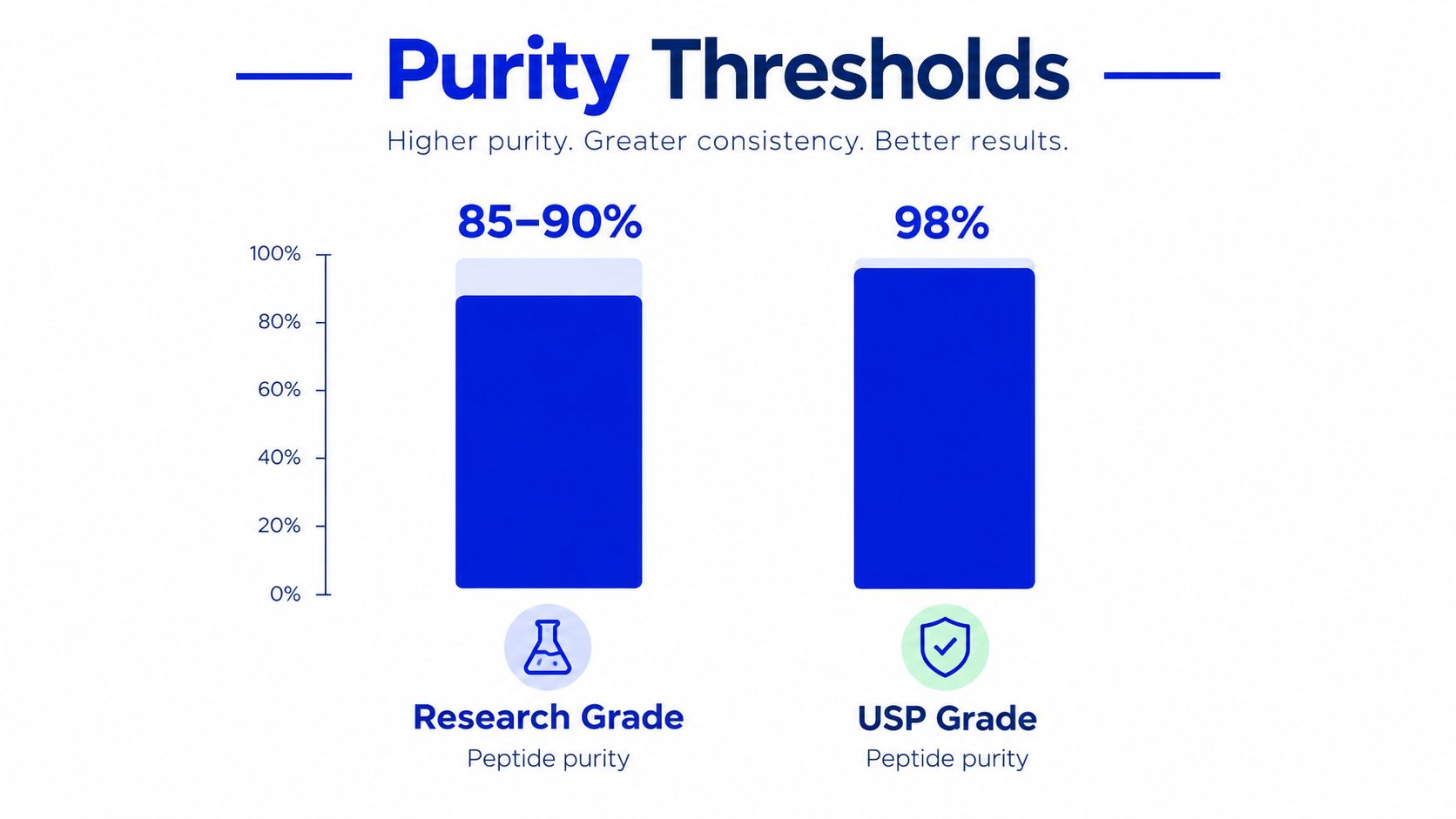
Purity values become useful only when you understand how they were generated. For research peptides, the practical baseline is often at least 98% by HPLC area, while 99% is commonly used for more sensitive in vitro work where minor impurities could distort results, according to this guide to reading a peptide COA.
That distinction isn't a universal pass or fail rule. The appropriate threshold depends on the assay, the peptide's susceptibility to degradation, the concentration used, and how strongly the biological system responds to related impurities.
Reversed-phase HPLC separates the target peptide from related compounds based on chromatographic behavior. With UV detection, the reported purity is usually an area-percent, calculated by dividing the primary chromatographic peak area by the total detected peak area.
That measurement is valuable, but it has limits. A high area-percent indicates that the main detected peak dominates the chromatogram. It doesn't independently prove that the peak has the correct sequence, correct folding, or the expected molecular structure.
For routine analytical work, HPLC may provide a useful release and comparison method. For a sensitive assay, a high-purity claim without supporting identity data leaves an important gap.
Mass spectrometry helps confirm molecular weight and can identify residue-level changes that HPLC alone may not resolve confidently. Relevant changes can include +1 Da deamidation or +16 Da oxidation, as well as truncations and other related species, according to this review of analytical workflows for peptide characterization.
The practical question is not whether every vial needs every possible technique. Ask whether the supplier's testing matches the risk of your experiment.
A Certificate of Analysis, or COA, is the central quality document because it is tied to a specific production lot. A polished webpage can describe a supplier's general process, but only a lot-linked document can help you evaluate the vial you received.
A useful COA should allow your lab to connect the product, test method, result, and production history. If the document contains only a product name and a purity claim, it may be too incomplete for work where traceability matters.
Use the same review sequence for every incoming lot. Consistency prevents an attractive result from distracting you from a missing control.
The area-percent calculation matters because it explains what the purity figure represents. As described in this COA interpretation resource, the main chromatographic peak area is divided by the total detected peak area. That doesn't mean the result captures every possible contaminant or confirms the full molecular identity.
A COA isn't automatically reliable because it exists. Ask for clarification when:
Save the COA with the lot record, purchase order, receiving inspection, and experimental batch notes. That small administrative step makes it easier to investigate an unexpected result without relying on memory.
Chemical purity and biological cleanliness are separate quality axes. HPLC can show a peptide is 99% chemically pure while missing biologically relevant bacterial endotoxin, so a high chromatographic result doesn't clear a material for every cell-based or in vivo application.
Endotoxin can enter through water, solvents, glassware, or lyophilization equipment. Even low-level contamination can bias inflammatory readouts and confound preclinical results, as outlined in this research-peptide endotoxin and sterility guide.
Dedicated assays are used because HPLC isn't designed to answer the endotoxin question. Common approaches include:
USP <85> provides a compendial framework for endotoxin detection. The important procurement point is that a supplier should identify the method and connect the result to the production lot, not merely state that the product is “clean.”
A generic supplier statement may describe an intended manufacturing process. It doesn't tell you whether a particular lyophilized batch remained within specification after production, handling, and packaging.
For cell-based or preclinical research, request the final-product endotoxin report for the lot under consideration. Also ask whether microbial testing is available and whether the sample tested was the final lyophilized material or an intermediate.
Don't assume that reconstitution eliminates the problem. Your solvent, water, container, and handling process can introduce new variables, so document them alongside the peptide lot. If an assay produces an unexpected inflammatory signal, the endotoxin record becomes part of the first troubleshooting review rather than an afterthought.
Purity tells you what dominates the chemical profile. Endotoxin testing helps determine whether the material could introduce a separate biological confounder.
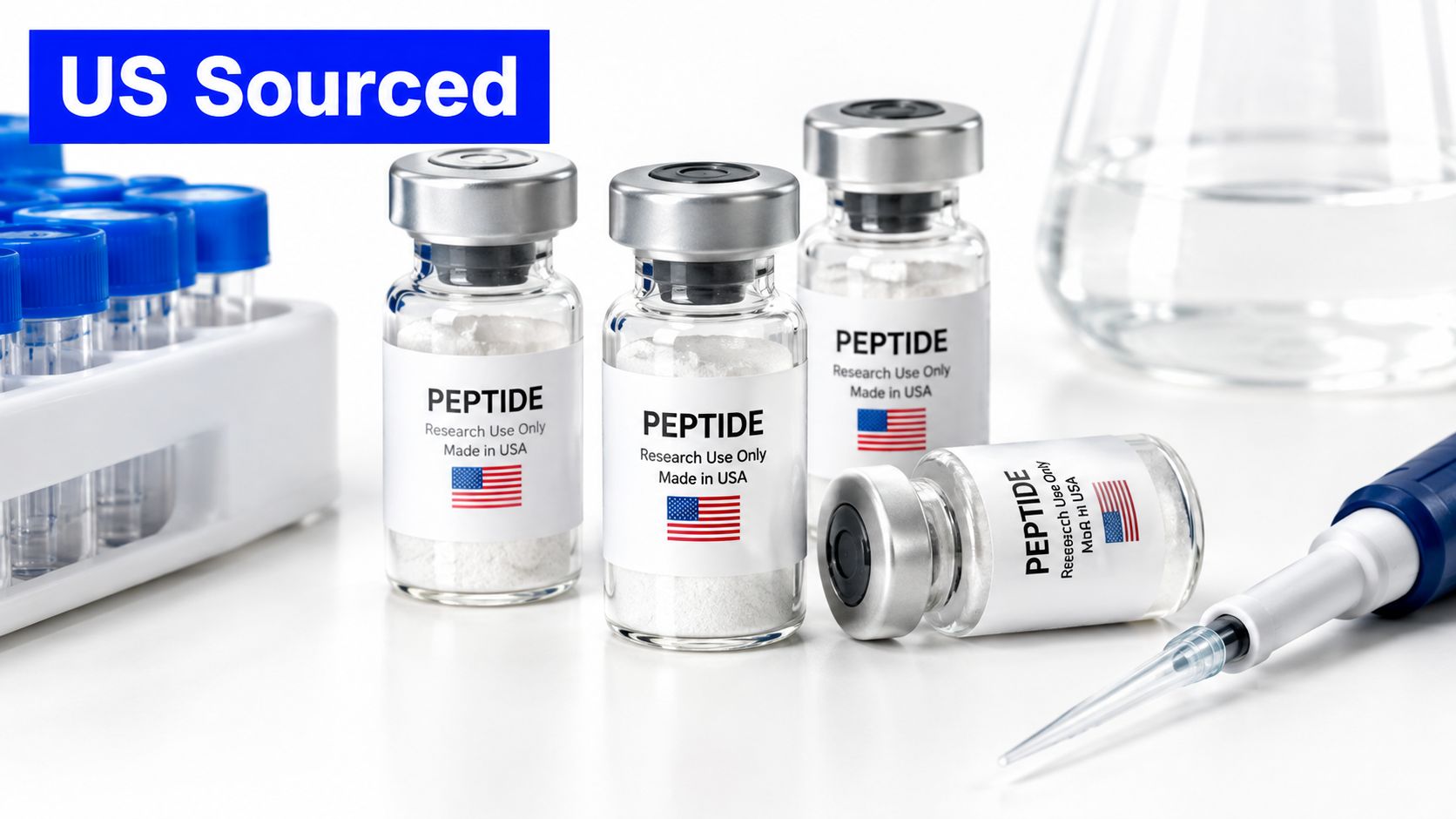
Supplier selection is a comparison of evidence, not a contest between product pages. A domestic supplier may offer clearer communication, simpler shipping logistics, and more direct access to batch records, but the phrase “Made in USA” doesn't replace analytical verification.
The stronger question is whether the vendor can show how production, testing, documentation, and support work together. A lower price may lose its value if a missing report delays an experiment or forces you to repeat a study.
| Procurement question | Stronger signal | Weaker signal |
|---|---|---|
| Can the supplier identify the tested lot? | Lot-matched COA and supporting reports | Generic product certificate |
| Is identity supported? | HPLC paired with MS where appropriate | Purity percentage alone |
| Is biological contamination addressed? | Batch-specific endotoxin and microbial information | “Sterile” or “clean” without method |
| Can the lab resolve an issue? | Responsive technical support and clear records | Unclear contact or vague replies |
| Can the shipment be tracked? | Defined shipping and order-tracking process | No practical delivery information |
Domestic sourcing can also reduce communication friction when a lab needs clarification about a COA, replacement shipment, or storage instruction. Overseas sourcing isn't automatically unsuitable, but an opaque supply chain makes it harder to verify who manufactured the material, where testing occurred, and which lot the report represents.
For a broader purchasing comparison, researchers can review this resource to compare peptide brands, then apply their own criteria for documentation, testing, shipping, and research-use compliance.
The FDA's peptide guidance materials distinguish between peptide drug products submitted in an NDA and generic peptide products submitted as ANDAs. The updated draft product-specific guidances address five technical areas, including recombinant, synthetic, or semi-synthetic submission pathways, innate immune response testing, impurity thresholds, higher-order structure assessment, and biological activity assessment, as described in the FDA's revised peptide product-specific guidance announcement.
Those materials concern regulated drug development, not a blanket approval of research suppliers. They do show why serious peptide evaluation involves more than a single purity number. Ask suppliers questions that reflect the same mindset: identity, impurities, structure, biological activity, and lot traceability.
This video can provide additional context for the visual and documentation questions that arise during supplier evaluation.
A well-documented peptide can still become an unreliable reagent if the receiving and storage process is casual. Shipping time, temperature exposure, moisture, repeated handling, solvent choice, and freeze-thaw events all belong in the procurement decision because they affect whether the material is usable when it reaches the bench.
Public FAQs often answer storage questions in isolation. A more useful approach treats the answers as a decision matrix that connects supplier behavior to your own workflow.
For lyophilized peptides, available handling guidance states that reconstitution requires bacteriostatic water or another suitable solvent. The same guidance suggests 36 to 46°F refrigeration and -30 to -20°C long-term freezing, while stating that U.S. delivery is generally 3 to 5 business days and that all sales are final, as reported in this peptide handling and shipping FAQ.
Use that information as a starting point, not as a universal stability guarantee. Peptide classes differ, and the supplier should provide compound-specific instructions where available.
At receipt, record:
A fast shipping promise matters only if the vendor communicates delays and packages the material appropriately. A return policy matters too, especially when all sales are final and a damaged or mismatched shipment could become the buyer's loss.
Before ordering, ask:
The question “Will this still be usable when it arrives?” can't be answered from delivery speed alone. You need the product condition, storage instructions, shipping record, and documentation together.
Reliable peptide procurement is a verification process. The supplier's marketing language may help you find a candidate, but your lab should make the final decision from evidence tied to the material, lot, method, and intended experiment.
Use this checklist before placing an order:
A procurement checklist can also improve consistency beyond peptide orders. The Procright procurement checklist offers a useful framework for organizing supplier review, documentation, and approval steps.
The best purchasing decision isn't necessarily the cheapest vial or the highest headline purity. It's the option that gives your lab enough evidence to understand what it received, enough control to handle it properly, and enough traceability to investigate an unexpected result.
Peptide Warehouse USA offers high-purity research peptides and related compounds for laboratory, analytical, and preclinical use, with lot documentation that includes COAs, microbial reports, and endotoxin reports. Visit Peptide Warehouse USA to explore research-use options and review the documentation and shipping information before your next order.