No products in the cart.

The lyophilized research peptide has arrived intact, but the certificate names a different lot than the vial. Your team saved time placing the order, and now nobody can release it for analytical work. A proper procurement process prevents that dead end by connecting the research requirement, supplier decision, purchase order, and evidence for the material delivered.
A researcher orders a peptide for an analytical comparison. The carton is intact, the vial is sealed, and the powder looks dry. Then the receiving technician checks the certificate of analysis and finds a batch identifier that does not match the vial label.
That mismatch does not establish that the peptide is defective. It does mean the lab cannot connect the reported results to the delivered material. Keep the sample out of the study until the supplier provides documentation that resolves the discrepancy.
The purchasing process failed to make matching lot documentation a condition of acceptance. Without that requirement, the buyer may treat dispatch as completion while the receiving team still lacks the evidence it needs.
A usable workflow links the research need, supplier decision, purchase order, and lot file. Check that the paperwork identifies the same lot as the vial, and recheck it if the supplier's site, ownership, or documents change. These controls apply to laboratory, analytical, and preclinical research. Research peptides are not for human consumption, and purchasing documents do not establish suitability for personal use.
Watch for these failures before approving another purchase:
Working definition: A proper procurement process turns a documented research requirement into an authorized purchase, verified delivery, controlled storage, and a retrievable acceptance record.
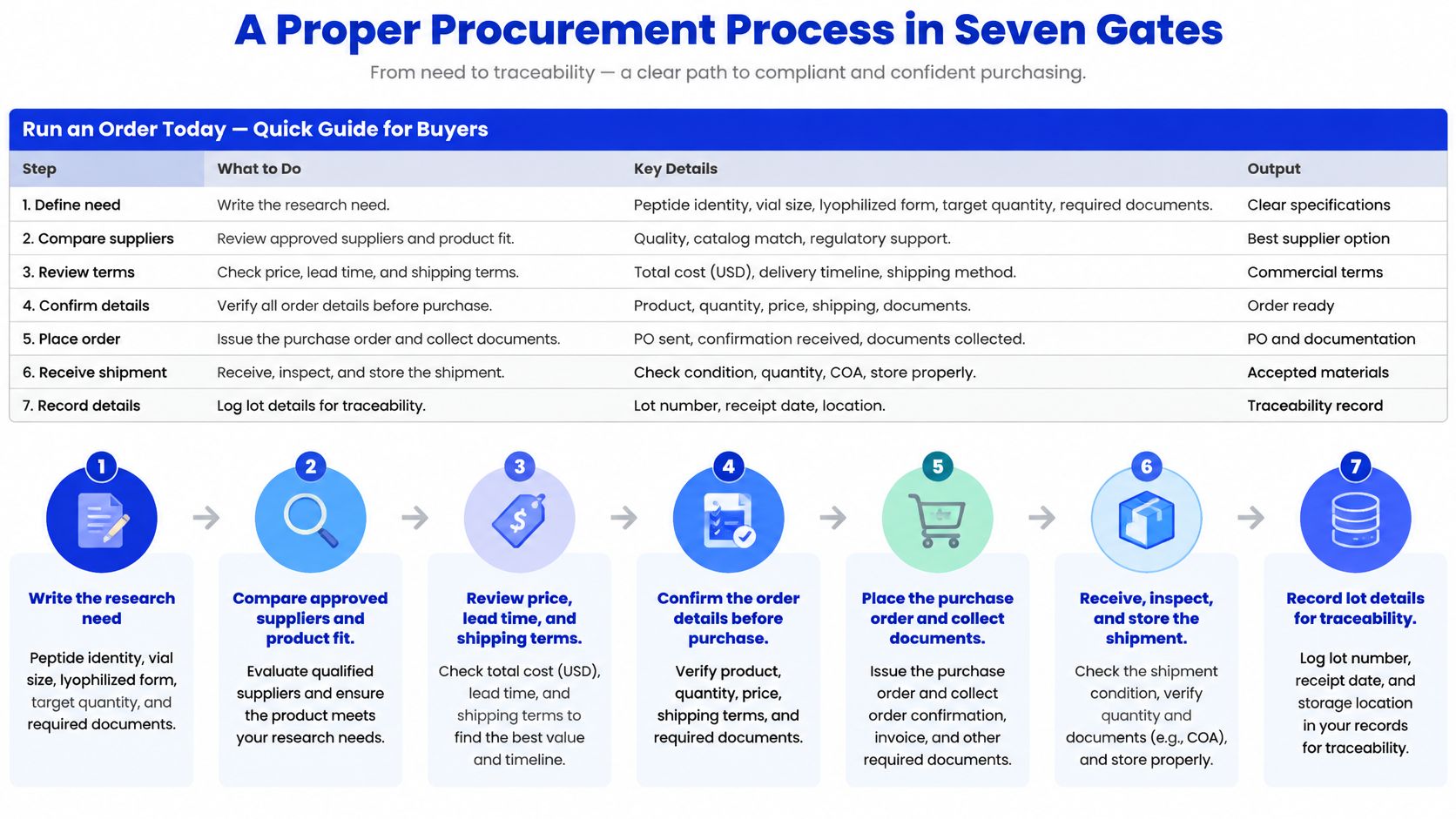
Keep the gate table near the receiving bench. Buyers and receivers can use it to check what must be in place before an order proceeds.
An order arrives with the correct peptide name but no clear match between the vial, its lot documents, and the purchase order. The receiving team cannot establish what was supplied, so the material stays on hold. A gate-by-gate process catches that mismatch before approval and keeps the evidence tied to the lot.
| Gate | Decision locked | Evidence in the file |
|---|---|---|
| 1. Define the need | Research use, peptide, size, and form | Written specification with identity, quantity, lyophilized form, and purity target |
| 2. Prequalify suppliers | Suppliers allowed to quote | Legal name, research-use terms, and document list |
| 3. Request comparable quotes | Offers against the same specification | Price, lead time, shipping terms, and promised reports |
| 4. Score quality apart from price | Award rationale | Evaluation matrix for identity, purity, COA, endotoxin, microbial testing, and delivery |
| 5. Approve the purchase | Authorized order | Conflict note, approver, budget approval, and purchase order number |
| 6. Receive against the lot | Accept or quarantine | Label, packing list, lot COA, and endotoxin and microbial reports |
| 7. Store and review | Retained file and reorder decision | Storage log, deviation record if needed, and supplier performance note |
This gate structure follows the OECD's procurement-integrity guidance, which addresses risks in specification, bidding, evaluation, and post-award delivery. A sound award decision does not establish that the delivered goods match the order.
Set pass-or-fail requirements for documentation the study depends on. If a microbial report is mandatory, a missing report should disqualify the offer rather than count as a small scoring penalty that a low price can offset. Compare cost only after the essential requirements are met.
The purchase order or accompanying agreement should state acceptance criteria, shipping conditions, required reports, change-notification expectations, and how discrepancies will be resolved. For critical supply arrangements, specify document retention, appropriate audit rights, and remedies for nonconforming delivery.
Speed and competition involve a trade-off. A repeat purchase from an approved supplier can use an established specification and evaluation record; a new supplier calls for closer review. If competition is not feasible, record the technical reason rather than creating a comparison that did not occur.
Keep the requirement, approved budget, quotations, scoring, approval, purchase order, receipt, and any deviation in a shared procurement file. Email can support the record, but the acceptance decision should remain accessible beyond the buyer's inbox.
For recurring supply, assess the full expected commitment, including planned options or renewals, before choosing the approval route. Approval levels should reflect the anticipated total value, not just the first order. Federal acquisition rules do not automatically govern a private lab, but assessing the full commitment helps prevent a series of small orders from obscuring the actual obligation.
Assign a named owner to each gate. Do not release the order until the required evidence is in the file.
An approved supplier is a starting point, not an automatic release decision. Open the supplier profile and the proposed lot documents together, then compare the identifiers field by field. Don't infer a connection because the files arrived in the same email.
Check the legal business name, research-use-only statement, and manufacturing description. The description should let a reviewer understand how the batch connects to its manufacturing and testing records, rather than relying on an unexplained sourcing claim.
Ask whether material is batch produced and batch tested, and whether a third-party laboratory reports identity and purity rather than only the seller. If the seller and laboratory use different sample identifiers, require a documented cross-reference.
Required fields for each lot document
| Document | Must name | Escalate if |
|---|---|---|
| Supplier profile | Legal business name, research-use-only statement, batch-level manufacturing description | Name or research-use terms missing |
| Certificate of analysis | Peptide name, exact lot, purity result and method, appearance, report date, testing lab | Lot differs or is missing, method unnamed, or no named lab |
| Endotoxin report | Same lot, stated specification, result, lab identity | Lot absent or result outside the stated limit |
| Microbial report | Same lot, test method, pass result or counts | Different batch or no method |
Read the purity result with its method, not as an isolated headline. A purity result doesn't replace evidence of identity, and it doesn't answer the microbial or endotoxin questions. Each required report addresses a separate acceptance criterion.
For endotoxin testing, compare the result, units, and stated limit. For microbial testing, find the method and the pass result or counts, then check them against the written specification. Don't create a more convenient acceptance limit after seeing the result.
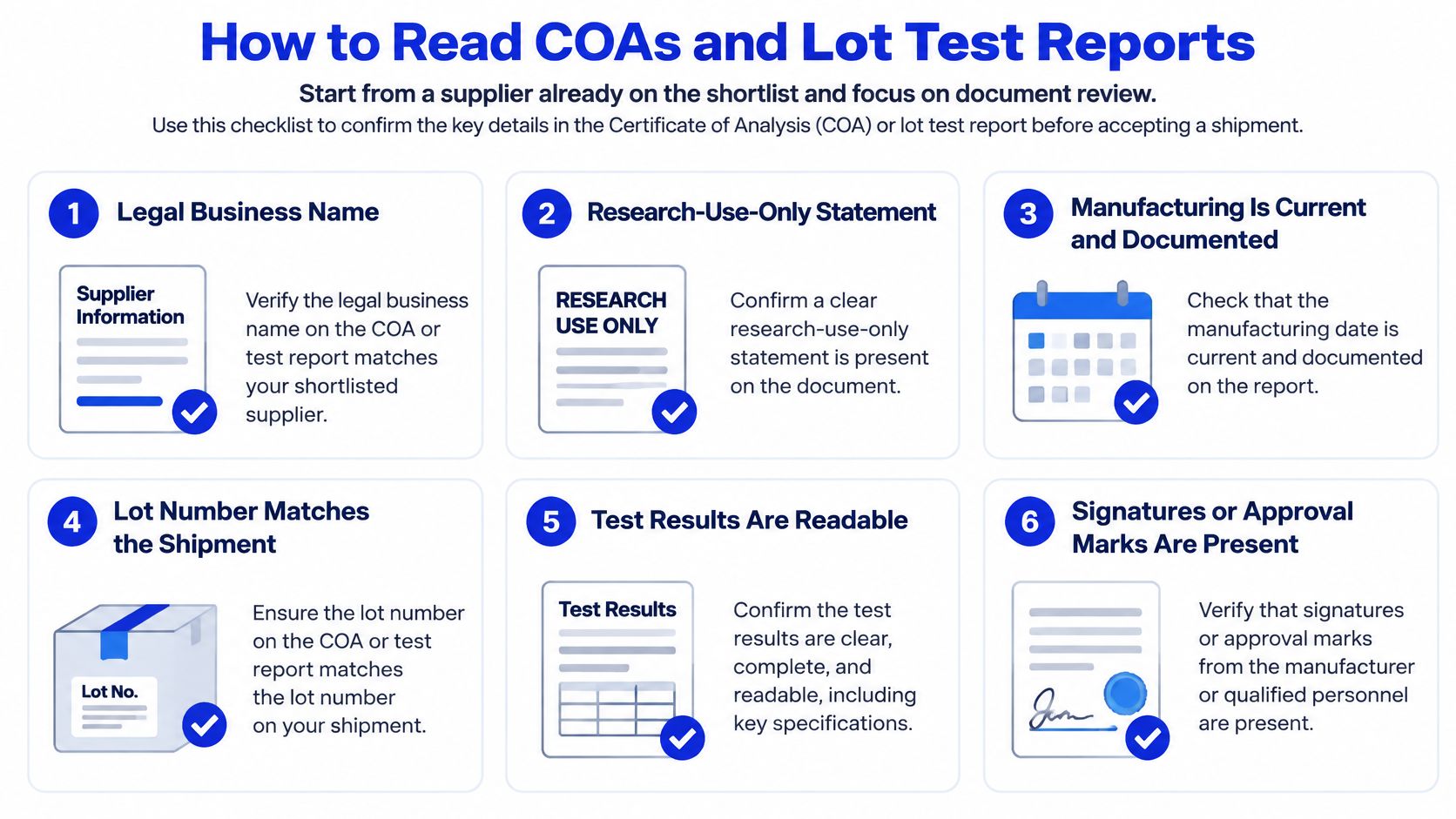
Check report dates, readable results, and signatures or approval marks where the laboratory's reporting system uses them. If authenticity is uncertain, verify the report through independently obtained laboratory contact details. A badge saying tested, without an exact lot identifier, is marketing rather than release evidence.
At Peptide Warehouse USA, our products are batch produced and batch tested. We work with established manufacturing partners and third-party laboratories to meet defined purity and identity specifications, and provide high-purity research peptides backed by third-party testing, including COAs, endotoxin, and microbial reports. For procurement, that document set still needs to correspond to the particular material ordered and received.
Supplier review must also continue after onboarding. The Research and Markets vendor-due-diligence overview describes a broader review scope that includes ownership, compliance, resilience, cybersecurity, and supply-chain relationships.
Set a review cycle for low-risk catalog purchases. For critical or scientifically sensitive materials, trigger a fresh review before the next order when ownership, manufacturing site, formulation, quality systems, or document format changes.
Keep an alternate source qualified against the same research requirement. Otherwise, a failed lot can pressure the buyer into accepting a file that would normally be rejected.
Receiving is a controlled handoff, not permission to start work. Before the carton arrives, identify who will inspect it, where held material will go, and who has authority to release it.
The routine below assumes supplier approval is complete. It focuses on handling and recordkeeping, not interpreting analytical results.
Place a matchable purchase order. Include peptide name, vial size, quantity, and the documents required for the delivered lot. Assign the order to a research project or internal request so the receiver knows who owns any exception.
Record the shipping choice. At Peptide Warehouse USA, we use trusted carriers and offer multiple delivery options at checkout. Retain the selected method and tracking record so staff can investigate a late delivery or suspected temperature excursion.
Plan the unpacking location. Our orders are packaged discreetly to protect integrity during transit. Discreet packaging isn't a substitute for controlled handling, and staff shouldn't open peptide vials in the mail room.
Receive into quarantine. Put the shipment in a labeled holding area rather than on the working bench. Maintain any specified storage conditions while it's held; quarantine status doesn't suspend the material's handling requirements.
Capture the physical evidence. Photograph the vial label and record lot, size, and receipt date. Check that the cap or crimp is intact and that the lyophilized powder appears dry, without treating appearance as proof of identity.
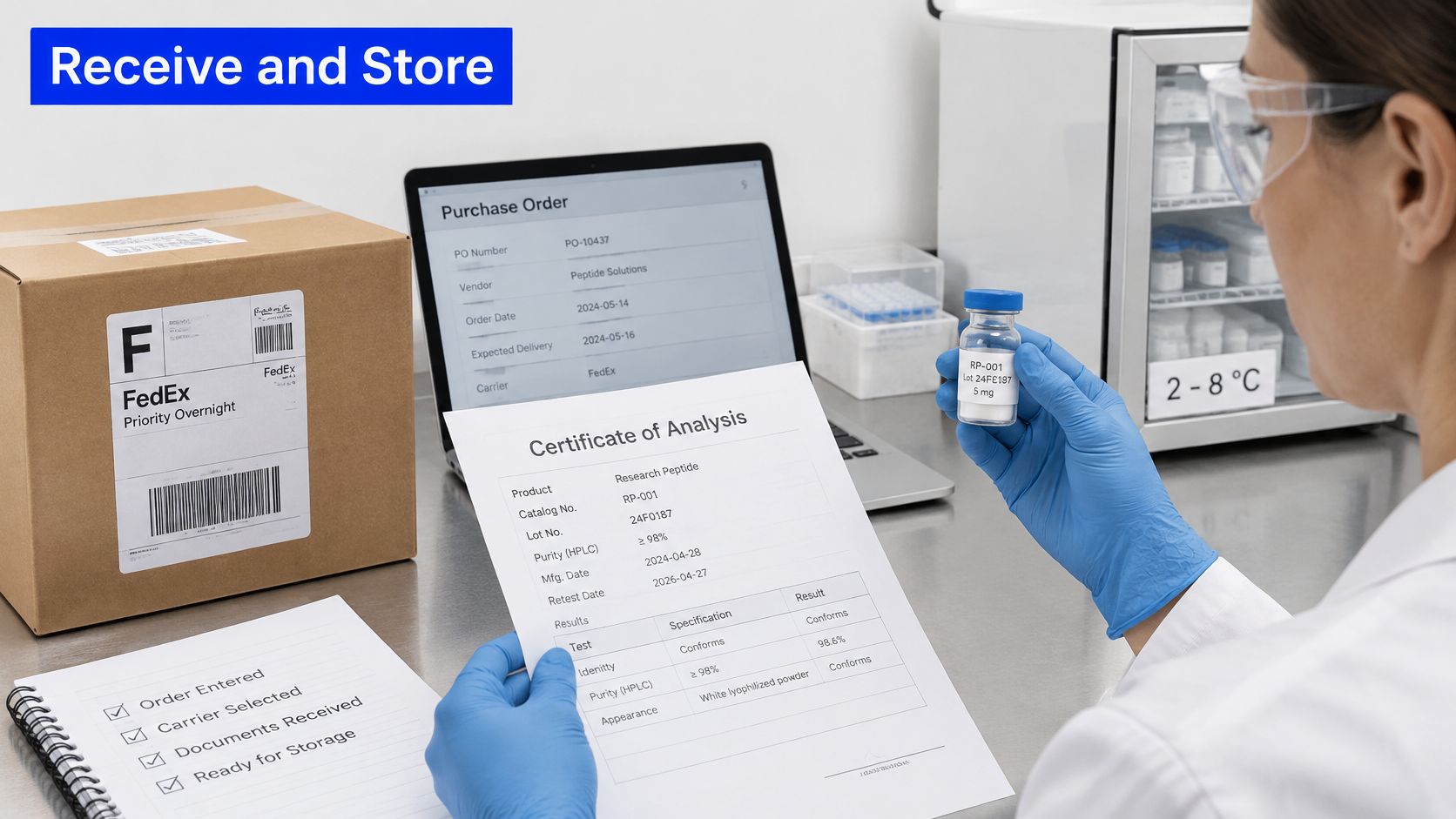
Reconcile the shipment. Match the purchase order, packing list, and invoice for peptide name, size, and count. Record shortages, substitutions, and unexplained extra vials rather than adjusting the receiving entry.
Attach the delivered documents. We provide COAs with products when available. Save the supplied COA with that lot's record; if a required document hasn't arrived, leave the acceptance decision open rather than assuming availability means receipt.
Transfer only released material. Store the matched lot cool, dry, and protected from light, following its label for specific conditions. If the label requires controlled temperature, use the appropriate monitored location rather than a convenient cupboard.
Separate accepted and held vials. Use distinct locations and visible status labels. Mark the container for laboratory research only, and preserve access to the original vial label.
Write the receiving note. Record the disposition, storage location, receiver, and unresolved issue, if any. A short factual note is more useful at reorder than a vague statement that everything looked fine.
Don't copy storage conditions from another peptide, even if the names or presentations look similar. If the label is unclear or the shipping condition raises concern, keep the lot held while the responsible reviewer obtains clarification.
Seller questions should stay focused on availability, documentation, and order status, not instructions for personal peptide use. A cleared lot has a simple record: one vial, one lot number, one document set, one storage location.
A clean-looking COA for a neighboring lot is still the wrong evidence. The peptide name may match, but that doesn't connect the reported test result to the vial in your hand. Keep the lot quarantined and send a written discrepancy notice.
Use the table to distinguish a material hold from a payment stop. A documentation defect may hold the vial; an unverified bank change stops payment even when the material records are otherwise acceptable.
When to quarantine a peptide shipment
| Record | Must match | Quarantine or stop if |
|---|---|---|
| COA | This lot, peptide name, purity method, and date | Lot differs, method unnamed, or lab unnamed |
| Endotoxin report | This lot, stated limit, result, and lab | Lot missing or result outside the stated spec |
| Microbial report | This lot, method, and pass or counts | Different batch or no method |
| Label and packing list | Purchase order name, size, and quantity | Size mismatch or unnamed extra vials |
| Invoice and bank details | Purchase order total and known payment instructions | New bank details sent only by email |
For a lot mismatch, identify both conflicting identifiers in the supplier query. Request a verifiable report for the delivered batch, not an assurance that the batches are equivalent.
For an unnamed purity method, request the method and the laboratory-issued record supporting the result. A percentage without a method doesn't meet a specification that requires one.
A microbial report without a method remains incomplete even if it says pass. A vial-size mismatch is a fulfillment exception that needs an authorized resolution, not a handwritten correction to make the order appear complete.
Don't average an out-of-specification result into an accepted lot or substitute a favorable neighboring-batch report. Preserve the original documents and record who authorized the eventual disposition.
More attachments don't prove the vial. The report has to name this lot and come from a named laboratory.
In ACCA's fraud report, only 57% of respondents said their organizations proactively looked for fraud, and ACCA identifies procurement and third-party fraud as increasingly widespread across value chains. The practical response is independent verification, not another form.
The requester shouldn't be the only person who approves the order and receives the shipment. In a small lab, assign a second reviewer to the acceptance and payment decisions, and retain conflict-of-interest declarations where relevant.
Confirm new bank details through a known phone number obtained independently of the change email. Don't call the number included in the suspicious message and treat that as verification.
Use the receiving record to reconcile the purchase order, invoice, shipping record, and goods before authorizing payment. Where prepayment is required, verify supplier identity and payment instructions before funds leave, then reconcile delivery afterward.
If the supplier cannot fix the file, don't release the lot or reorder that item until a replacement document set matches. Record the unresolved issue so another buyer doesn't repeat the purchase unknowingly.
Open the last peptide order before increasing quantity or setting up recurring supply. A successful checkout and an uneventful delivery aren't enough to justify a larger commitment. The acceptance record should support the next decision.
Tick these items against the actual order:
If something is missing, complete the file or change the supplier before placing a larger order. A volume discount doesn't resolve an evidence gap, and a prior purchase doesn't excuse an undocumented change.
Reorder only when the same lot identity can be traced from quote to vial to stored container.
When a quotation precedes lot allocation, retain the supplier's later allocation confirmation as the connection between the quoted item and shipped batch. Don't imply that the quote named a lot when it didn't.
Peptide Warehouse USA is a US research chemical supplier for buyers who want to evaluate documented research lots. We are not a compounding pharmacy or compounding facility under Section 503A, nor an outsourcing facility under Section 503B, of the Federal Food, Drug, and Cosmetic Act.
Materials are for research, laboratory, or analytical use only, not for human consumption. We don't provide medical or clinical advice; our support assists with non-medical, non-clinical questions about availability, documentation, and order status.
Use account tools, order tracking, and shipping information to keep purchasing records organized. Those conveniences support administration, but they don't replace the laboratory's acceptance decision.
Statements about research peptides have not been evaluated by the FDA and aren't claims to diagnose, treat, cure, or prevent any disease. The useful next step is a documented lot, not a promise about personal results.
Peptide Warehouse USA offers research peptides supported by third-party testing documentation, including COAs, endotoxin, and microbial reports. Visit Peptide Warehouse USA to explore options, review account and shipping tools, and contact support about the documentation needed for your next laboratory order.