
No products in the cart.


Research-grade PT-141 typically costs $25 to $75 per 10 mg vial, or roughly $2.50 to $7.50 per mg, while branded Vyleesi runs $230 to $300 per dose at retail. The access channel is the single biggest cost variable.
The most popular advice about PT-141 cost is also the least useful: compare the sticker price of one vial and choose the cheapest listing. That approach ignores active content, testing, shipping, dosing frequency, wastage, dispensing format, and the service bundled into clinical access.
For procurement teams, the molecule is only one part of the invoice. A serious comparison separates branded prescription access, compounded or clinic-supplied programs, and research-grade supply, then calculates the effective cost for the actual project. The framework below is designed to help laboratories avoid false bargains and make defensible sourcing decisions.
The cheapest PT-141 listing is rarely the cheapest purchase. Buyers compare different products, access channels, and billing units, then mistake the headline figure for a comparable price. Bremelanotide, the active drug behind PT-141, received FDA approval as Vyleesi on June 21, 2019, for acquired, generalized hypoactive sexual desire disorder in premenopausal women. That approval established a branded reference point without setting a price for research-grade material.
The 2026 PT-141 pricing summary places the branded autoinjector at about $930 per 4-dose box. Uninsured manufacturer programs may reduce the price to $99 per box, while copay cards may bring some commercially insured patients to $0. Those figures describe access to a finished prescription product, not the molecule alone.
A defensible comparison starts with the unit. Normalize every research quote to $/mg, then account for dosing frequency, unused material, shipping, and the number of doses the project requires. A vial with a lower sticker price can cost more per usable milligram if its strength, fill volume, or handling requirements create waste.
The practical market divides into three tiers:
These prices cover different cost structures. The branded tier includes the device, prescription dispensing, and possible insurance or manufacturer support. Clinical programs add consultation, fulfillment, and service overhead. Research suppliers price the material, testing, packaging, and distribution.
Procurement rule: Compare equivalent units first. A branded dose, monthly clinic bundle, and research vial are separate purchasing categories.
Insurance and assistance can materially change the effective branded price. The FDA-approved product is described at roughly $930 to $1,200 for a 4-dose carton. Manufacturer programs may reduce it to $99 per box for uninsured patients or $0 for many commercially insured patients, excluding government-funded plans, according to HealthRx's patient-assistance overview.
Channel markup appears in other complex purchases too. Teams reviewing pricing for AI voice agents already check usage limits, support, implementation, and platform fees instead of relying on one headline number. PT-141 procurement requires the same discipline. Ask which costs are included, convert the quote to $/mg, and then test it against the project's dosing frequency.
A PT-141 listing becomes useful only after you identify what the vendor has priced into it. Purity, documentation, vial strength, manufacturing controls, and vendor support can all move the final quote. A low sticker price may reflect efficient production, or it may reflect missing verification that your lab would otherwise need to purchase or manage separately.
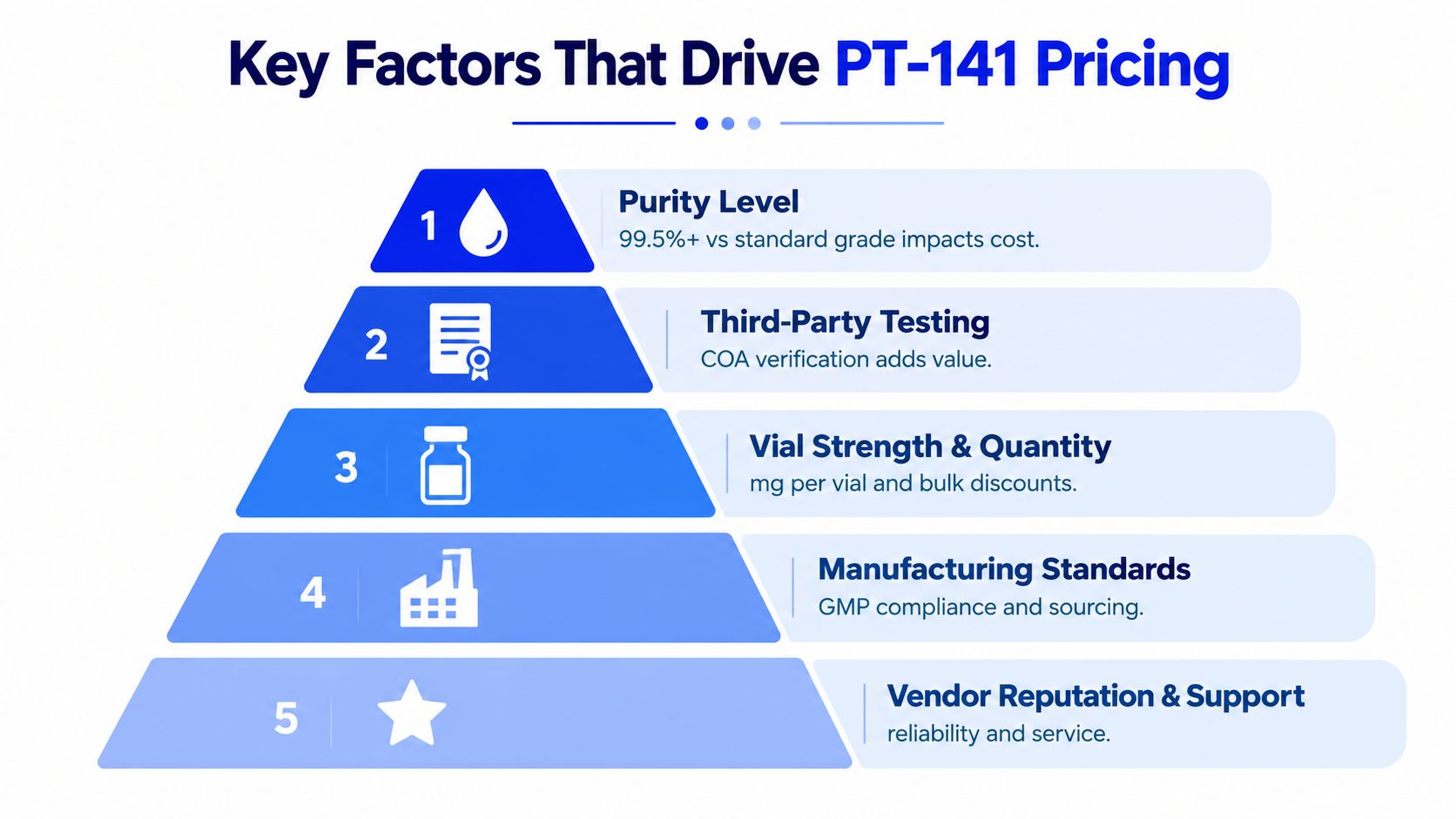
Purity claims matter only when the listing supports them. Some suppliers distinguish standard research material from products described at 99.5% or higher purity, but the number alone doesn't establish whether the stated result belongs to the lot you're buying. Request a lot-specific Certificate of Analysis, not merely a generic document attached to every product page.
Third-party testing can add cost, but it also reduces uncertainty. A useful documentation package should make it possible to connect the product, lot, test result, and stated active content. If the vendor can't provide that chain, treat the quote as incomplete rather than assuming the missing evidence is included.
Price-per-milligram changes sharply with format. Peptul's bremelanotide pricing data shows research-market examples ranging from about $1.50 to $5.50 per mg, with some high-volume listings near $0.50 per mg. In vial terms, lower-end market offers can place a 10 mg vial around $15 to $55, while larger formats reduce marginal cost per milligram.
That doesn't mean the largest vial is automatically the right purchase. Labs must consider study duration, stability, storage, expected consumption, and the risk of unused material. Bulk pricing is valuable when the project has a defined demand forecast. It can be wasteful when the protocol is exploratory or likely to change.
A lyophilized vial, a prepared liquid, a nasal spray, and an autoinjector aren't equivalent products. They require different packaging, handling, administration systems, and quality checks. The more complete the delivery format, the more the buyer may be paying for convenience and device integration rather than peptide mass.
Vendor reputation and support also belong in the cost model. Responsive order handling, clear lot records, and accessible documentation don't replace laboratory verification, but they can reduce procurement friction and prevent delays caused by incomplete records.
The lowest vial price rarely represents the lowest usable cost. Choose the tier according to the material's purpose, dosing format, documentation, and service included in the quote. Laboratory or analytical work calls for documented research material. An FDA-approved prescription involves a finished medication, insurance eligibility, and clinical access. A clinic-style program may also include consultation, dispensing, and ongoing support.
| Tier | Typical Cost Range | Per-Dose Estimate | Documentation | Insurance Eligible |
|---|---|---|---|---|
| Branded Vyleesi | About $930 to $1,200 per 4-dose carton | About $230 to $300 at retail | Prescription product and manufacturer materials | May be eligible when coverage applies; manufacturer assistance has specific restrictions |
| Compounded or telehealth-supplied | About $80 to $200 per month in independent summaries; higher-touch bundles can reach $300 to $800 | Depends on the program and dosing schedule | Varies by provider and dispensing pathway | Depends on the product, plan, and access route |
| Research-grade vial | About $25 to $75 for a 10 mg vial | Must be calculated from the research protocol | Should include lot-specific research documentation | Not a substitute for an insured prescription |
The table shows why direct price comparisons fail. Branded products include a standardized delivery device and prescription pathway. Compounded or telehealth-supplied products may combine material with clinical administration and shipping. Research products usually separate the peptide from those services, so their apparent price advantage reflects a different package.
Normalize each option by usable $/mg, then account for dosing frequency and handling. A monthly program can look inexpensive until its recurring service fees are multiplied across the study period. A research vial can look cheap until the protocol requires frequent dosing, additional verification, or replacement material. Channel markup and molecule cost belong in separate lines of the procurement model.
Branded Vyleesi provides a defined prescription product and standardized delivery device. Eligible patients may reduce out-of-pocket cost through manufacturer or insurance programs, but cash retail pricing remains materially higher than the peptide-only cost of research material.
Compounded or telehealth access can include clinician interaction, dispensing, and shipping. That package may suit an individual who needs a managed access route, but it is not a direct substitute for a laboratory procurement order. Review consultation charges, refill terms, shipping, and dosing instructions separately.
Research-grade PT-141 is generally the most economical route for laboratory budgets. It still requires review of the COA, active content, lot traceability, packaging, intended-use restrictions, and storage requirements. A low quote without lot-specific records is incomplete evidence, regardless of the listed vial size.
A procurement team should select the tier that delivers a usable, documented input for the intended work. The cheapest sticker price can become expensive after unplanned testing, expedited shipping, failed runs, or unused material. Compare the molecule, the channel, and the service package separately before approving the order.
A low vial price can conceal an expensive procurement decision. Evaluate the documented active content, dosing frequency, and channel fees before comparing supplier totals.
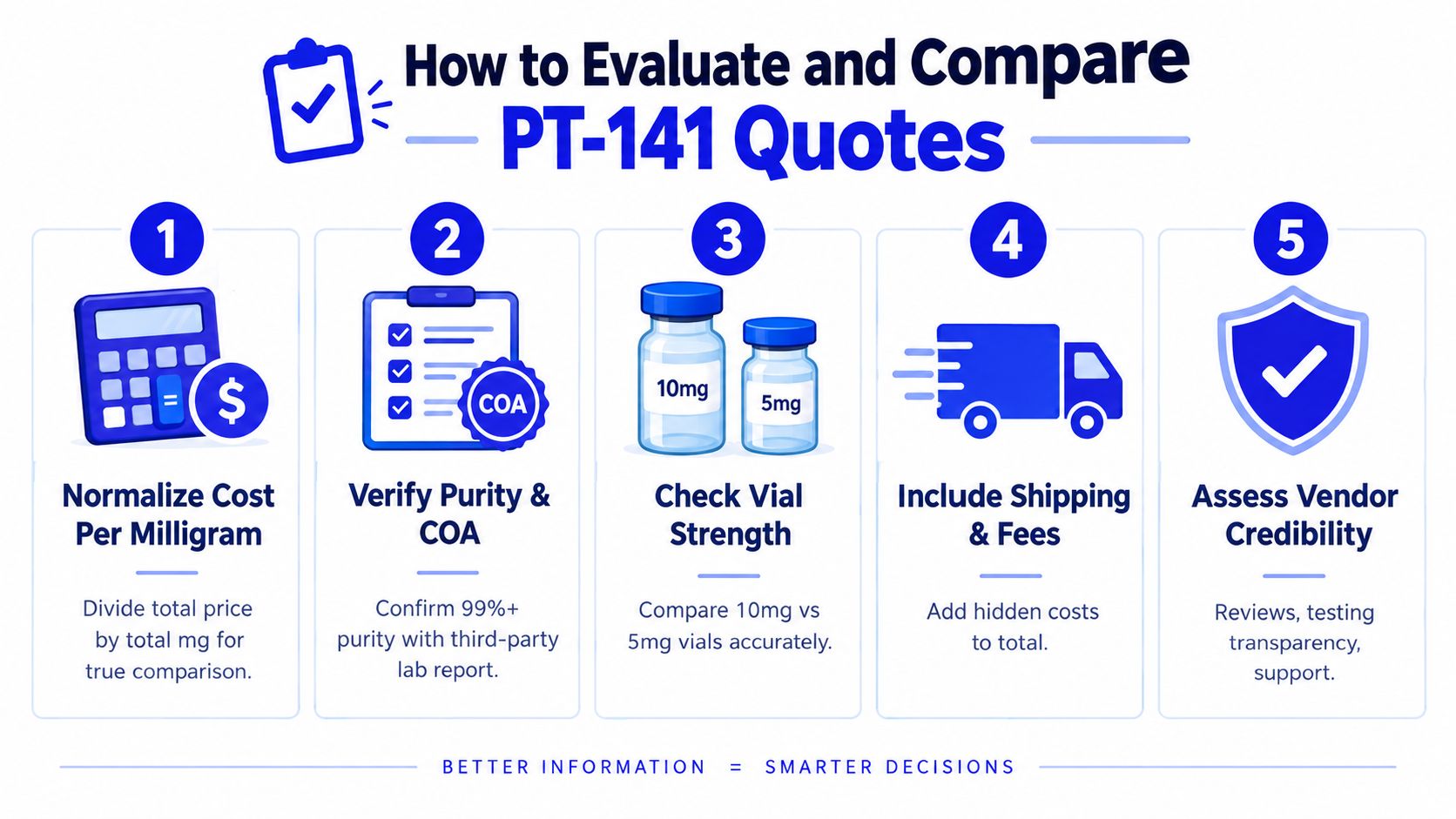
Practical test: If you cannot calculate active-content cost, protocol consumption, and channel fees, you cannot compare PT-141 quotes reliably.
A very low quote deserves questions before approval. It may reflect volume pricing, limited documentation, a different formulation, lower service coverage, or stock that fails your lab's requirements.
Require the quote to state packaging and storage expectations. Keep enough detail in procurement records for another team member to reorder the same specification without relying on memory or a sales conversation.
The vial price is often the least useful number in a PT-141 budget. Monthly cost follows actual consumption, so procurement teams should normalize every quote to price per milligram, then account for dose amount, dosing frequency, shipping, wastage, and service fees. Without those inputs, a monthly estimate is incomplete.
One cost illustration uses a $89 10 mg vial, a $44.50 cost per 2 mg dose, 8 doses, $15 shipping, and 10% reconstitution wastage, resulting in a stated true monthly total of $406.60. Use that figure as a modeling example only. It does not establish a universal PT-141 protocol or recommend human use.
For research planning, calculate:
Material cost = price per mg × total mg consumed
Then add the costs that a vial-only comparison hides:
Published pricing examples span from about $11.34 for a very low-dose protocol to $150 to $400 for research or clinic-style programs. That spread reflects different dose assumptions, usage patterns, and purchasing channels. Separate the molecule cost from channel markup before deciding that one quote is cheaper.
Two vendors may offer similar vial sizes while creating different total costs. A lower-priced option with weaker documentation can force a lab to replace material, repeat a run, or discard a questionable lot. A higher unit price may be justified when it reduces uncertainty and preserves a usable procurement record.
Bulk formats can reduce $/mg, but unused material still carries a cost. Forecast demand before ordering, then choose the pack size that balances unit savings against storage and wastage.
Do not use clinical dosing guidance to design a laboratory protocol, and do not treat research-grade pricing as a personal-use price. Human use requires an appropriate licensed clinician and an approved access pathway.
A cheap PT-141 vial isn't a bargain if your team can't verify what arrived. Research results depend on traceability, consistent specifications, and a documented connection between the material and the lot tested.
The most important records usually include:

A low-price vendor may save money at checkout while creating costs later. If the COA doesn't match the lot, the team may need to quarantine the shipment. If testing is incomplete, researchers may need to arrange additional analysis before using the material. If results vary unexpectedly, the lab can lose samples, instrument time, labor, and schedule capacity.
Those costs are difficult to assign to a single vial, but they matter more than a small difference in sticker price. Procurement should evaluate the cost of uncertainty, not just the cost of material.
Peptide Warehouse USA describes its research catalog as supported by third-party documentation that includes COAs, microbial and endotoxin reports, and stated purity levels up to 99.5%. That type of documentation is the standard buyers should ask vendors to demonstrate before approving a source, regardless of which supplier they ultimately choose.
Research products are not for human consumption. Institutional safety procedures, regulatory requirements, and protocol-specific testing remain the laboratory's responsibility.
A budget-conscious academic lab running preliminary analytical work should prioritize a clearly specified vial, transparent $/mg, and accessible lot documentation. It shouldn't pay for a branded autoinjector or a clinical service bundle that the experiment doesn't use. The most economical path is usually a research-grade product with enough documentation to support the planned assay.
A well-funded institution conducting longitudinal work has a different procurement problem. It should prioritize lot continuity, documented manufacturing controls, reproducible specifications, and a supply plan that reduces the risk of changing material mid-study. Bulk pricing can help, but only after the lab has validated the source and forecast demand.
Use these decision criteria:
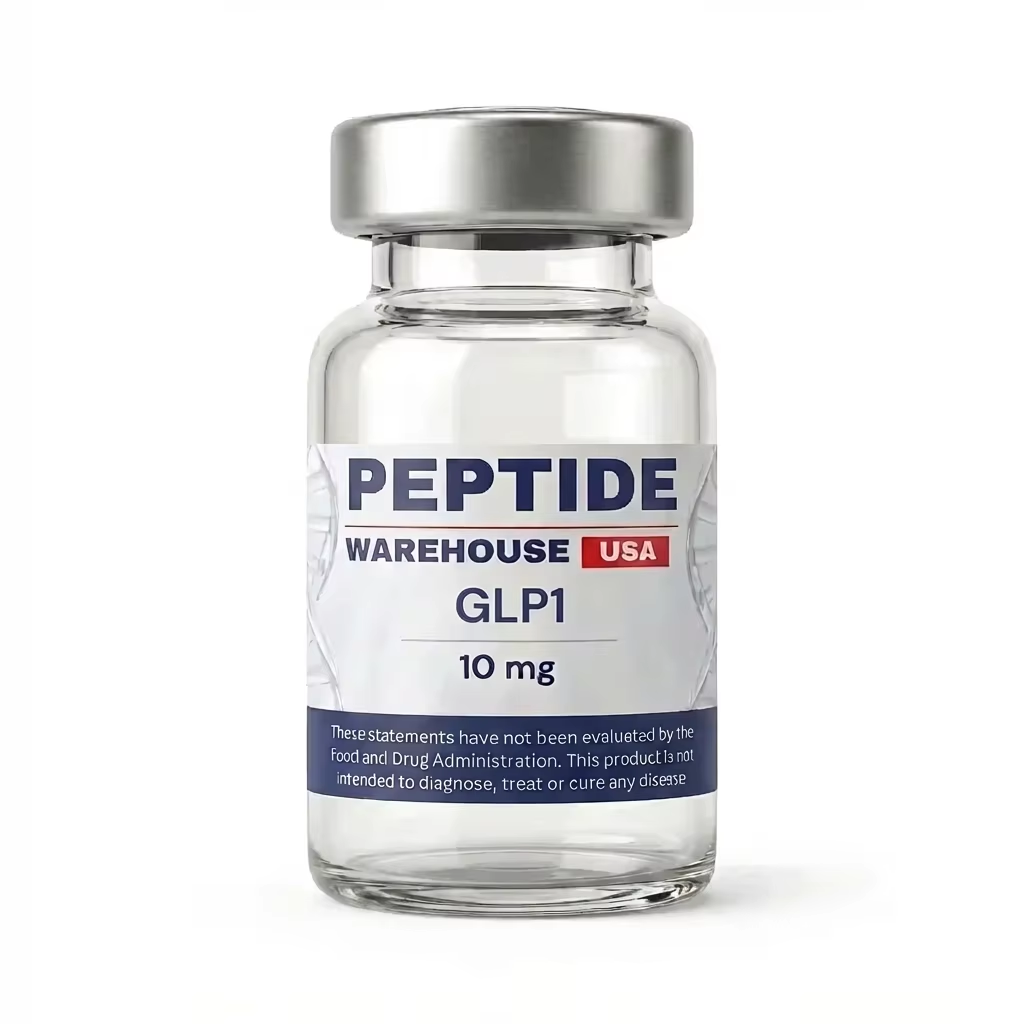
Peptide Warehouse USA lists research PT-141 with public pricing of $43.99, tiered to $39.99 for 2 to 9 units, $36.99 for 10 to 19 units, and $34.99 for 20 or more units, according to the product information supplied for this guide. The company also lists a PT-141 spray option, so buyers can compare available formats while keeping intended research use and documentation requirements in view.
The right sourcing decision isn't the lowest advertised number. It's the lowest credible total cost for material that fits the protocol, arrives with usable records, and can be reordered without creating avoidable uncertainty.
For a transparent research procurement option, visit Peptide Warehouse USA to explore its PT-141 formats, public tiered pricing, and third-party documentation. Review the lot records, testing materials, shipping terms, and intended-use requirements before placing an order.
Leave a comment