No products in the cart.


If you're searching pt 141 nasal spray Amazon, the first bad habit to break is treating Amazon like a research procurement channel. It's not built for batch traceability, lot-specific analytics, or controlled handling, and those are the things that decide whether a peptide purchase helps your work or poisons it with noise. The right question isn't which listing looks friendliest, it's which supply chain can prove what's in the bottle.
PT-141 sits in a strange place online. On one side, you've got a prescription compound with a real pharmacology history. On the other, you've got marketplace listings, user reviews, and inconsistent product claims that look convenient but don't give a bench scientist much to trust. If you're buying for anything serious, convenience is the least important filter.
Amazon is good at shipping boxes, not proving identity. That matters because PT 141 nasal spray Amazon listings are optimized for consumer browsing, while research work depends on documentation you can audit later. A crowded marketplace with mixed ratings may tell you demand exists, but it doesn't tell you the product is reproducible or even meaningfully standardized.
The marketplace itself shows that problem. One Amazon query returned 51 results for “pt-141 peptide for men,” and listings on the same marketplace display customer-interest signals such as 3.6 out of 5 stars and at least 50+ bought in past month on one product page. Those signals may help a casual shopper, but they don't answer the questions a lab has to ask about identity, purity, storage, or batch history. Amazon's PT-141 product listing gives you consumer-facing noise, not a chain of evidence.
A retail platform rewards easy comparison, not analytical completeness. The problem isn't that Amazon is “bad,” it's that it solves a different problem than procurement for experimental materials. Even a listing with decent star ratings can still leave you guessing about who made it, how it was handled, and whether the same item will arrive next time.
Practical rule: if a supplier can't show lot-specific documentation before you pay, assume you're buying convenience, not certainty.
That's why I tell people to stop asking whether the Amazon listing looks professional enough. Ask whether it gives you COAs, traceable lot data, storage details, and a defensible trail if the experiment comes under review. If it doesn't, it's not a serious source, it's a shopping cart.
There's also a reseller problem. Marketplace listings can be copied, relabeled, and re-posted faster than most buyers can verify them. If you want a clear overview of why unauthorized seller control matters, the operational logic in unauthorized seller tactics from Online Brand Growth maps closely to the sourcing risk here.
Fragmented listings create fragmented expectations. One seller might claim one concentration, another might imply a different format, and the reviews might come from buyers using completely different contexts. That's not a research environment, that's a pile of incompatible anecdotes.
For a researcher, reproducibility starts before the first dose. You need a supply chain that is boring in the best way, same identity, same documentation, same handling standard, same answer when you ask for the paperwork twice. Amazon doesn't usually give you that. It gives you options, and options are not the same as proof.
PT-141 is the research name for bremelanotide, a melanocortin receptor agonist with central nervous system activity. The FDA-approved reference product is Vyleesi, a prescription medication for acquired, generalized hypoactive sexual desire disorder (HSDD) in premenopausal women, not a retail Amazon spray. That distinction matters because it separates a regulated pharmaceutical context from marketplace packaging. Rite Aid's PT-141 reference makes the prescription-only point plain.
If you are evaluating supplier claims, anchor them to the clinical compound, not the retail listing. Review summaries for bremelanotide show that real users report mixed outcomes, which is exactly what you would expect from a drug with a defined pharmacologic profile and variable tolerability. Drugs.com's bremelanotide reviews are a cleaner reference point than anonymous seller copy.
The practical takeaway is straightforward. PT-141 is not a made-up niche ingredient. It is a medically active compound with known pharmacology, and sourcing mistakes can distort interpretation fast.
A published product monograph reports a half-life of 2.7 hours, with a range of 1.9 to 4.0 hours, and independent medical commentary describes nasal-spray duration at about 26 to 54 minutes per dose. That pharmacokinetic profile is exactly why handling quality matters so much. If a product degrades, gets stored badly, or delivers inconsistently, you cannot separate the compound's behavior from the supplier's mistakes.
That is also why the nasal route gets so much attention. Intranasal delivery is positioned around quicker systemic entry and shorter exposure windows than oral use, but the short half-life raises the stakes for consistency. For controlled work, the formulation has to be documented, the storage has to be cold, and the delivery mechanism has to behave the same way every time.
For procurement, Agenty's product URL extraction belongs in the workflow before anyone treats a listing as credible. A supplier page can look polished and still fail the basic checks that matter for reproducibility.
A short half-life is not a convenience feature. It is a warning label for sloppy sourcing.
Amazon does show PT-141 products, but the display is messy in exactly the ways researchers dislike. A current PT 141 search results page shows 25 results, and one listing is labeled “PT 141 300 MCG Spray 20MG”, with the text stating that each application provides 300 micrograms of PT-141. That search page gives you a concrete glimpse of format and claimed dose, but not the analytical backbone behind it.
The bigger issue is that marketplace language and research language aren't the same thing. A listing can state a dose, a buyer can leave a review, and the page can still omit the exact pieces a serious buyer needs, like a lot-specific COA, analytical method disclosure, or clear chain-of-custody handling. Those omissions matter more than the star rating.
There's a reason shoppers end up comparing screenshots instead of data sheets. Amazon surfaces convenience markers, not quality control markers. One listing may look active, another may look better reviewed, and a third may promise the same product in a slightly different format. None of that tells you whether the spray was produced, filled, or stored in a way that supports reproducible work.
The review story is especially unstable. User-generated comments on the listing include people saying the spray “worked” and others saying it produced “no effect” even after trying up to 4 sprays per nostril. That kind of disagreement is exactly what you expect when product uniformity is unclear and delivery performance varies from buyer to buyer. It's useful as consumer sentiment, but it's weak evidence for any controlled setting.
If you need a mechanical way to pull product pages and compare what's written, the workflow notes in Agenty's product URL extraction guide are more relevant than the review section itself. The point is to document what the page claims, not to trust the page at face value.
The visible market data points to demand, not validation. Multiple listings, mixed star values, and “bought in past month” signals tell you people are clicking. They don't tell you the bottle is correctly filled, the concentration is accurate, or the device sprays consistently.
For a bench scientist, that's a hard stop. A marketplace page can help you map the noise, but it can't replace source verification. If you're sourcing PT-141 for any outcome that matters, you need evidence the marketplace doesn't publish by default.
The regulatory picture is cleaner than the retail picture. Vyleesi is the FDA-approved bremelanotide product, and it is prescription-only for a defined patient population. PT-141 nasal spray on Amazon is a different category entirely, and product convenience does not change that regulatory fact.
That distinction matters because approved use comes with medical oversight for a reason. Side effects commonly discussed in clinical commentary include nausea, flushing, headache, and taste disturbance, and those are not minor if you are trying to interpret a response or compare sources. The question is whether the product's status and handling match the seriousness of the work.
A compound can be medically real and still be badly represented in consumer retail. That is the core problem with PT-141 marketplace searching. The search phrase suggests availability, but the approved product sits in a prescription framework, not in a generic online cart.
Public review patterns for bremelanotide also show why researchers should stay cautious. The aggregate comments on Those review signals reflect a compound people experience very differently even in a clinical context. That does not validate Amazon listings, it shows why this is not a casual commodity. Outcomes vary, tolerability varies, and sourcing quality matters.
If you are a researcher, do not treat safety as something you sort out after the package lands. Build it into the vendor screen. A supplier that makes you dig for documentation before purchase is already telling you how much friction you will face later if something looks off.
Procurement rule: any product without documented composition, purity, and handling is a variable, not a solution.
The short version is blunt. Retail convenience is cheap until it costs you a failed run, an unusable batch, or a protocol you cannot defend. That is the hidden price of trying to source a research compound like it is a household item.
Start with paperwork, then decide whether the vendor deserves a purchase order. If a supplier wants your business for PT-141, request a recent, lot-specific COA first. Then ask which analytical methods were used, how the material was stored, and how the shipment is handled from warehouse to your door.
You should also check the formulation itself. One PT-141 nasal spray formulation is described as 20 mg in a 10 mL bottle, equal to 2 mg per mL, with about 100 sprays per bottle and 0.1 mL per spray. That formulation reference gives a practical baseline for testing concentration claims without assuming every vendor uses the same setup.
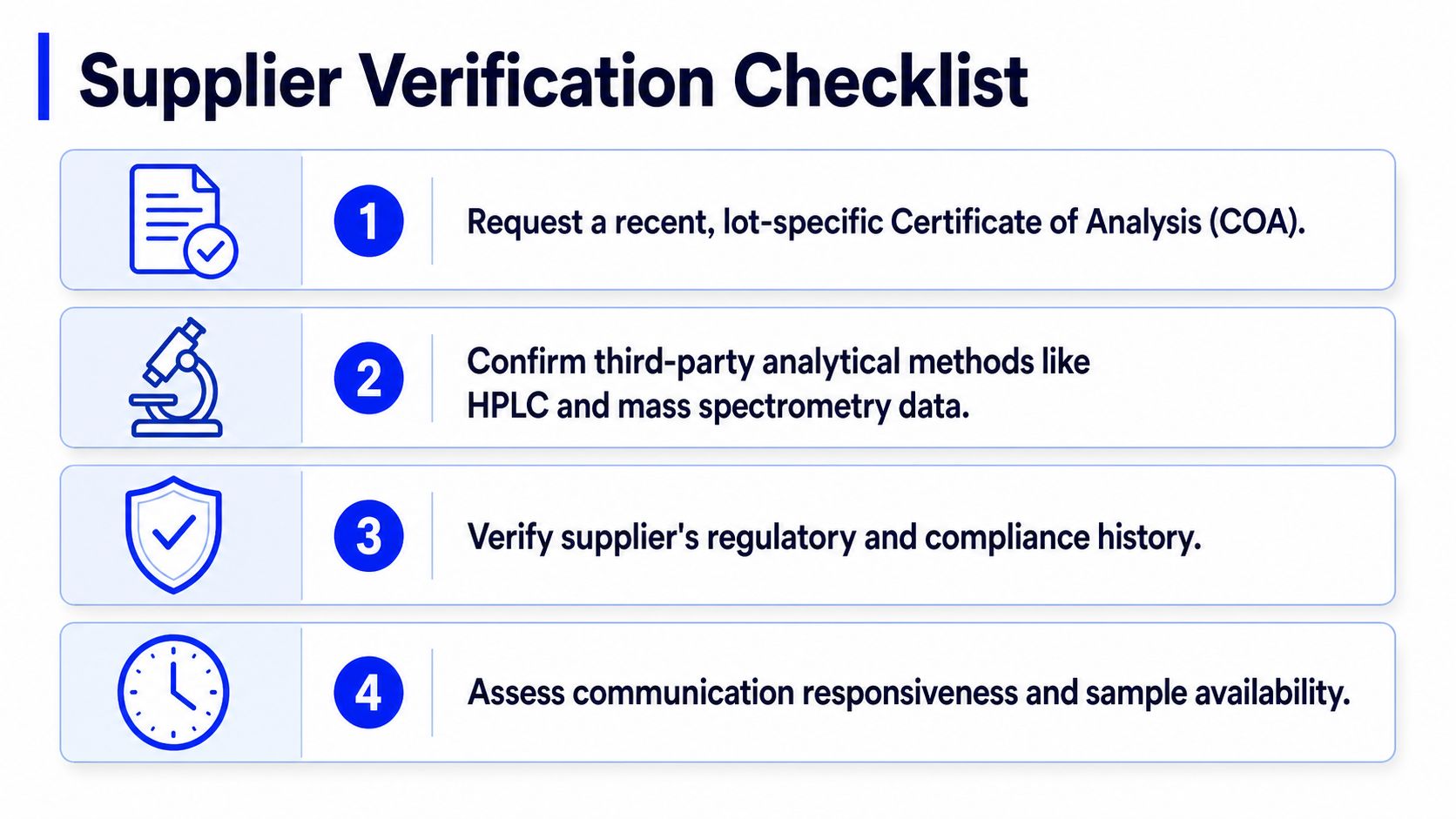
Use this as a hard filter alongside other procurement criteria.
Those four checks do not guarantee perfection, but they separate suppliers that run on documentation from sellers that run on convenience. If a vendor hesitates on any of them, walk away.
Concentration math is the fastest way to catch sloppy listings. A product that says 20 mg in 10 mL equals 2 mg/mL, and a stated spray volume like 0.1 mL per spray should align with the claimed dose math. If the numbers do not fit cleanly, the listing deserves more skepticism.
Amazon rarely makes that easy to verify, which is why procurement-minded buyers treat the listing as a starting point. The supplier should make the documentation easy to review, and the product should be labeled for research, laboratory, or analytical use only, not for human consumption.
The cleanest way to choose a channel is by use case. Amazon is built for speed and convenience, research suppliers are built for documentation and batch traceability, and compounding pharmacies sit in the prescription-medication lane. If you collapse those into one bucket, you'll buy the wrong thing for the wrong reason.
| Channel | Documentation | Intended Use | Fit for Research |
|---|---|---|---|
| Amazon listing | Usually consumer-facing, often incomplete | Retail purchase | Weak fit |
| Research supplier | COAs, batch testing, analytical data | Laboratory or analytical work | Strong fit |
| Compounding pharmacy | Prescription-driven pharmacy documentation | Patient-specific use | Not a research source |
Amazon gives you speed and reviews, which is fine for shopping. It does not reliably give you lot-specific analytical documentation, cold-chain clarity, or a defensible sourcing trail. For anything that depends on reproducibility, that's a bad trade.
Research suppliers are different because the business model is centered on verification. They typically frame products for research-use-only, and the whole point is that you can ask for the paperwork before the order becomes a problem. Compounding pharmacies are a separate lane entirely, because they're tied to prescription use rather than experimental sourcing.
If the question is “what's easiest to click,” Amazon wins.
If the question is “what can survive scrutiny,” it usually doesn't.
A good purchasing process is boring. One researcher I'd trust would compare two vendors side by side, ask each for the exact lot-specific COA, check the analytical methods, confirm the stated purity and microbial or endotoxin testing if relevant, and verify cold-chain shipping. The vendor that answers quickly and cleanly gets the next email. The vendor that dodges gets crossed off.
I'd also look for plain, unambiguous labeling. If the product page buries the use case or blurs the line between research and consumer use, that's a problem. The best vendors don't force you to infer whether the item is meant for the bench or the bathroom.
PT-141 has a real history in the literature. A PubMed-indexed abstract says Palatin was developing PT-141, a synthetically modified analog of PT-14, as a nasal spray for potential treatment of erectile dysfunction and female sexual dysfunction. That early-2000s development note is useful because it reminds you the compound's scientific identity predates modern retail hype.
A supplier like Peptide Warehouse USA positions PT-141 in a research-chemical framework with batch documentation and research-use-only labeling. That's the sort of structure you want if your priority is traceability, not impulse buying. It gives you a clearer procurement lane than a general marketplace ever will.
Amazon can tell you what the market is talking about, but it can't tell you whether a PT-141 spray belongs in a controlled workflow. That's the core takeaway. If you care about reproducibility, stop shopping for the prettiest listing and start screening for documentation, analytical proof, and proper handling.
Use the checklist. Compare channels by purpose. Treat every retail claim as unverified until the supplier can back it up with batch-specific evidence. That's the procurement stance that saves experiments, time, and credibility.
Peptide Warehouse USA offers PT-141 nasal spray in a research-chemical context with batch documentation, COAs, and clear research-use-only labeling. If you're evaluating PT 141 nasal spray Amazon listings and want a cleaner sourcing standard, visit Peptide Warehouse USA to review documented options and compare them against the checklist above.