No products in the cart.


If you've been searching for PT-141 nasal spray Canada, you've probably run into the same problem many researchers face. The literature points to a real intranasal research history, but the market pages blur together approved medicine, research listings, and outright unauthorized products. That mix makes procurement feel simple on the surface and messy the moment you check the details.
For a Canadian graduate student, lab manager, or independent researcher, the practical question isn't whether PT-141 exists. It's whether a listing is a research-use product, how the dose is packaged, what the delivery system delivers, and whether the seller can be verified against Canadian regulatory reality. Those are the questions that matter when you're trying to build a defensible methods section, a procurement record, or a supplier comparison.
A researcher in Toronto opens a browser tab late at night, searches for PT-141 nasal spray Canada, and immediately gets a mix of product pages, regulatory warnings, and forum-style claims. That search pattern is common because PT-141 keeps showing up in the literature as a central signaling compound, not just a peripheral helper. For someone planning a preclinical or analytical project, the appeal is obvious, a needle-free format can be easier to handle than an injectable vial, and a metered spray looks simpler to standardize on paper.

The intranasal route also appears in searches because published work treated it as a distinct delivery system, not a novelty. In double-blind studies, first erection response occurred in about 30 minutes, and the response became statistically significant only at doses greater than 7 mg (Nature article on intranasal PT-141). That kind of timeline matters for researchers who are comparing onset, handling, or route-dependent behavior in controlled settings.
The market interest is not random. Intranasal PT-141 was studied as a rapid, on-demand format, and that makes it easy for buyers to map onto lab workflows that need compact dosing and minimal handling steps. A metered spray also lets researchers think in terms of per-spray micrograms and bottle yield, which is much easier to document than an unstructured liquid.
Practical rule: if a PT-141 page can't tell you the bottle volume, the amount of peptide, and the dose per spray, it's not giving you enough information for research planning.
That's why the Canadian search trail usually ends in three places at once, the literature, the product listing, and the compliance check. The rest of the decision comes down to how the formulation is built, whether the seller is transparent, and whether the item is an authorized product or just a research listing dressed up with local shipping language.
PT-141, or bremelanotide, is a melanocortin-receptor agonist. In plain language, think of it as a molecule designed to dock with a specific receptor family involved in central signaling pathways that researchers study in sexual-function models. It is not a peripheral vasodilator in the simple sense, so the mechanism matters when people compare it with other compounds.
A helpful analogy is a key that fits a particular lock inside a control room, not on a pipe. The lock is the receptor family, and the control room is the central nervous system pathway researchers are interested in. That's why intranasal PT-141 has drawn attention, the route was tested as a way to get a research compound into the body quickly enough to interact with those central pathways on an on-demand basis.
Published double-blind studies showed the key points that keep coming up in formulation discussions. Erectile response became statistically significant only at doses greater than 7 mg, the first erection occurred in about 30 minutes, and PT-141 was generally well tolerated with no clinically significant changes in vital signs, laboratory tests, ECGs, or physical exams (Nature article on intranasal PT-141). Those details are important because they show the intranasal route was studied as a serious delivery system, not just as a convenience format.
Human evidence also shows that intranasal PT-141 had a pharmacodynamic interaction with PDE5 inhibition. In a randomized cross-over study of 19 men with erectile dysfunction, 7.5 mg intranasal PT-141 plus 25 mg sildenafil produced a significantly greater erectile response than sildenafil alone, with no new adverse events or higher event severity versus monotherapy (PubMed study). That tells researchers the nasal route was used to modulate central melanocortin signaling in a way that could amplify an existing PDE5 pathway.
The technical point is simple. PT-141 nasal spray was studied as a rapid central-acting research route, not as a stand-alone peripheral blood-flow product.
Those published dose bands help explain why current Canadian supplier pages cluster around 10 mg devices or similar metered delivery targets. When a listing aligns with the literature, it's easier to see whether the page reflects a research formulation or just a marketing wrapper.
A Canadian researcher opening a PT-141 nasal spray listing will usually see a research-use bottle with a metered pump, not a finished consumer medicine. That layout signals how the product is meant to be handled. The useful details are the total peptide amount, the spray yield, the bottle size, and the stated purity.
One current Canada-market listing describes 10 mg total peptide at 100 mcg per spray, with a stated purity of ≥98% (Canadian product listing). Other Canada-facing listings describe a 15 mL container with 10 mg of PT-141 and a larger 30 mL version with 20 mg, both presented as research products. Those differences are not cosmetic. They change how much material sits in each bottle and how the pump output fits a study plan.
The broader literature gives the market some context. Intranasal PT-141 studies commonly used doses from 5 mg to 20 mg, with 10 mg as the most commonly studied dose, and onset typically reported at 30 to 60 minutes. That is one reason a 10 mg device appears often in supplier catalogs. The dose band lines up with what a lab would expect from a metered intranasal format.
A few practical points follow from that:
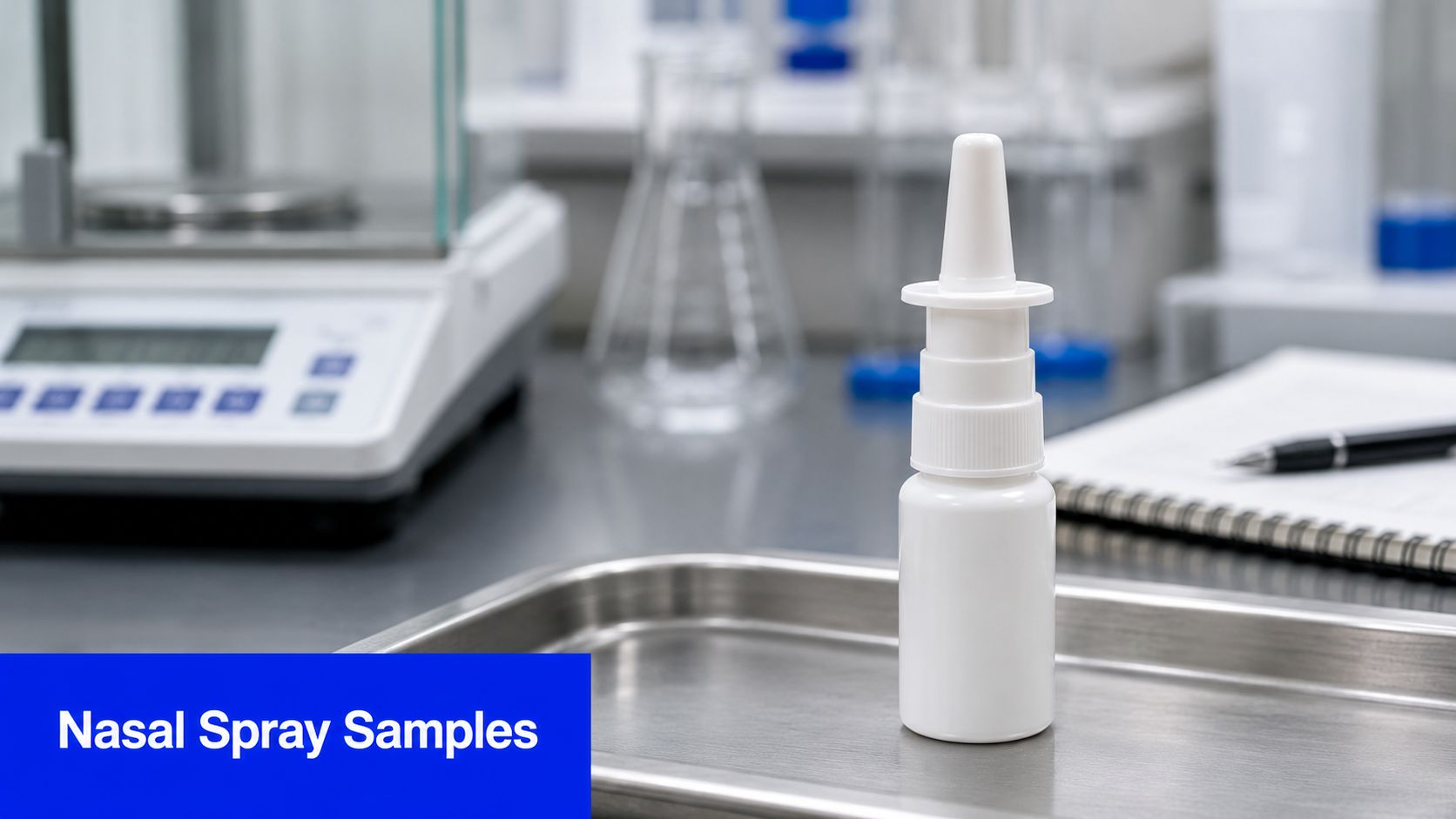
The takeaway is straightforward. PT-141 nasal spray in Canada appears as a category of research listings that vary by micrograms per spray, bottle volume, and pump yield, so buyers need to compare formulations instead of assuming they are interchangeable. For a broader compliance-oriented view of how suppliers present market claims, see OneSafe on bank crypto investments.
The regulatory picture is cleaner than the marketplace copy suggests. Health Canada has not approved bremelanotide, PT-141, for any indication, and one regulatory guide states that no New Drug Submission for bremelanotide appears in Health Canada's Drug Product Database or its register of submissions under review (regulatory status guide). That means Canadian buyers should not confuse a research listing with an authorized drug.
For Canadian access, the mechanism that sometimes applies is the Special Access Programme, and even then it is for serious or life-threatening conditions when conventional therapies have failed (regulatory status guide). That process is case by case. It does not turn an online peptide page into an approved medication.
Health Canada has also taken enforcement action against unauthorized products. A government recall notice says unauthorized injectable peptide drugs including PT-141 were seized and states that the products had not been authorized, meaning they had not been assessed for safety, efficacy, and quality and were illegal to sell in Canada (Health Canada recall notice). That warning matters even more when a listing uses vague marketing language.
The FDA approved PT-141 under the brand name Vyleesi in June 2019 as a subcutaneous injection for acquired, generalized hypoactive sexual desire disorder in premenopausal women (FDA approval summary in regulatory guide). That approval does not transfer to Canadian nasal sprays. A nasal-spray listing is still a separate research-market product unless it has its own authorization.
For readers who also track regulated markets outside peptides, the distinction is similar to what one sees in other high-compliance sectors, where local access and product authorization are never the same thing. A useful parallel discussion appears in OneSafe on bank crypto investments, where the key issue is how jurisdiction and authorization shape what can be offered.
Bottom line: a Canadian shipping claim, local currency, or “research use only” label doesn't create authorization.
Intranasal PT-141 is not approved for human use, and one independent source notes that the FDA halted intranasal PT-141 research in 2007 because of blood-pressure concerns (intranasal PT-141 summary). Any nasal-spray page should therefore be read as a research-market listing, not a regulated therapy.
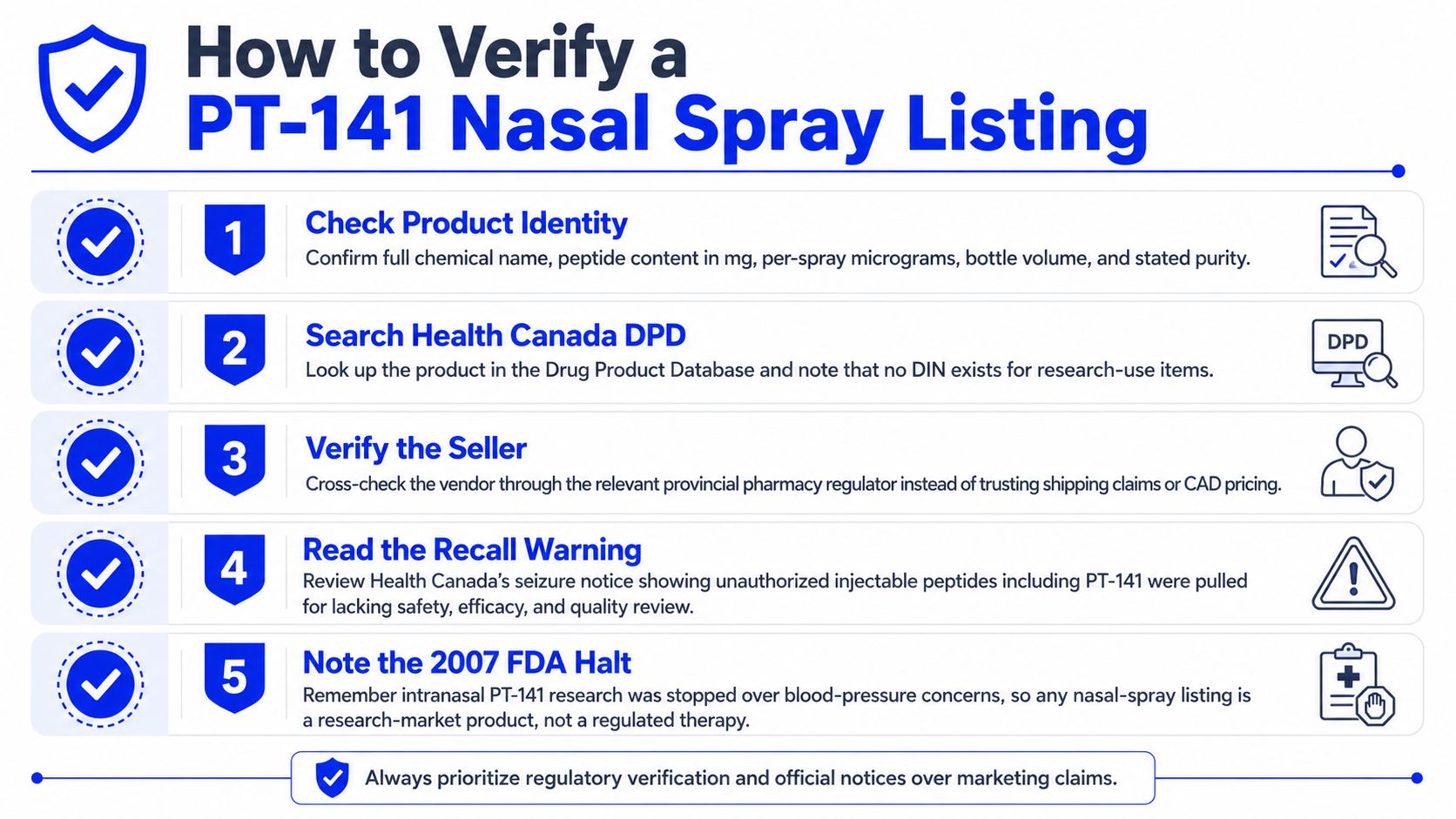
The quickest way to sort a real research listing from a marketing page is to treat the page like a paper trail. Start with the product page, move to Health Canada's database, and then examine the seller's regulatory footprint. A legitimate research supplier makes those checks possible. A promotional page usually leaves gaps.
Check product identity.
Confirm the full chemical name, the amount of peptide in mg, the micrograms per spray, the bottle volume, and the stated purity. If the page leaves out any of those details, you do not have enough information to compare listings or judge whether the formulation is consistent.
Search Health Canada's Drug Product Database.
Look for a Drug Identification Number. For research-use products, you should not expect one, and that absence still tells you something useful about the product's regulatory status.
Verify the seller.
Cross-check the vendor through the relevant provincial pharmacy regulator, not through shipping claims, Canadian pricing, or generic bremelanotide language. A listing can sound local and still offer no real authorization trail.
Read the recall warning.
Health Canada's seizure notice shows why unauthorized peptide products carry risk. The issue is the absence of safety, efficacy, and quality review, not just the packaging or the wording on the page.
Check whether the listing treats intranasal PT-141 as a research item.
Intranasal PT-141 research was halted over blood-pressure concerns, so a nasal-spray page should be read as a research-market listing, not a regulated therapy page.
A label that says research use only does not make a product authorized for use as a drug. Health Canada has warned that unauthorized peptide products sold online can cause serious harm, and that warning applies even when the page sounds polished. The wording is a buying signal, not a regulatory status.
That is why the verification order matters. A real research supplier gives you a product identity, a regulatory trail, and a seller you can cross-check. A marketing page tends to hide one or more of those pieces, which makes procurement harder and increases the chance that the listing belongs in the caution pile instead of the order file.
If the seller cannot document the exact formulation and its regulatory status, the listing belongs in the caution pile, not the procurement order.
That separates a marketing claim from an authorized product. One is trying to persuade you. The other can be traced through a regulator's database and a documented seller chain.
The easiest way to avoid confusion is to separate the approved prescription path from the research path. Vyleesi is the FDA-approved bremelanotide product, and it is a subcutaneous injection approved in June 2019 for acquired, generalized hypoactive sexual desire disorder in premenopausal women (regulatory guide). That approval defines one regulated route, one labeled use, and one documentation chain.
| Pathway | Regulatory status | Typical context |
|---|---|---|
| Vyleesi injection | FDA-approved | Prescription use in the U.S. |
| PT-141 nasal spray listings | Research-market products | Laboratory, analytical, or preclinical use |
The nasal-spray route does not inherit the approval of the injection. A Canadian listing may use the same active ingredient name, but that doesn't change the legal category or the quality evidence attached to the product. For procurement, that means a researcher is buying a research chemical with its own documentation chain, not a therapy with regulatory backing.
The injection route comes with a more defined pharmaceutical pathway, while intranasal delivery introduces more uncertainty around delivered dose and comparative reproducibility. That doesn't make the nasal spray useless. It just means the study needs to be honest about formulation details and route-specific variability.
Practical takeaway: if your protocol depends on exact exposure, don't treat an intranasal research listing like a prescription product.
Researchers often compare these two paths because the same molecule appears in both contexts. The comparison only works if you keep the regulatory category clear, and if you document the nasal product as a separate research item instead of a substitute for an approved drug.
Canadian buyers usually deal with PT-141 nasal spray as a cross-border research purchase. In practice, that means the item is often shipped from a U.S.-based supplier, declared as a research chemical, and received only if the institution permits that type of material. Customs paperwork and internal approval matter more than the checkout page.
The storage language on research listings is usually plain because the goal is to protect the formulation, not to imply medical use. Keep the product in a cool, dry environment, protected from light, and handled according to the supplier's documentation. That sounds basic, but it matters for pump performance and for consistency across repeated handling.
A second issue is bottle behavior. For nasal-spray research products, refrigeration practices, bottle orientation, and general handling can affect pump accuracy and reconstitution stability. If a study depends on repeatable delivery, the team should record storage conditions as carefully as the dose itself.
If your lab already uses temperature-controlled transport for sensitive materials, the category is familiar. A general overview of packaging and transit planning appears in temperature controlled storage, which is useful background when you're thinking about how to protect a spray product during transit and receipt.
The core point is simple. Shipping, storage, and handling are part of the product's research identity. If those steps aren't documented, the spray is harder to compare and harder to defend in a lab record.
A transparent research supplier gives you more than a product name. It gives you lot-specific documentation that lets you evaluate what arrived, not just what was promised. For PT-141 nasal spray, that usually starts with a Certificate of Analysis, then extends to microbial and endotoxin reporting.
The COA confirms identity and purity for that specific lot. A stronger listing may state purity up to 99.5%, but the value is that the number is attached to a tested batch rather than a generic promise. The microbial report speaks to biological contamination limits appropriate for laboratory work, while the endotoxin report helps confirm pyrogen limits relevant to preclinical comparisons.
A batch-tested supply chain also gives the researcher a traceable lot number. That matters when you write methods, compare runs, or explain why one bottle was used for a given experiment. If a supplier also states that the product is USA-manufactured and batch tested, the traceability is clearer than on a page that only repeats “high purity” without documents.
Researchers also benefit from asking how the product is packaged for transit. A supplier that understands sensitive shipment handling may reference practical tools such as types of medical cooler bags, which helps frame why temperature discipline matters during delivery and storage.
Useful test: if a supplier can't show you the lot-level paperwork, it's asking you to trust the label instead of the data.
Peptide Warehouse USA is one option for researchers who want a U.S.-made research supply chain with batch production, batch testing, and documentation such as COAs, microbial reports, and endotoxin reports. If you're comparing transparent sourcing options for PT-141 nasal spray and related research peptides, visit Peptide Warehouse USA to review the product documentation and available research formats.