No products in the cart.



You've typed “PT 141 online” into a search bar because you need a reliable peptide for a laboratory project. The results look simple at first, but the listings may represent very different things: an FDA-approved prescription product, a research-use-only vial, a nasal spray, or a poorly documented marketplace item. A similar name doesn't guarantee equivalent identity, purity, sterility, packaging, or traceability.
This guide separates PT-141, or bremelanotide, from the products marketed around it. You'll learn how the compound works, what the FDA-approved product is, why online research listings require careful scrutiny, how to read supplier documentation, and which safety and compliance questions deserve attention before an order reaches your lab.
A lab buyer searching for PT 141 online often starts with a practical need, not a medical question. You may be comparing product formats, looking for a specific lot, checking whether a vendor provides a Certificate of Analysis, or trying to replace a supplier that can't document its manufacturing process. Search results rarely make those distinctions clear.
The central problem is that “PT-141” can function as both a research name and a marketing term. PT-141 is commonly used to refer to bremelanotide, the active peptide associated with Vyleesi, but an online listing may not provide the same controls as the approved product. The FDA approval applies to a defined prescription product and a specific clinical indication, not to every vial, spray, or bulk peptide sold under the PT-141 name. The FDA approval letter identifies the approved product and its labeled use.
A low listed price may reflect a smaller quantity, a different formulation, missing testing, weak packaging, or no meaningful batch traceability. It doesn't tell you whether the material is suitable for your experiment. A high price doesn't prove quality either.
A disciplined buyer evaluates the complete evidence package:
Practical rule: Treat the product page as an initial lead, not as proof that the material is what the listing says it is.
The strongest sourcing decision usually comes from comparing documentation, communication, packaging, and repeatability across lots. That process protects downstream work from a problem that no protocol adjustment can fully fix: starting with material of uncertain identity or composition.
PT-141 is the research and marketing name commonly associated with bremelanotide, a synthetic peptide that activates melanocortin receptors. Published research identifies MC3R and MC4R as important targets in the central nervous system, particularly in the hypothalamus. The PubMed-indexed research provides the receptor-level background for this mechanism.
PT-141 was derived from melanotan II, but its development focused on a different biological objective than tanning-related products. Its value in a laboratory setting lies in examining melanocortin signaling and pathways associated with sexual behavior, rather than treating the material as a general-purpose sexual enhancement ingredient.
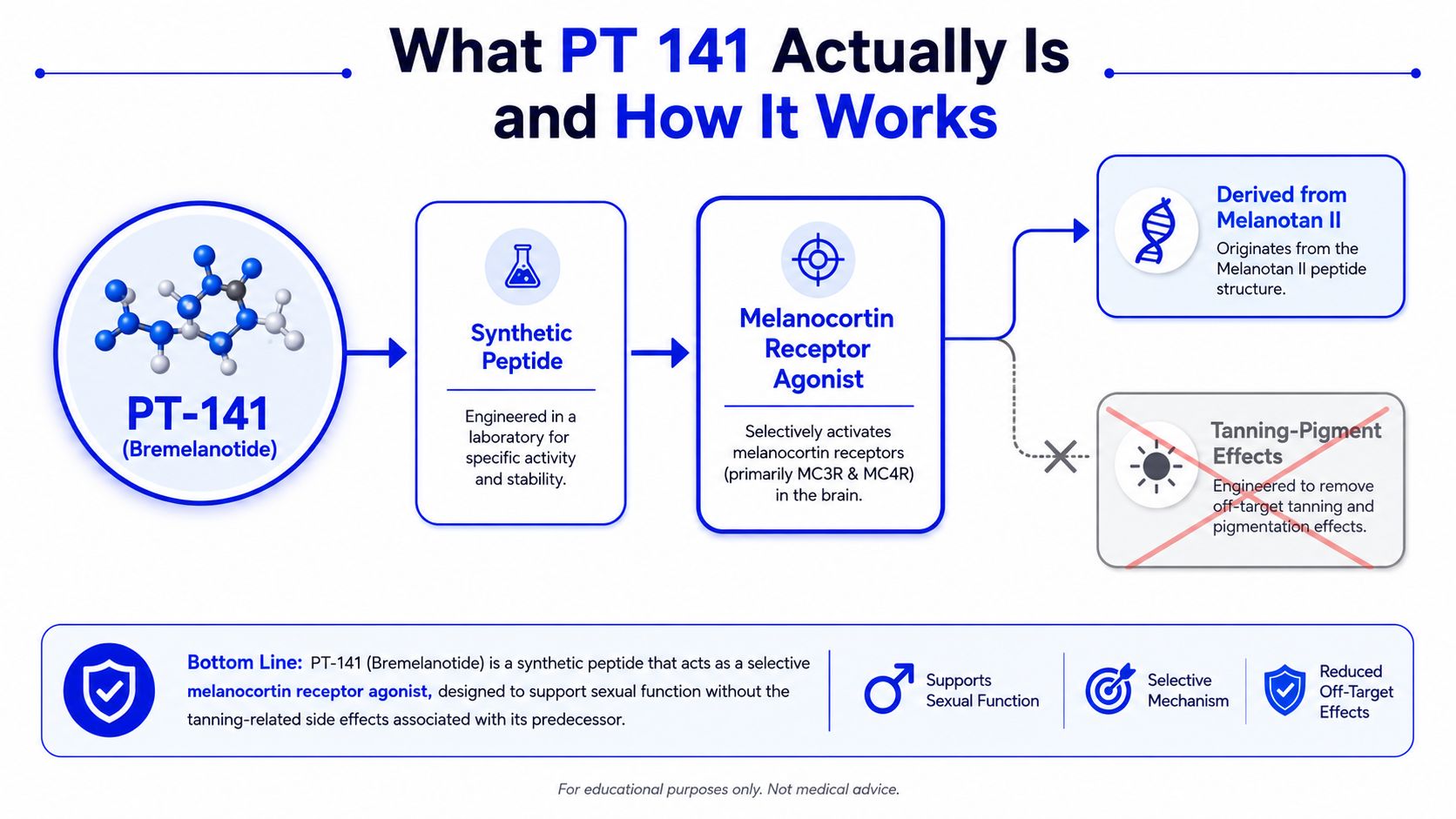
PT-141's mechanism differs from that of PDE5 inhibitors. PDE5 inhibitors primarily affect vascular smooth-muscle signaling and blood flow. Bremelanotide acts through melanocortin receptors in the central nervous system, so researchers should not treat the two compound classes as interchangeable.
That difference shapes experimental design. A study of receptor activation, behavioral pathways, or central nervous system signaling needs controls suited to those endpoints. A project focused on tissue exposure or vascular response may require a different set of controls and measurements.
The product name alone does not identify the material in a listing. A buyer may encounter:
These formats may differ in concentration, excipients, container closure, storage requirements, and intended use. For a lab, the practical question is whether the supplier can show what material was produced, how it was tested, and which batch the lab will receive. That evidence connects the online listing to the physical sample and helps researchers judge whether the product fits the planned work.
A lab buyer searching PT-141 online can encounter a research listing that uses the same compound name as an FDA-approved medicine. The regulatory history is narrower than that shared name suggests. On June 21, 2019, the U.S. Food and Drug Administration approved bremelanotide under the brand name Vyleesi for acquired, generalized hypoactive sexual desire disorder, or HSDD, in premenopausal women. It became the first approved melanocortin receptor agonist for a sexual dysfunction indication and the second FDA-approved medication for HSDD after flibanserin, approved in 2015. The FDA approval record records that regulatory history.
The approval rested on the RECONNECT phase 3 program, conducted in 2015 and 2016. In its two key studies, bremelanotide response rates for the co-primary endpoints were 58.3% and 58.2%, compared with placebo rates of 36.1% and 35.4%. The resulting treatment difference was roughly 22 percentage points in each trial. The clinical review in Therapeutic Advances in Psychopharmacology summarizes these results and the longer safety observation.
The approved medicine is a defined finished product, not an unidentified powder. Each labeled dose is a 1.75 mg subcutaneous autoinjector dose in 0.3 mL, administered into the abdomen or thigh at least 45 minutes before anticipated sexual activity. The FDA prescribing label specifies its route and administration.
Its pharmacokinetic profile supports on-demand use. Peak plasma concentrations occur about 30 to 60 minutes after subcutaneous administration, while the elimination half-life is roughly 2.7 hours. Observed clinical effects may last approximately 6 to 8 hours. For researchers, plasma exposure and observed activity are related but not identical endpoints. The mechanism and pharmacokinetic summary provides this timing context.
For sourcing decisions, the practical distinction is simple: FDA approval describes a specific product, indication, delivery system, and labeling framework. An online PT-141 listing may refer to the peptide alone, with its identity, purity, formulation, and batch documentation determined by the supplier. That boundary matters before a lab treats an online listing as equivalent to Vyleesi.
The U.S. approval does not broadly cover male sexual dysfunction, weight loss, anti-aging, or general performance enhancement. Its approved use remains limited to the labeled HSDD indication.
The approved product and an online PT-141 research listing may share an active ingredient name, but they don't share the same regulatory pathway. Vyleesi is a prescription product with formal labeling, defined delivery hardware, and post-approval safety monitoring. A research listing may be a lyophilized vial or spray sold under research-use-only language, with quality depending heavily on the supplier's testing and documentation.
The evidence base also differs. The clinical evidence supporting approval came from randomized, placebo-controlled trials, including the RECONNECT program. An online listing's marketing language, customer reviews, or anecdotal reports cannot substitute for that evidence, especially when the formulation and manufacturing controls aren't identical.
| Attribute | FDA-Approved Bremelanotide, Vyleesi | Online PT-141 Research Listings |
|---|---|---|
| Regulatory status | Approved prescription product for a defined indication | Usually marketed for laboratory or research use only |
| Format | Defined subcutaneous autoinjector | May be a lyophilized vial, solution, or nasal spray |
| Labeling | Formal prescribing information | Supplier-specific product documentation |
| Evidence | Clinical development and controlled trials | May rely on analytical reports and supplier materials |
| Dose precision | Defined finished-product format | Depends on formulation, fill, and documentation |
| Sterility evidence | Product-specific manufacturing controls | Must be verified from supplier records and test reports |
| Traceability | Formal pharmaceutical supply chain | Varies by vendor and lot |
| Post-market oversight | FDA-recognized monitoring framework | Accountability depends on supplier practices |
A research-use-only product isn't a substitute for the approved medicine, and an approved medicine isn't automatically the right material for every laboratory protocol. Researchers may need a specific concentration, container, excipient profile, or handling format that differs from the clinical product.
The practical risk is false equivalence. A listing that uses the name PT-141 may not document peptide content, residual solvents, microbial status, endotoxins, or container integrity with enough detail for your study. A lower price can therefore represent missing controls rather than a more efficient supply chain.
Supplier vetting should begin before payment, not after a vial arrives. Start by requesting the batch-specific Certificate of Analysis, then check whether the document identifies the exact product, lot number, testing laboratory, test methods, and release date. A generic PDF with no connection to the lot you're buying is weak evidence.
HPLC is commonly used to assess chromatographic purity, but a percentage alone doesn't establish identity or suitability. Ask what the reported purity represents, whether the chromatogram is available, and whether the result concerns the target peptide rather than total vial material.
Mass spectrometry provides a separate identity check. The reported mass should correspond to the claimed compound, and the report should identify the sample tested. For serious work, the strongest package combines HPLC purity data, mass spectrometry identity data, and batch-level documentation rather than relying on one number.
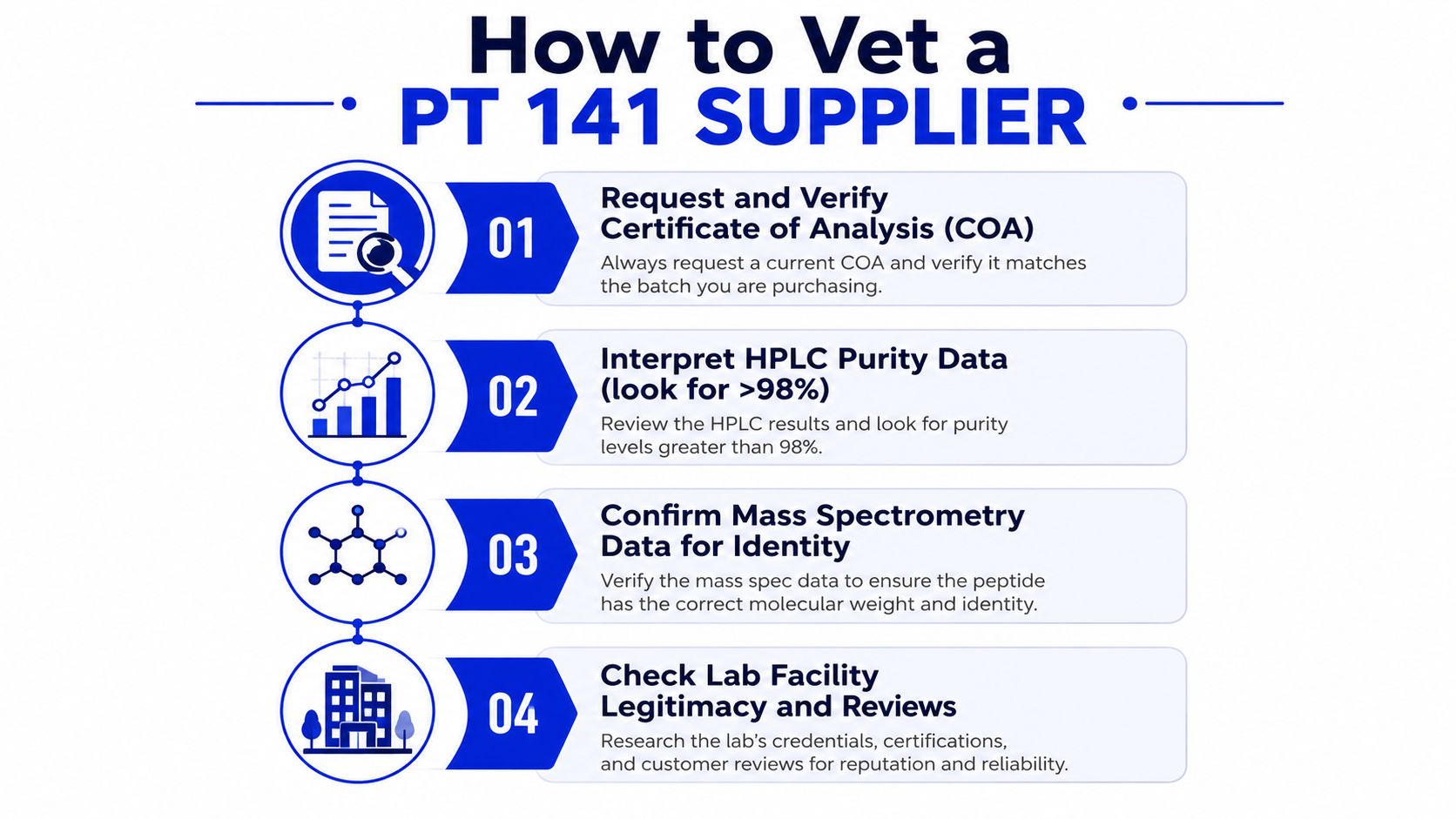
A supplier's response style is informative. Vendors that answer technical questions clearly, provide the relevant reports, and explain storage or shipping conditions show a different level of accountability from sellers who redirect every question to a checkout page.
Documentation beats presentation. A polished storefront can't compensate for an unverifiable lot record.
Manufacturing origin also deserves scrutiny. Ask whether synthesis occurs in a facility with a stated quality system, whether the country of synthesis is disclosed, and whether the supplier can explain packaging and release procedures. ISO or GMP references are useful only when the vendor can identify what they apply to. They shouldn't be treated as decorative badges.
Bremelanotide's clinical profile includes tolerability and cardiovascular considerations that online listings often underemphasize. Nausea is the most common adverse event, while flushing, headache, and injection-site reactions are also frequent. Blood pressure can rise transiently, so cardiovascular risk and uncontrolled hypertension require particular caution. The clinical safety review indexed by PubMed discusses these safety issues.
During the core clinical phase summarized in that review, serious adverse events occurred in 1.1% of bremelanotide-treated patients versus 0.5% with placebo. Longer follow-up extended safety observation to 76 weeks, with no new safety signals identified during the extension period. Those findings describe the studied clinical product and population, not every online formulation sold under the PT-141 name.
A research team discussing translational work should distinguish an analytical compound from a product intended for administration to people. The approved labeling and clinical references identify concerns involving cardiovascular disease, uncontrolled hypertension, pregnancy, breastfeeding, and certain hepatic or renal conditions. Safety and efficacy aren't established for pediatric use, and pregnancy may harm the unborn baby, while breastfeeding data are inadequate.
Chronic exposure has also been associated with darkening of skin and mucosal tissue, known as hyperpigmentation. This is one reason repeated-use discussions shouldn't rely on a simple “works or doesn't work” framework.
For a human subject study, eligibility, monitoring, concomitant medications, and adverse-event procedures belong in an approved clinical protocol. A general health resource such as order impotence test from Repose Healthcare may help readers understand the type of assessment often discussed around sexual-health concerns, but it doesn't replace clinician evaluation or institutional review.
Research personnel should follow the lab's established chemical and biological safety procedures when handling reconstituted peptide. The clinical safety profile doesn't establish the safety of an undocumented product, and it doesn't remove the need for appropriate personal protective equipment, labeling, storage controls, spill procedures, and waste handling.
The first compliance distinction is between an FDA-approved drug product and a research material marketed for laboratory use. FDA approval of Vyleesi doesn't authorize a vendor to sell every PT-141 product for human administration, and research-use-only labeling doesn't grant permission to administer a product to people.
A compliant lab should establish its own acquisition trail. That usually includes a documented research purpose, an approved internal protocol, purchasing records, lot information, storage records, and a clear chain of custody. Institutional requirements vary, so the responsible biosafety, compliance, and procurement personnel should review the applicable rules before ordering.
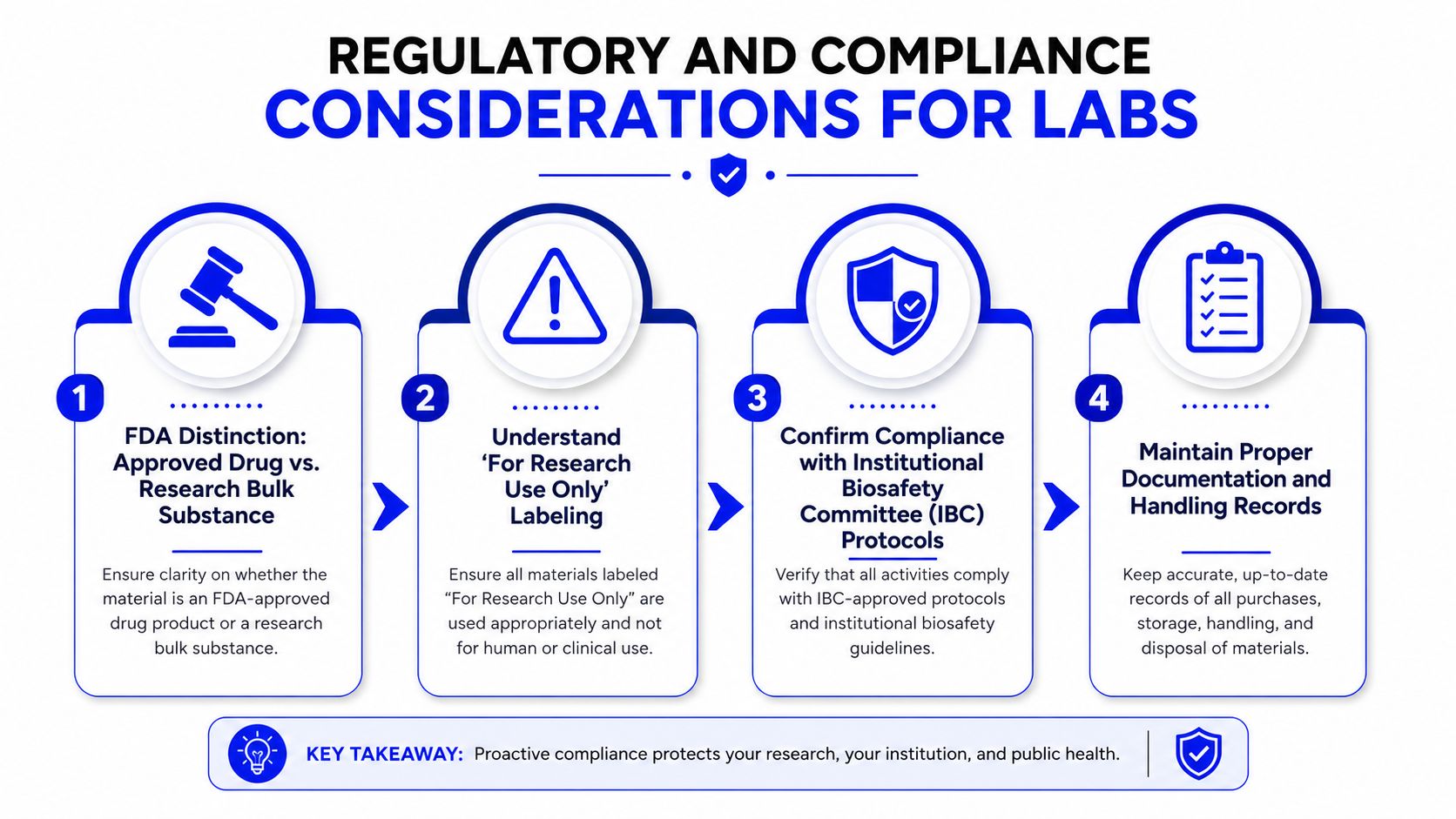
A supplier that uses research-only language should clearly state that the product isn't for human consumption. It shouldn't provide treatment instructions, promise medical outcomes, or present a research vial as equivalent to a prescription medicine.
Labs should also check whether import requirements, state-level rules, institutional biosafety procedures, or other controls apply to the material and its intended use. Importing a peptide without the appropriate research basis or documentation can create delays, inspection concerns, or other regulatory problems.
A compliant purchase is more than a transaction. It connects the material, the experiment, the responsible institution, and the records that explain why the acquisition was appropriate.
Procurement teams can use a broader procurement compliance checklist to organize approval records, vendor checks, and documentation ownership. For peptide work, add the COA, lot number, storage requirements, and research-use-only statement to that internal process.
A reliable PT-141 purchase rests on four gates. If one gate fails, pause the order instead of trying to compensate with a lower price or a larger quantity.
First, verify the analytical record. Request the COA before payment. Confirm that HPLC data and mass spectrometry results refer to the batch you'll receive, and determine whether the reported purity concerns the target peptide or total material.
Second, establish manufacturing origin. Look for a clear statement about where synthesis occurs, who performs testing, and how the supplier handles batch release. A vague claim about “premium quality” is less useful than a named testing process and an identifiable lot.
Third, confirm traceability. The vial, outer packaging, invoice, and COA should connect through a consistent batch or lot identifier. Photograph the package when it arrives, then record receipt condition, storage location, and any temperature requirements specified by the supplier.
Fourth, review the compliance posture. The listing should use research-only language and avoid claims about treating sexual dysfunction, improving performance, or replacing approved medicines. The absence of human-use marketing is a meaningful signal that the supplier understands the boundary around research materials.
One clean report doesn't prove that every future lot will match it. Ask whether the supplier retains batch records and whether testing is repeated across production runs. Reproducibility begins with consistent sourcing, not with optimistic assumptions about a familiar product name.
Marketplaces and anonymous resellers create extra uncertainty because the original synthesizer, storage history, and documentation chain may be unclear. A supplier with direct support, identifiable product records, clear shipping policies, and accessible testing documentation gives the lab more control over the purchasing process.
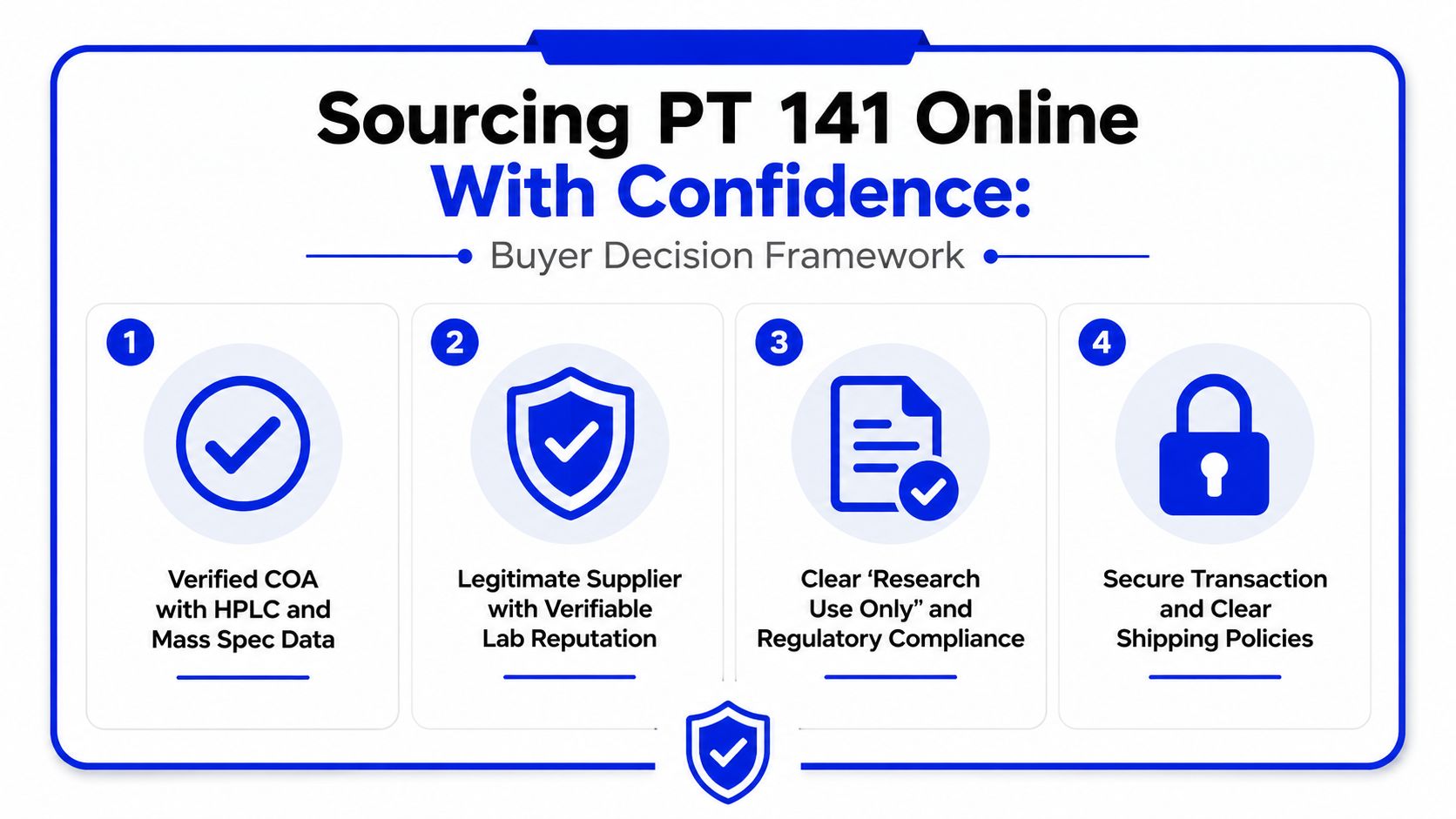
Use this framework before placing your next order. Compare the documentation package, not just the product title, and keep the approved bremelanotide product separate from research listings in your records and discussions.
Peptide Warehouse USA offers research-use-only PT-141 products with stated U.S. manufacturing, batch documentation, and supporting COA, microbial, and endotoxin records. Visit Peptide Warehouse USA to review the available research peptide options and evaluate whether the documentation and sourcing information fit your laboratory's procurement requirements.