No products in the cart.


A common PT-141 search asks for a single dose number. That's usually the wrong starting point. PT-141 peptide dosage only becomes meaningful when you pair the number with route of administration, concentration after reconstitution, draw volume, timing, and safety limits.
In a research setting, precision matters more than shorthand. A vial label, an insulin syringe, and a milligram target have to line up exactly or the protocol stops being reproducible. That's where most confusion starts.
This guide takes the practical route. It moves from pharmacology and protocol selection to reconstitution math, injection volume, handling, and storage. The focus stays on accurate laboratory workflow, compliant interpretation of reported dosing standards, and the research-only context of PT-141, also known as bremelanotide.
PT-141 isn't a compound you handle well by approximation. In peptide work, the stated dose is only one part of the protocol. The actual outcome depends on whether the vial was prepared correctly, whether the intended route matches the protocol, and whether the draw volume reflects the target concentration.
Researchers often run into the same problem. They know the target dose in milligrams, but they don't know how to convert that number into a measured liquid volume without introducing error. That gap is where reproducibility starts to fail.
A more useful way to think about PT-141 is as a sequence of linked decisions:
Practical rule: If you can't show the concentration, the syringe volume, and the timing in one line of notes, the dosage record isn't complete.
PT-141 is best approached with the same discipline used for any other sensitive research peptide. That means treating dosing as a workflow, not a headline number. When that workflow is built correctly, it becomes much easier to compare protocols, interpret side effects, and maintain consistency across runs.
What does PT-141 do after it leaves the syringe and enters the system?
PT-141, or bremelanotide, is a melanocortin receptor agonist. Its primary relevance in dosing discussions is that it acts through central melanocortin signaling rather than through a direct vasodilatory pathway. The approved prescribing information for Vyleesi from the U.S. Food and Drug Administration describes bremelanotide as a melanocortin receptor agonist used in a defined clinical setting, which helps frame why route, timing, and tolerability must be documented carefully in research use.
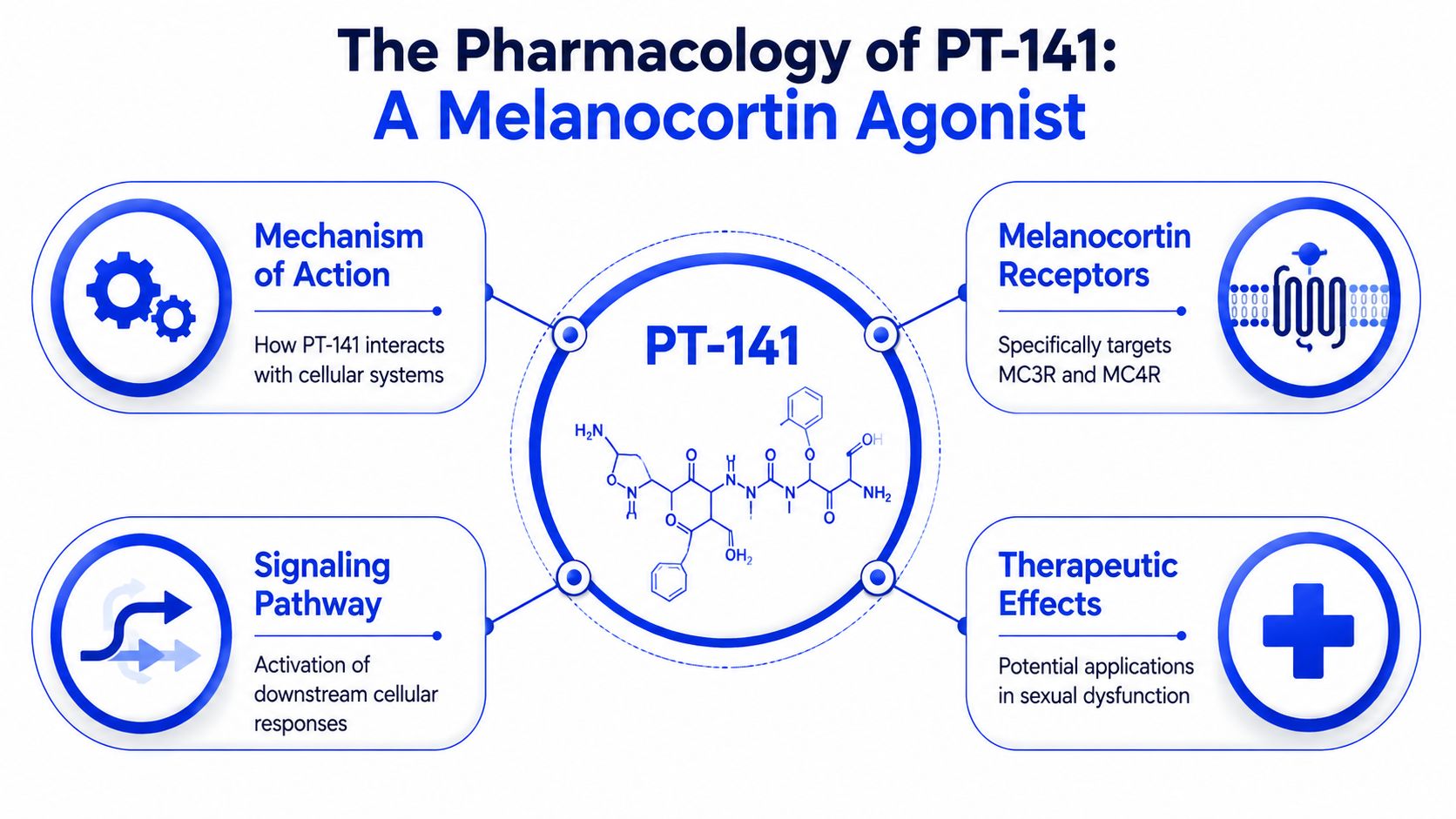
A receptor agonist works like a chemical signal that fits a specific binding site and triggers a downstream response. In practical dosing terms, that means the measured amount in milligrams is only the starting number. What matters in the protocol is how much active peptide reaches receptor targets over time, at what rate, and with what adverse effects.
That is why PT-141 cannot be treated as a generic "more is stronger" compound. If exposure is too low, the observed signal may be weak or inconsistent. If exposure rises beyond the tolerated range, the dominant finding may shift from intended pharmacologic effect to nausea, flushing, or blood pressure changes. For a laboratory notebook, this is the difference between a readable experiment and a noisy one.
The lock-and-key analogy still helps here, but only to a point. The better laboratory analogy is a titration curve. Small changes in delivered amount can shift the observed response window, especially when preparation error, route selection, or timing inconsistency is introduced upstream.
The receptor target may be similar across formulations, but the delivery profile is not. A subcutaneous injection creates one absorption pattern. An intranasal preparation creates another. Those differences affect onset, peak exposure, and the timing of both intended and unwanted effects.
The pharmacology connects directly to the workflow covered later in the article. If the reconstituted concentration is wrong, the injected volume will be wrong. If the injected volume is wrong, receptor exposure will differ from the written protocol even when the stated dose looks correct on paper.
Clinical pharmacology data summarized in the European Medicines Agency product information for bremelanotide indicate that exposure and effect unfold over a defined post-administration window rather than immediately. For a researcher, that means the dose entry is incomplete unless it includes clock time, route, observation intervals, and the point at which effects were first noted.
Nausea deserves particular attention because it often appears near the same general period in which systemic exposure becomes more apparent. That relationship is one reason careful starting-dose selection matters. It also explains why two protocols that list the same milligram amount can produce different observations if they differ in route, concentration, or actual delivered volume.
For PT-141, pharmacology is not background theory. It is the map that connects peptide choice, preparation accuracy, administration timing, and observed response into one usable protocol.
What dose is the protocol referring to. A fixed approved clinical dose, or a researcher-selected starting point used to test tolerability? That distinction matters because the number on the vial is only one part of the workflow. The protocol category determines how that number should be interpreted, documented, and converted into an injection volume later.
For FDA-approved use, bremelanotide is not presented as a flexible range. It is a defined subcutaneous dose of 1.75 mg used before anticipated sexual activity under labeled frequency limits. The approved prescribing framework for Vyleesi is summarized in the FDA prescribing information, which specifies no more than one dose within 24 hours and no more than 8 doses within a month.
That fixed-dose design is useful in a laboratory discussion because it provides a reference point. It is the calibrated weight on the bench. Once a protocol moves away from that reference, the researcher is no longer following the approved regimen and should label the record accordingly.
The distinction is methodological, not semantic.
Reported research use is usually described as a starting range followed by adjustment based on observed tolerance. In practice, that means the protocol is built in stages rather than copied from the approved label. A reported overview from Peptides Institute's PT-141 protocol overview describes male research protocols that often start at 0.5 to 1.0 mg subcutaneously, with a more common working range of 1.0 to 1.75 mg once tolerability is established.
Another reported source, Peptides Explorer's dosage guide, places 1.5 mg to 1.75 mg in the range often discussed for male research and cautions that higher amounts are associated with more nausea. That does not create an approved male standard. It shows that research-oriented protocols are typically exploratory, observation-driven, and dependent on route and tolerability.
A useful way to frame the difference is this: the approved protocol answers, “What did regulators clear for a specific indication and population?” Research dosing asks, “What starting amount and adjustment plan best fit this experimental model?” Those are different questions, so the resulting dose records should not share the same label.
| Protocol | Subject | Dose Range | Frequency Limit |
|---|---|---|---|
| FDA-approved Vyleesi protocol | Premenopausal women with HSDD | 1.75 mg subcutaneous | No more than once per 24 hours and no more than 8 doses per 28-day month |
| Reported male starting protocol | Male research use | 0.5 mg to 1.0 mg subcutaneous | Use reported safety limits as a ceiling in protocol design |
| Reported male working range | Male research use | 1.0 mg to 1.75 mg subcutaneous | Use reported safety limits as a ceiling in protocol design |
| Reported intranasal protocol | Intranasal research use | 2 mg to 3 mg intranasal, with a separate report of 7 mg in erectile function research | No more than once daily and 8 times per month in reported guidance |
For lab records, three labels prevent a large share of dosing errors: FDA-approved protocol, reported research protocol, and route-specific exploratory protocol. If those labels are missing, a 1.75 mg entry can look identical on paper even when the route, population, and preparation method are completely different.
A PT-141 dose only makes sense when matched to its delivery method. A milligram delivered subcutaneously and a milligram delivered intranasally don't behave as equivalent protocol choices.
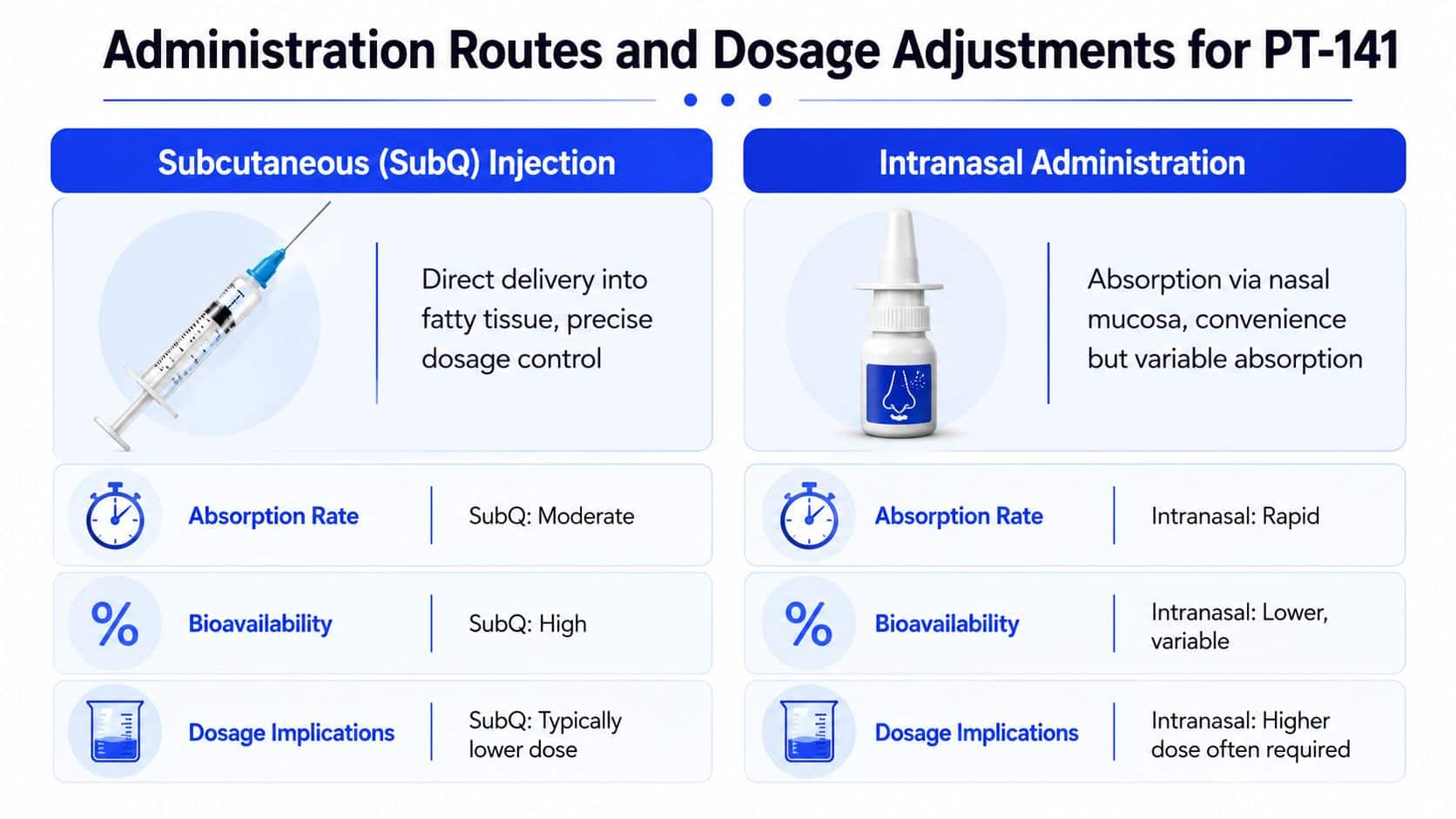
Subcutaneous administration is the cleaner route for dose control. It allows a defined liquid volume to be injected into fatty tissue, which gives the researcher more precise control over what was delivered.
That's why the fixed approved protocol uses subcutaneous injection. It's also why most research discussions treat the subcutaneous route as the baseline reference point when comparing dosing.
For first-time tolerance assessment, one reported guide advises starting at 1.0 mg subcutaneously before titrating toward 1.75 mg, specifically to gauge nausea sensitivity, as noted in Peptide Deck's PT-141 dosage guide.
Intranasal PT-141 is a different protocol category. The same Peptide Deck source reports 2 to 3 mg intranasally administered 30 to 60 minutes before activity, reflecting lower bioavailability than subcutaneous delivery. Another reported source describes a 7 mg nasal spray dose in erectile-function-focused research, which appears in Peptides.org's PT-141 dosage calculator discussion.
Those differences are the practical lesson. Nasal delivery may be convenient, but the amount required can be substantially higher depending on the protocol being referenced. That means researchers shouldn't transfer subcutaneous expectations directly to a nasal format.
A route change is a protocol change. Treat it that way in your records.
How do you turn a labeled milligram target into a draw volume you can reproduce on the bench? That is the practical question behind PT-141 preparation. A vial of lyophilized powder does not give you a usable dose until you define the concentration, confirm the math, and document the volume to be drawn.
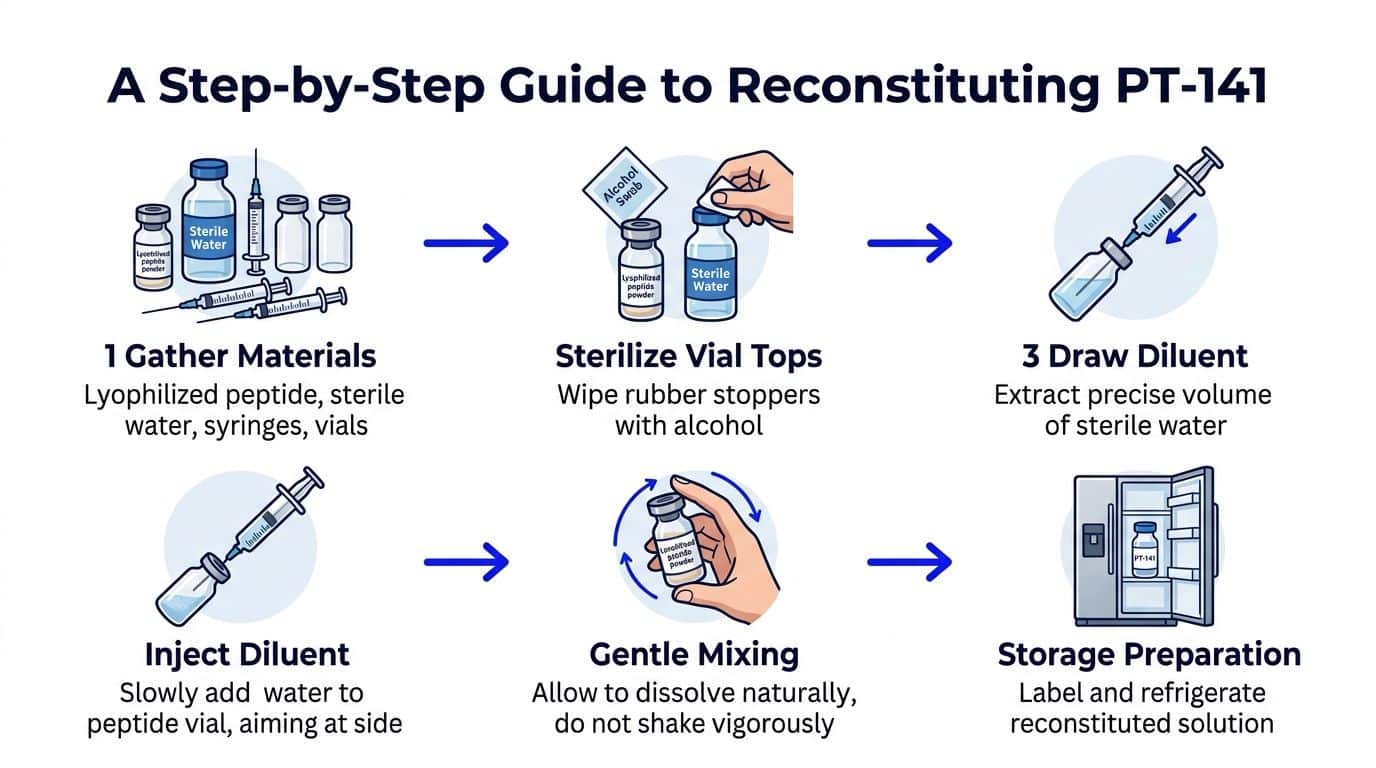
Preparation errors usually start before the needle enters the vial. They start with an incomplete setup, unclear labels, or missing calculations.
Lay out all materials first so the workflow stays controlled from start to finish:
Clean the work surface. Verify the vial strength on the label. Confirm how much diluent you intend to add before you begin. If that number changes midway, the concentration changes too, and every later dose calculation has to change with it.
Write down the intended formula in advance. A simple lab note is enough: vial content, diluent volume, final concentration, target dose, draw volume, date, and operator initials.
The goal is to dissolve the powder without introducing contamination or avoidable mechanical stress. PT-141 handling is straightforward if the sequence is disciplined.
That slow addition step matters. A direct, forceful stream can foam the contents and makes visual inspection harder. In practice, the vial should be treated like a measurement standard. Once mixed, every later syringe draw depends on that concentration being correct.
For a visual demonstration of sterile handling and peptide preparation workflow, this video is useful as a general laboratory reference:
Bench note: After reconstitution, the working number is the concentration in mg/mL.
This is the step that determines whether the protocol is reproducible. The arithmetic is simple, but it has to be written out.
Start with the base equation:
Concentration (mg/mL) = total peptide in vial (mg) ÷ total diluent added (mL)
Then calculate the withdrawal volume:
Draw volume (mL) = target dose (mg) ÷ concentration (mg/mL)
Example:
If the target dose is 1.75 mg, the draw volume is:
1.75 mg ÷ 5 mg/mL = 0.35 mL
On a standard 1 mL insulin syringe, 0.35 mL corresponds to 35 units. For a general peptide dosing math reference, Peptides.org's calculator discussion shows the same concentration-to-volume logic in practical terms.
The process works like a stock-solution calculation in any other lab setting. The vial amount sets the numerator. The diluent volume sets the denominator. The target dose then tells you what fraction of that solution to withdraw.
A quick verification table helps prevent transcription mistakes:
The practical rule is simple. Never record only the dose in milligrams. Record the vial strength, reconstitution volume, final concentration, and syringe volume together. Without all four, another researcher cannot reproduce the preparation with confidence.
Preparation accuracy doesn't help much if the solution is handled poorly after reconstitution. Peptides are sensitive materials, and storage discipline protects both integrity and interpretability.
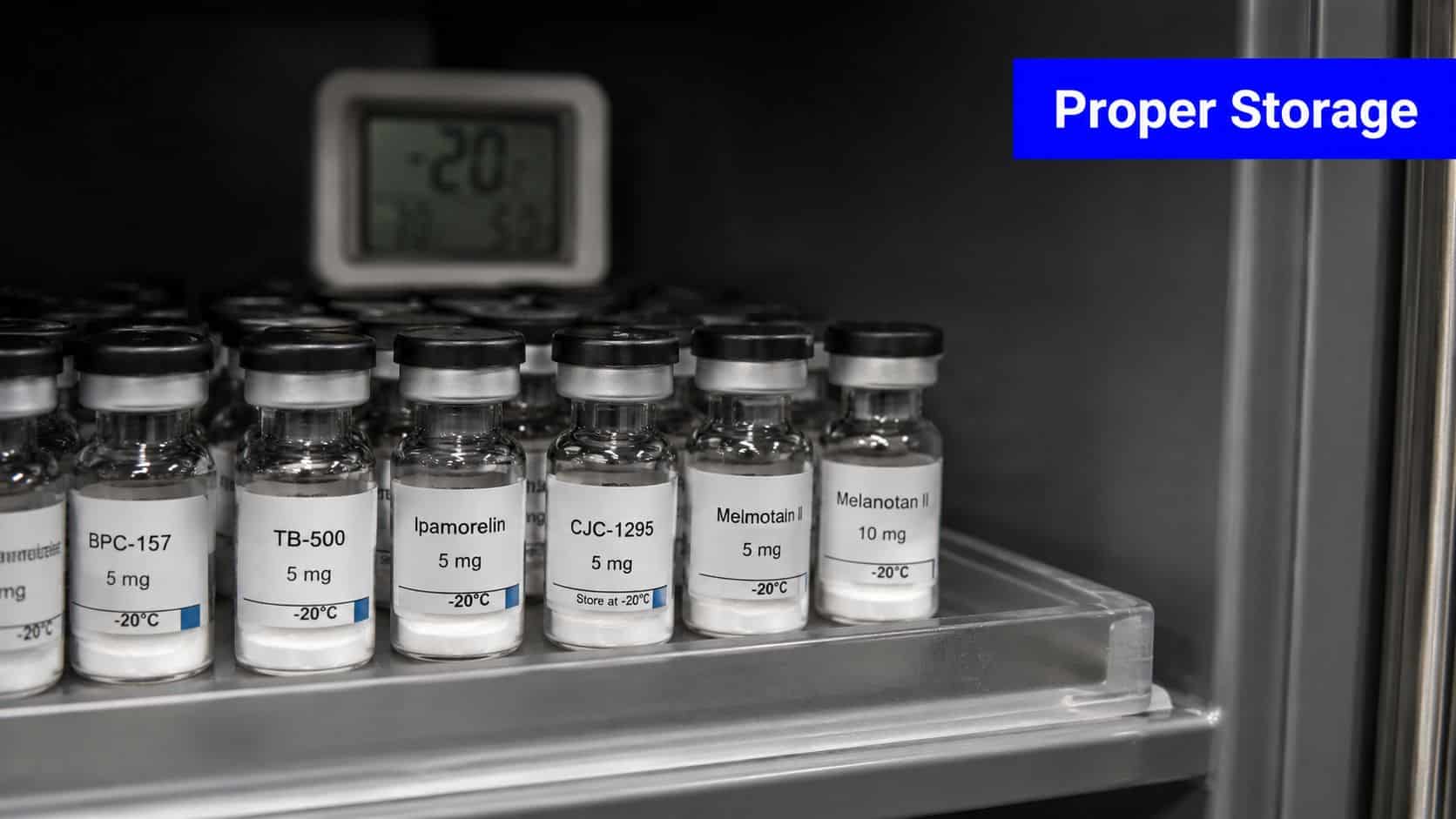
Treat the lyophilized vial and the reconstituted solution as separate handling states. The powder is more stable in storage than the mixed solution. Once liquid is added, contamination control and temperature control become much more important.
Use practical storage rules:
You'll often see generalized shelf-life claims in peptide discussions, but unless that information is product-specific and documented, it's better to stay qualitative. In laboratory practice, shorter, cleaner handling windows are usually the safer choice.
A good storage protocol also protects against documentation drift. If two vials look identical but only one has a concentration label, the dosing error has already started.
What does a correct PT-141 dose mean if the handling schedule around that dose is unsafe, undocumented, or impossible to reproduce?
Dose accuracy and safety have to be treated as one workflow. In practice, adverse effects often appear first where protocol discipline is weakest: the starting dose is too aggressive, the interval between administrations is too short, or the reconstituted vial is used without clear labeling and exposure tracking. For PT-141, nausea is the tolerability issue that most often limits protocol design, and clinical safety information for the approved product also describes flushing, headache, and injection-site reactions among reported adverse events in studied use conditions, as outlined in the prescribing information for Vyleesi from the U.S. Food and Drug Administration.
Contraindications should be handled with the same precision as concentration math. Bremelanotide has blood pressure and heart rate effects, so protocols that involve subjects with uncontrolled hypertension or known cardiovascular disease require medical oversight and a clear exclusion framework. The official prescribing information for Vyleesi from Cosette Pharmaceuticals also describes use restrictions tied to cardiovascular status and highlights gastrointestinal adverse effects that can affect tolerability and study continuity.
Administration frequency also needs a hard ceiling. Repeated exposure is not just a scheduling variable. It changes the safety profile of the protocol. The DailyMed drug label for bremelanotide describes limits on use frequency and warns about focal hyperpigmentation with repeated administration. That matters in research settings because a poorly spaced dosing plan can distort both tolerability observations and interpretation of repeat-dose data.
A simple way to frame PT-141 safety is to treat it like any other potent signaling compound. The milligram value is only one part of the exposure. Route, interval, subject selection, and record quality all shape the actual outcome.
Before any PT-141 vial enters an active protocol, confirm the full chain of handling:
The practical lesson is straightforward. A PT-141 protocol is only as good as its weakest step. Choosing a starting dose, reconstituting the vial correctly, drawing the right volume, spacing administrations conservatively, and storing the solution under controlled conditions all serve the same goal: a result another researcher can audit and reproduce.
If you're sourcing materials for analytical or preclinical work, Peptide Warehouse USA offers high-purity research peptides with batch documentation, COAs, and a research-only supply model. Learn more and explore options if you need a more consistent procurement workflow for PT-141 and related peptide studies.