No products in the cart.


You're at the bench with a lyophilized peptide vial, a syringe, and a reconstitution solution 30 mL vial. The label tells you the compound's mass, but not always which solvent to choose, how much to add, or how to convert the resulting concentration into a precise research aliquot. A small mistake at this stage can affect solubility, sterility, calculations, and the traceability of the entire experiment.
This guide builds the process from the ground up. You'll learn what the 30 mL format is, how bacteriostatic water differs from preservative-free sterile water and saline, how to calculate peptide concentration, and how to handle, label, and store reconstituted research samples. The examples are for laboratory, analytical, and preclinical research planning only, not for human or animal administration.
A 30 mL reconstitution solution is a sterile diluent supplied to dissolve or dilute compounds for injection-based laboratory workflows. In the bacteriostatic format, it contains water for injection and 0.9% benzyl alcohol, or 9 mg/mL. This preservative inhibits bacterial growth and supports repeated withdrawals from the same vial. The FDA labeling describes the presentation as sterile and nonpyrogenic, for diluting or dissolving drugs for intravenous, intramuscular, or subcutaneous injection according to manufacturer instructions. FDA labeling for the 30 mL bacteriostatic water presentation
The term multi-dose describes the container and intended workflow. It does not relax aseptic requirements. Each puncture can introduce contamination, so the preservative supports controlled handling but does not replace a clean work surface, sterile technique, or a new sterile needle and syringe for every withdrawal.
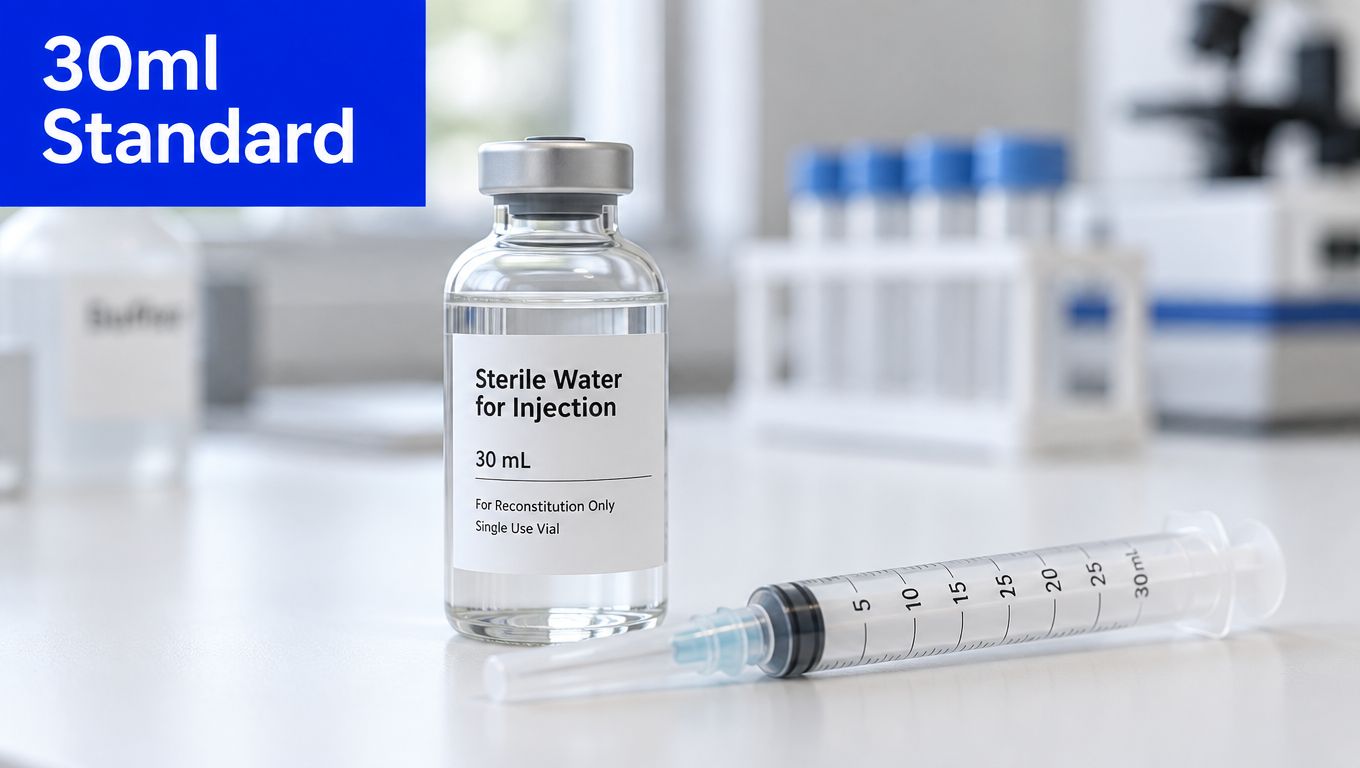
The format occupies a useful middle ground between a single-use ampoule and a larger bulk container. It provides liquid for repeated laboratory preparations while keeping the vial manageable for handling, storage, and inventory checks. Its familiar presentation also appears in regulated healthcare and laboratory supply chains.
Packaging supports that workflow. Major-market specifications describe the 30 mL product as a plastic flip-top multi-dose vial, allowing controlled access and dose management alongside the liquid formulation. McGuff's product specifications for bacteriostatic water
A vial marked bacteriostatic water is not automatically compatible with every peptide, compound, assay, or research protocol. The required solvent may instead be preservative-free sterile water, saline, a buffer, or another validated solution. Compatibility depends on the formulation, intended application, target concentration, pH requirements, and stability information supplied by the manufacturer.
Practical rule: Treat solvent selection as part of experimental design, not as an interchangeable supply decision.
Before opening the vial, verify its identity, preservative status, lot information, expiry information, and physical clarity. Then check the compound's reconstitution instructions. If the documentation specifies a diluent, follow that requirement rather than selecting the 30 mL format only because it is convenient. This decision determines whether the formulation remains suitable for the planned research workflow.
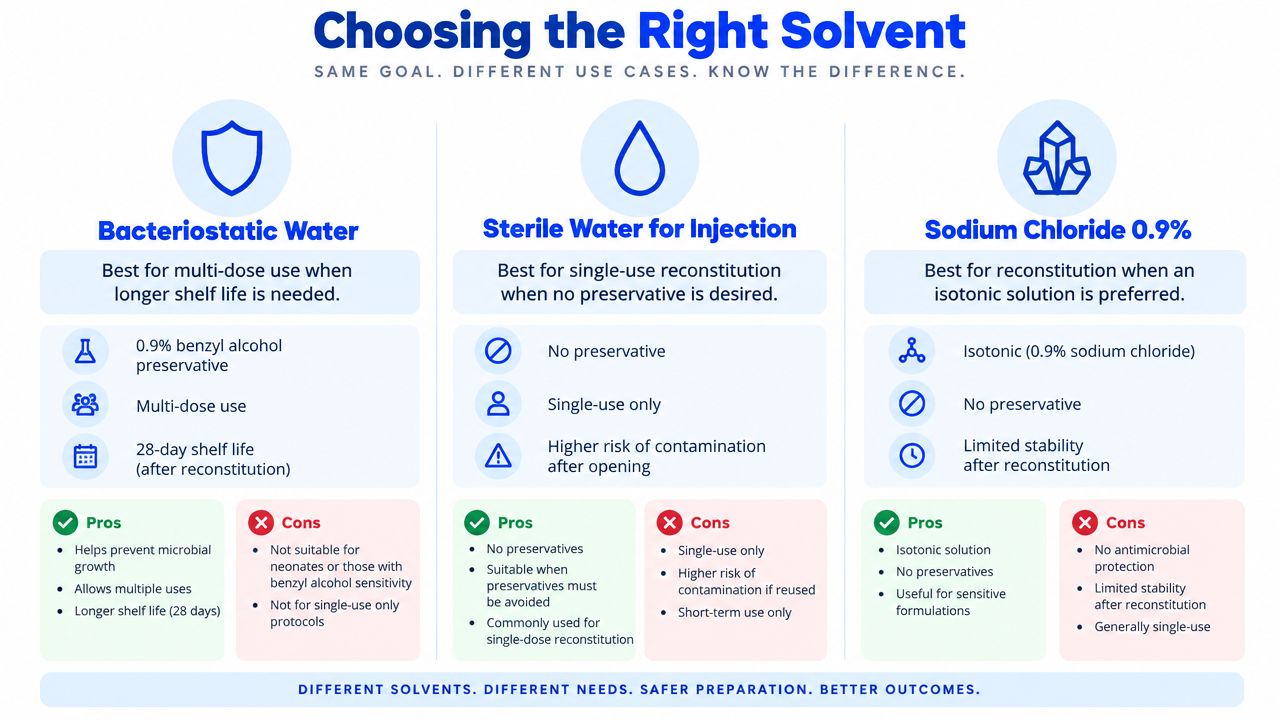
The central decision is simple: will the reconstituted sample be accessed repeatedly, and does the compound permit a preservative? Bacteriostatic water is designed for multi-dose access because it contains 0.9% benzyl alcohol, while preservative-free sterile water is intended for single-use handling. Saline introduces sodium chloride and therefore isn't a neutral substitute for water.
The FDA labeling for bacteriostatic water identifies it as a multiple-dose container containing 0.9% benzyl alcohol and limits its use to diluting or dissolving drugs for injection according to manufacturer instructions. FDA labeling for bacteriostatic water
Bacteriostatic water contains sterile water for injection and 0.9% benzyl alcohol. It fits a controlled workflow in which a compatible reconstituted sample is accessed more than once. The preservative inhibits bacterial growth, but it doesn't sterilize a contaminated vial and doesn't make poor technique acceptable.
Preservative-free sterile water contains no benzyl alcohol. It can be appropriate when a protocol requires a preservative-free diluent or when the entire reconstituted preparation is used in a single controlled event. It isn't the default choice for a vial that will be repeatedly sampled.
Sodium chloride 0.9% contains saline rather than water alone. It may be appropriate when the compound's documentation specifies an isotonic saline environment or a particular ionic condition. It should not be selected merely because it is readily available, since salts can change solubility, pH behavior, or assay performance.
Read the compound documentation first. If the manufacturer specifies preservative-free water, saline, or another solvent, that instruction controls the decision.
Check whether repeated access is required. If the sample will be used once and discarded, a preservative-free single-use diluent may be suitable when the protocol allows it. If repeated withdrawals are part of the validated workflow and the compound tolerates benzyl alcohol, a bacteriostatic multi-dose vial may be more practical.
Check compatibility rather than assuming it. Benzyl alcohol can affect certain sensitive formulations, and saline can alter an experiment's ionic environment. A convenient solvent becomes the wrong solvent if it changes the assay or destabilizes the compound.
Exclude nonsterile water. Distilled water for general laboratory use isn't equivalent to sterile water for injection and shouldn't be used as a substitute for a validated reconstitution solvent.
The product distinction matters because preservative status changes the intended workflow. A 30 mL vial isn't just a volume decision. It combines a liquid formulation, a closure system, and a handling model that must match the research protocol.
Concentration calculations become manageable when you keep the units consistent. Start with the mass of lyophilized peptide in milligrams and divide it by the final solution volume in milliliters.
Concentration in mg/mL = peptide mass in mg ÷ final volume in mL
For a 10 mg lyophilized vial, adding 5 mL of compatible solvent gives:
10 mg ÷ 5 mL = 2 mg/mL
Adding 2 mL gives:
10 mg ÷ 2 mL = 5 mg/mL
These examples use the supplied 10 mg vial scenario and demonstrate the calculation method. They don't establish a recommended concentration for any particular compound.
Record the peptide mass. Use the amount stated on the vial or its accompanying documentation.
Choose a target concentration. Select a concentration that supports the assay's required working range and the measuring device's practical resolution.
Calculate the solvent volume. Rearrange the formula:
Solvent volume in mL = peptide mass in mg ÷ target concentration in mg/mL
Check the intended final volume. The peptide cake adds some physical volume after dissolution. For routine bench calculations, researchers often use the solvent volume as the working approximation, but high-precision work should follow the validated method or account for final-volume behavior.
Write the result into the batch record. Record peptide mass, solvent identity, solvent lot, added volume, calculated concentration, date, and operator initials.
Once concentration is known, calculate the volume required for a desired mass:
Volume in mL = desired peptide mass in mg ÷ concentration in mg/mL
At 2 mg/mL, a 1 mg research aliquot requires:
1 mg ÷ 2 mg/mL = 0.5 mL
At 5 mg/mL, a 1 mg research aliquot requires:
1 mg ÷ 5 mg/mL = 0.2 mL
If your laboratory uses an insulin syringe marked in units, verify the device calibration before converting. On a U-100 scale, one milliliter corresponds to 100 units, so 0.5 mL corresponds to 50 units and 0.2 mL corresponds to 20 units. Those unit conversions describe the measuring scale, not a human-use dose, and the device markings must be confirmed before use.
| Solvent Added (mL) | Resulting Concentration (mg/mL) | Volume per 1 mg Dose (mL) |
|---|---|---|
| 2 | 5 | 0.2 |
| 5 | 2 | 0.5 |
The safest calculation habit is to perform the arithmetic twice, preferably with a calculator or validated spreadsheet, then have another trained person verify the entry. Concentration errors often begin with a unit mismatch, a misplaced decimal, or confusion between the amount of solvent added and the final solution volume.
A good calculation still fails if the transfer introduces contamination or excessive agitation. Prepare the materials before puncturing the vial, including the compatible solvent, sterile syringe, sterile needle, alcohol swabs, labels, and the relevant protocol or batch record.
Clean the work surface and organize materials so you don't reach over open containers.
Inspect both vials. Don't use a container with damaged closure components, unexpected particles, cloudiness, leakage, or questionable labeling.
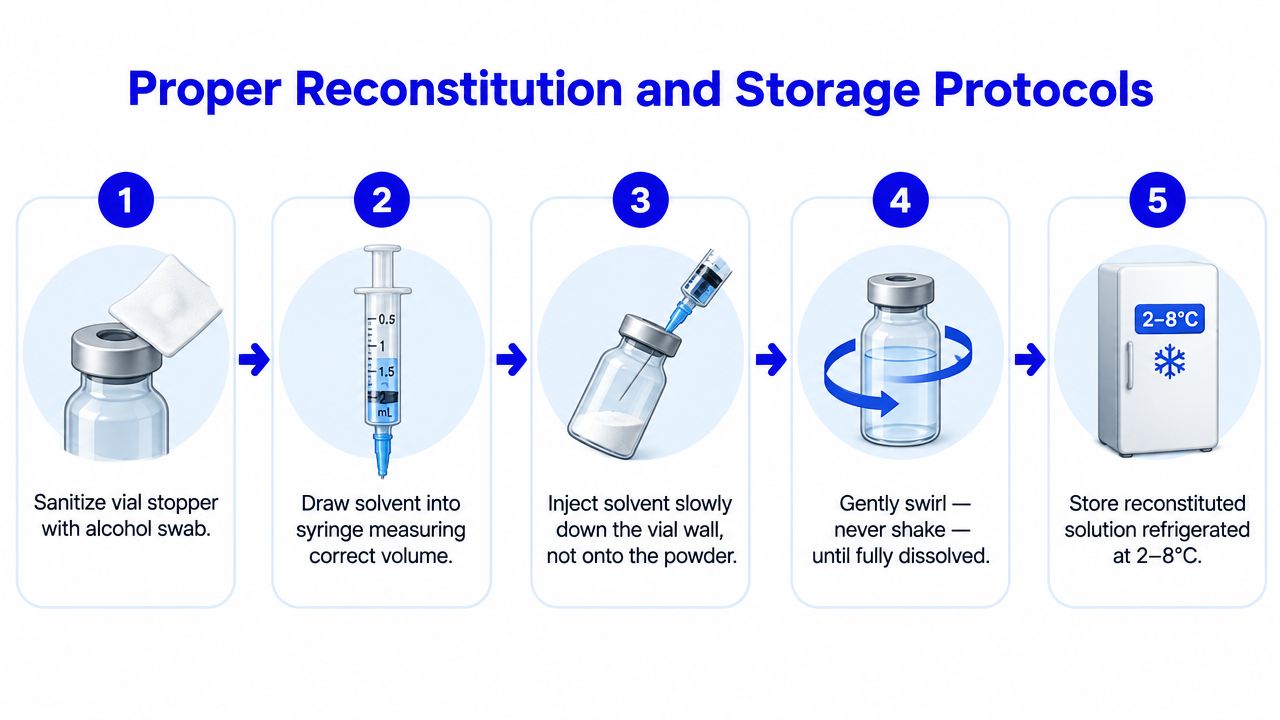
Remove the protective cap from the vial stopper, then disinfect the stopper with an appropriate alcohol swab. Allow the surface to dry rather than touching it immediately.
Draw the calculated solvent volume using a new sterile syringe and needle. Keep the needle and syringe connections protected from contact with the bench, gloves, or other nonsterile surfaces.
If the protocol requires pressure equalization, manage vial pressure deliberately and according to the applicable laboratory procedure. Avoid uncontrolled force that can cause splashing, aerosol formation, or loss of material.
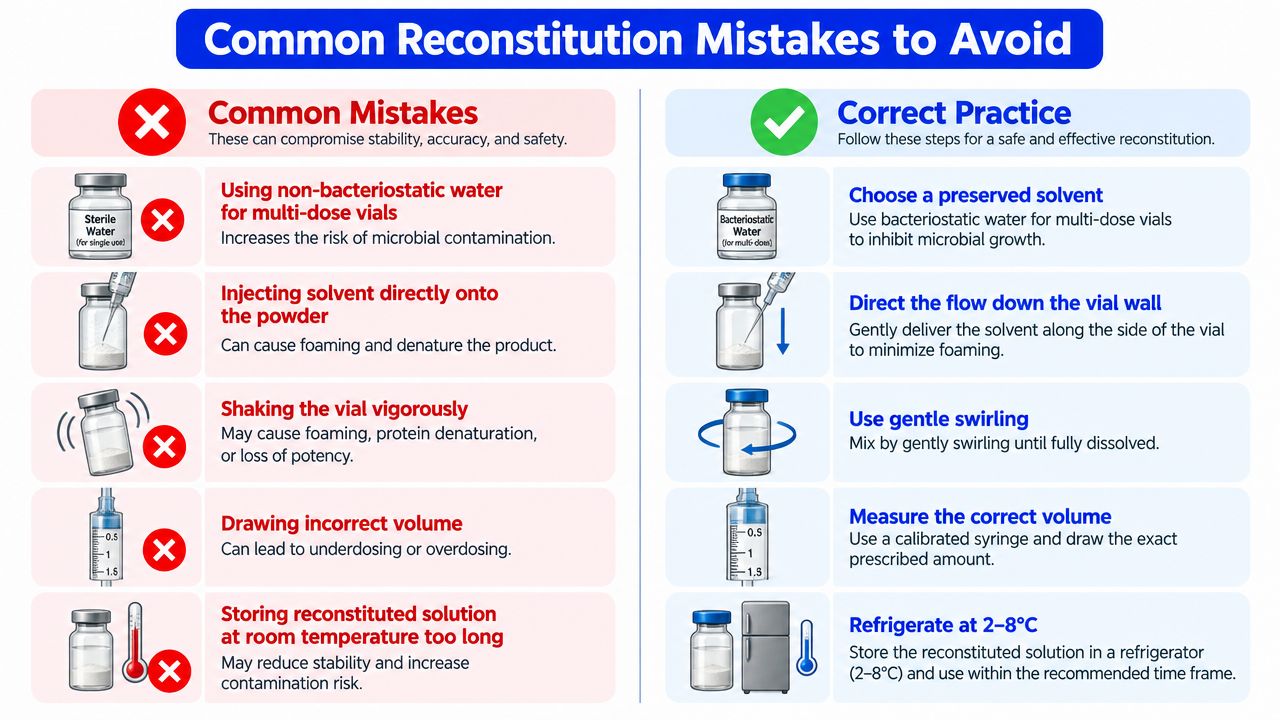
Direct the solvent slowly down the inside wall of the peptide vial instead of aiming the stream directly at the powder. This reduces foaming and limits mechanical stress.
Allow the solvent to contact the material, then gently swirl the vial until the solution appears fully dissolved. Never shake a delicate peptide vial vigorously unless the compound's validated instructions specifically require a different approach.
A useful label should identify the compound, solvent, concentration, preparation date, operator, and relevant lot numbers. Include any assigned storage condition and discard or review date required by your laboratory's quality system. If the solution changes color, develops visible particles, or behaves unexpectedly during dissolution, quarantine it and document the observation before deciding what to do next.
For laboratories handling hazardous substances, connect the reconstitution procedure to the broader chemical risk assessment. A practical resource on workplace controls is this COSHH assessment for UK businesses, which can help teams organize hazard information, exposure controls, and documented procedures.
Cold storage should follow the compound's validated documentation. The supplied protocol visualization identifies refrigeration at 2 to 8°C, but that range should not override product-specific stability instructions. Protect samples from light when indicated, minimize temperature cycling, and avoid repeatedly warming and cooling the vial.
The instructional video below can provide a visual reminder of the handling sequence. Use your own approved laboratory SOP as the controlling document.
The most dangerous assumption is that bacteriostatic water makes a vial safe under any handling conditions. It doesn't. Benzyl alcohol inhibits bacterial growth, but the preservative doesn't correct a contaminated stopper, a reused needle, an unsuitable solvent, or a poorly controlled temperature history.
Using the wrong water for repeated access. Preservative-free sterile water doesn't provide the same multi-dose preservative function as bacteriostatic water. If repeated withdrawals are planned, check whether the compound and protocol permit a preserved diluent.
Using a nonsterile water source. General distilled water isn't a validated substitute for sterile water for injection. The fact that water looks clear says nothing about its microbiological suitability.
Reusing needles or syringes. A needle that has contacted a vial, bench, glove, or other material can transfer contamination back into the container. Use a new sterile assembly for each withdrawal as required by your SOP.
Injecting solvent directly onto the powder. A forceful stream can create foam and increase agitation. Direct the liquid down the vial wall and add it slowly.
Shaking vigorously. Mechanical stress can promote foaming and may damage sensitive peptide structures. Gentle swirling is the safer default unless the validated instructions say otherwise.
Measuring by guesswork. A small volume error changes the calculated concentration. Record the solvent volume and verify the arithmetic before aliquoting.
Ignoring solvent compatibility. Benzyl alcohol, saline, pH, and ionic strength can interact with a formulation. A compound that requires preservative-free solvent shouldn't be placed in bacteriostatic water just because the vial is available.
Leaving the sample warm or exposed to light. Temperature excursions and light exposure can reduce stability for sensitive materials. Follow the product documentation and record any excursion rather than silently returning the vial to storage.
Pause before the first withdrawal and confirm five items:
A preserved solvent improves a multi-dose workflow, but it never replaces aseptic technique or compound-specific compatibility data.
If any answer is uncertain, don't proceed on assumption. Consult the compound documentation, your laboratory manager, quality lead, or the responsible safety professional.
Reconstitution quality starts before the vial reaches the laboratory. A reliable purchasing process should connect the solvent, peptide, documentation, storage conditions, and batch record so researchers can trace every preparation back to its source.
Look for documentation that allows a trained reviewer to evaluate the material rather than relying on a product title alone. Useful records may include:
Certificate of Analysis. Confirm the compound identity, stated purity, lot number, and test date where provided.
Microbial and endotoxin documentation. These records help the laboratory assess whether the material suits its analytical or preclinical workflow.
Clear preservative information. A product should identify whether it contains 0.9% benzyl alcohol or is preservative-free.
Manufacturing and batch details. Transparent production records support investigation when results vary between lots.
Defined research-use status. Supplies should be labeled and handled according to applicable laboratory, institutional, and regulatory requirements.
Peptide Warehouse USA offers research peptides and related compounds, along with a 30 mL bacteriostatic water product for laboratory reconstitution workflows. Its published supplier information describes USA manufacturing, batch testing, Certificates of Analysis, and documentation addressing microbial and endotoxin testing. Products are sold for research, laboratory, or analytical use only, not for human consumption.
A consistent workflow combines the right solvent with correct mathematics, aseptic transfer, controlled storage, and complete records. Before ordering, compare the product documentation with your protocol and confirm that the selected formulation is compatible with the compound and intended experiment.
Choose the solvent and peptide supplies that match your laboratory's validated workflow, then document every preparation from lot number through final concentration. Visit Peptide Warehouse USA to explore its research-use peptides, compounds, and 30 mL bacteriostatic water option for controlled laboratory reconstitution.