No products in the cart.

You’re probably in the same spot most buyers hit after a few hours of searching. Every vendor says their material is pure, every listing looks polished, and every forum thread seems to swing between hype and suspicion. That’s why serious research peptides reviews can’t stop at product claims. They have to start with documents, traceability, and the vendor’s willingness to show their work.
The peptide category itself is real science, not internet trend-chasing. A 2022 review of therapeutic peptides noted that more than 80 therapeutic peptides had already reached the global market, with hundreds more in development. The problem isn’t whether peptides matter. The problem is how to separate legitimate research materials from weak documentation, recycled paperwork, and unsupported claims.
If I were training a new lab buyer, I’d give them one rule first. Never evaluate a peptide by the product page alone. Evaluate the batch, the test methods, the vendor’s transparency, and the way other buyers describe real handling and documentation experience.
Most sourcing mistakes happen before the product arrives. A buyer sees a strong purity claim, a polished label, and a few positive comments, then assumes the rest of the quality system must be solid too. That assumption causes more trouble than almost anything else in peptide procurement.
The peptide field deserves serious attention. It’s built on a legitimate scientific base, and the commercial and academic interest around it didn’t appear out of nowhere. As noted earlier, the therapeutic side of the field has already produced marketed drugs and a deep development pipeline, which is why peptide research keeps drawing serious attention instead of fading out as a short-lived niche.
What changes in the research market is not the importance of peptides. It’s the uneven quality of what gets sold under that label.
A good review process looks less like shopping and more like intake control. You’re not asking, “Does this product sound promising?” You’re asking:
Practical rule: If a vendor makes the product easy to buy but the batch hard to verify, treat that as a quality warning.
When teams build reliable research peptides reviews, they usually score vendors on a short list of operational criteria instead of marketing language.
| Review area | What to check |
|---|---|
| Documentation | Batch-specific COA, recent testing date, readable methods |
| Identity | Product name, lot number, molecular confirmation |
| Purity | Clear chromatographic result, not just a headline claim |
| Safety panel | Endotoxin, microbial, and contaminant reporting if available |
| Transparency | Fast answers, consistent paperwork, no evasive replies |
| Handling | Proper packaging, storage guidance, shipping logic |
That framework won’t make every decision easy. It will make weak vendors easier to reject.
A Certificate of Analysis, or COA, is the first document I check and the first document many buyers misunderstand. It functions much like a nutrition label for a peptide lot, but with greater implications. It doesn’t just summarize what should be in the vial. It should tell you what batch was tested, how it was tested, and whether the report belongs to the material being sold.
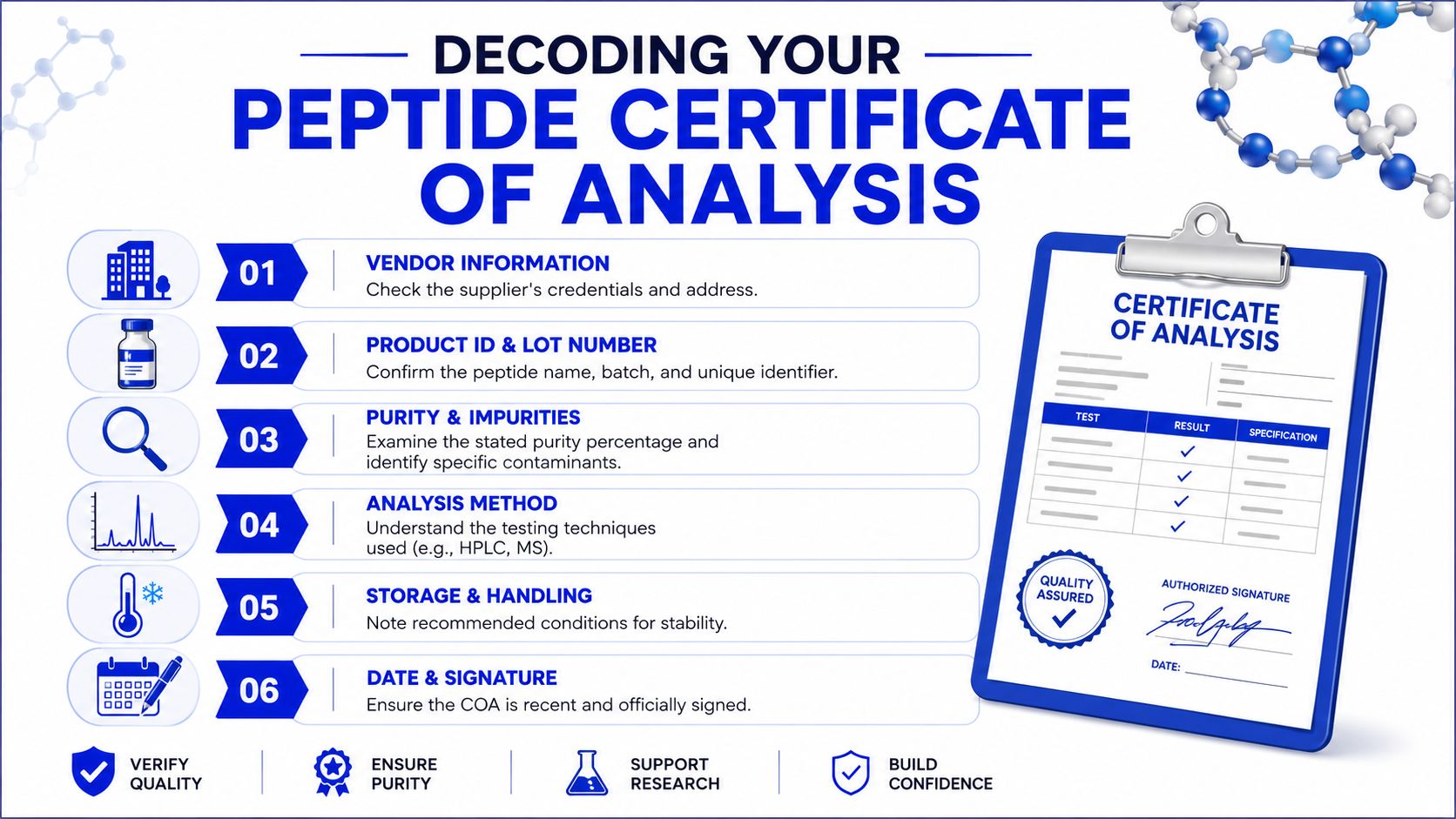
Before reading the analytical data, confirm that the document can be tied to a real batch.
Look for these fields first:
If the COA doesn’t show a clear lot number, I treat it as incomplete. If the lot number exists but the seller can’t tell you whether current inventory matches that lot, I treat it as unreliable.
Many buyers stop at the purity line. That’s not enough.
HPLC is commonly used to assess purity by showing how much of the sample appears as the main peptide peak versus other peaks. If a seller advertises a strong purity result, the chromatogram or summary table should support that claim.
Mass spectrometry, often listed as MS, serves a different role. It helps confirm molecular identity by checking whether the measured mass matches the expected peptide.
You want both ideas answered:
A COA that only gives a purity headline without showing how identity was confirmed is weaker than it looks. A COA that confirms identity but says little about impurities is also incomplete for buyer review purposes.
A strong COA answers identity, purity, batch linkage, and timing in one place.
Most bad COAs don’t look dramatic. They look vaguely acceptable. That’s what makes them dangerous.
Watch for patterns like these:
When I train new staff, I tell them to review a COA in this order:
That order matters. If the batch link fails, the rest of the report doesn’t help much.
A high purity number can create false confidence. Buyers see a clean headline and assume the material is ready for use. In practice, purity is only one part of quality, and sometimes not the most important part.

Purity reporting usually focuses on how much of the sample appears to be the target peptide versus other detectable components under the stated method. That’s useful, but it doesn’t answer every risk question.
Purity alone does not tell you:
This is why experienced buyers ask for more than a single chromatogram.
A peptide can look clean on a purity report and still be poorly documented from a safety and handling standpoint.
If the vendor offers broader batch documentation, these are the reports I prioritize.
A vendor that can provide these reports on request is telling you something important about their process. They’re treating quality as a system, not a slogan.
The short explainer below is useful if you want a broader refresher on lab quality context before comparing suppliers.
Some vendors only display the document most likely to convert a sale. That’s usually the purity page. A better practice is to ask whether additional batch-level reports exist and whether they match the same lot number.
If the answer is clear and the paperwork lines up, that’s a good sign. If the answer shifts, stalls, or turns into vague reassurance, move on.
One factual example of this documentation style is Peptide Warehouse USA, which states that its lots are supported by third-party COAs along with microbial and endotoxin reports for research, laboratory, and analytical use. That doesn’t remove the need to review each batch. It does reflect the kind of documentation stack a careful buyer should look for.
A COA only matters if the vendor handles documentation truthfully and consistently. That’s the point many buyers miss. They ask, “Do you have testing?” when the better question is, “Can you show that this exact batch was tested, by whom, and when?”
The market is crowded enough that paperwork quality has become a core review issue, not a side concern. An independent analysis reported 7,933 samples procured from 224 vendors, which highlights how fragmented this supplier market is. In a market that large, weak documentation doesn’t stand out by looking obviously fake. It hides inside volume.
Trustworthy vendors tend to behave the same way across interactions. Their listing language is restrained. Their documents are consistent. Their support team can answer direct questions without switching topics or leaning on hype.
Poor vendors often reveal themselves operationally, not visually.
Common red flags include:
Send short, direct questions and judge both the answers and the speed of response.
Here’s a practical set:
The point isn’t to interrogate. It’s to test whether the vendor runs a real quality process.
If a supplier answers detailed questions with sales language, you’ve learned something important about how they operate.
Real transparency is specific. It looks like filenames, lot numbers, dates, method names, and clean answers. It doesn’t look like “our products are premium” repeated in three different ways.
A vendor doesn’t need to be perfect to be credible. They do need to be traceable.
Online feedback can help, but only if you treat it as one input among several. The best research peptides reviews don’t confuse user anecdotes with verified evidence, and they don’t let glowing testimonials override missing batch documentation.
That distinction matters because broad peptide claims often outrun the human evidence. As discussed in Eric Topol’s review of the peptide craze, for many research compounds there is no evidence from randomized human trials supporting the popular claims made online, and long-term human safety data remains limited. That means reviews built on stories alone should stay in the “interesting signal” category, not the “validated conclusion” category.
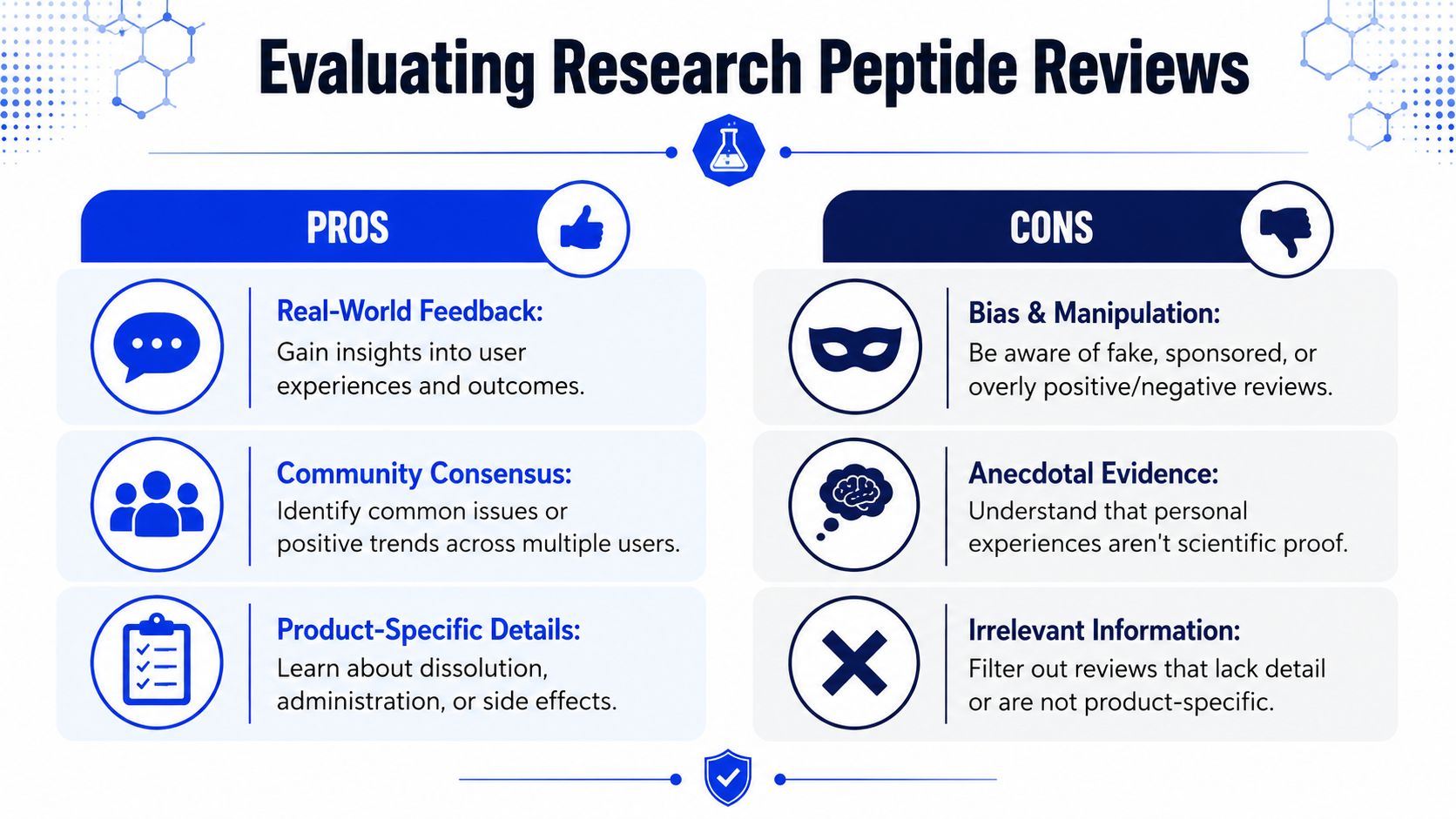
A strong review is usually concrete, restrained, and specific about process.
Look for details such as:
If you want to calibrate what believable customer evidence looks like in general, it helps to study structured examples of social proof outside the peptide space. Good testimonials tend to include context, specifics, and a clear description of what was experienced.
Weak reviews are usually easy to spot once you know the patterns.
I treat community feedback as a screening tool, not a final decision tool.
Use it to answer questions like:
| Useful question | Better review signal |
|---|---|
| Does this vendor ship consistently? | Repeated comments on packaging and timing |
| Do buyers receive documentation? | Mentions of COAs, lot numbers, and support responses |
| Are problems handled professionally? | Specific notes on replacements, clarification, or follow-up |
Ignore reviews that try to settle scientific questions with enthusiasm alone. The right question isn’t whether people sound convinced. It’s whether their experience helps you verify documentation, handling, and supplier behavior.
The last stage happens after you’ve reviewed the paperwork and decided the vendor is worth considering. You then protect the integrity of the material from shipment through storage. A clean batch can still become a bad purchase if shipping, packaging, or intake handling are sloppy.
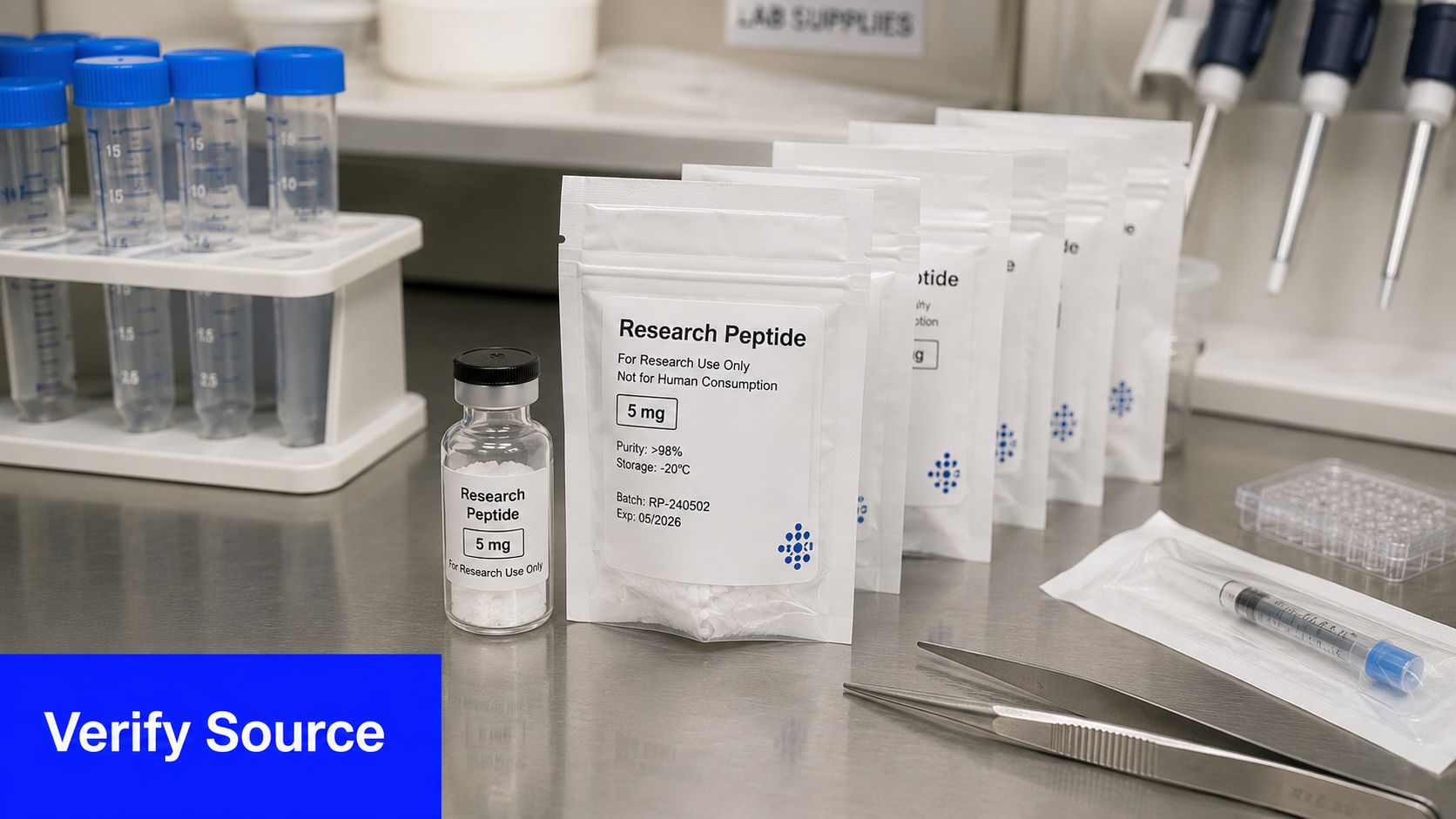
Before ordering, confirm how the material is packed and what storage conditions the vendor recommends. Lyophilized material, liquid products, and nasal spray formats don’t all present the same handling profile. The vendor should be able to state how the product is packaged and what conditions help preserve integrity.
When the order arrives, inspect it before logging it into inventory.
Use a short receiving checklist:
Buy as if you may need to audit the purchase later. That habit catches problems early.
Buyers often skim “For Research Use Only” language as boilerplate. That’s a mistake. It’s part of the risk profile.
Recent discussion around peptide sourcing shows that regulation and enforcement are changing, and recent expert coverage noted that states such as Alabama have begun cracking down on research-grade peptides. The same discussion also drew a clear line between FDA-approved peptide medicines and gray-market products sold as research use only. For buyers, that means disclaimers aren’t just legal fine print. They tell you how the seller positions the product, what claims they should not be making, and how carefully you need to read compliance language.
A compliant vendor should make three things clear:
That clarity protects both the buyer and the integrity of the procurement process.
If you’re comparing suppliers and want a vendor that publishes batch-focused documentation for research use, Peptide Warehouse USA is one option to review. Explore its peptide catalog, COA-based documentation approach, and support resources, then compare those materials against the vetting checklist above before you buy.