No products in the cart.


You’re probably seeing the same pattern everywhere. One forum thread says a peptide vendor is flawless. Another says the vial arrived warm, the batch looked off, or the support team vanished when someone asked for testing data. Then a product page adds star ratings, a few dramatic testimonials, and a polished Certificate of Analysis that may or may not mean anything.
That’s the core problem with research peptides reviews. Most of them aren’t reviews in any scientific sense. They’re a mix of anecdote, marketing, and partial documentation. If you want to source reliable compounds, you have to stop reading them like a shopper and start auditing them like a lab buyer.
The right question isn’t “What did this peptide do for someone?” The right question is “What objective proof supports identity, purity, handling, and traceability?” That shift changes everything.
The modern peptide market is crowded with commentary, but very little of it is built for actual due diligence. Reviews often blur together vendor experience, biological claims, personal experimentation, and reposted lab documents. That makes casual browsing feel informative when it often isn’t.
Independent reporting in 2025 noted growing consumer interest in unapproved peptides and a marketplace for “research chemicals” that haven’t gone through normal clinical trials or approval pathways. The same reporting also tied part of that interest to the way FDA-approved GLP-1 drugs have normalized peptide discussion in the broader public conversation, even as demand can outpace careful interpretation of non-approved products, as described by NutraIngredients reporting on unapproved research peptides.
A typical buyer sees three kinds of information mixed together:
That mix creates a false sense of certainty. A product can look heavily “reviewed” without being well documented.
Practical rule: If a review spends more time on what the compound supposedly did than on how the batch was verified, it’s low-value for sourcing.
The phrase research only shouldn’t be treated as throwaway legal copy. It tells you how the product should be evaluated. These compounds are sold under a laboratory or analytical use framework, so your criteria should match that framework.
That means asking procurement questions, not wellness questions. Who made the batch? Was identity confirmed? Is there batch-specific documentation? Was the sample screened beyond simple purity? Can the vendor explain storage, handling, and lot traceability without getting vague?
A common failing in many research peptides reviews is that they compare brands the way people compare supplements or skincare, when the more appropriate comparison is between scientific suppliers. Once you adopt that mindset, testimonials become secondary and documentation becomes primary.
A Certificate of Analysis, or COA, is the first document that deserves your attention. Not because every COA is trustworthy, but because it gives you something concrete to inspect. A review without batch documentation is only a story.
Peer-reviewed literature on peptide development places identity and purity confirmation by LC–MS/HPLC at the start of a reliable review process, and also notes that many linear peptides are rapidly degraded by proteases and often need modification to improve stability and bioactivity. That’s why the first checkpoint is proof of what the material is, not claims about what it supposedly does, as outlined in the PMC review on peptide drug development and analytical verification.
A useful COA should answer a short list of basic questions:
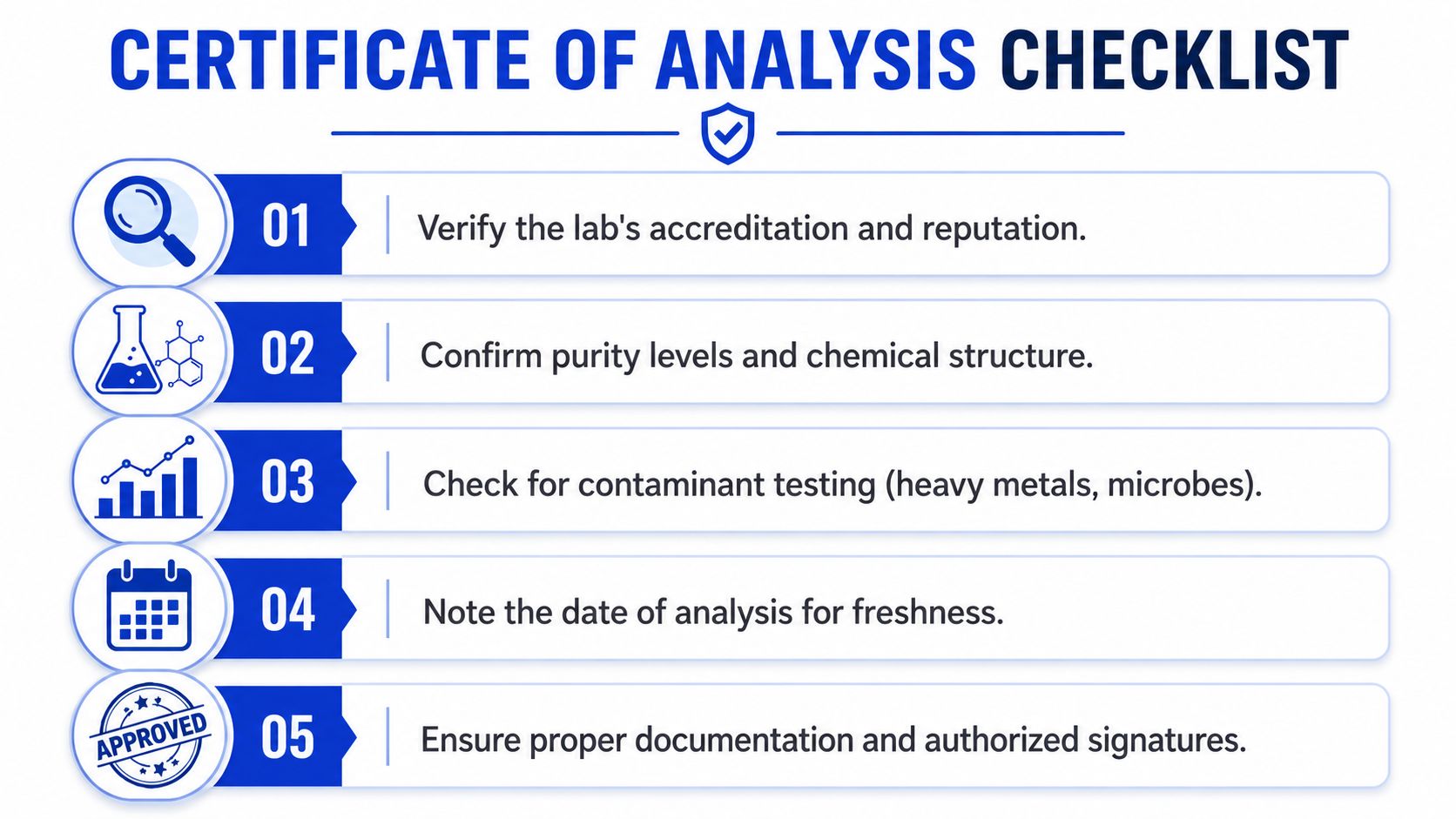
A vendor can post a generic PDF and call it transparency. That’s not the same as providing a real batch record. You want a lot number, analysis date, method references, and results that correspond to the item being sold now, not a template recycled across products.
HPLC usually tells you about purity. In plain terms, it helps show whether the sample is mostly the intended compound or a mixture with other components. A purity number by itself is not enough, but it’s still important.
LC–MS or mass spectrometry supports identity. It helps answer a more basic question: does the material match the expected molecular profile for the peptide named on the label?
A quick way to consider this:
| Test type | Main purpose | What it does not prove by itself |
|---|---|---|
| HPLC | Purity profile | Full identity, sterility, or handling quality |
| LC–MS | Identity confirmation | Complete impurity characterization |
| COA document | Batch summary | Whether the issuing lab is independent or reliable |
If a product page highlights purity but says nothing about identity testing, that’s incomplete. A clean-looking chromatogram doesn’t automatically mean the peptide is the right peptide.
A peptide can look “high purity” on paper and still fail the more important question of whether the batch was correctly identified and properly documented.
A few warning signs come up repeatedly:
Another red flag is when a vendor treats reasonable questions like hostility. If support can’t explain whether the COA is batch-specific, whether testing was internal or external, or whether additional reports exist for endotoxin or microbial screening, that tells you a lot.
A COA is only as strong as the system behind it. A document can be technically formatted and still offer weak assurance if the testing source is unclear, unverifiable, or too closely tied to the seller.

There’s a practical difference between first-party testing and third-party testing.
First-party testing means the seller, manufacturer, or a directly controlled lab generated the results. That can still be useful, but it requires more skepticism. Third-party testing means an independent lab produced the report. That doesn’t make the report flawless, but it reduces one obvious conflict.
When validating a testing claim, check for these points:
If a vendor refuses to identify the lab, that’s a problem. If the vendor names the lab but can’t connect the report to the lot being sold, that’s also a problem.
Purity isn’t the only issue that matters. For research procurement, contaminant screening can be just as important as peptide identity.
Expert commentary on BPC-157 and similar compounds has emphasized that translational risk depends heavily on context, including study design, dose, route, and species. That same skeptical framework applies to sourcing. Functional claims are weak if the sample itself hasn’t been validated by mass spectrometry and screened for contamination concerns, as discussed in expert commentary on translational risk and technical validation.
Here’s what to ask for in addition to a basic COA:
A vendor doesn’t need to flood you with paperwork. They do need to show that quality control extends beyond one purity graphic.
A useful explainer on evaluating documentation and lab workflow is below.
Most bad reviews don’t look obviously fake. They look slightly too neat, slightly too emotional, or slightly too aligned with a sales page. That’s why reading research peptides reviews requires the same skepticism you’d apply to a questionable lab record.
Fake or biased reviews often rely on broad praise instead of usable detail. They repeat product names, talk about “fast results,” or describe the vendor in marketing language rather than buyer language.
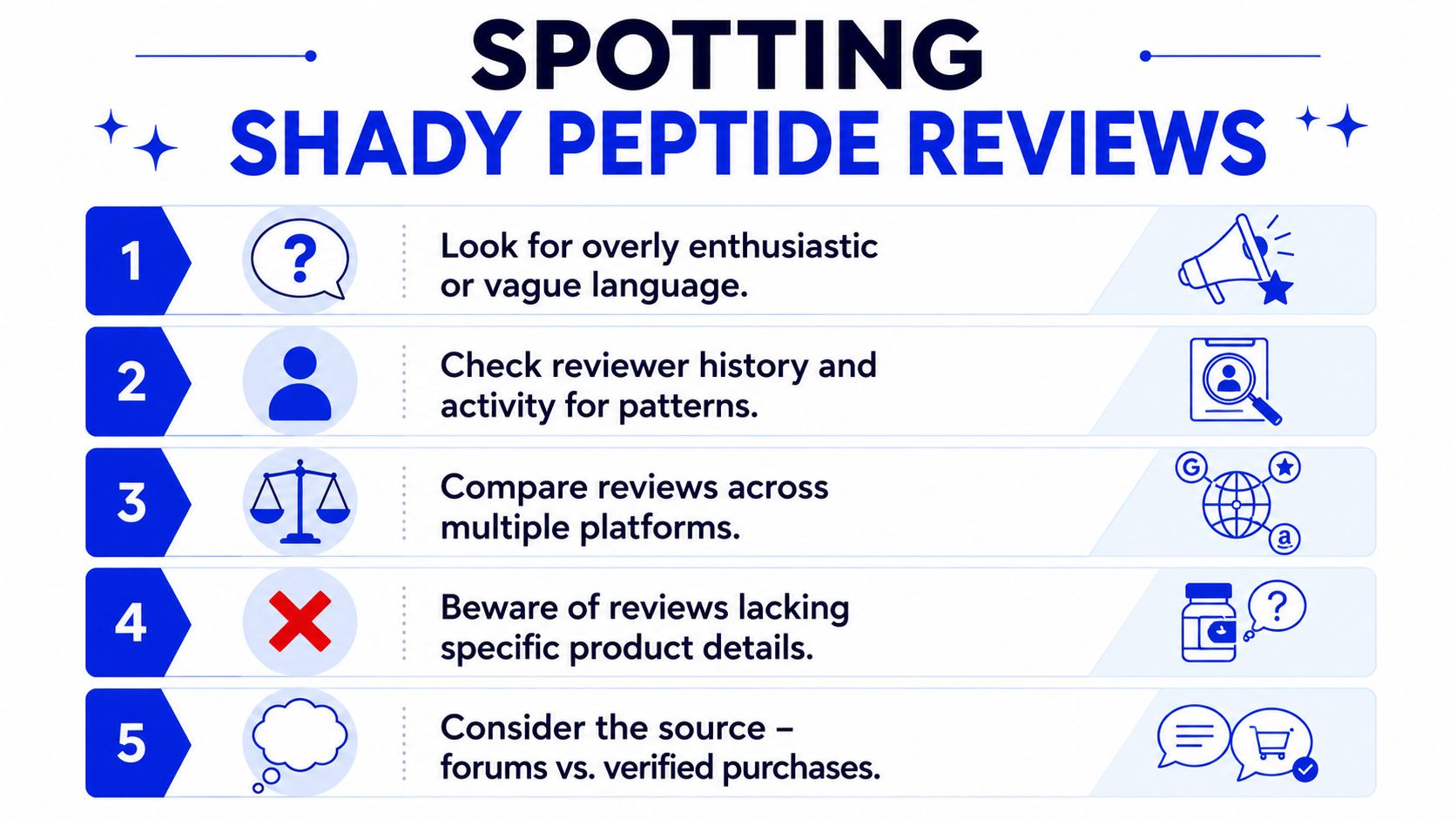
Common warning signs include:
If a review can’t tell you anything about documentation, shipping condition, communication quality, or test report access, it has limited value for sourcing.
Some reviews are genuine and still not useful. A real person may believe a peptide worked well for them, but that doesn’t tell you whether the product was validated properly or whether the claimed effect means anything outside that narrow context.
A broader 2025 review of bioactive peptides noted that the literature is uneven, with wide variation in dosage methods, sample sizes, and evaluation criteria, and also stated that long-term safety, bioavailability, and sustainability remain concerns because much of the existing work is short term, according to the PMC review on the expanding peptide evidence base.
That matters when you read bold personal claims. The gap between animal data, early-stage findings, and durable human evidence is exactly where bad review culture thrives.
Try this filtering method:
| Review claim | Better question |
|---|---|
| “This peptide worked amazingly” | Was the batch documented and analytically confirmed? |
| “Everyone on the forum recommends this vendor” | Are there batch-specific reports and consistent QC records? |
| “I felt effects quickly” | What does that say about product verification, if anything? |
Anecdotes can tell you whether a vendor shipped on time or answered questions. They can’t replace analytical evidence.
Vendor quality shows up in operations long before it shows up in a complaint thread. The way a supplier handles packaging, documentation, support, and product categorization often tells you more than a page full of testimonials.
A careful vendor behaves like a scientific supplier, not like a hype-driven storefront. That means the basics are handled with discipline.
Look for signs such as:
This is the same logic labs use when mastering vendor risk assessment. Operational sloppiness rarely stays isolated. It tends to affect fulfillment, documentation, and quality controls as well.
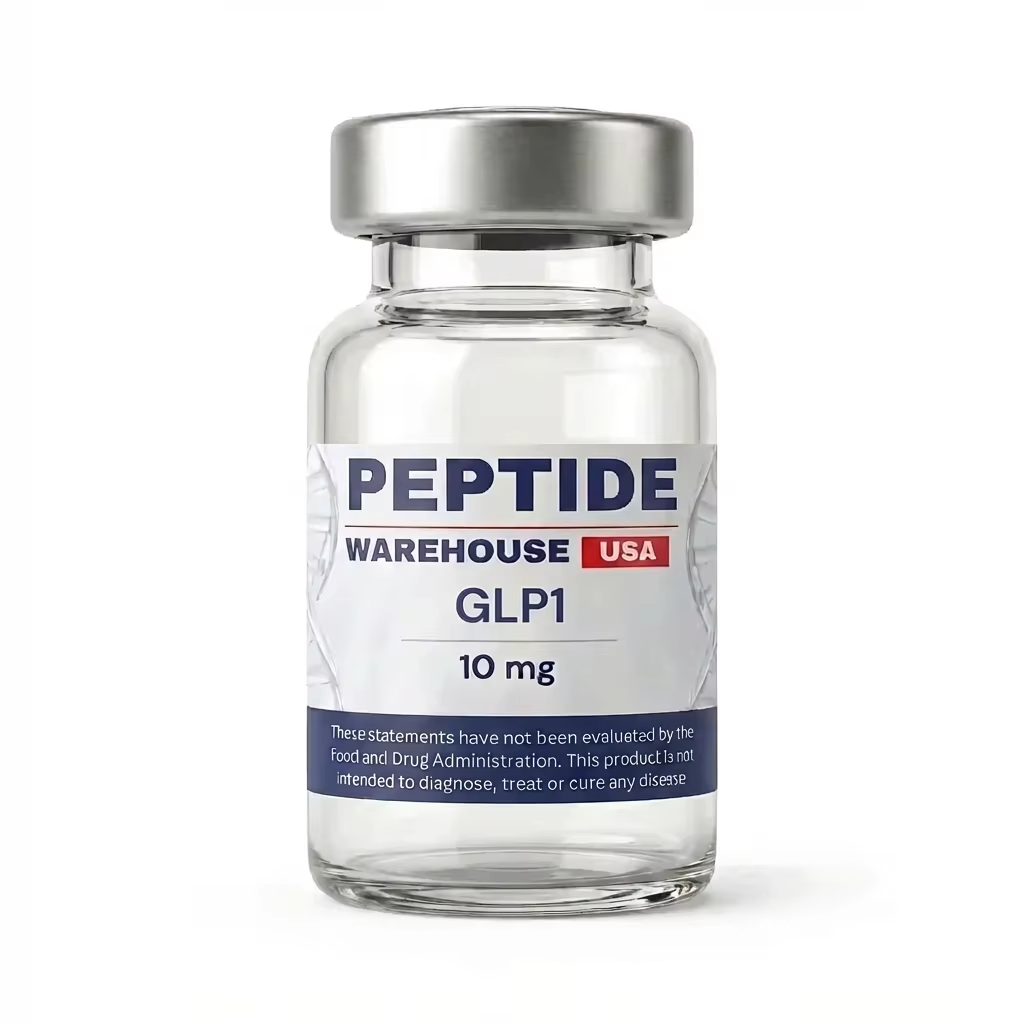
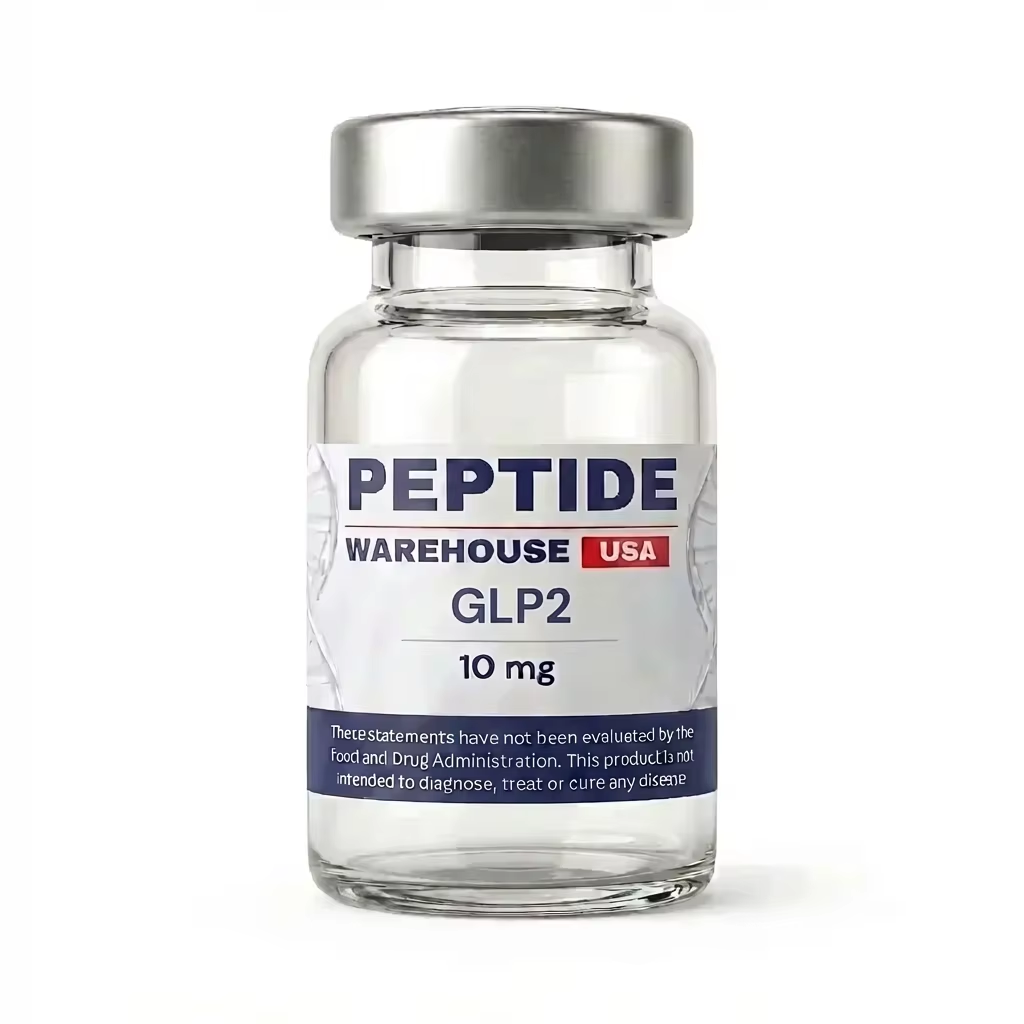
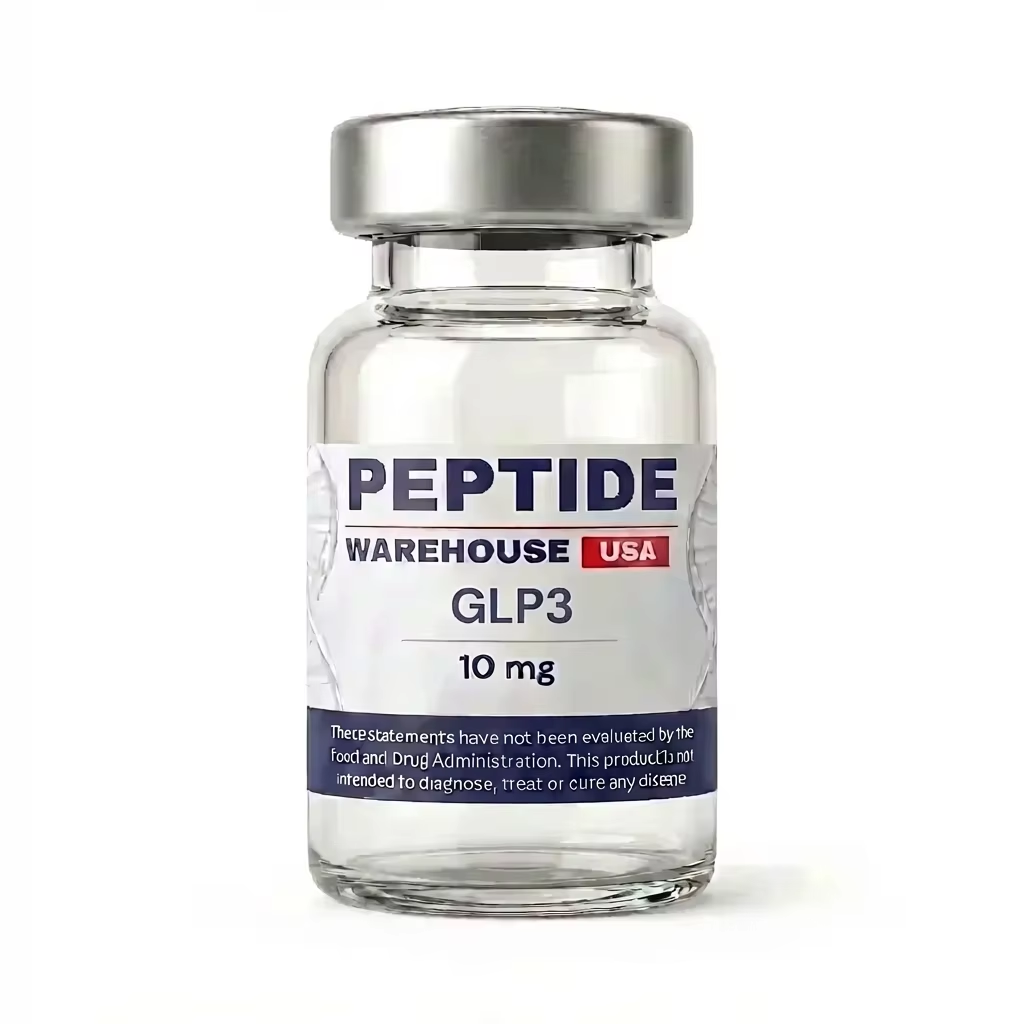
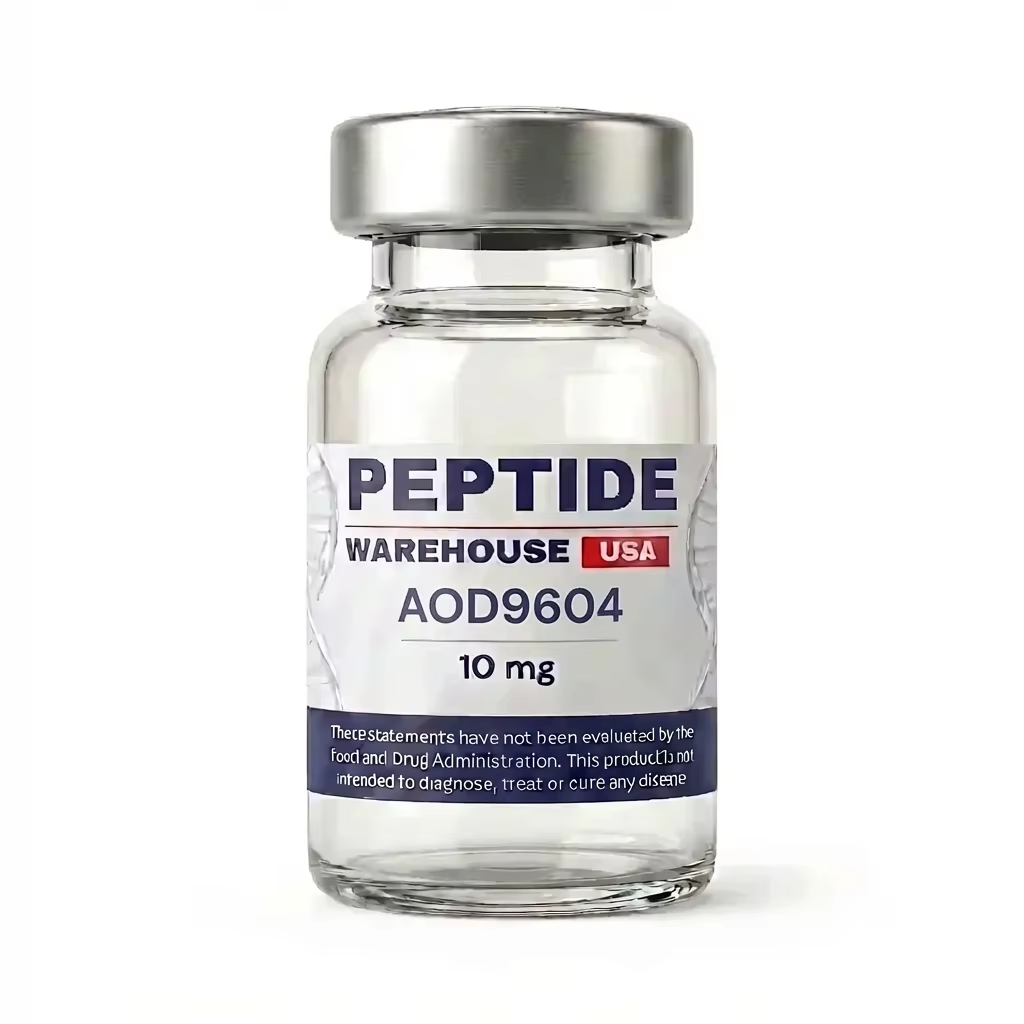
A serious supplier makes it easy to verify what you’re buying. If a company posts batch documentation, distinguishes third-party reports from product-page marketing, and maintains a support process that can answer technical questions, that’s useful. For example, Peptide Warehouse USA states that it provides batch-oriented documentation such as COAs along with microbial and endotoxin reports for research products, which is the kind of documentation-first approach buyers should prioritize.
A weak vendor usually leans on urgency, lifestyle language, and vague reassurances. The product page may be polished, but the operational details feel improvised. In my experience, that mismatch matters. Companies that are careless with labels, records, or storage instructions are rarely meticulous where buyers can’t see.
Legal posture isn’t background noise. It’s part of product quality assessment. If a vendor downplays the meaning of “for research use only,” that should change how you interpret everything else on the site.
Industry reporting says that in late 2023 and 2024, the FDA increased scrutiny by moving peptides such as BPC-157, TB-500, and Ipamorelin to a restricted list affecting compounding access, and warning letters were later issued to several online peptide vendors, as summarized by One Twenty’s report on FDA scrutiny and peptide companies. Whatever your view of the market, that tells you one thing clearly. Regulatory attention has tightened.

A vendor’s response to that environment matters. Serious suppliers state the research-only status plainly, keep claims restrained, and organize their business around documentation and controlled sourcing. Weak ones blur lines, imply personal-use outcomes, or market as if the disclaimer doesn’t really count.
The disclaimer is not a footnote. It tells you what standards should govern the purchase.
Before placing an order, ask direct questions and pay attention to the quality of the answers.
The answers don’t need to be elaborate. They do need to be clear.
The best way to read research peptides reviews is to stop treating them as verdicts and start treating them as raw material. Testimonials may tell you something about customer experience. They don’t tell you enough about identity, purity, contamination control, or batch traceability.
Confident sourcing comes from a repeatable process. Check the COA. Confirm whether testing is third-party. Look for microbial or endotoxin reporting when it matters. Read reviews for operational clues, not biological promises. Judge the vendor by documentation quality, shipping discipline, and regulatory posture.
That’s the difference between buying on hope and sourcing with standards. If you keep your focus on proof instead of hype, the market gets much easier to manage.
If you want a supplier that presents research peptides through a documentation-first, research-only lens, Peptide Warehouse USA is worth reviewing. You can explore batch-oriented product information, compare available COAs and supporting reports, and learn more about options that fit laboratory, analytical, and preclinical procurement needs.