No products in the cart.


Published Selank research protocols most commonly reference intranasal 250–750 mcg per administration, two to three times daily, and subcutaneous 250–500 mcg once daily, with no FDA-approved human regimen. That's why a Selank peptide dosage chart is less a fixed prescription than a map of how researchers have split dose, frequency, and cycle length across different delivery routes.
Selank is a useful case study in why dosage charts matter. The numbers people quote online often look simple on the surface, but the underlying references are built from different protocols, different routes, and different assumptions about exposure. If you read the chart like a bench reference instead of a marketing summary, the pattern becomes clearer, and the gaps become just as important as the ranges themselves.
A Selank peptide dosage chart is a compiled research artifact, not a single official standard. Its rows are usually reconstructed from published protocols, package-insert style references, and laboratory summaries rather than from one universally accepted human dosing program. That distinction matters because Selank is a synthetic heptapeptide derived from tuftsin, and the chart reflects how different groups have translated that molecule into intranasal or injectable use.
The chart usually captures three variables together, dose per administration, frequency, and cycle length. A row that says 250–500 mcg once daily does not mean the same thing as a row that says 250–750 mcg two or three times daily, even if the peptide is the same, because total exposure and timing differ.
Route changes the interpretation as well. Intranasal Selank is often presented with split doses across the day, while subcutaneous references tend to cluster around smaller daily maintenance amounts. The chart is describing recurring protocol patterns, not setting a universal clinical rule.
For a broader peptide context, the ProMD peptide therapy overview helps place Selank within the wider research-peptide framework without treating it like an approved drug model.
Practical rule: If a chart row does not show route, frequency, and cycle length together, it is incomplete for dosing interpretation.
The most reliable way to use the chart is to treat it like a reference grid. Read the row, identify the route, check the frequency, then ask what the cycle length implies for cumulative exposure. That sequence avoids a common mistake, collapsing a route-specific protocol into a single number that looks precise but is not usable.
Most Selank dosing numbers come from a mixed evidence stack, not from modern dose-finding trials. The strongest openly accessible material is mechanistic and experimental, including work on gene-expression effects and enkephalin-related signaling in the research literature indexed in the public summary set. That's important because it tells you the field has biological rationale, but not a clean, standardized human dose-response curve.
Protocol pages often quote ranges around 100–900 mcg per dose and cycle lengths of 10–21 days or longer breaks, but those figures are aggregations, not a single consensus endpoint. The research-facing literature reflected in neutral summaries shows wide variation, and it does not produce one universally accepted human regimen. A chart can therefore be internally consistent and still be externally provisional.
That's the core interpretive challenge. Some rows are anchored to Russian clinical inserts, some to vendor guides, some to community protocol tables, and some to experimental summaries. Each source type carries a different confidence level, so the same numeric pattern can't be weighted equally.
For readers who want a comparison point in another peptide domain, the discussion around alpha GPC dosing for shift workers shows a similar problem, practical dose summaries often outpace the quality of the underlying evidence.
Bench-level takeaway: A Selank table is best treated as a compiled reference set, not as proof that one dose is optimal.
That means high-confidence claims should stay narrow. If a row comes from a Russian-approved protocol or a package-insert style reference, it deserves more weight than a vendor-derived extrapolation. If it spans a wide daily total without route detail, it should be treated as a weaker planning guide, not a definitive answer.
A useful way to read the Selank peptide dosage chart is as a matrix with four columns, route, dose per administration, frequency per day, and cycle length or washout. If one of those columns is missing, the row is only partly interpretable. The same peptide can look “higher” or “lower” depending on whether the chart is presenting a single spray, a split nasal protocol, or a maintenance injection row.
Two charts can both be technically correct and still disagree numerically because they may be anchored to different source classes. A Russian clinical insert, for example, can reflect a tightly defined nasal schedule, while a vendor guide may combine multiple research summaries into a broader range. Neither is automatically wrong, but they're answering slightly different questions.
That's why source weighting matters. A chart row with a clearly stated route and cycle length is more useful than one that only lists a dose. A row that also specifies a reconcentration or vial assumption is even more practical, because it can be converted into working volume.
A simple internal checklist helps separate strong rows from weak ones:
| Route | Dose per administration | Frequency | Approx. daily total | Cycle length |
|---|---|---|---|---|
| Intranasal | 250–750 mcg | 2–3 times daily | 500–1,500 mcg/day | Often short-course, split-dose protocols |
| Subcutaneous | 250–500 mcg | Once daily | 250–500 mcg/day | Maintenance-style research references |
| Injectable table row | 500 mcg, 1 mg, 2 mg entries | Varies by chart | Depends on frequency | One example uses 2–3 times/week over 8 weeks |
| Time-based chart row | 150–300 mcg | Weeks 1–2 and week 4 | Route-dependent | Week-structured protocol |
| Time-based intranasal row | 600–900 mcg daily | Same timeframes | 600–900 mcg/day | Week-structured protocol |
The most reliable way to build your own reference is to combine rows from published protocols into one working table, then label each row by source type. That gives you a practical research map without pretending every number has the same evidentiary weight.
A Selank chart reads differently once the route changes, because intranasal and injectable entries are not interchangeable. Intranasal references commonly cluster at 250–750 mcg per administration, repeated two to three times daily, which yields daily totals around 500–1,500 mcg/day. Injectable references sit lower per administration, with subcutaneous maintenance guidance commonly centered on 250–500 mcg once daily.
Route does more than change convenience. It changes the exposure pattern the chart is trying to represent, so a nasal row and an injection row should not be merged into one generic “Selank dose.” Even when the totals look similar on paper, the timing, delivery method, and research use case are different.
The intranasal side is anchored by a package-insert-style protocol that specifies two drops at 75 mcg per drop, given three times daily for up to 14 days, which comes to 450 mcg/day Selank intranasal protocol. That figure matters because it comes from a concrete short-course protocol, not from a broad extrapolated range.
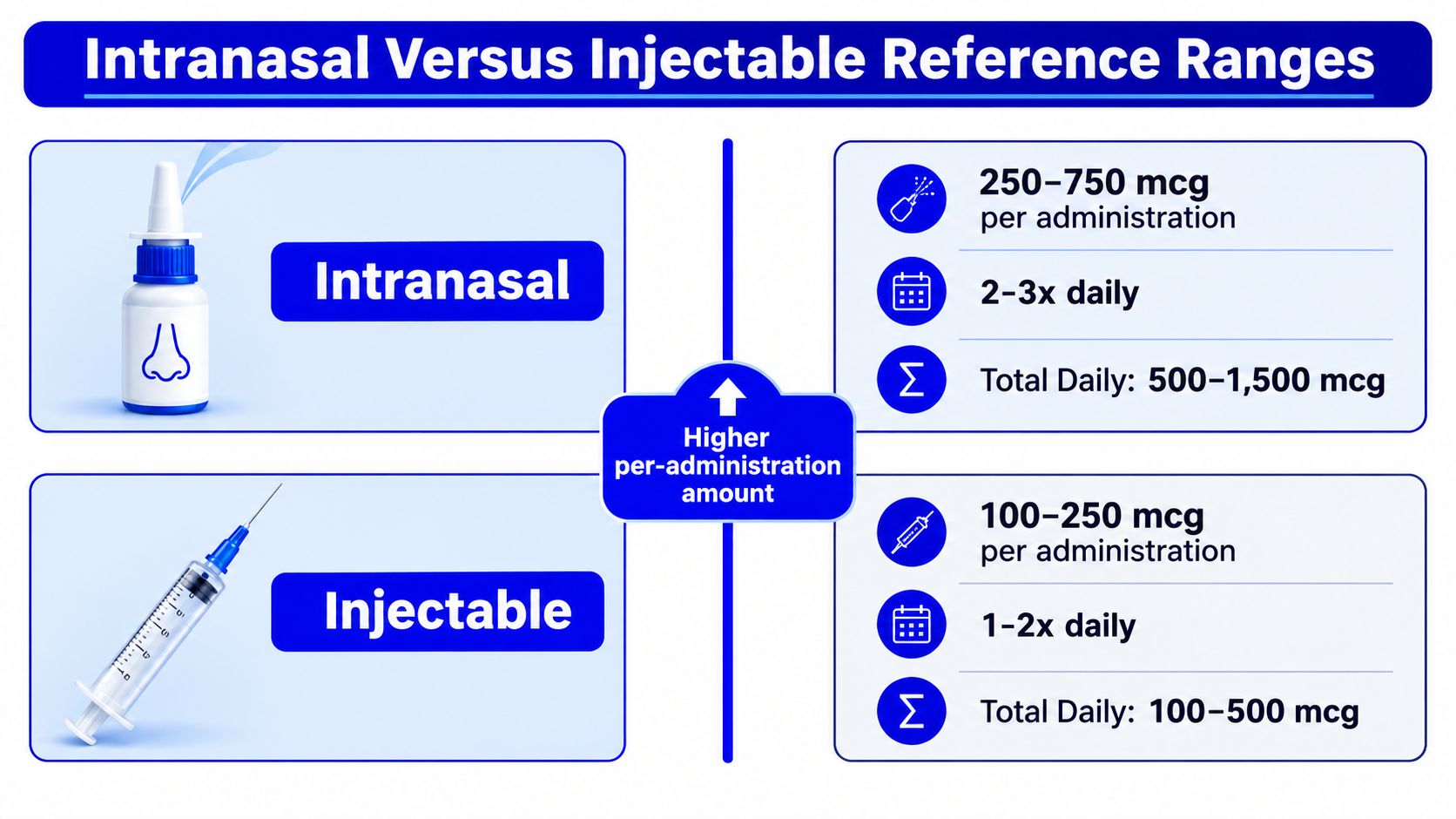
The same peptide ends up with different totals because the chart is built around route-specific assumptions, not one shared bioavailability value. Injectable tables may also list 1 mg or 2 mg entries at lower frequency, which shows that some references organize the chart around both dose size and spacing rather than a single daily target Selank dosing guide. That logic is different from the intranasal schedule, which usually splits exposure across the day.
The 250–500 mcg once daily figure belongs to subcutaneous maintenance-style guidance, while the 450 mcg/day intranasal figure comes from a separate short-course protocol. Reading those rows as if they describe the same dosing problem flattens the chart and hides the route-specific structure.
Use the route first, then the number. If the delivery model is nasal, read the intranasal column. If it is subcutaneous, read the injectable column. Mixing them blurs the chart into something it was never meant to be.
A dosing chart becomes operational only after the vial concentration is fixed. A commonly cited compounding-style reference starts with a 10 mg Selank vial and adds 3 mL bacteriostatic water, which produces about 3.33 mg/mL Selank vial protocol. At that concentration, a 300 mcg injection is about 0.09 mL, and a 500 mcg injection is about 0.15 mL.
The conversion is straightforward once the concentration is set. Divide the target micrograms by the concentration in micrograms per milliliter, then convert the result to syringe markings. That is what turns a chart from a nominal dose list into a usable dosing reference.
For a U-100 insulin syringe, the markings become the point of control. A 300 mcg target sits near 0.09 mL, and a 500 mcg target sits near 0.15 mL, so small reading errors matter more than they would in a loosely defined protocol. In practice, reproducibility depends on the syringe and, if a nasal device is used, the actual pump output.
Calibration beats estimation. If the syringe marking or pump output is off, the chart no longer reflects the dose you think you are using.
A short intranasal example makes the same point. If a researcher targets 250 mcg per spray, the device has to be checked against its actual output, not only the nominal label claim. The same logic applies to a subcutaneous maintenance row built around 500 mcg/day, because the measured dose is only as accurate as the volume drawn.
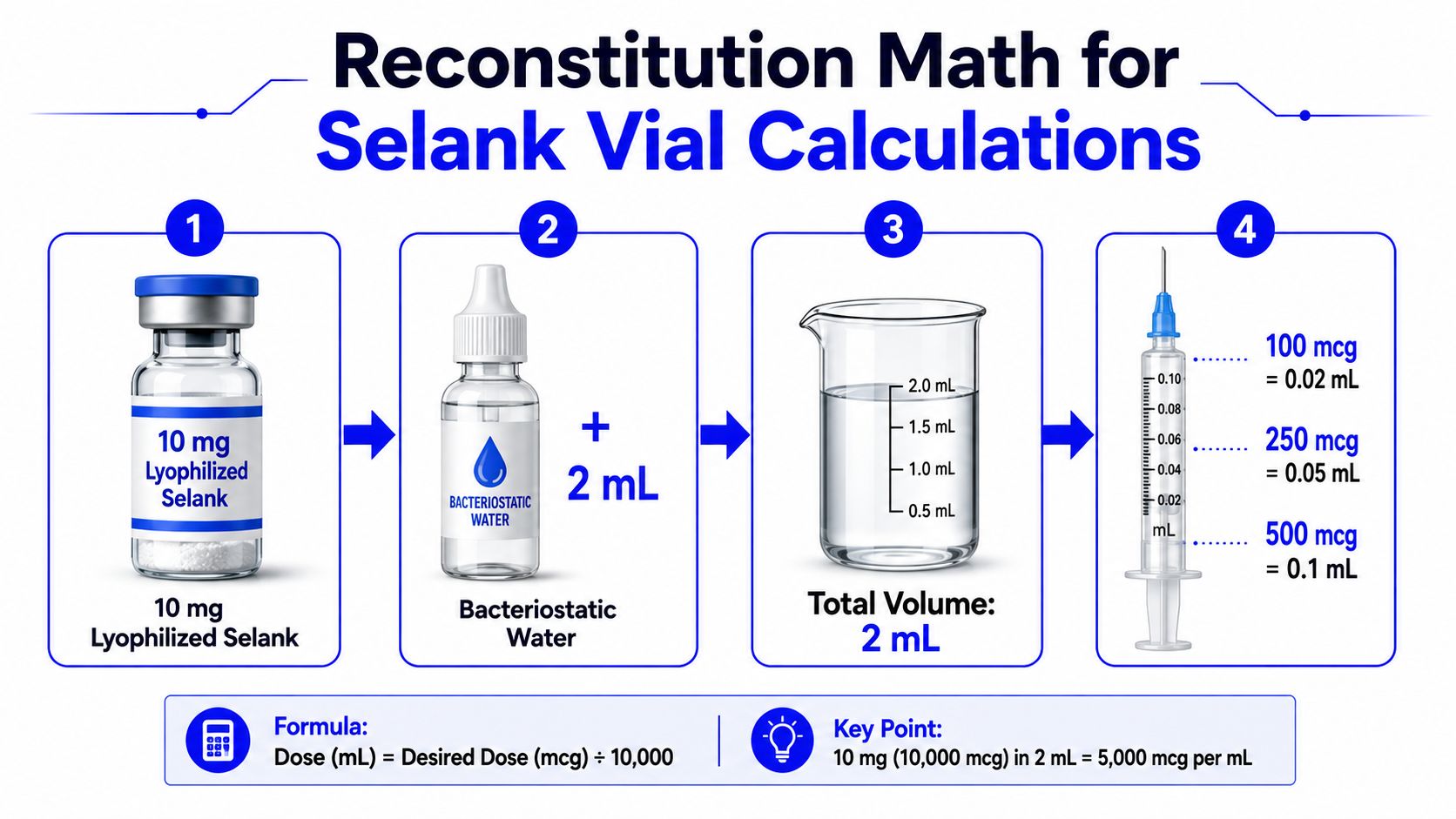
The visual makes the calculation easier to follow. Once the vial is reconstituted, every downstream dose depends on the same concentration math, so the reconstitution step belongs inside the chart rather than beside it.
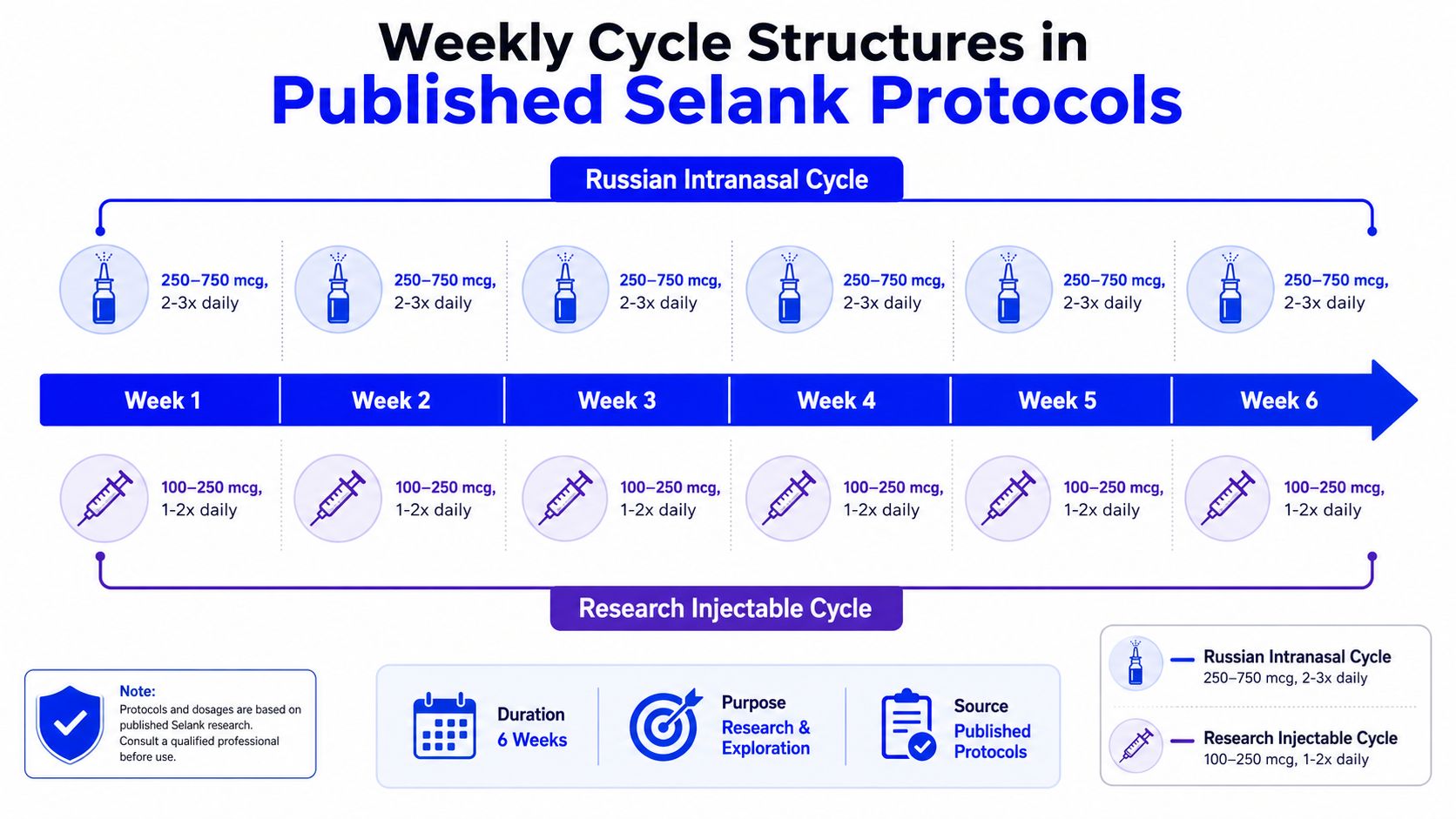
Published Selank charts are more useful as cycle maps than as isolated dose lists. One example pairs 150–300 mcg with Weeks 1–2 and keeps the same range in Week 4, while the intranasal column remains at 600–900 mcg daily across those same periods Selank dosage calculator. The point of that layout is not just the amount, it is the way exposure is organized over time.
Selank references are usually built around fixed courses rather than open-ended use. A Russian intranasal protocol is commonly described as 250–750 mcg per administration, given two to three times daily, for a 14-day course, which places the schedule in a narrow short-course framework Russian intranasal Selank dosage. That means the chart has to be read as dose plus duration, because the same per-administration figure carries a different meaning once the cycle length is fixed.
Other published protocol summaries present a different structure. The Selank dosing guide describes a 1 mg row on a 2–3 times per week schedule over an 8-week cycle Selank dosing guide. That pattern is not a duplicate of the intranasal short-course rows, it reflects a separate weekly cadence with a longer planning horizon. In practical terms, the chart is showing that Selank dosing is not standardized around one universal rhythm, and the spacing between doses can matter as much as the dose itself.
The reading rule is straightforward.
The weekly structure shown in the chart also matches the visual protocol summary used in this article, where Russian intranasal and research injectable patterns are placed side by side A visual guide outlining the weekly cycle structures for Russian intranasal and research injectable Selank peptide protocols.. That kind of layout is useful because it separates the route-specific cadence from the raw microgram figure.
The chart works best when dose and calendar are read together. If only the micrograms are recorded, the protocol's actual exposure pattern is lost.
Storage discipline is part of dosage accuracy. If a vial shifts in concentration or degrades before use, the chart math becomes unreliable no matter how clean the original calculation was. A research-grade Selank setup therefore needs a stable storage plan from the moment the vial arrives.
Lyophilized Selank is generally handled in a cool, dry, light-protected environment, and reconstituted material should be managed to minimize freeze-thaw stress. When multi-day access is needed, bacteriostatic water is the practical choice because it supports repeated handling better than plain sterile water.
A compact notebook checklist keeps the batch usable:
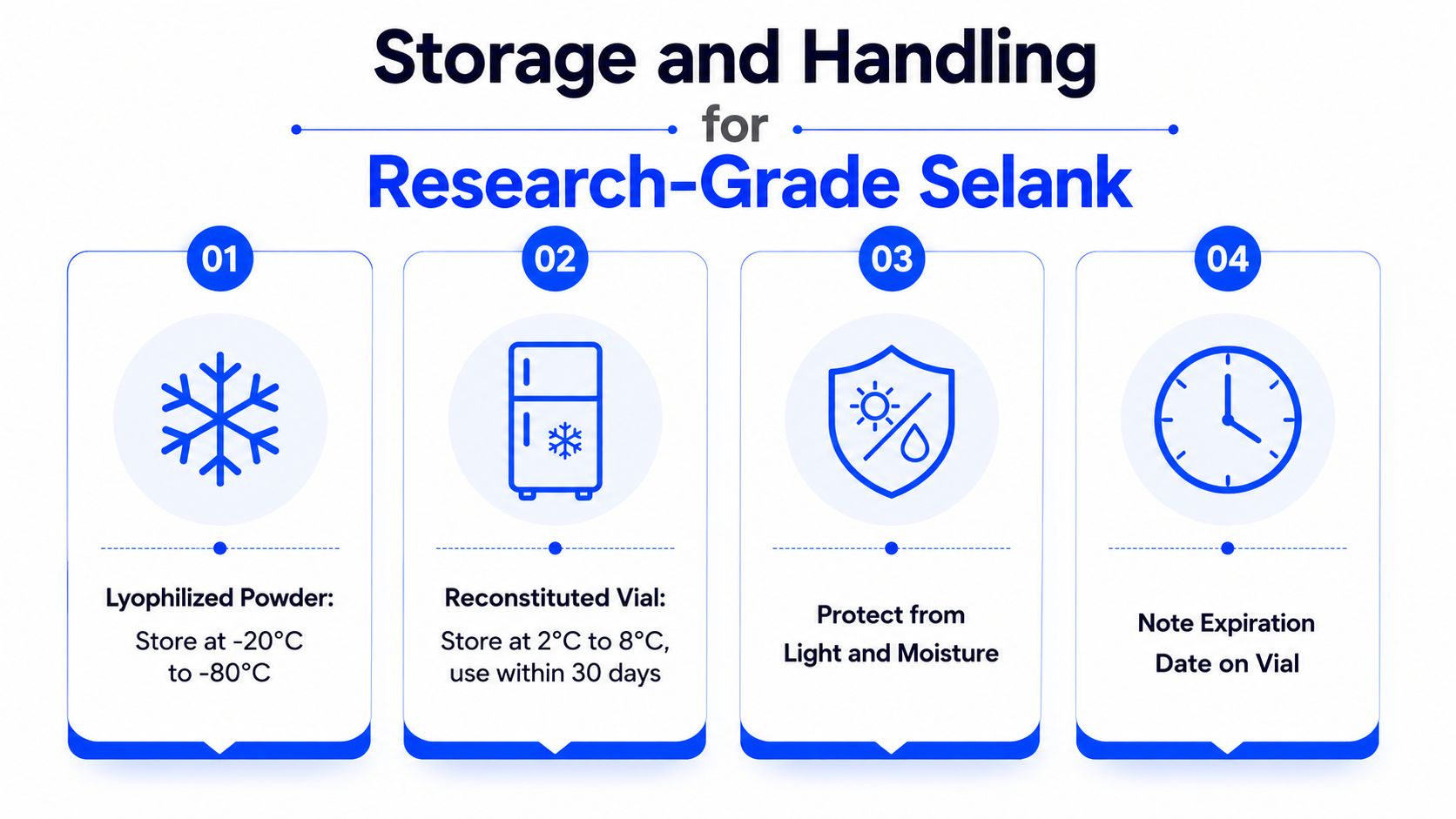
The storage card reinforces a simple idea. Concentration drift and handling errors are silent failures, and they can invalidate a dose chart before anyone notices.
Document first, dose second. If the batch isn't labeled, the chart can't be trusted later.
That's especially true in lab settings where more than one vial may be open at once. A clean storage trail turns the dosage chart from a theoretical reference into a repeatable research workflow.
High-dose Selank claims often sound more decisive than the evidence supports. Research-reference tables do cluster around moderate ranges such as 250–500 mcg or 300–500 mcg, but some higher-dose tables extend to 2,250–3,000 mcg/day without strong clinical standardization Selank research summary. That spread is exactly why a dosage chart should be read skeptically.
The first filter is source type. A protocol rooted in Russian clinical use deserves more weight than a community-generated extrapolation, because it is closer to a documented human schedule. The second filter is route specificity, because intranasal and subcutaneous rows are not interchangeable. The third filter is cycle length, because a dose that looks aggressive in isolation may be less so across a short, bounded course.
A useful way to think about it is this:
That makes the central caveat plain. More Selank is not clearly better, and nothing in the public reference set justifies treating the highest table as the best table. A careful reader should ask what outcome the chart is trying to support, whether the route matches the intended use, and whether the cycle is doing most of the work.
For another practical example of a peptide-adjacent anxiety discussion, the low dose naltrexone anxiety resource shows how easily people can confuse general wellness language with actual dose support. Selank deserves the same scrutiny.
A Selank dosage chart is most useful when it functions as a decision aid, not a single-number summary. The rows only make sense if you can separate route, frequency, and cycle structure before you choose a dose.
Start with the route, because the published references do not treat intranasal and subcutaneous use as interchangeable. Intranasal rows usually point to repeated administrations across the day, while injectable rows tend to emphasize smaller once-daily maintenance style schedules. If a chart mixes those formats in one line, the number may be real but the interpretation is weak.
Then check whether the number is presented as a per-administration amount or a daily total. That distinction matters more than the raw figure. A row built around a single administration can look conservative until it is repeated several times, and a daily total can hide how divided doses were used.
Is the row tied to a published protocol, or is it an extrapolated range copied from another reference page? Is the cycle short and bounded, or does it read like an open-ended maintenance suggestion? Does the table give enough detail to reconstruct the schedule without guessing? These questions separate a practical reference from a loose summary.
The same caution applies to vial math. Reconstitution numbers are only useful if the concentration, syringe scale, and intended route are all stated clearly enough to prevent accidental overdraw or underdraw. A chart that presents the arithmetic without the protocol context may be technically correct and still clinically unhelpful for research planning.
Treat the chart as a map of agreement and disagreement across sources. Where multiple protocols converge, the row is easier to trust. Where the table relies on one route, one cycle style, or one concentration setup, the number should be read as source-bound rather than universal.
Selank products discussed in this article belong in laboratory, analytical, or preclinical use only, not human consumption. That framing matters because the chart is a research reference, not an approved dosing standard.
If you're building a lab workflow around Selank, visit Peptide Warehouse USA to review research-grade options, batch documentation, and the product details that support clean protocol handling. Their catalog is set up for laboratory and analytical use, which makes it a practical place to compare Selank alongside other research peptides when you are refining a dosing reference.