No products in the cart.


You’re probably in a familiar spot. The protocol is drafted, the target compound is selected, and now the hard part starts: finding selank peptide for sale from a supplier that won’t create problems later in receiving, documentation, storage, or assay consistency.
That’s where most buyers lose time. The market is crowded with vague purity claims, incomplete batch records, and product pages that say far more than the paperwork can support. For a research peptide like Selank, buying well means understanding the molecule, checking the right documents, and treating compliance as part of quality control.
A common procurement failure starts the same way. A lab places an order based on a clean-looking product page, then runs into problems after payment: incomplete batch documentation, unclear import paperwork, or shipping conditions that were never specified. With Selank, the buying decision has to connect the science to the practical realities of sourcing, receiving, and documenting a research peptide correctly.
A listing is only useful if it supports auditability. Before purchase, the supplier should be able to identify the material clearly, provide batch-level records, explain the test methods used to confirm identity and purity, and state the product’s research-use-only status without ambiguity. If any of that is vague, procurement risk goes up fast.
Start with traceability. The product page and the supporting documents should agree on the peptide name, lot number, quantity, and form supplied, usually lyophilized powder. The seller should also make the chain of documentation easy to verify, especially the COA and any chromatographic data tied to that lot.
Then check operational details. Serious suppliers state how the material is packed, how it ships, and what storage conditions apply on arrival. Those points affect sample integrity and receiving workflows just as much as the chemistry does.
Compliance is just as important. Selank sold for laboratory procurement should be labeled for research use only, with no suggestion of personal or clinical use. That language needs to match the invoice, customs paperwork, and package labeling.
Price still matters, but it comes after documentation, handling, and compliance. A low quote does not help if the shipment is held at the border or if the receiving team cannot match the vial to a valid batch record.
For cross-border orders, import preparation deserves its own review. Customs delays often come from classification errors, incomplete product descriptions, or paperwork that does not match the shipment contents. Teams that import research materials regularly can benefit from the practical guidance published by J.W. Smith Customs Brokers Ltd., especially where medical and laboratory goods require precise documentation.
Practical rule: If a supplier can take payment immediately but cannot provide clear batch documents before shipment, keep looking.
A research team usually reaches this section after the procurement questions start piling up. The sequence on the label has to match the compound in the vial, the intended mechanism has to match the study design, and the legal status has to match the paperwork. Selank sits right in that intersection.
Selank is a synthetic heptapeptide associated with Russian peptide research and discussed in both neurologic and psychiatric research contexts. In the United States, it is not FDA-approved for clinical use. For a buyer, that is not a side note. It defines how the material should be labeled, purchased, documented, and used in the lab.
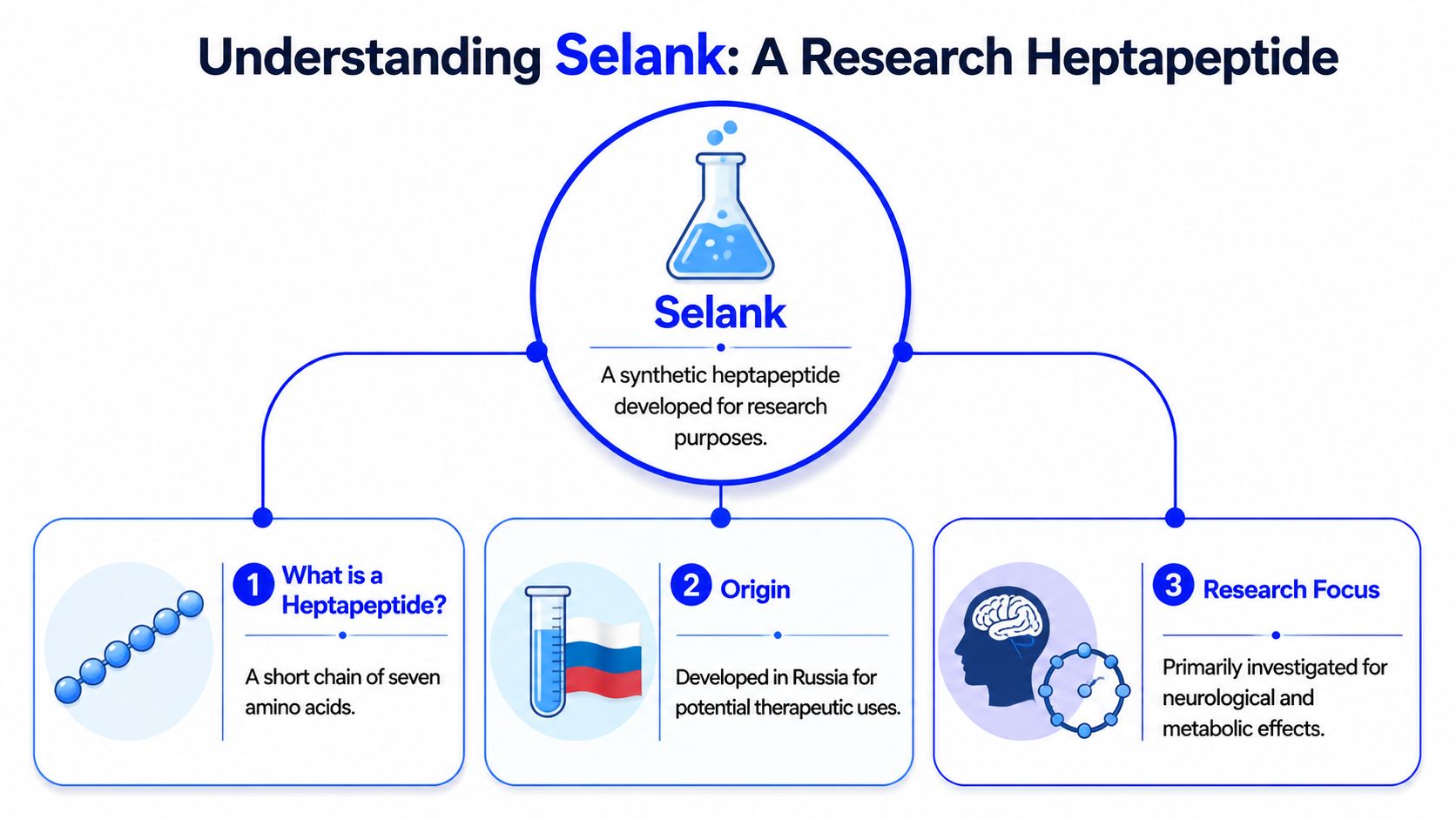
Selank is structured as a seven-amino-acid sequence: H-Thr-Lys-Pro-Arg-Pro-Gly-Pro-OH. That sequence is the starting point for any serious review of a product listing, because it defines what the supplier is claiming to sell.
The molecule is built from the Tuftsin tetrapeptide (Thr-Lys-Pro-Arg) with an added Pro-Gly-Pro segment at the C-terminus. That is more than a naming detail. It distinguishes Selank from tuftsin itself and from loosely described analogs that sometimes appear in low-discipline catalogs.
For research buyers, this has a direct procurement consequence. Sequence confirmation matters as much as the reported purity number. A vial can show high purity by HPLC and still fail the project if mass spectrometry or batch records do not support the correct identity.
The Pro-Gly-Pro extension is one of the reasons Selank is treated as a distinct research peptide rather than a simple restatement of tuftsin. Researchers have discussed that modification in connection with peptide stability and central nervous system research interest, which is why the exact terminal structure needs to be verified at purchase, not assumed from the product name.
That point gets missed often. Labs sometimes focus on a headline purity percentage and move on. In practice, the better question is whether the supplier has analytical support for the full heptapeptide sequence, including the C-terminal extension, and whether that support is tied to the specific lot being shipped.
The useful question is simple: does the batch documentation support the exact heptapeptide your protocol requires?
Selank also draws research interest because it is often framed as a peptide with effects extending beyond a single receptor interaction model. That changes the way experienced groups plan assays. If the work involves transcriptional effects, neurotransmission, or time-dependent downstream responses, the structural assignment of the material becomes part of experimental control, not just vendor paperwork.
Scientific understanding and purchasing discipline meet at this intersection. A lab studying Selank does not just need a vial labeled correctly. It needs a lot with the right sequence, identity data that match that lot, and documentation that supports research use only from order placement through receipt.
A lab does not order Selank to satisfy curiosity alone. It orders Selank because a protocol calls for a specific peptide and a defined question, often one that sits between neurobiology, signaling, and assay design. That distinction matters. Procurement decisions should reflect the type of work being done, not broad claims copied from product pages.

Selank is commonly investigated in preclinical settings where the endpoint is not limited to a single receptor interaction. Researchers have discussed it in the context of neurotransmission, downstream signaling, and transcription-related effects. For a buyer, that changes the risk profile. If the assay depends on time-course shifts in expression or pathway activity, inconsistency between lots can distort the readout long before anyone notices a problem in the data review.
That is why I treat Selank sourcing for mechanistic work differently from sourcing a simpler screening reagent. The peptide may be entering studies that compare expression changes, behavioral proxies in preclinical models, or multi-marker panels tied to GABAergic and related CNS pathways. In that setting, sequence accuracy, batch traceability, and controlled handling all matter because small material differences can create false positives or wash out a real signal.
Researchers also examine Selank in models related to serotonin-linked neurochemical activity and anxiety-relevant pathways. The scientific interest is real. The compliance boundary is still clear. Research interest does not convert a research peptide into an approved therapeutic material.
Some groups also investigate Selank outside a narrow CNS frame. It has appeared in discussion around broader signaling behavior in preclinical systems, including work that looks at systemic or metabolic responses rather than neurotransmission alone.
That wider use creates a practical sourcing issue. A peptide used across different assay types needs tighter receiving controls than one used in a single pilot run. If one lot is split across neurochemical work, expression analysis, and exploratory metabolic models, the documentation trail has to stay intact from receipt through aliquoting and storage. Otherwise, the lab cannot cleanly explain variance between datasets.
I have seen this mistake more than once. A team buys one vial for a small CNS study, then extends the same material into unrelated exploratory work without tightening sample logging or freeze-thaw control. The result is messy interpretation. The peptide did not necessarily fail. The handling plan did.
The research question should shape the purchase standard.
Good procurement supports good experimental control.
That is the practical takeaway from Selank research activity in the lab. The peptide attracts interest because the biology under investigation can span several pathways and model types. That same breadth is why disciplined purchasing, clear labeling, and documented handling matter before the vial is ever opened.
A common procurement failure starts before checkout. A lab sees a clean product page, a stated purity figure, and a low price, then places an order without confirming whether the batch can be documented well enough for internal review. If the vial arrives with a generic COA, no identity data, or mismatched lot records, the problem is no longer price. It is traceability.
Supplier review for Selank should be handled like incoming material qualification. Purity is one checkpoint. It does not cover peptide identity, batch consistency, contamination risk, packaging quality, or whether the seller understands research-use-only compliance.
For Selank, I look for three core records first: a lot-specific COA, chromatographic purity data, and mass spectrometry identity confirmation. Without those, a buyer is relying on marketing copy.
The COA should match the exact lot number on the vial label and shipping paperwork. A sample certificate posted for illustration is not enough. Buyers should also confirm that the purity result is tied to that lot, not copied across multiple batches. For research peptides, suppliers commonly present HPLC purity results in the high-purity range, but the useful question is whether the result is batch-specific and recent.
Identity confirmation matters for a different reason. A peptide can test as relatively clean and still be the wrong material, degraded material, or a mislabeled substitute. Mass spectrometry helps verify that the molecular mass aligns with the labeled peptide.
Contamination controls also deserve a direct question. If a supplier cannot explain whether microbial or endotoxin testing is performed, documented, or available on request, that gap should be treated as part of the risk assessment, especially for more controlled research environments.
Use this standard when comparing sellers:
One factual example of a supplier format in this category is Peptide Warehouse USA. It presents itself as a U.S. research chemical supplier with documentation-focused positioning. That does not replace qualification on your side. It shows the kind of supplier profile buyers should expect to review critically.
| Verification Point | What to Look For |
|---|---|
| Purity testing | An HPLC or equivalent chromatographic result tied to the specific lot |
| Identity confirmation | Mass spectrometry data supporting the labeled peptide identity |
| COA access | A lot-specific COA available before or at purchase |
| Contamination controls | Clear answers on microbial or endotoxin testing, if applicable |
| Product format | A defined research format with clear labeling and fill amount |
| Batch traceability | Matching lot numbers across vial label, COA, and shipping paperwork |
| Use restrictions | Explicit research-use-only language with no human-use claims |
| Packaging quality | Intact seals, legible labels, and no signs of moisture or transit damage |
| Support responsiveness | Direct, specific answers to documentation questions before payment |
| Import readiness | Commercial paperwork and product labeling aligned with research status |
Price still matters. It just belongs later in the decision.
The practical trade-off is simple. A cheaper vial with weak documentation can cost more in delayed review, failed intake, or unusable material than a properly documented batch from a supplier that answers technical questions clearly. Good buying discipline starts with records, not promises.
A common failure point happens after the purchase order is closed. The vial arrives on time, the label looks fine, and someone sets it on a bench while intake paperwork waits. For a research peptide, that gap between delivery and controlled storage can do more damage than a week of supplier emails.
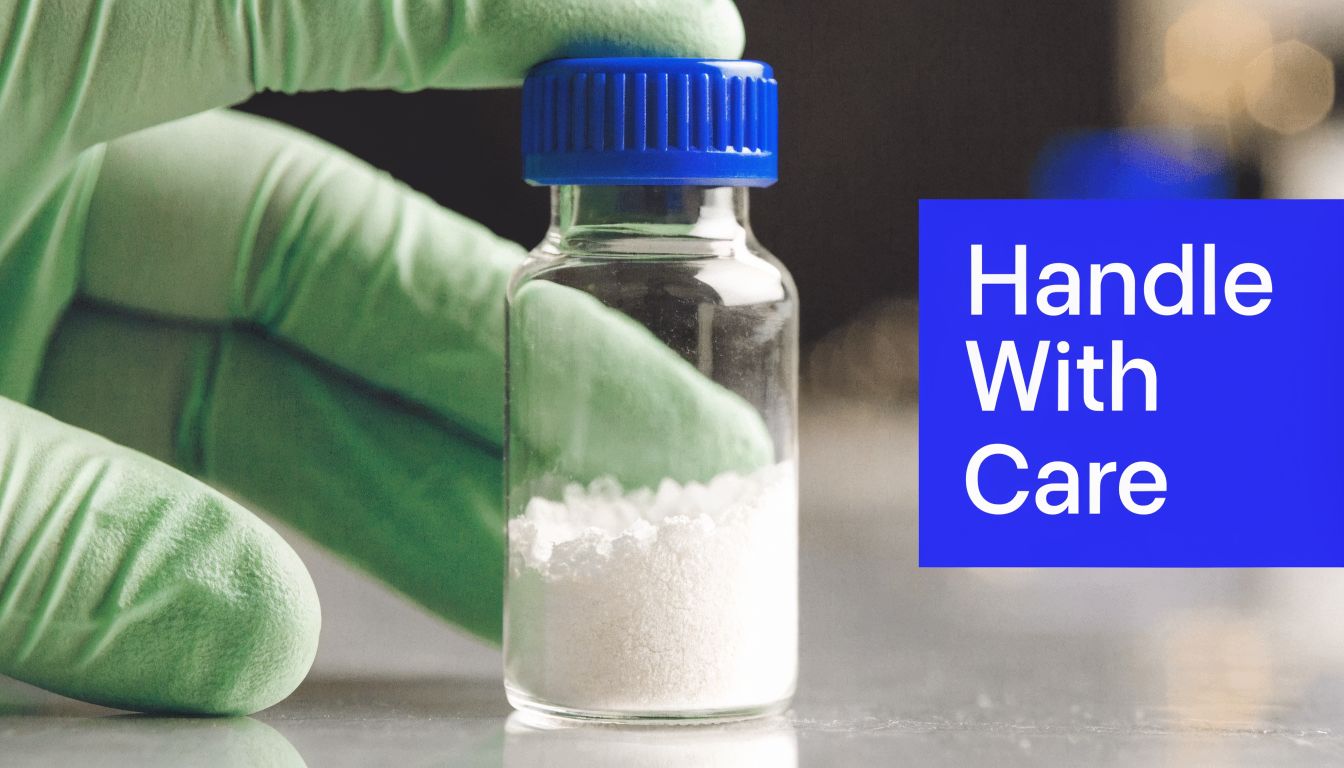
Selank is often supplied as a lyophilized powder in a sealed vial. That format usually offers better stability during shipping than a premixed solution, but only if receiving staff treat intake as part of quality control.
Start with identity and condition. Confirm that the vial label, lot number, fill description, and accompanying paperwork match before the material is logged into inventory. Check the seal, cap, and stopper. Look for cracks, moisture, smearing on the label, or signs that the cake has collapsed or discolored. If anything does not reconcile, quarantine the vial and resolve it before use.
Storage discipline should be simple and repeatable:
Shipping and storage are connected. A peptide can leave the supplier in good condition and still become questionable if it sits in a mailroom, ships without adequate thermal control, or enters a lab without immediate logging. Labs with a written intake process catch those failures early.
Reconstitution needs the same level of control as supplier qualification. Use a diluent your lab has approved for the intended research workflow, apply clean technique, and add the liquid slowly to limit foaming or physical stress. Do not shake the vial aggressively. Gentle swirling is the safer approach for preserving solution quality.
Many research teams choose bacteriostatic water for short-term stock handling because the preservative can help reduce contamination risk after the vial is opened. Others use sterile water based on protocol constraints and intended timing of use. The trade-off is practical. Preservative-containing diluents may help with handling after reconstitution, but the selected diluent still has to fit the assay design and internal SOPs.
Document the exact solvent, volume added, resulting concentration, date of reconstitution, and initials of the operator. If multiple people access the same vial, log that too. Poor concentration records create more bad data than buyers like to admit.
A controlled process usually looks like this:
Route-of-administration claims should not drive purchasing or handling decisions for a research-use-only peptide. Product pages and informal buying guides often mix format, absorption claims, and use-case language in ways that are not helpful for compliant procurement. A better approach is to separate scientific interest from sourcing control. Buy the format your lab can document, store, and track properly. For a general market overview of how Selank is commonly discussed by buyers, Peptides Selank purchasing guide shows why those distinctions matter.
This walkthrough gives a visual overview of handling basics:
Storage and reconstitution are part of procurement quality, not an afterthought. If the vial is sold for research use only, the lab also needs to handle it that way from receipt through final recordkeeping.
A familiar procurement scenario goes like this. The research team wants Selank quickly, the vendor page looks acceptable at first glance, and the unanswered questions only surface during internal review. The practical fix is to screen the material as both a scientific input and a compliance-sensitive purchase.
| Question | Answer |
|---|---|
| Is Selank legal to buy in the United States? | It may be sold in the U.S. as a research product, but it is not approved by the FDA for clinical use in the United States. Commercial listings should be presented for research purposes only. |
| Is Selank approved for human use? | No. For U.S. procurement, Selank should be treated as a research-use-only material, not a human-use product. |
| Why do product pages stress research-use only? | That labeling defines the compliant sales position. Commercial Selank listings should be limited to research, laboratory, and analytical use only, with no human consumption claims. |
| Where did Selank originate? | Selank was developed by the Russian Institute of Molecular Genetics in connection with research into psychiatric and neurologic disease areas. |
| What form is Selank usually sold in? | Laboratories usually encounter Selank as lyophilized powder in sealed vials. That format supports controlled storage, lot tracking, and reconstitution records. |
| What should I ask for before buying? | Request a lot-specific COA, HPLC purity results, identity confirmation by mass spectrometry, and any available microbial or endotoxin documentation. If a supplier cannot provide lot-level paperwork, treat that as a sourcing risk. |
| Is higher listed purity enough by itself? | No. A high purity figure without identity testing, lot traceability, and clear release documentation leaves gaps that matter during QC review. |
| Are there meaningful differences between delivery formats? | Yes, but buyers should separate format from marketing. The relevant question is whether your lab can receive, document, store, and handle that format under its own controls. |
| Can I rely on seller claims about effects? | Only if the claims stay within research context and are supported by documentation. Clinical-style benefit language is a compliance problem, not a buying advantage. |
| What’s the safest buying mindset? | Buy as though the material will be reviewed by procurement, QA, or an institutional compliance officer months later. Clean paperwork, lot traceability, and clear research-use labeling hold up better than vague assurances. |
One issue causes repeated confusion. Historical or foreign research interest in Selank does not change its U.S. regulatory position. For buyers in the U.S. market, the workable standard is straightforward. Treat Selank as a research material, keep records consistent with that status, and avoid suppliers that blur the line with consumer-style claims.
I use one test when reviewing a supplier file: if the institution asks for the order record, COA, lot number, storage instructions, and label images six months later, the package should still be complete and internally consistent. If any part of that chain is missing, the buying decision was weak from the start.
As noted earlier, Peptide Warehouse USA is one example of a vendor that presents research peptides with batch-focused purchasing support and research-use-only positioning. Review the paperwork first, then decide whether the listing meets your lab’s documentation standards.