No products in the cart.



Lyophilized powder vials, amidate variants, and pre-made nasal sprays are the main formats you'll encounter when searching for Semax for sale. The most useful quality signal is a current, third-party COA showing HPLC purity and endotoxin data for the specific batch.
A researcher who types “Semax for sale” into a search bar can quickly end up comparing products that only look similar. One listing may show a small vial of dry peptide, another a nasal spray, and a third an amidate variant with little explanation of how its chemistry or delivery differs. Price and phrases such as “high purity” often appear prominently, while batch documentation remains difficult to find.
That makes the first buying decision less about choosing the lowest price and more about identifying what you're purchasing. Semax has a long history in Russian clinical use, but products sold through research channels can differ in form, concentration, formulation, testing, and storage history. The framework below is designed to help a new researcher evaluate those differences without treating a sales page as a scientific document.
The search usually starts with a practical question. A researcher needs Semax for a laboratory or preclinical project, enters the product name, and sees several listings that appear interchangeable. The pages may mention purity, nasal delivery, or research use, but they often leave out the details needed to compare one lot with another.
The formats most likely to appear are:
The single strongest dividing line between a defensible source and a risky one is a batch-specific, third-party Certificate of Analysis. For Semax, the document should include an HPLC purity result and a chromatogram, along with mass confirmation and endotoxin information when available. A large purity number printed on a product page isn't enough if no independent report identifies the tested lot.
Practical rule: Treat the product page as an introduction. Treat the COA, batch number, formulation details, and storage record as the evidence you use to make a procurement decision.
A sensible comparison also asks whether the format matches the experiment. Powder may be appropriate when a lab needs control over reconstitution and concentration. A spray may be more practical for a repeated nasal-delivery study, provided the formulation and pump performance are documented. The label “Semax” alone doesn't establish that two products are equivalent.
Semax is a synthetic heptapeptide, meaning it contains seven amino acids. Its sequence is Met-Glu-His-Phe-Pro-Gly-Pro, and it was derived from the ACTH(4–10) fragment rather than developed as a complete natural hormone. Researchers study it for neurobehavioral and central nervous system effects, not as a replacement for ACTH's endocrine activity. The peptide's chemical identity and fMRI findings provide useful background for understanding why nasal administration is central to much of the research.
The distinction between sequence origin and biological purpose matters. Semax retains a peptide backbone related to ACTH(4–10), but research describes it in the context of neurotrophic signaling, brain function, and behavior, rather than hormonal stimulation. That's why a lab investigating attention, stress-response models, neural signaling, or rehabilitation biology may encounter Semax in a CNS-focused literature search.
Semax was developed in the 1980s by researchers at the Institute of Molecular Genetics of the Russian Academy of Sciences. It later became a prescription medicine in Russia and was registered there in 1994, with sources describing more than three decades of clinical use in that market. This historical overview of Semax helps explain why Russian and Eastern European publications account for much of the compound's clinical background.
That history gives researchers context, but it doesn't remove the need to assess each material independently. A Russian clinical history doesn't prove that an unidentified powder, spray, or amidate product from an online seller has the same identity, purity, concentration, or manufacturing controls.
One human volunteer study found that intranasal 1% Semax produced measurable resting-state fMRI changes in the default mode network within 5–20 minutes after administration. The result shows that central effects can occur rapidly after nasal delivery, but an imaging change isn't the same as proof of a therapeutic or cognitive outcome.
Researchers also examine Semax in relation to BDNF and neurobehavioral pathways. A useful way to place these topics in broader context is this guide to nootropics for deep work and high output, which discusses the wider category of focus-oriented compounds without making Semax and other nootropics interchangeable.
Format determines what the researcher controls and what the supplier has already decided. A dry vial gives the lab more flexibility over preparation, while a finished spray gives the lab a defined delivery system but less control over the formulation.
| Attribute | Lyophilized Powder | Amidate Variant | Nasal Spray |
|---|---|---|---|
| Primary form | Dry peptide requiring reconstitution | Modified peptide form | Pre-made liquid formulation |
| Dose control | Higher preparation flexibility | Depends on the study design and supplier documentation | Locked to the labeled concentration and pump |
| Storage considerations | Sealed powder and reconstituted solution have different handling needs | Must follow the supplier's stability information | Depends on the liquid formulation and container |
| Research utility | Useful for controlled preparation and dosing studies | Useful for investigating a modified peptide form | Useful when the study requires ready-to-use nasal delivery |
| Main question | Can the lab document reconstitution and concentration? | Is the modification clearly identified and tested? | Are concentration, pump delivery, and formulation documented? |
Lyophilized Semax is freeze-dried to create a dry material that can be reconstituted for laboratory work. Researchers may prefer it when the protocol requires control over dilution, preparation timing, or concentration. That flexibility comes with responsibility. The lab must document the diluent, preparation conditions, labeling, storage, and use window.
A powder listing should identify the exact amount, peptide form, lot number, and storage instructions. “10 mg” tells you the nominal quantity, but not whether the material has been independently tested or whether the vial was handled correctly during shipment.
An amidate variant includes a C-terminal modification that suppliers may present as a way to investigate a different stability or exposure profile. That doesn't make it interchangeable with the parent peptide. The lab should confirm the exact chemical name, molecular mass, sequence notation, and analytical method before using it in a comparison study.
The published evidence base for amidate variants is thinner than the evidence base for parent Semax. A researcher shouldn't transfer conclusions from one form to the other without confirming that the studies used the same substance.
A pre-made spray removes the reconstitution step and may provide a consistent container and pump for a nasal-delivery experiment. It also fixes the concentration, carrier, dose per actuation, preservative system, and packaging selected by the supplier.
That convenience can be valuable, but only when the documentation is complete. Ask for the labeled concentration, fill volume, pump information, lot-specific testing, storage requirements, and any available microbial or endotoxin reports. The right format follows the experimental question, not the most attractive product image.
A COA should let you connect the material in your hands to a defined production lot and a set of analytical results. It shouldn't be a generic certificate with a product name and a rounded purity statement.
The HPLC section is usually the first place to look. Researchers generally want to see a dominant peak associated with the target peptide, the reported purity result, the test method, the sample identity, and the chromatogram itself. A purity percentage without the underlying trace gives you much less information about closely related impurities or degradation products.
Mass spectrometry adds a second identity check. The observed molecular weight should align with the calculated value for the stated Semax form. That comparison matters especially when evaluating a parent peptide against an amidate or another modified form, because a similar product name doesn't guarantee the same molecular mass.
Endotoxin testing, often performed with an LAL method, is important when the material may be used in a biological research setting. Microbial testing or sterility information can add useful context, particularly for liquid nasal formulations, although the specific test scope and intended use still need to be understood.
A COA doesn't turn a research chemical into a medicine. It tells you what was tested, under which lot and method, and whether the reported result supports your laboratory's acceptance criteria.
A defensible certificate should connect clearly to:
| COA Field | Acceptable Value | Red Flag |
|---|---|---|
| HPLC purity | Reported result with chromatogram and method | Rounded purity number with no trace |
| Mass spectrometry | Observed mass consistent with the stated Semax form | No mass confirmation |
| Endotoxin | Lot-specific result with method and units | No endotoxin information where it matters to the study |
| Microbial testing | Applicable result and test description | “Sterile” with no supporting test information |
| Batch number | Matches the vial and order record | Missing or inconsistent lot number |
| Testing laboratory | Identifiable independent laboratory | Unclear issuer or reused template |
| Document timing | Fits the listed manufacture or release date | COA predates the stated batch or appears reused across products |
One certificate also has a limit. It proves the tested sample, not every vial ever sold under the same product name. Ask whether testing is performed by lot or based on a periodic sample. If the supplier can't answer basic questions about batch traceability, the low sticker price may not represent good research value.
Semax isn't FDA-approved in the United States, and it isn't an over-the-counter medicine. The FDA's July 23–24, 2026 Pharmacy Compounding Advisory Committee materials included Semax among the bulk drug substances under discussion for the 503A Bulks List, with evaluated uses listed as cerebral ischemia, migraine, and trigeminal neuralgia. The official FDA meeting record is the appropriate place to check the regulatory record.
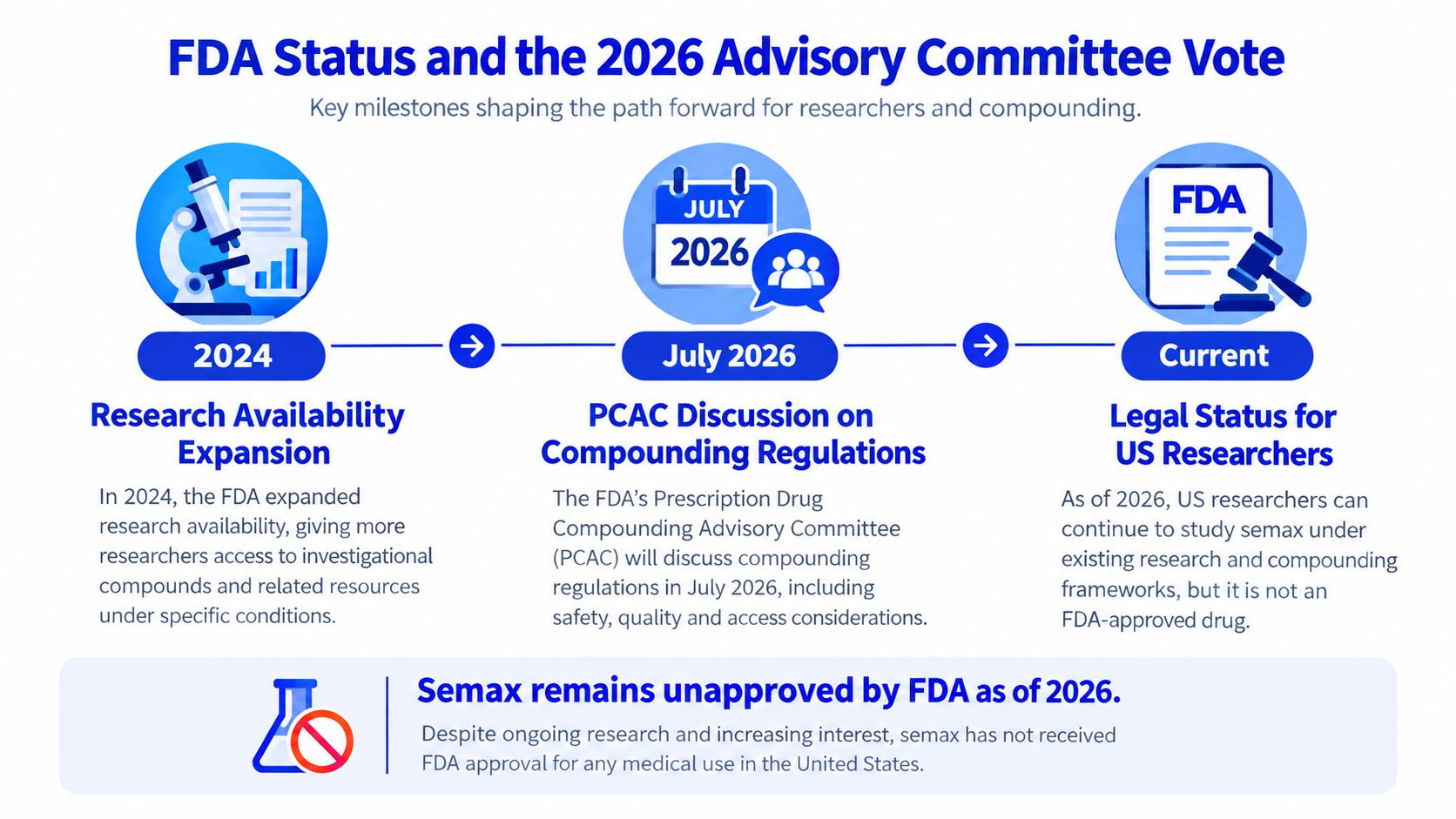
The committee's recommendation was advisory. A July 2026 news report described a narrow vote recommending six peptides, including Semax, for compounding, but that recommendation didn't itself authorize compounding or convert Semax into an FDA-approved drug. This report on the advisory vote illustrates why the words “recommended” and “approved” shouldn't be treated as synonyms.
The regulatory discussion signals increased scrutiny of substance identity, formulation, quality controls, and health claims. It doesn't establish that every product marketed as Semax is suitable for laboratory, clinical, or personal use. It also doesn't make an online research listing equivalent to a pharmacy-dispensed preparation.
For a U.S. researcher, the practical conclusion is straightforward:
A regulatory recommendation can change the policy conversation without resolving product quality or clinical evidence. The current status should be checked against official FDA materials rather than inferred from a seller's headline.
Price comparisons for Semax are unusually easy to misread because listings combine different formats and amounts. Search results show a 10 mg vial listed at $32.99, $42.99, $55.00, and $76.99, while nasal spray listings appear around $130. This market snapshot demonstrates why a sticker price alone doesn't explain value.
The listed products may differ in salt or modification, concentration, formulation, testing, shipping, and documentation. A lower price can become less attractive if the buyer has to resolve missing batch data, uncertain storage, or an unclear quantity of active peptide.
| Format | Typical Unit Price | Cost per mg | Documentation Tier |
|---|---|---|---|
| 10 mg lyophilized vial | $32.99 to $76.99 | Varies by listing | Compare lot-specific COA and test scope |
| Nasal spray | Around $130 in listed search results | Depends on concentration and fill | Check formulation, pump, batch testing, and microbial data |
| Other formats | Not directly comparable | Calculate only after confirming active amount | Require identity and purity documentation |
For powder, divide the listed price by the stated milligrams, then examine what the price includes. The result is only a starting point. It doesn't account for reconstitution materials, shipping conditions, analytical verification, or the time needed to resolve incomplete documentation.
For sprays, price per milligram can be misleading because the product is also a delivery system. The researcher is paying for a liquid formulation, container, pump, and preparation that may be useful for a repeated nasal-delivery protocol. Those features matter only if the supplier provides enough information to evaluate them.
A lower number on the product page isn't automatically a lower cost for a defensible experiment.
Before comparing two listings, write down the active amount, exact form, concentration, delivery format, COA availability, testing laboratory, and shipping conditions. If any of those fields are blank, the comparison isn't complete.
Handling starts when the package arrives. Inspect the seal, vial label, lot number, and shipping condition before putting the material into storage. Record the receipt date and compare the vial information with the COA and order confirmation.
For sealed lyophilized material, a laboratory may use -20°C storage for long-term holding and 2–8°C for active use when those conditions match the supplier's documentation. Protect the vial from light. Reconstituted solutions generally have a shorter stability window than sealed dry powder, so the lab should define an experimental use period rather than treating the solution as indefinitely stable.
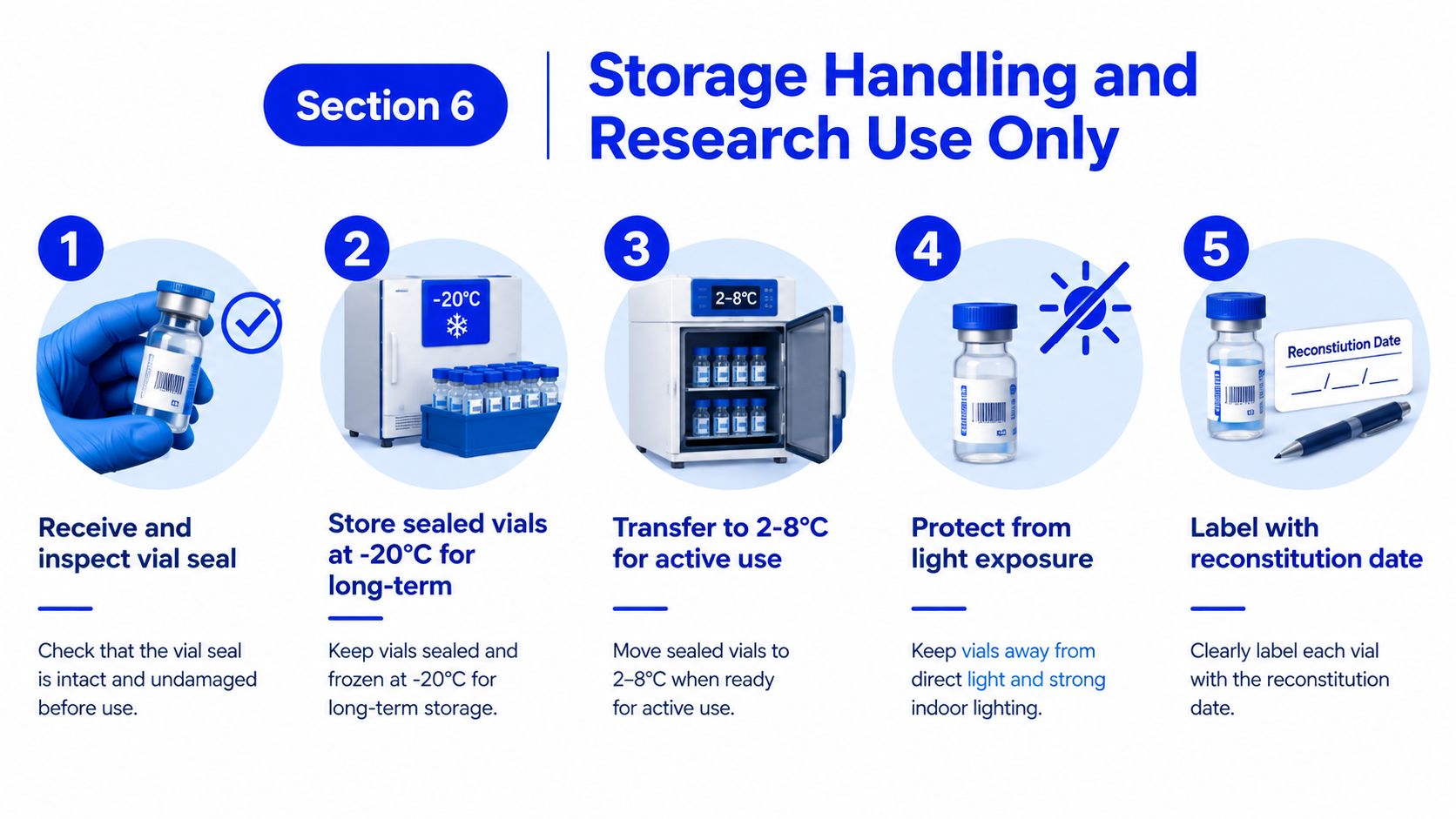
A basic procurement and handling record should include:
Semax sold through research-peptide channels is a laboratory reagent, not an FDA-approved human therapy and not a dietary ingredient. “Research use only” isn't a casual disclaimer. It defines the boundary for procurement, handling, labeling, experimental design, and institutional oversight.
A careful purchase comes down to three linked decisions: format, source, and documentation.
Choose lyophilized powder when the project needs preparation flexibility, defined reconstitution, or a dry material for storage. Choose a pre-made spray only when the ready-to-use delivery format matches the protocol and the supplier discloses concentration, carrier, pump information, storage, and lot testing. Consider an amidate variant only when the study specifically requires that chemical form and the analytical documentation identifies it clearly.
For the source itself, look for a current third-party COA, a physical business address, clear product identification, and a support team that can answer technical questions before purchase. A supplier should be able to explain whether its HPLC, mass spectrometry, endotoxin, and microbial results are linked to the individual lot.
Before opening the vial: Confirm the form, amount, batch number, COA, storage conditions, and research-use designation in your lab record.
Peptide Warehouse USA lists Semax among its research products and provides lot documentation, including COAs and microbial and endotoxin reports, for its catalog materials. Researchers can compare the listing with other suppliers while checking whether the available format and records fit their own protocol.
Peptide Warehouse USA offers Semax and related research peptides in formats intended for laboratory, analytical, and preclinical work, with product documentation available for procurement review. Visit Peptide Warehouse USA to compare the Semax option, review available quality records, and contact the team with questions about format, purity documentation, or shipment logistics.