No products in the cart.



You're probably here because two names keep appearing together in product catalogs, forum threads, and peptide discussions: Semax and Selank. They sound related, they're often offered in similar formats, and they're both discussed under the broad umbrella of a Semax Selank peptide comparison. That's where confusion starts.
A researcher looking at both compounds usually wants a straightforward answer. Are these basically the same tool with different branding, or are they meaningfully different molecules with different research value? The short answer is that they're distinct peptides with different origins, different primary areas of study, and a human evidence base that deserves more scrutiny than many summaries give it.
That last point matters. Public content often jumps from mechanism to conclusion too quickly. A more careful approach separates what has been observed in preclinical work, what has been described in regional clinical use, and what still hasn't been established by broadly replicated randomized trials. If you're comparing compounds for laboratory, analytical, or preclinical work, that distinction is often more useful than hype about “benefits.”
Semax and Selank sit close together in peptide conversations because both are short synthetic neuropeptides, both are often discussed in intranasal formats, and both come with a reputation that's larger than the evidence many readers have reviewed. That makes them easy to group together and just as easy to misunderstand.
The useful starting point is simple. Semax is primarily associated with cognitive and neuroprotective research. Selank is primarily associated with anxiolytic and stress-modulating research. Those are broad labels, not final answers, but they help orient the discussion.
Readers also tend to get tripped up by the phrase “evidence-based” in this area. A peptide can have a plausible mechanism, interesting gene-expression data, and longstanding regional clinical use without having the kind of globally replicated human trial base that many scientists would want before making strong claims. That's especially relevant here.
Practical rule: Don't treat mechanistic plausibility, regional use, and robust clinical proof as interchangeable forms of evidence.
A careful comparison of Semax and Selank should answer four questions:
That framework is more helpful than asking which peptide is “better.” In research, the better molecule is usually the one that fits the question, the route, and the quality controls you can defend.
Semax is a synthetic heptapeptide analog of ACTH(4-7). It has also been described as a 7-amino-acid synthetic polypeptide with a molecular mass of 813.92 Da in a product reference that highlights its compact size and straightforward analytical characterization via mass spectrometry in research settings (Semax product details from ProSpec).
Historically, Semax has a specific regional context that shapes how the literature should be read. It was registered in Russia in 1994 for cerebrovascular indications, and later literature has focused more on cognitive and neuroprotective effects than on anxiolysis, as summarized in an independent clinical explainer (Semax research overview).

That history explains why Semax often appears in discussions around focus, cognition, and neuroprotection rather than in discussions centered on stress response. It also explains why many modern summaries sound confident. There is a long trail of use and commentary around the compound, especially in Russian-language material.
Published Russian clinical use has often reported intranasal dosing in the range of 0.1% to 1% solution, with approximately 6,000 mcg per day given in 10-day courses, according to the same Semax overview linked above. The important qualifier is that independent Western randomized controlled trial evidence is still lacking.
That gap between historical use and broader validation is where a lot of online content loses precision. Semax may be discussed as a nootropic peptide, but that label can blur several different questions:
Semax is best understood as a defined short peptide with a specific clinical history in Russia and a narrower evidence base than many marketing summaries imply.
For a junior scientist or lab manager, the practical takeaway is to treat Semax as a legitimate research subject with clear historical context, not as a settled global standard. It's compelling because it has both a long regional record and a still-limited internationally replicated evidence base. Those two facts can both be true at the same time.
If Semax is usually introduced through cognition and neuroprotection, Selank is usually introduced through anxiolytic and stress-modulating research. It is a synthetic heptapeptide analogue of the endogenous peptide tuftsin.
Selank's published sequence is Thr-Lys-Pro-Arg-Pro-Gly-Pro (TKPRPGP), and its molecular weight is 751.9 Da, which places it in a similar size range to Semax while keeping it chemically distinct (Selank overview with sequence details).
That distinction is more than a naming detail. Semax and Selank are both short peptides, but they don't come from the same parent framework. Selank is a tuftsin analogue, not an ACTH-fragment analogue. For research planning, that means you shouldn't expect the same downstream biology on the basis of their similar delivery formats or discussion in the same communities.
Selank has been described in the literature as an anxiolytic and stress-modulating compound, and a key historical marker is that it completed third-phase clinical testing in Russia as a selective anxiolytic (Selank vs Semax clinical summary).
One of the more interesting human observations reported for Selank is short-term transcriptional activity. In one human study, administration was associated with significant changes in the expression of 45 genes within 1 hour, with 22 genes still altered at 3 hours, according to the same clinical summary. Broader writeups also emphasize possible links to GABAergic signaling and generally favorable tolerability, while still noting that the evidence base remains relatively limited and geographically concentrated.
A reader can easily overinterpret that kind of gene-expression finding. It doesn't automatically establish long-term clinical effectiveness, but it does suggest that Selank isn't just a vague calming compound with anecdotal appeal. It appears to produce measurable downstream biological effects on a short time scale.
That profile makes Selank especially relevant when the research question is about stress pathways, emotional regulation, or neurobiological responses that overlap with anxiety models. It is not merely “Semax for calm.” It has its own research identity.
The fastest way to make sense of a Semax Selank peptide comparison is to separate structure, focus, route, and evidence instead of blending them into one category called “brain peptides.”
| Attribute | Semax | Selank |
|---|---|---|
| Parent analogue | ACTH(4-7) analogue | Tuftsin analogue |
| Peptide length | 7 amino acids | 7 amino acids |
| Reported molecular weight | 813.92 Da | 751.9 Da |
| Main research emphasis | Cognitive and neuroprotective effects | Anxiolytic and stress-modulating effects |
| Historical clinical context | Registered in Russia for cerebrovascular indications | Completed third-phase clinical testing in Russia as a selective anxiolytic |
| Common discussion around administration | Often discussed in intranasal form | Often discussed in intranasal form |
| Evidence caveat | Human evidence outside Eastern Europe remains limited | Human evidence outside Eastern Europe remains limited |
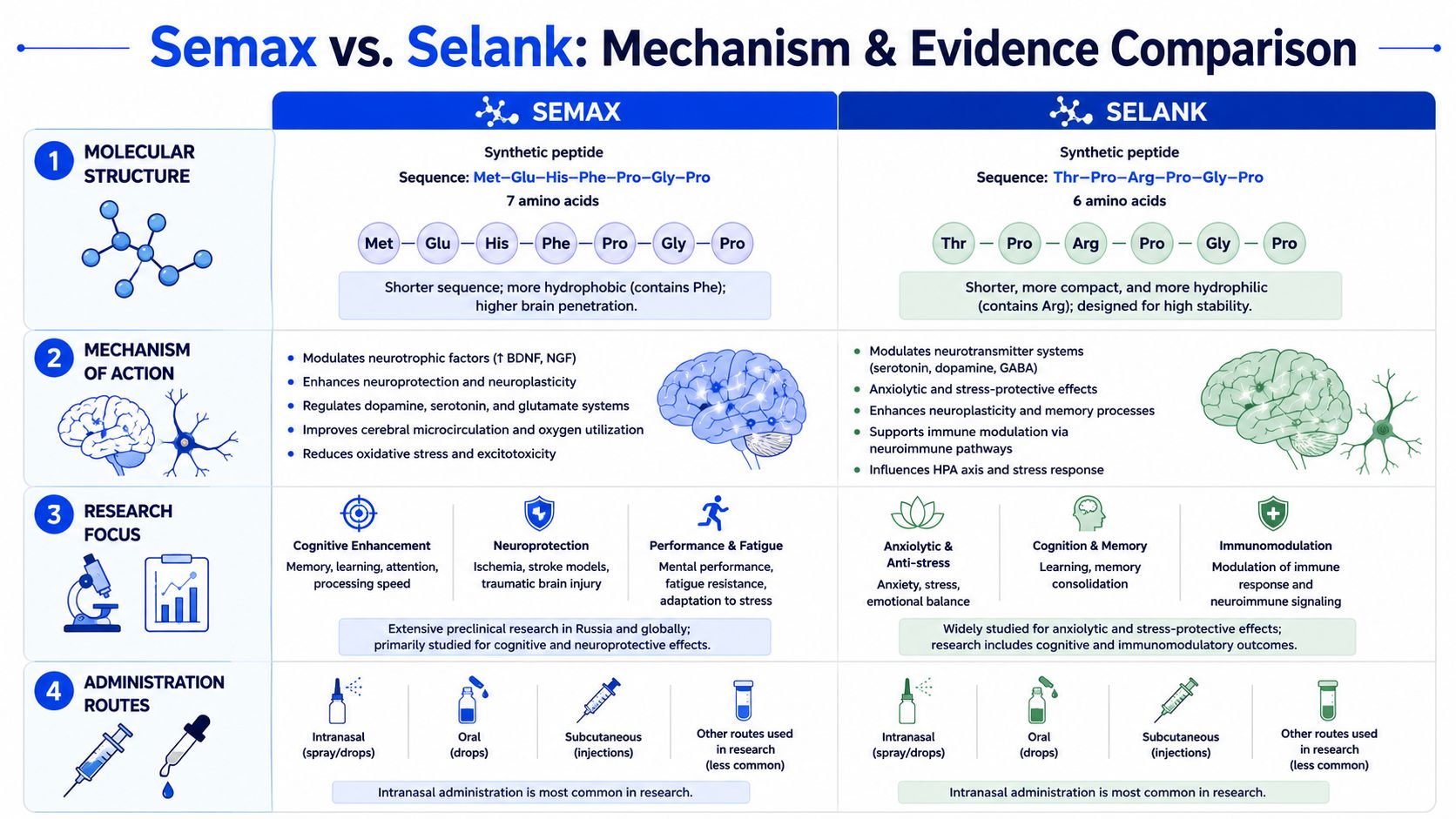
Both peptides are heptapeptides. That's why they're often grouped together. But similar length doesn't mean similar role.
Semax's compact size and defined mass profile make it relatively straightforward to characterize analytically. Selank occupies a comparable size range but derives from a different biological template and is associated with different downstream pathways. In practical research terms, that means assay design, expected readouts, and model selection should follow the peptide's actual biology rather than the convenience of pairing them.
A useful way to think about the difference is this:
This is the part many buyers and even some experienced readers want stated plainly. A careful review of the literature suggests that the human evidence base for both Semax and Selank remains weak outside Russia and Eastern Europe, with much of the public-facing support coming from preliminary findings, regional clinical populations, and secondary summaries rather than large-scale, widely replicated randomized trials (review discussing the limited evidence base).
That doesn't make the compounds uninteresting. It changes how you should talk about them.
The honest question isn't only “what does this peptide seem to do?” It's also “how confidently can we separate mechanistic promise from proven clinical effect?”
For lab decision-making, that creates a sensible hierarchy:
Many useful peptide discussions grow more credible. Instead of arguing that one molecule “wins,” they acknowledge that both compounds have specific research value and both require restraint in interpretation.
A common research problem looks simple on paper. Two teams say they are studying Semax or Selank, but one uses an intranasal preparation and the other uses a reconstituted injectable solution. If the outcomes differ, the peptide may not be the only reason.

Route is not a packaging detail. It is part of the experimental model.
For Semax and Selank, intranasal delivery often attracts attention because it may provide a path to central nervous system exposure through nasal and olfactory-associated transport. Injectable delivery is usually discussed in a different way. It is generally chosen when a study needs more controlled systemic exposure and tighter dose accounting. Those are related goals, but they are not the same goal.
That distinction matters because the evidence base is uneven. Mechanistic discussions about nasal delivery are useful for hypothesis generation, yet they do not automatically establish equivalent absorption across formulations, batches, or administration techniques. In other words, a nasal spray can be biologically plausible without being interchangeable with an injectable preparation.
A useful comparison is sampling water from two points in the same river. Both samples come from the same system, but they can still tell you different things depending on where and how you collect them. Administration route works the same way. It shapes what kind of exposure you are testing.
For study planning, keep four variables separate:
The usual operational choice is between lyophilized powder that requires reconstitution and a premade nasal spray format. That choice affects more than convenience. It changes how many handling steps sit between the labeled material and the administered dose.
Lyophilized material gives the team more control over solvent selection, concentration, and aliquoting, but it also introduces more opportunities for preparation error. Premade nasal formats reduce some preparation steps, yet they add their own variables, such as spray-device consistency, container stability, and dose-per-actuation verification. A lab that ignores those differences can end up comparing workflows rather than comparing Semax with Selank.
This is also where evidence quality and administrative discipline meet. If the published literature is already limited, preventable formulation noise becomes even more costly because it further weakens interpretation.
Good records help contain that problem. Batch IDs, reconstitution logs, storage temperatures, freeze-thaw history, administration timing, and route-specific SOPs should be captured in a form the team can audit later. Groups running multi-lot or multi-route studies may find structured documentation systems useful, including Polymerize's guide for managing research data.
A brief sourcing point belongs here as well. Peptide Warehouse USA mentions batch-linked research documentation such as COAs and related testing records for Semax and Selank materials. For procurement review, that paperwork is more informative than broad product claims.
Before changing route or formulation, ask three direct questions:
When readers ask about safety, they often mean adverse effects. In a research setting, that's only part of the picture. The other part is whether the material itself is what the label says it is.
Available reports on Selank have often emphasized generally favorable tolerability, especially in summaries discussing its mechanistic and clinical profile. But “well tolerated” doesn't answer the most operational safety question in peptide research, which is whether the batch is pure, traceable, and suitable for the planned use.
That's why a narrow side-effect conversation can miss the bigger risk. A poorly characterized sample can distort results, create reproducibility problems, and undermine any interpretation you hoped to make about Semax or Selank themselves.
If your material identity is uncertain, your downstream biology is uncertain too.
For Semax and Selank research materials, quality assurance should be treated as part of experimental design, not as a purchasing afterthought.
Use a checklist that covers more than one document:
A Certificate of Analysis, or COA, is useful only if the details are readable and batch-specific. Generic paperwork doesn't help much. A lab should be able to match the vial, the paperwork, the receiving log, and the study record without guessing.
There's also a mindset issue here. Researchers sometimes focus on the peptide's theoretical pathway but skip vendor verification because the compound itself seems familiar. That's backwards. With compounds whose public reputation can outpace the strength of broad human data, the integrity of the material becomes even more important.
A disciplined team usually treats Semax and Selank like any other specialized research reagent. Verify identity. Verify documentation. Record storage and handling. Then interpret the biology with appropriate caution.
A useful Semax Selank peptide comparison doesn't end with a winner. It ends with a sharper question.
Choose Semax when the work is centered on cognition, neuroprotection, or related neurobiological models tied to its ACTH-fragment lineage and historical research profile. Choose Selank when the work is centered on anxiolytic signaling, stress modulation, or short-term neurobiological activity more consistent with its tuftsin-analogue identity.
The more important conclusion is about evidence. Both peptides are interesting. Both have a real literature behind them. Neither should be discussed as though the human evidence base is equally mature across all regions and all use cases. That distinction helps researchers avoid exaggerated claims and build better experiments.
If you're evaluating product formats, keep route and formulation separate from peptide identity. If you're evaluating suppliers, put documentation quality close to the top of the list. And if you're training a team, make sure they understand the difference between mechanism, observed effect, and proven clinical effectiveness.
That's the practical way to think about these compounds. Not as interchangeable “brain peptides,” but as two related, compact molecules with different histories, different research emphases, and different evidentiary limits.
If you want to learn more about research-grade Semax and Selank materials, explore the catalog at Peptide Warehouse USA. It's a straightforward place to review available peptide formats, documentation practices, and research-use product options before you make a procurement decision.