No products in the cart.


You've got the vial on the bench, the bacteriostatic water ready, and the syringe markings in front of you. The missing piece is turning the label on the vial into a draw volume you can trust. A sermorelin reconstitution calculator exists for exactly that moment, when milligrams on the vial, micrograms in the dose, and U-100 insulin syringe units all have to line up without guesswork.
That's where the confusion usually starts. The vial says mg, the protocol speaks in mcg, and the syringe is marked in units, where 1 mL = 100 units on a U-100 scale. Get one conversion wrong and the final draw is off, which is why a good calculator is less about convenience and more about keeping the arithmetic consistent across the whole prep workflow, from vial to dilution to syringe. If you want a broader, non-technical perspective on peptide-related longevity topics, the anti-aging expert insights discussion from Peak Performance is a useful companion read.
You start with a lyophilized vial and a syringe of bacteriostatic water, and the first question is practical: how much diluent goes in, what concentration does that create, and how many syringe units does the target dose become? A sermorelin reconstitution calculator ties those steps together, because the answer to one depends on the answer to the one before it.
The first conversion is milligrams to micrograms, because vial labels and dose instructions do not always use the same unit. The second is micrograms to mL, because concentration only exists after the peptide is reconstituted. The third is mL to U-100 units, because the syringe shows volume, not peptide mass.
That chain matters in a real bench setup. A 5 mg vial mixed with 2 mL of bacteriostatic water gives 2.5 mg/mL, so a 200 mcg target dose becomes 0.08 mL or 8 units on a U-100 syringe, while 300 mcg becomes 12 units and 500 mcg becomes 20 units Peptide Calcs sermorelin reconstitution tool. The same 5 mg and 2 mL setup also shows about 25 doses per vial at 200 mcg per dose.
Practical rule: if the vial mass, diluent volume, and target dose do not stay in the same conversion chain, the draw is already at risk.
A calculator keeps that chain visible from start to finish. It works like a workflow tool, not a single math shortcut, which is helpful in research-only settings where consistency matters more than improvisation. For readers who want a broader context on peptide handling and dose planning, these anti-aging expert insights can help frame why careful reconstitution habits matter before a syringe is ever drawn into view.
A reconstitution calculator is easiest to use when you treat it as a sequence of small checks. Start with the vial label, then move to the mixed concentration, then translate that concentration into a draw volume, and only after that convert the draw into U-100 units. That order matters because each step depends on the one before it, much like checking a calculation before making a final entry in a lab notebook.
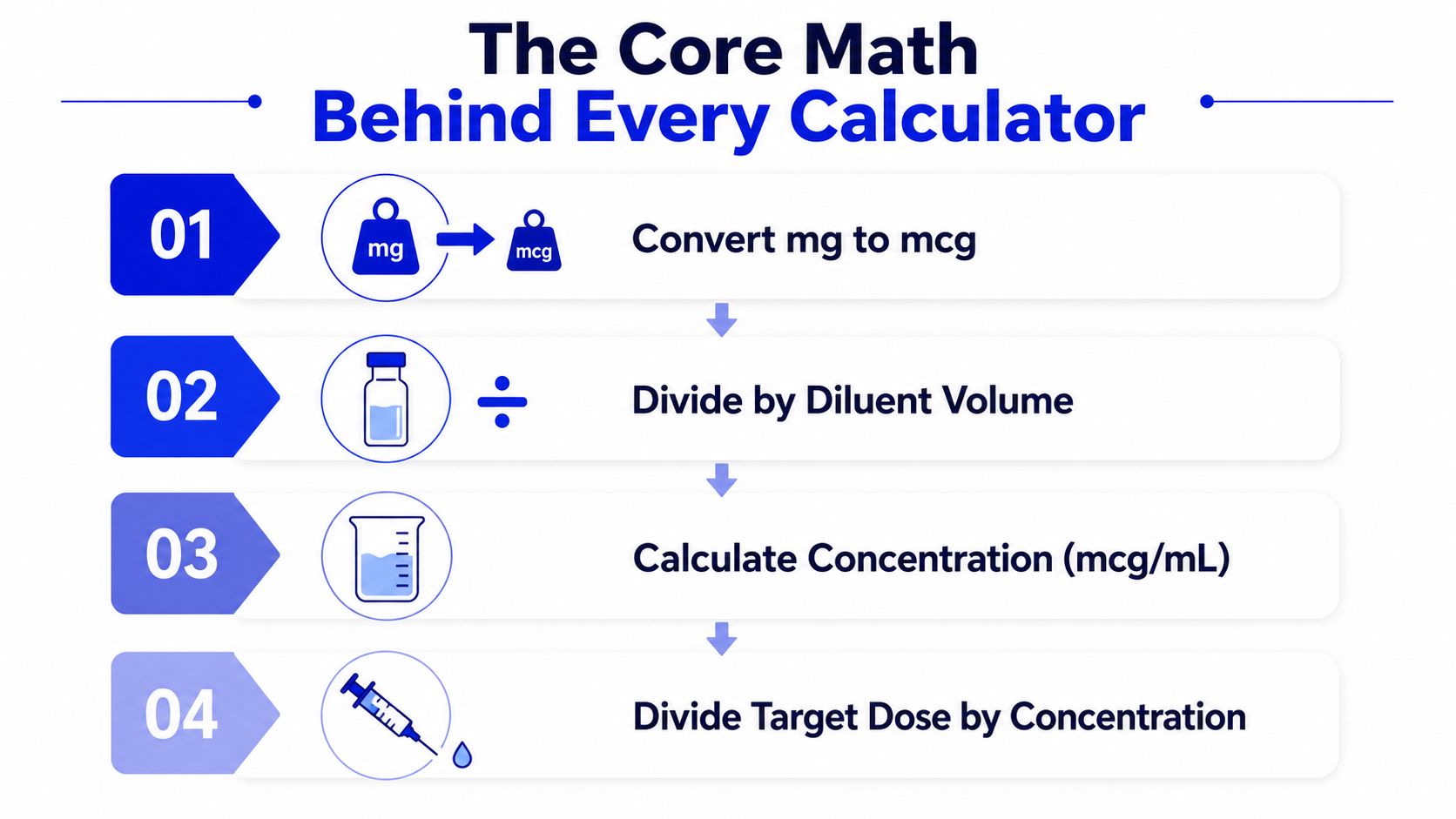
The first step is to convert the vial's labeled mg into mcg. The second is to divide that total by the chosen diluent volume so you get mcg/mL, which tells you how much peptide sits in each milliliter after reconstitution. The third step is to divide the intended dose by that concentration to get the injection volume in mL. The final step is to convert mL into U-100 units, since that is the scale most researchers read directly on the syringe Get Peptide Pilot reconstitution guide.
Start with a 5 mg vial and add 2 mL of bacteriostatic water. The vial contains 5,000 mcg total, so the reconstituted concentration is 2,500 mcg/mL. A 200 mcg target dose is then 200 divided by 2,500, which gives 0.08 mL Get Peptide Pilot reconstitution guide.
The syringe conversion comes last. Because 1 mL = 100 units, 0.08 mL = 8 units Get Peptide Pilot reconstitution guide. That final number is the practical endpoint, since it is the mark a researcher draws to on a U-100 syringe.
A different diluent choice changes the arithmetic without changing the vial content. If the same 5 mg vial is mixed with 1 mL, the concentration doubles, so the same 200 mcg dose becomes a smaller volume and a tighter syringe draw. If it is mixed with 3 mL, the concentration drops, and the same dose becomes a larger draw that is often easier to read, though less concentrated overall. That is why the calculator functions as a workflow tool, not just a formula box. It helps you see how the vial label, the reconstitution volume, and the target dose fit together before you touch the syringe.
For readers who like a second example to test the logic, the pattern still holds with a different vial strength. A 10 mg vial contains 10,000 mcg total, so if it is reconstituted with 2 mL, the concentration becomes 5,000 mcg/mL, and a 250 mcg target dose would be 0.05 mL, or 5 units. The algebra changes only because the starting amount changes, while the sequence of steps stays the same.
If you want a broader habit to apply while checking units and proportions, the guide for confident clinical decisions is a useful reminder that careful calculations depend on the same habit of tracing each number back to its unit and source.
A calculator does not replace the math, it organizes the math into a faster check.
The main advantage is reproducibility. Once the vial amount, diluent volume, and target dose are fixed, the same calculation chain applies every time, which keeps the result consistent across different vial sizes and reconstitution choices.
A good sermorelin reconstitution calculator does more than convert powder into liquid math. It helps you choose a diluent volume that fits the way you read a syringe, so the final dose is easy to measure without forcing you to guess between tiny marks. For a 5 mg vial, the reconstitution choice changes the concentration enough that the same target dose can move from a very small draw to a much easier one Real Peptides sermorelin ratio guide.
A 1 mL reconstitution creates a concentrated solution at 5,000 mcg/mL. That gives 2 units for 100 mcg, 4 units for 200 mcg, 6 units for 300 mcg, and 10 units for 500 mcg Real Peptides sermorelin ratio guide. The arithmetic is straightforward, but the smaller the draw, the easier it is to misread a line or overshoot by a unit.
A 2 mL reconstitution lowers the concentration to 2,500 mcg/mL. The same targets become 4 units for 100 mcg, 8 units for 200 mcg, 12 units for 300 mcg, and 20 units for 500 mcg Peptide Calcs sermorelin calculator. That spacing is one reason this volume is often favored, since the common research doses fall on marks that are easier to see cleanly.
A 3 mL reconstitution brings the concentration down to about 1,667 mcg/mL Real Peptides sermorelin ratio guide. The dose occupies more of the syringe barrel, which can make some readings easier to separate, but it also changes the unit mapping enough that you should recheck the conversion every time the diluent volume changes.
| Diluent Volume vs Concentration for a 5 mg Vial | Bacteriostatic Water | Concentration | 100 mcg | 200 mcg | 300 mcg | 500 mcg |
|---|---|---|---|---|---|---|
| Option 1 | 1 mL | 5,000 mcg/mL | 2 units | 4 units | 6 units | 10 units |
| Option 2 | 2 mL | 2,500 mcg/mL | 4 units | 8 units | 12 units | 20 units |
| Option 3 | 3 mL | 1,667 mcg/mL | 6 units | 12 units | 18 units | 30 units |
The table is most useful as a bench check, not just a math summary. If your target dose is in the 200 to 300 mcg range, a 2 mL mix keeps the draw visible without making it so large that small measurement errors are hidden, which is why it often feels easier to work with in practice Peptide Calcs sermorelin calculator. If your workflow depends on very fine adjustments, a more concentrated mix gives you smaller unit steps, but it also demands a steadier read of the syringe.
A calculator becomes easier to trust once you watch the same conversion logic move from vial label to syringe mark in a few different setups. The arithmetic stays the same, but the draw changes with the amount of diluent, so the workflow changes with it.
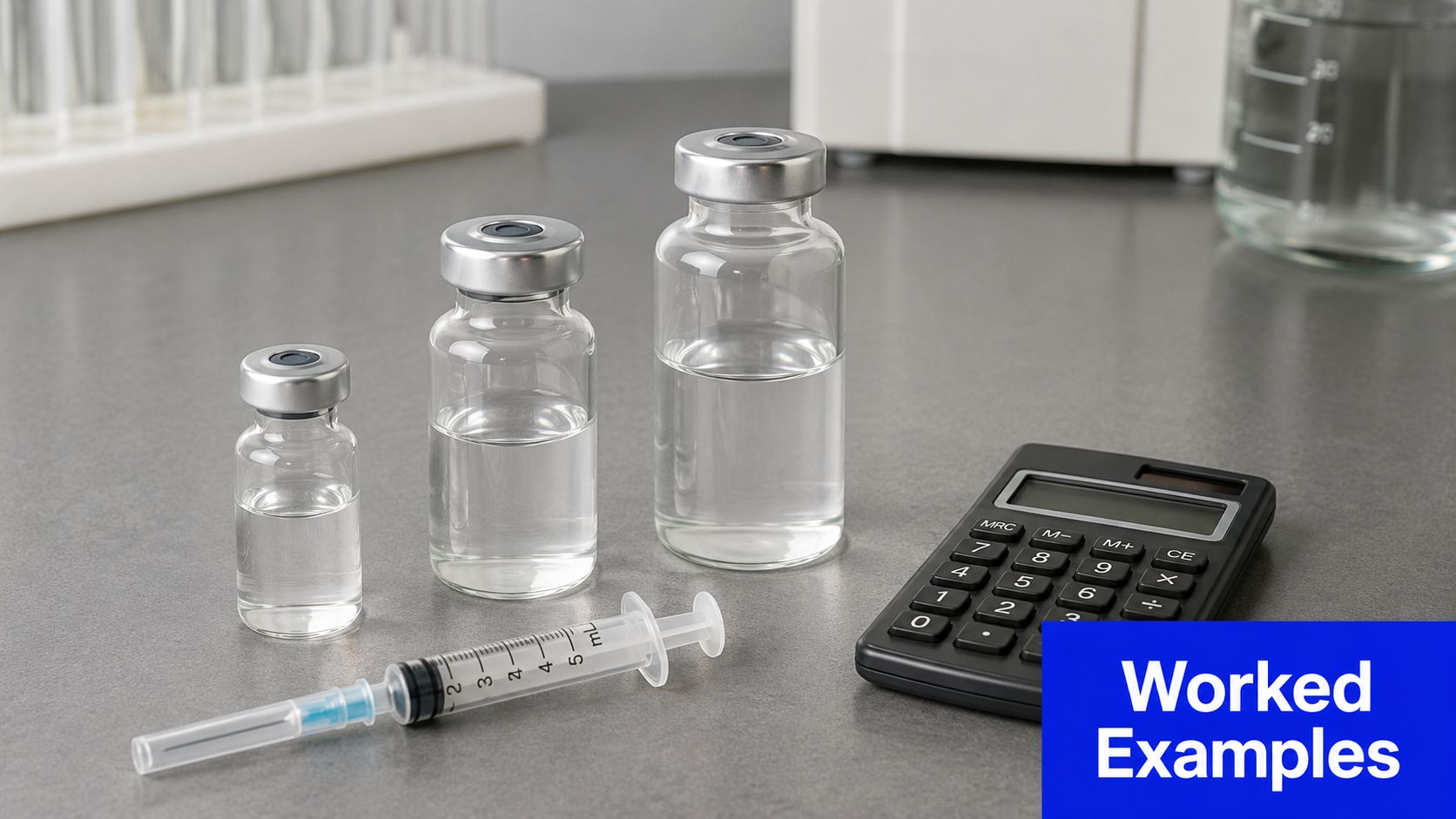
A 5 mg vial mixed with 2 mL produces 2.5 mg/mL, which is 2,500 mcg/mL. If the target is 200 mcg, the draw lands at 8 units. At the bench, that is the kind of reading that is easy to verify because it sits far enough above zero to see clearly, but not so high that the syringe becomes crowded.
This setup is useful as a reference point when you are checking whether the vial label, the diluent volume, and the syringe scale are all speaking the same language.
A 2 mg vial in 2 mL gives 1 mg/mL Sermorelin dosage calculator reference. The smaller peptide load lowers the concentration, but the math path does not change. You still start with the vial label, convert the mass into a per-milliliter concentration, and then translate the dose into syringe units.
That is where the calculator helps as a workflow tool. It keeps the sequence visible, so a first-time researcher can see how the same logic applies even when the vial size is different and the final draw sits in a different place on the barrel.
Bench habit: after any reconstitution, re-check the concentration line before you read the syringe, not after.
A 10 mg vial mixed with 3 mL gives a concentration of 3,333 mcg/mL Know Your Peptide calculator reference. In that setup, 100 mcg equals 3 units, 200 mcg equals 6 units, and 300 mcg equals 9 units. The higher peptide load compresses the draw into a smaller part of the syringe, so the same dose occupies fewer visible marks.
This is the kind of example that shows why diluent choice matters for precision. A more concentrated mix can make the unit count smaller and cleaner, but it also leaves less room for casual reading, so the syringe has to be handled with a steadier eye.
A 6 mg vial mixed with 4 mL creates a concentration of 1.5 mg/mL, or 1,500 mcg/mL Know Your Peptide calculator reference. At that strength, 150 mcg draws to 10 units, and 300 mcg draws to 20 units. The draw is larger than the 10 mg example above, even though the vial contains less total peptide, because the extra diluent spreads the same material across more volume.
That difference helps explain why two correct reconstitutions can feel very different at the syringe. One gives a compact draw that is easy to miss if you are not careful, and the other gives a wider draw that is easier to inspect, but can take more space in the barrel.
A 1 mg vial in 1 mL gives 1 mg/mL, which is 1,000 mcg/mL Sermorelin dosage calculator reference. In that case, 100 mcg equals 10 units. This is a simple example, but it is useful because the round numbers make the conversion chain easier to see from end to end.
It also shows the same workflow in its most compact form. Read the vial amount, note the diluent, confirm the concentration, then check where the target dose lands on the syringe before any draw is made.
The biggest mistakes are rarely about the algebra itself. They happen in the handoff between steps, where a correct calculation gets paired with the wrong unit, the wrong draw, or a vial that isn't ready to use.
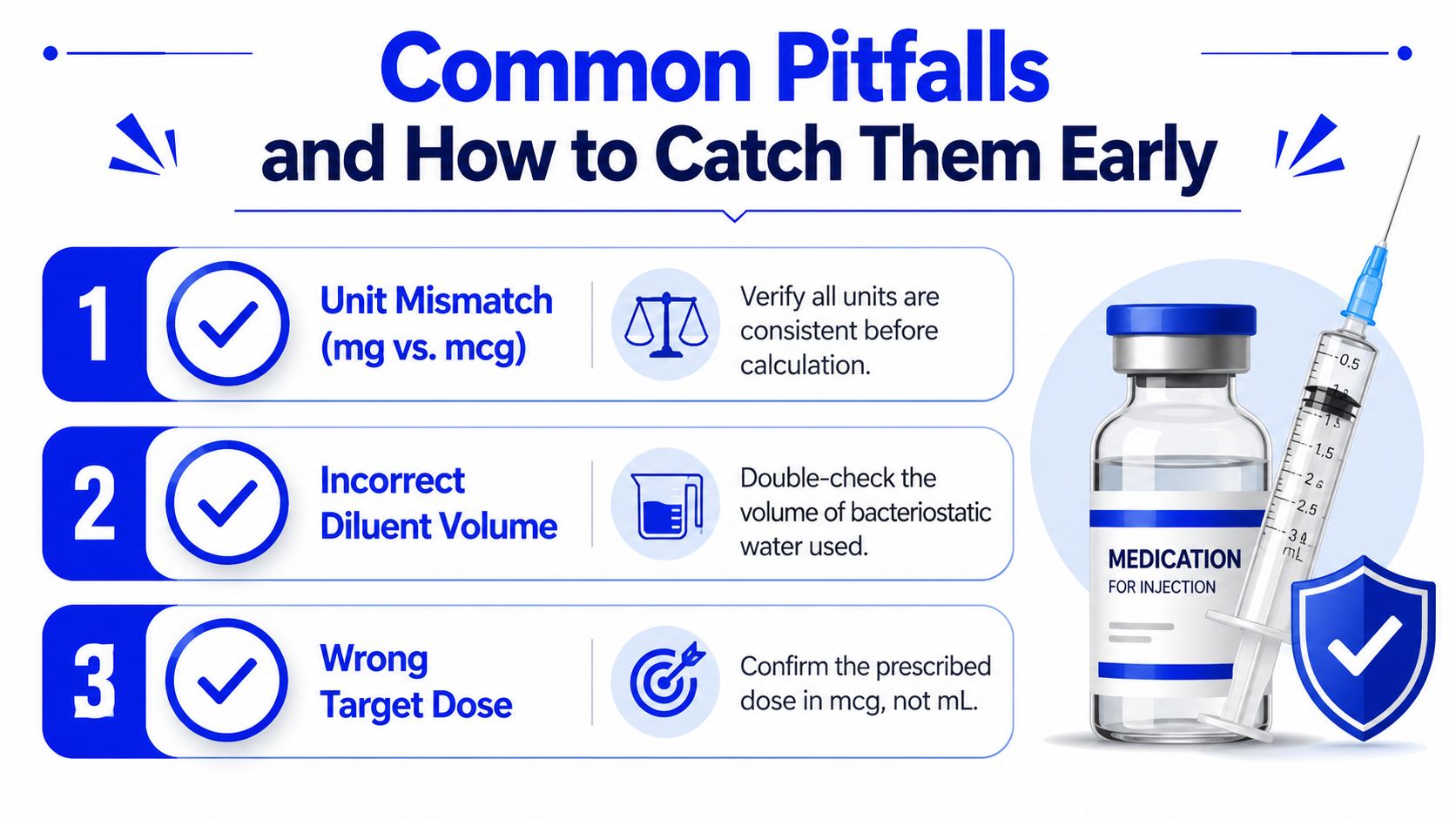
Unit mismatch is the one that causes the most damage. Vial content sits in mg, dose often sits in mcg, and the syringe is read in U-100 units, where 1 mL = 100 units Get Peptide Pilot reconstitution guide. If those labels aren't translated carefully, a tenfold error can slip through even when the calculator itself is correct.
Incomplete dissolution is the other major risk. One protocol says to add bacteriostatic water slowly down the vial wall, swirl gently instead of shaking, and wait for full dissolution, which can take 10 to 15 minutes after a 5-minute rest Get Peptide Pilot reconstitution guide. If the solution isn't homogeneous, the draw you take may not reflect the true concentration.
Awkward fractional units are less dramatic, but they matter for reproducibility. A dilution that leaves you estimating tiny partial marks is harder to repeat between users, especially when precision depends on a readable U-100 syringe Know Your Peptide calculator reference. A cleaner concentration usually makes the workflow easier to verify.
Missing date records create a different kind of failure. If the vial sits without a reconstitution date, nobody knows whether the solution is still inside its use window, which makes the whole prep less reliable. That's a workflow problem, not a math problem.
A quick verification habit helps:
If you keep those checks separate from the calculator, the calculator stays useful instead of becoming a false sense of security.
Once the math is settled, the next check is whether the vial will still be usable when you return to it. Reconstituted sermorelin is typically kept refrigerated at 2 to 8°C, and protocol notes may point to different use windows, such as about 4 weeks or 21 days depending on the workflow. The exact limit depends on the protocol being followed, but the storage logic stays the same.
A clean calculation does not help if the vial is handled poorly afterward. Light exposure, repeated warming, and rough movement all work against stability, so the reconstituted vial should receive the same care as the parent vial, with refrigeration, gentle technique, and a clear reconstitution date written on the label. Once the powder becomes a solution, the material is no longer in the more stable lyophilized state, so the bench routine needs to reflect that change.
A correct dose calculation is only useful if the vial is still viable when you draw it.
That point is easier to see in a side-by-side comparison. The workflow questions around storage, dilution, and dosing math also show up in the comparison guide on semaglutide reconstitution protocols for telehealth patients, which helps illustrate how those pieces fit together across peptides rather than as separate steps.
This article stays in the research-use-only frame. It is meant to help readers understand calculation, dilution, and handling logic, not to provide clinical guidance or dosing advice. That distinction matters because the same arithmetic can support analytical work without becoming medical instruction.
Read the vial in mg, choose a diluent volume that gives you clean U-100 markings, add the bacteriostatic water slowly down the vial wall, swirl gently, and wait for full dissolution. Then draw the calculated units, record the reconstitution date, and refrigerate the vial at the protocol-appropriate temperature.
The sermorelin reconstitution calculator is best treated as a workflow companion, not a shortcut. Once the inputs are correct, the same math applies to any vial size, and the output becomes a repeatable bench reference instead of a guess. If you're evaluating research-grade sermorelin or related compounds, explore a catalog that keeps sourcing, testing, and research-use labeling clear from the start.
Peptide Warehouse USA supplies research peptides and related compounds for laboratory, analytical, and preclinical use, with U.S.-made sourcing, transparent batch documentation, and a research-use-only framework that fits this kind of work. If you're comparing sermorelin options or building out a peptide workflow, visit Peptide Warehouse USA to explore the catalog and see what's available for your research needs.