No products in the cart.


A tiny peptide can influence a surprisingly large slice of human biology. In skin research, GHK-Cu has been reported to trigger expression changes in approximately 31% of human genes toward a younger profile, which helps explain why it keeps appearing in conversations about repair, firmness, and visible skin quality [GHK-Cu gene expression research].
That headline can also confuse people. Some readers encounter GHK-Cu as a cosmetic ingredient. Others know it as a research peptide with broader regenerative interest. The useful way to think about skin biology GHK-Cu is this: it isn't just another “anti-aging” additive. It acts more like a signaling system that can influence how skin cells rebuild, defend, and reorganize tissue.
For a well-informed reader, the key questions aren't hard to state. What exactly is GHK-Cu? Why does copper matter? How does a small tripeptide affect collagen, extracellular matrix turnover, and inflammation? And if you're evaluating it in a lab, what separates a valid experiment from a noisy one?
GHK-Cu matters in skin research because it behaves less like a basic cosmetic ingredient and more like a signaling cue. Researchers study it for the same reason they study traffic controllers in a busy city. The interesting question is not whether one car moves, but whether the whole system flows better when the signals are timed correctly.
That framing helps explain why GHK-Cu continues to draw attention. Aging skin does not decline through one pathway. Fibroblasts become less responsive, collagen fibers lose organization, and the extracellular matrix shifts from a well-maintained scaffold to a structure that is repaired less efficiently. A peptide that influences several of those processes at once is more interesting than one that only coats the surface or supplies temporary hydration.
Published research has linked GHK-Cu to broad changes in gene expression and to effects on fibroblast activity, collagen-related pathways, and matrix regulation [overview of GHK-Cu research history and mechanisms]. That is why it is often described as a remodeling peptide. The label matters because remodeling is a systems-level concept. Skin strength, texture, and resilience depend on how cells, structural proteins, enzymes, and signaling molecules work together over time.
A practical way to read the literature is to ask whether GHK-Cu improves coordination. A construction site offers a useful analogy. Adding more bricks does not fix a building if the crew, timing, and blueprint are all off. In the same way, more collagen alone does not guarantee better skin architecture. The quality of repair depends on whether matrix production, matrix breakdown, antioxidant protection, and cell signaling stay in balance.
For readers who are also thinking about product claims or study design, this point keeps the science grounded. A meaningful GHK-Cu result does not come from copper merely touching skin. It depends on whether the peptide-copper complex stays intact, reaches biologically relevant layers, and is tested under conditions where signaling can be measured clearly rather than obscured by poor formulation or weak experimental control.
GHK-Cu is not just another skincare acronym. It is a defined molecular complex with a specific biological identity, and that identity explains why researchers study it differently from plain copper salts or generic peptides.
GHK refers to the tripeptide glycyl-L-histidyl-L-lysine. "Tripeptide" means a chain of three amino acids. Small does not mean trivial, though. In biology, short peptide sequences often behave like concise molecular messages. Cells can detect them, respond to them, and change behavior accordingly.
Cu refers to copper bound to that peptide. Together, they form a chelated complex. That detail matters. A chelate is more like a coordinated unit than a casual mixture in the same bottle. In GHK-Cu research, scientists are studying the behavior of the peptide-copper complex itself, because binding changes how copper is presented and how the molecule interacts with biological systems.
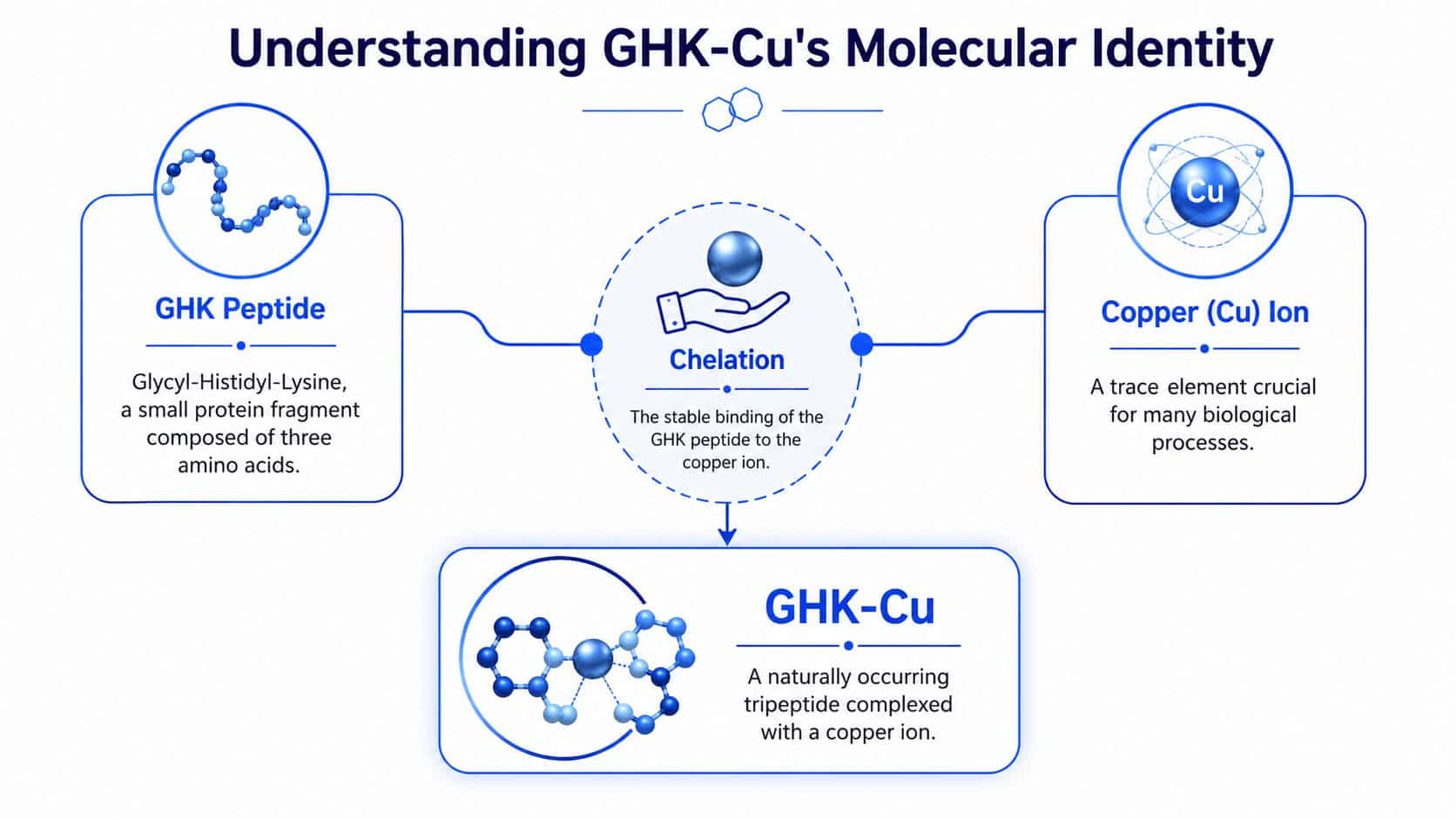
A practical comparison helps here. Loose copper in solution resembles raw material delivered to a job site with no routing plan. GHK-Cu resembles packaged material with labeling, destination, and handling instructions attached. The copper is still copper, but the context changes the biological outcome.
Copper participates in many reactions tied to tissue maintenance, antioxidant defense, and repair. Skin cells need it, but they do not handle free copper casually. The body controls copper tightly because the same metal that supports enzyme function can also become disruptive when it is poorly managed.
GHK appears to help organize that copper exposure. Researchers often describe GHK-Cu as a signaling complex with copper-binding capacity, not as a simple way to add more mineral to skin. That is a useful distinction for anyone trying to connect molecular biology with visible skin outcomes. Growth factors for fine lines are often discussed in the same consumer conversations, but GHK-Cu enters the discussion through a different route. Its interest comes from peptide signaling joined to metal coordination.
This also clears up a common point of confusion. A copper salt and GHK-Cu are not interchangeable test materials. One may expose tissue to copper. The other presents copper through a peptide structure that can influence how the signal is received and how the compound behaves in a biological setting.
The article's laboratory perspective is important. A study on GHK-Cu is only valid if the molecule being tested is the intact complex and if the test conditions preserve that state long enough for cells or tissue models to respond. If the complex degrades, dissociates, oxidizes, or sticks to the wrong formulation components, the experiment may stop being a GHK-Cu study in any meaningful sense.
That point is easy to miss outside research settings. Consumer discussions often treat ingredient names as if they guarantee biological performance. They do not. For GHK-Cu, molecular identity, stability, and delivery conditions all shape the result.
Skin delivery also needs realistic expectations. The complex is small, but skin is selective, especially when the barrier is intact. Penetration depends on the vehicle, pH, surrounding ingredients, and whether the peptide remains stable from storage through application. Researchers therefore pay close attention to formulation design instead of assuming that a low molecular weight alone will solve delivery.
A careful reader can use that logic right away:
The molecular identity of GHK-Cu is the starting point for everything that follows. If you miss that, the rest of the skin biology becomes harder to interpret correctly.
Most skin ingredients do one job. GHK-Cu is interesting because it appears to manage a process. In practice, that process is skin remodeling, the constant replacement of worn, damaged, or disorganized extracellular matrix with newer, better-structured tissue.
Fibroblasts are the workhorse cells of the dermis. They make collagen and help organize the extracellular matrix that gives skin its strength and elasticity. When fibroblasts lose efficiency, skin tends to look thinner, looser, and less resilient.
In human dermal fibroblast studies, GHK-Cu demonstrated a consistent capacity to increase collagen production by 70–80% compared to untreated controls, while also upregulating genes for elastin, decorin, and glycosaminoglycans essential for extracellular matrix structure [fibroblast collagen and matrix findings]. That isn't just a collagen story. It's a matrix story.
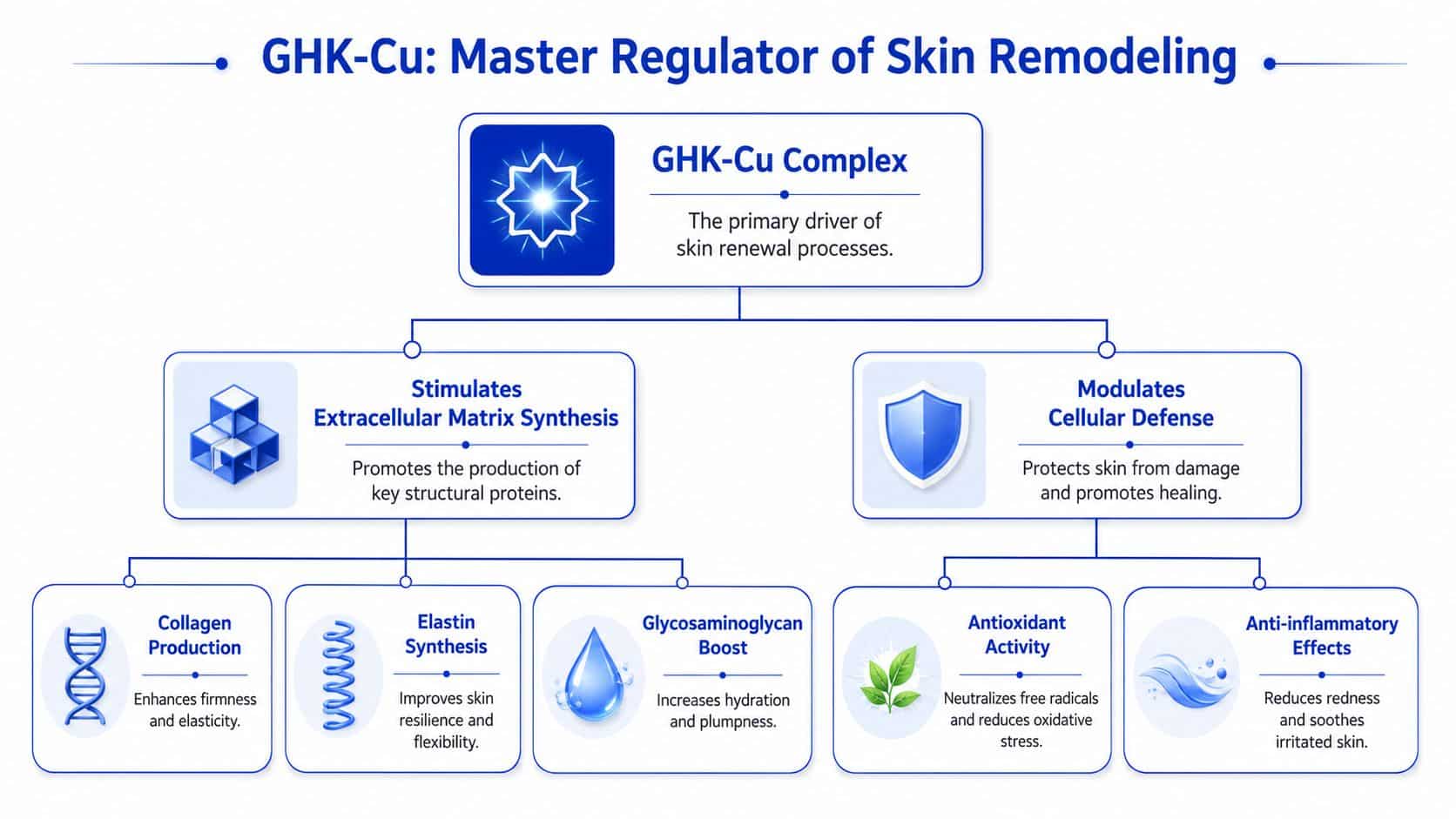
Think of the matrix as the scaffolding, cushioning material, and tension system of skin all at once. Collagen provides structural support. Elastin contributes recoil. Glycosaminoglycans help retain water and influence plumpness. Decorin helps organize collagen fibrils. When a peptide influences several of these at the same time, the result can look more coherent than what you'd expect from a single-pathway ingredient.
People often hear “more collagen” and stop there. Skin doesn't improve just by piling new material on top of old, damaged matrix. Remodeling requires selective breakdown too.
GHK-Cu has been described as modulating matrix metalloproteinases, or MMPs, which are enzymes that help clear worn or damaged matrix components. That sounds counterintuitive at first because MMP activity is often associated with photoaging. The nuance is control. Too much breakdown is destructive. Controlled breakdown is necessary for replacement.
Working analogy: Healthy remodeling resembles a well-run renovation. Crews remove damaged beams, preserve what still works, and install stronger supports in the same project.
This is one reason GHK-Cu attracts both skincare interest and lab interest. A peptide that stimulates fibroblasts while helping regulate matrix turnover may support better tissue organization than an ingredient that only pushes synthesis.
For readers comparing categories, this is also where it helps to understand adjacent regenerative tools. If you're interested in how signaling molecules are used in aesthetic skin support, Mesoderm RX has a useful overview of Growth factors for fine lines, which complements the broader discussion around peptides and extracellular matrix biology.
Cell biology can feel abstract until you connect it to skin outcomes. Better collagen support and matrix organization can translate into firmer-feeling skin, smoother texture, and improved resilience. More balanced remodeling can also help explain why GHK-Cu is discussed in photoaging and recovery contexts rather than only in wrinkle marketing.
Here are the practical takeaways:
None of that means instant results. Remodeling is slow biology. But it does explain why the benefits of peptides often become clearer when you think in terms of tissue quality, not just wrinkle counts.
Healing is where skin biology stops being theoretical. A peptide can look promising in a remodeling discussion, but damaged tissue asks a harder question: can that signal help skin shift from alarm mode into organized repair?
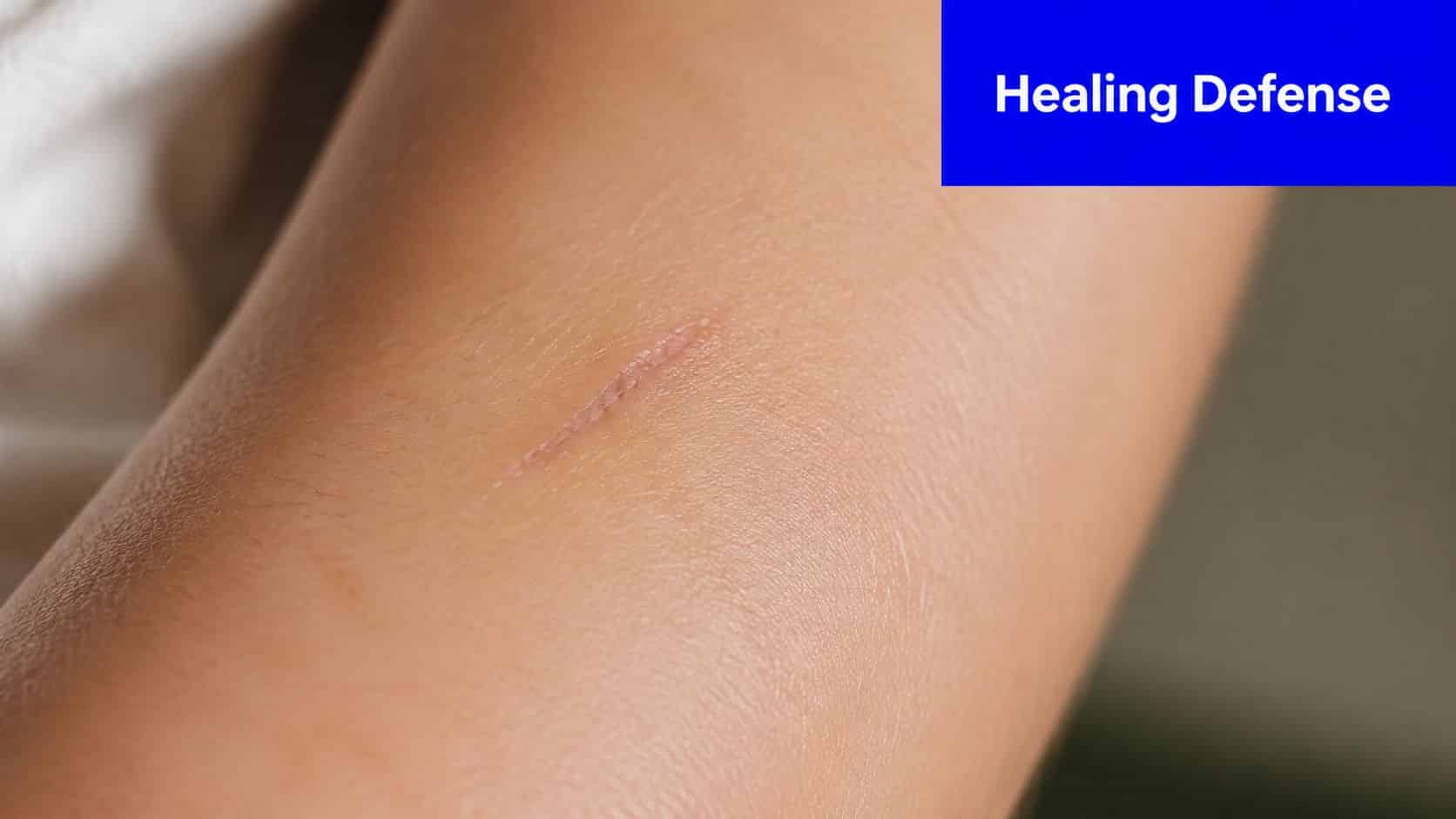
GHK-Cu has remained relevant in wound and skin research for decades because its role appears broader than simple matrix stimulation. Researchers have studied it in the context of wound closure, scar quality, inflammatory control, and tissue recovery. That matters for anyone trying to connect consumer interest to real laboratory questions. In healing models, the useful question is not only whether more collagen appears. The better question is whether the tissue environment becomes more capable of orderly repair.
A wound moves through phases. Early on, the tissue needs containment and cleanup. Later, it needs cell migration, matrix deposition, and support for newly forming tissue. If inflammatory signaling stays too high for too long, repair quality can drop even when the building blocks for collagen are present.
GHK-Cu is often discussed as a coordinator in that sequence. It has been associated with anti-inflammatory effects, support for repair processes, and protection against oxidative stress in the skin literature. Those three functions belong together. Inflammation, oxidation, and rebuilding are not separate lanes. They behave more like gears in the same machine, and poor alignment in one gear can slow the whole repair program.
That is why repair biology cannot be reduced to "make more collagen."
Inflammation is useful at the start of injury. It recruits immune cells, clears debris, and helps defend against infection. The problem is persistence. Prolonged inflammatory signaling can damage nearby tissue, disturb fibroblast behavior, and increase the odds of disorganized healing.
In practical skin terms, a calmer post-injury environment can mean less visible redness, less collateral damage, and a better setting for matrix repair. GHK-Cu is of interest because it has been described as reducing inflammatory pressure rather than provoking irritation as a path to renewal. That separates it from ingredients whose benefits depend on controlled damage or aggressive turnover.
A useful comparison is construction after a fire. You need cleanup crews first, but if the sirens never stop and the site stays chaotic, rebuilding stalls.
Injured or UV-exposed skin does not deal only with inflammation. It also deals with reactive molecules that can harm lipids, proteins, and DNA. Those reactions can distort signaling at the exact moment the tissue is trying to restore structure.
Research on GHK-Cu has linked it to protective effects in stressed skin cells, including work on keratinocyte survival under UVB stress and the handling of harmful byproducts generated during lipid peroxidation. For a non-specialist, the key idea is straightforward. Repair works better when the local environment contains less chemical noise.
A repair signal is more convincing when it supports rebuilding and lowers the stressors that interfere with rebuilding.
For readers who want a visual overview of the repair discussion, this video gives a useful starting point before you dig back into primary literature.
Healing tissue needs more than fibroblasts and collagen precursors. It needs oxygen, nutrients, and a route for reparative cells to reach the site. That is why angiogenesis keeps appearing in serious wound-healing discussions. New tissue cannot mature well if the local supply system is weak.
Reports in the broader GHK-Cu literature describe effects related to angiogenesis and fibroblast recruitment during the proliferative phase of healing. Those details are easy to overlook in cosmetic summaries, but they are exactly the kind of details researchers watch in lab design. If a compound changes wound appearance, the next question is how it changed the repair environment. Better vascular support and better cell recruitment are plausible parts of that answer.
This also helps explain why GHK-Cu draws attention in scar and recovery contexts. The peptide is being studied as a signal that may improve how skin conducts repair, not only how skin looks after the fact.
GHK-Cu has attracted unusual interest for a small peptide because the evidence does not sit at just one level. It appears in cell studies, in animal repair models, and in human skin studies. That layered pattern matters. In skin biology, a signal that works in a dish but fails in tissue is common. A signal that shows up across multiple levels is more interesting, and more demanding to evaluate carefully.
A practical way to read the literature is to sort it by question. Cell studies ask what the peptide tells skin cells to do. Animal work asks whether those cellular instructions change tissue repair in a living system. Human studies ask the question consumers care about. Do those molecular effects become visible changes in skin quality over time?
The earliest case for GHK-Cu came from fibroblast research. Fibroblasts are the skin's construction cells. They build and organize much of the extracellular matrix, including collagen and related support molecules. When researchers exposed these cells to GHK-Cu under controlled conditions, they observed stronger matrix-building activity, which gave the peptide its reputation as a remodeling signal.
Potency also shaped early interest. Reports have described biologic activity at extremely low concentrations. That point is easy to misunderstand. Low-concentration activity does not guarantee that every finished product delivers the same exposure where it matters. It does tell researchers something important about study design. With GHK-Cu, dose is not just about using more material. It is about reaching the range where the signal is biologically relevant.
Animal repair studies helped move GHK-Cu out of the "interesting cell culture molecule" category. Across preclinical wound models, the broader literature has associated the peptide with faster closure, better tissue organization, and less visible scarring, as noted earlier. Those findings fit the mechanistic story already discussed in this article. A repair signal that supports matrix rebuilding, calms inflammatory excess, and improves the local healing environment should, in principle, change how tissue recovers.
Human evidence is narrower, but more concrete. In one clinical study of photoaged skin, participants using a GHK-Cu cream for several weeks showed improvements in measures tied to skin structure and visible aging, including density, thickness, laxity, and wrinkle-related endpoints [clinical study in photoaged facial skin]. That is the kind of result researchers want to see. The molecular story begins to connect with outcomes a person can notice in the mirror.
Comparative data has also kept GHK-Cu in the conversation. In some published discussions of topical use, GHK-Cu has performed well against familiar benchmark ingredients in collagen-related outcomes, as noted earlier. The right conclusion is restraint, not hype. These comparisons suggest relevance. They do not settle superiority across all formulations, doses, or patient groups.
Evidence filter: The strongest reading of the literature is that GHK-Cu has support across mechanism, preclinical repair, and human cosmetic outcomes, but the quality of the result still depends on dose, delivery system, and study design.
| Study Type | Key Findings |
|---|---|
| In vitro fibroblast studies | Increased collagen-related and extracellular-matrix activity, supporting the idea that GHK-Cu acts as a repair and remodeling signal at the cellular level. |
| Preclinical wound models | Faster wound closure, improved tissue repair patterns, and reduced scarring have been reported in living systems, consistent with a broader healing-support role. |
| Human photoaging trial | Topical use in photoaged skin produced measurable improvements in structural and visible aging endpoints over the study period [clinical study in photoaged facial skin]. |
| Comparative clinical observations | Published comparisons have kept GHK-Cu relevant alongside better-known topical actives, though results should be interpreted in the context of formulation and protocol differences. |
The larger lesson is simple. GHK-Cu is neither a cosmetic myth nor a finished scientific story. It sits in the more interesting middle ground. The biology is credible, the human signal is promising, and the details of formulation and experimental setup often determine whether that promise becomes a convincing result.
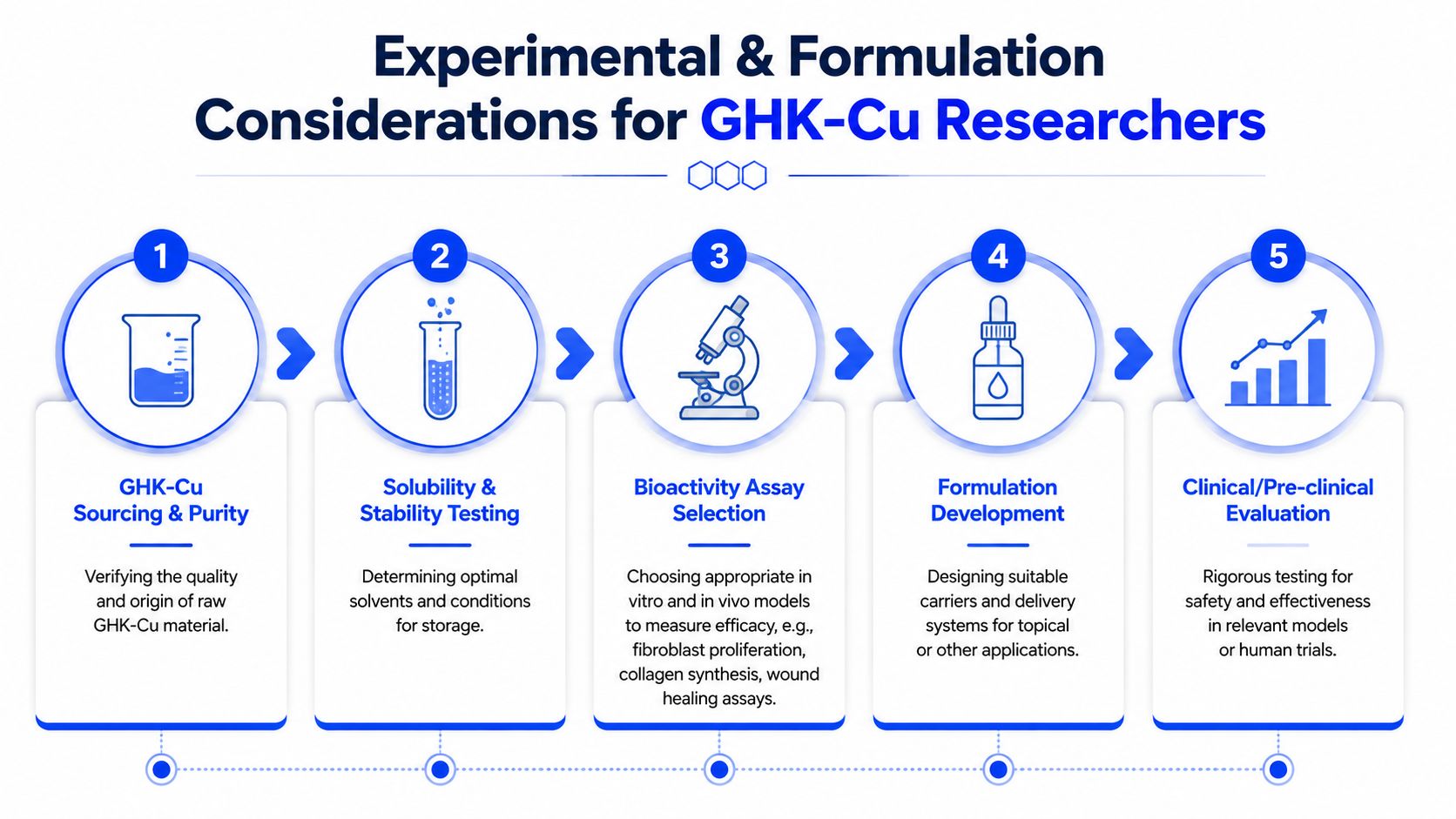
A lot of GHK-Cu confusion starts in the lab. A weak design can make an active peptide look ineffective. An overly aggressive dose can make a useful signal disappear. A poor vehicle can keep the peptide away from the cells you're trying to study.
In cultured human fibroblasts, GHK-Cu at nanomolar to micromolar concentrations increases collagen synthesis by 30% to 70%, but this concentration-response curve plateaus at higher concentrations, where excessive GHK-Cu can become inhibitory rather than stimulatory [dose-response considerations in fibroblasts]. That single detail changes how a serious researcher should design experiments.
Many molecules look stronger when you raise the dose. GHK-Cu may not behave that way indefinitely. A bell-shaped or plateauing response means you need a range-finding study, not a single “high dose versus control” setup.
Researchers can improve signal quality by building around a dose series:
The assay should match the claim. If you're studying extracellular matrix synthesis, collagen-focused readouts make sense. If you're studying broader remodeling, add gene expression and matrix-regulation markers.
Useful categories include:
Match the readout to the question. “Does it raise collagen protein?” and “Does it change remodeling-related transcription?” are related, but they aren't the same experiment.
A careful researcher also keeps timing in mind. Early signaling changes may appear before measurable matrix deposition. If sampling windows are poorly chosen, a biologically active peptide can appear quiet.
Topical research adds another layer of complexity. The peptide has to remain stable in the formula, survive storage, and reach the right skin compartment in useful amounts. If it degrades, oxidizes, or binds in the wrong place, your outcome data won't reflect the peptide's true potential.
Common formulation issues include:
For skincare developers, product benefits either become believable or fall apart, a distinction often determined by the formulation. A well-formulated GHK-Cu serum isn't just a peptide in water. It's a delivery strategy aimed at preserving signal integrity long enough for the biology to matter.
If the starting material is poor, the rest of the experiment doesn't recover. That sounds obvious, but GHK-Cu sourcing is one of the most underappreciated variables in reproducible work.
Researchers should expect more than a label and a claimed identity. A credible supplier should provide a documentation trail that supports what the vial contains and whether one batch resembles the next.
A practical sourcing checklist includes:
For skin-focused work, purity isn't only a procurement issue. It is part of the biological question. If impurities trigger irritation or alter cell behavior, the observed effect may be partly due to noise rather than the peptide-copper complex you're trying to evaluate.
Safety discussions around GHK-Cu often become muddled because online content leans heavily on anecdotal irritation stories while skipping mechanism. One research-based critique notes that common questions about copper overload are poorly answered because current content often ignores evidence showing that GHK-Cu modulates copper metabolism to improve bioavailability and exhibits antioxidant and anti-inflammatory effects at nanomolar concentrations [discussion of copper balance and safety context].
That doesn't mean every product is automatically well tolerated or every experiment is risk-free. It means researchers should judge safety and performance from documentation, formulation logic, and measured outcomes rather than from simplistic “copper equals irritation” narratives.
A strong sourcing decision usually comes down to a few essential factors:
Good peptide work starts before the first assay. It starts with material you can trust enough to interpret.
GHK-Cu stands out because it links several parts of skin biology that are usually discussed separately. It supports remodeling, participates in repair-related signaling, and remains relevant in both consumer skincare conversations and serious preclinical planning. That combination is rare.
The next advances will likely come from better delivery systems, tighter formulation control, and more rigorous human data. For anyone studying skin biology GHK Cu, the central lesson is straightforward. This peptide is most useful when it's treated as a signaling tool, not as a trend ingredient. If you're evaluating options for future work, learn more and explore options that prioritize research-grade quality and documentation.
Researchers who need transparent documentation, US-made sourcing, and batch-level testing can explore Peptide Warehouse USA for research-use GHK-Cu and related compounds. Their catalog is built for laboratory, analytical, and preclinical use, with COAs, microbial and endotoxin reports, and stated purity documentation designed to support reproducible work.