No products in the cart.


The most established SLU PP 332 peptide dosage in the published literature is 50 mg/kg administered twice daily in mice, using intraperitoneal dosing. That matters because this is preclinical animal data, not a human protocol, and no human dosage has been established in the cited literature.
Those seeking dosage information often want a neat protocol. With SLU-PP-332, the honest answer is narrower and more useful: the workable reference point comes from rodent studies, and good research practice starts with respecting that limit rather than pretending there's a clinical standard.
If you're evaluating this compound for laboratory use, the gap isn't just “what dose was used?” Instead, the gap is how to turn a published mouse dose into a clean, reproducible workflow: weighing subjects correctly, calculating per-dose milligrams, handling the material without degrading it, and checking whether the vial in front of you matches what the label claims. That's where most avoidable errors happen.
How do you study exercise-like metabolic signaling when you need tighter experimental control than training interventions can provide? That's the practical appeal of SLU-PP-332. Researchers use it as a targeted tool to probe energy regulation pathways that are otherwise difficult to isolate.
SLU-PP-332 gets attention because it sits at the intersection of mitochondrial biology, substrate utilization, and metabolic adaptation. In research terms, that makes it useful for asking focused questions about how cells shift fuel preference and respond to receptor-driven signaling.
For dosage, the key point is simple. The most established SLU PP 332 peptide dosage comes from preclinical mouse work that typically used 50 mg/kg twice daily, and there is no established human dose in the cited literature. That should shape the entire way you read product pages, protocol discussions, and anecdotal claims.
A lot of metabolic compounds get discussed too loosely. They get grouped under “fat loss,” “performance,” or “exercise mimetic” labels without enough attention to receptor biology or study design.
SLU-PP-332 deserves a more disciplined approach because it isn't useful as a concept only. It's useful when the experiment is tight.
A strong protocol doesn't begin at injection. It begins when you verify that the material, calculations, and storage plan all match the study question.
That mindset separates exploratory work from noise.
SLU-PP-332 is a synthetic agonist of estrogen-related receptors ERRα, ERRβ, and ERRγ, with chemical registry number 303760-60-3 and a molecular weight of 290.3, according to Cayman Chemical product information for SLU-PP-332. In plain language, it's a small research molecule designed to activate a receptor family involved in cellular energy regulation.
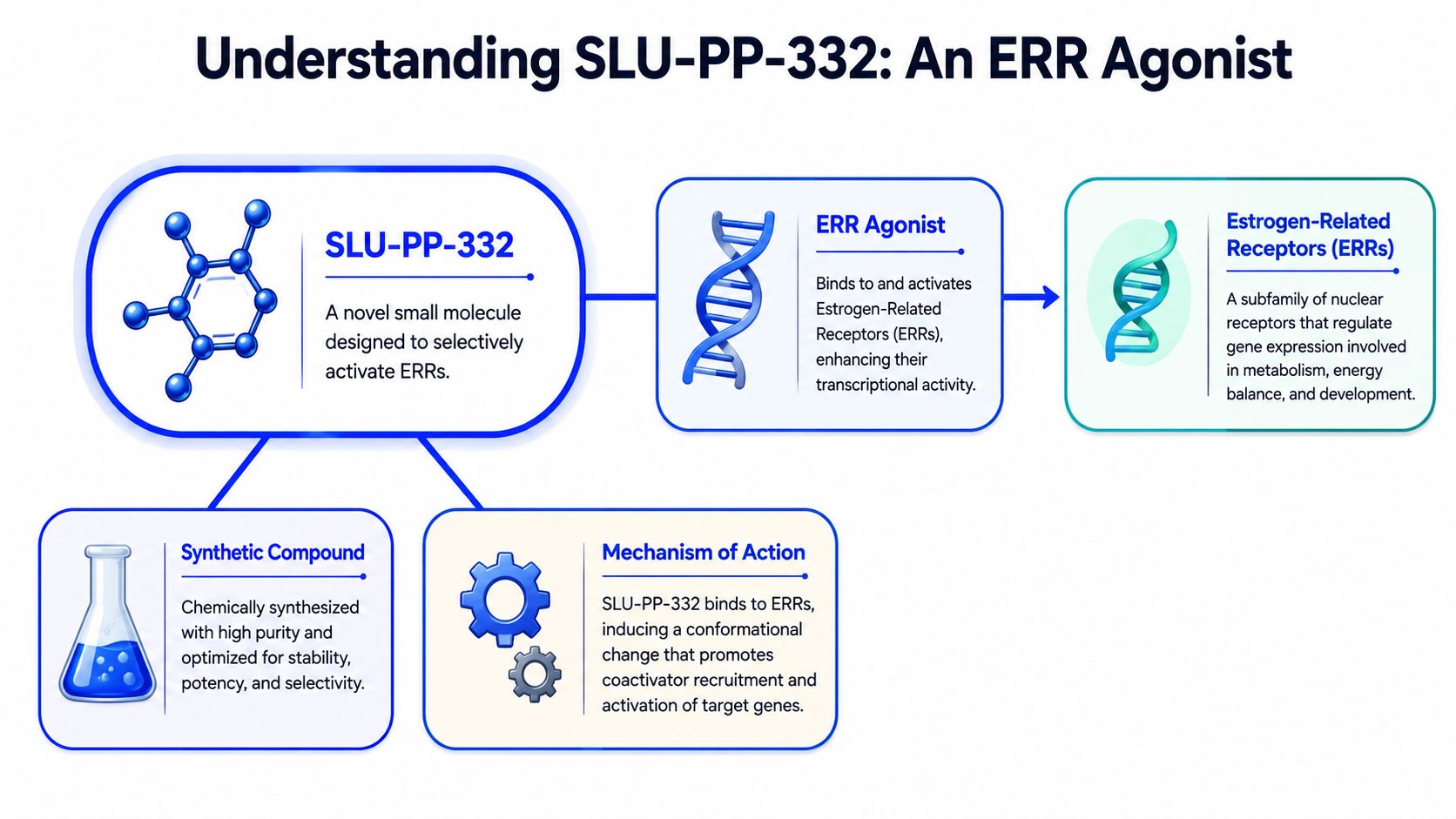
ERRs are nuclear receptors tied to how cells manage energy demand. In practical metabolic research, investigators care about them because they influence pathways linked to mitochondrial activity and fuel use.
That helps explain why SLU-PP-332 is often discussed as an “exercise mimetic.” The phrase is attractive, but the useful part is narrower. It means the compound is studied for its ability to activate signaling programs that overlap with endurance-related metabolic adaptation.
A separate finding summarized in the same Cayman reference notes that, in mice, respiratory exchange ratio decreased within 2 hours of administration, which points to a rapid effect on metabolic substrate use after dosing. The same reference also identifies 50 mg/kg twice per day in animals as a research dose and notes use at that dose in a glucose tolerance test.
Researchers sometimes misclassify compounds like this as peptides in the commercial sense. Mechanistically, SLU-PP-332 is better understood as a synthetic small molecule research compound targeting ERR signaling. That distinction matters because handling expectations, formulation choices, and interpretation of vendor materials may differ from classic peptide workflows.
What tends to work in research communication:
Practical rule: If a compound has no established human standard, every discussion of dosage should stay anchored to the species, route, and schedule actually reported in the literature.
That rule avoids most of the confusion surrounding SLU PP 332 peptide dosage.
The most informative published dosing data come from a mouse metabolic study, not from human trials. In that study, researchers dosed 8 to 10 male mice per group with 50 mg/kg intraperitoneally twice daily, and after 28 days the treated animals weighed about 12% less than controls. The same report found that vehicle-treated mice gained about 5 g of fat mass versus less than 0.5 g in the treated group, with measurable changes appearing within 12 days and strengthening by 28 days, as described in the preclinical SLU-PP-332 study in PMC.
This is the anchor for any serious discussion of SLU PP 332 peptide dosage. The literature gives you a concrete regimen, a species, a route, and a time course.
Those details are more valuable than loose summaries because they tell you what was required to produce the reported metabolic phenotype in a controlled setting. They also show that dosing frequency mattered. The study wasn't built around a casual, intermittent exposure model.
A few practical observations follow from that:
The treated mice didn't just differ on body weight. The study also reported lower plasma total cholesterol, HDL, triglycerides, fasting glucose, and insulin, along with reduced hepatic steatosis. That pattern is why the compound generated so much interest in metabolism research.
Still, there are limits that experienced researchers shouldn't blur.
| Study feature | What the data support | What the data do not support |
|---|---|---|
| Species | Controlled mouse data | Human dosing guidance |
| Dose | 50 mg/kg twice daily in mice | A universal dose across models |
| Outcome timing | Early measurable changes and stronger later effects | Guaranteed replication in every protocol |
| Interpretation | Strong preclinical metabolic signal | Clinical efficacy claims |
The strongest mistake I see with compounds like this is not miscalculation. It's over-translation. A rodent protocol is a rodent protocol until human data exist.
If you're evaluating benefits of peptides or adjacent compounds in a research catalog, that's the standard to keep. Use the published study to frame experimental design. Don't use it to imply established therapeutic use.
Once you've chosen the published animal dose as your reference, the next step is straightforward arithmetic. Most SLU PP 332 peptide dosage errors in the lab come from poor weight conversion, not from complex pharmacology.
Use this formula:
Subject weight in kg × dose in mg/kg = total mg per dose
For the published mouse reference, the dose is 50 mg/kg per dose.
Worked example:
If the study design uses the same twice-daily schedule reported in the literature, that amount applies to each administration, not to the whole day combined.
For anyone who wants a broader framework for accurate peptide dosing for biohackers, that guide is useful for understanding the arithmetic behind mg/kg calculations, concentration planning, and syringe-volume logic. The principle carries over well to preclinical compound work.
The table below keeps the published 50 mg/kg reference front and center.
| Subject Weight | Total mg per Dose |
|---|---|
| 20 g (0.020 kg) | 1.0 mg |
| 25 g (0.025 kg) | 1.25 mg |
| 30 g (0.030 kg) | 1.5 mg |
| 35 g (0.035 kg) | 1.75 mg |
| 40 g (0.040 kg) | 2.0 mg |
A few practices reduce dosing drift:
Researchers often spend more time debating compound hype than fixing these basics. In practice, the basics are what protect reproducibility.
Good dosing math won't save a poorly handled sample. Reconstitution and storage are where otherwise careful projects start to drift, especially when multiple people share vials across several days.
A simple process flow helps keep that under control.
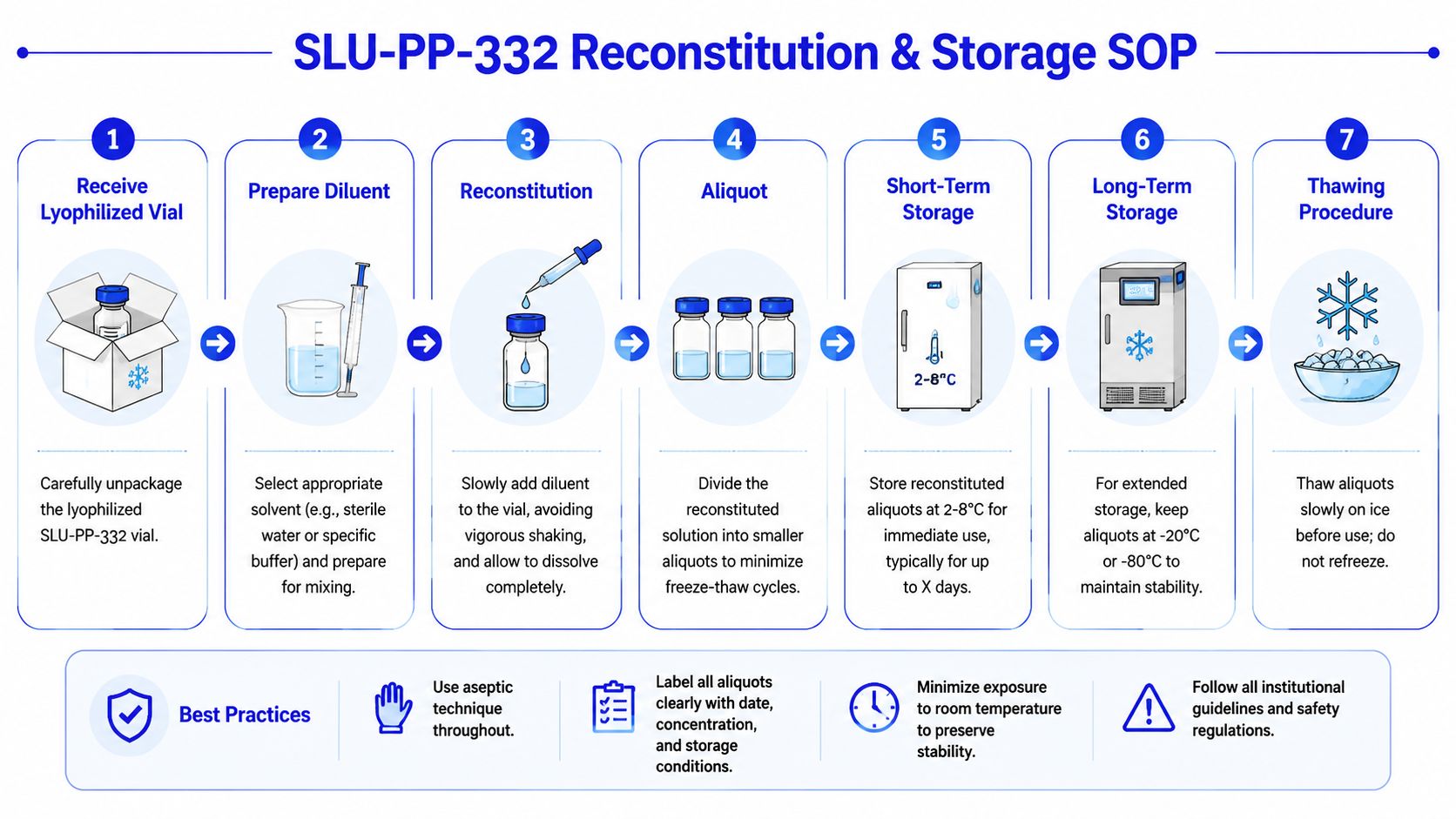
Treat reconstitution like a short standard operating procedure, not an improvised bench task.
Materials to prepare first
Suggested workflow
Later in the section, it's useful to see a visual walkthrough of handling basics:
Storage isn't glamorous, but it changes outcomes. The goal is to minimize avoidable degradation and prevent repeated handling from becoming the hidden variable in the study.
Use these habits:
If the concentration on your label doesn't match the concentration in your notebook, stop and resolve it before the next dose. Most “compound problems” start as labeling problems.
What usually doesn't work is casual bench storage, unlabeled secondary tubes, or changing solvents between batches without documenting the reason. Those aren't minor issues. They're reproducibility failures.
A Certificate of Analysis is only useful if you know what to inspect. Too many buyers glance at the purity line, ignore everything else, and assume the material is ready for serious work.
That isn't enough for a compound like SLU-PP-332, where identity and traceability matter as much as a headline purity figure.
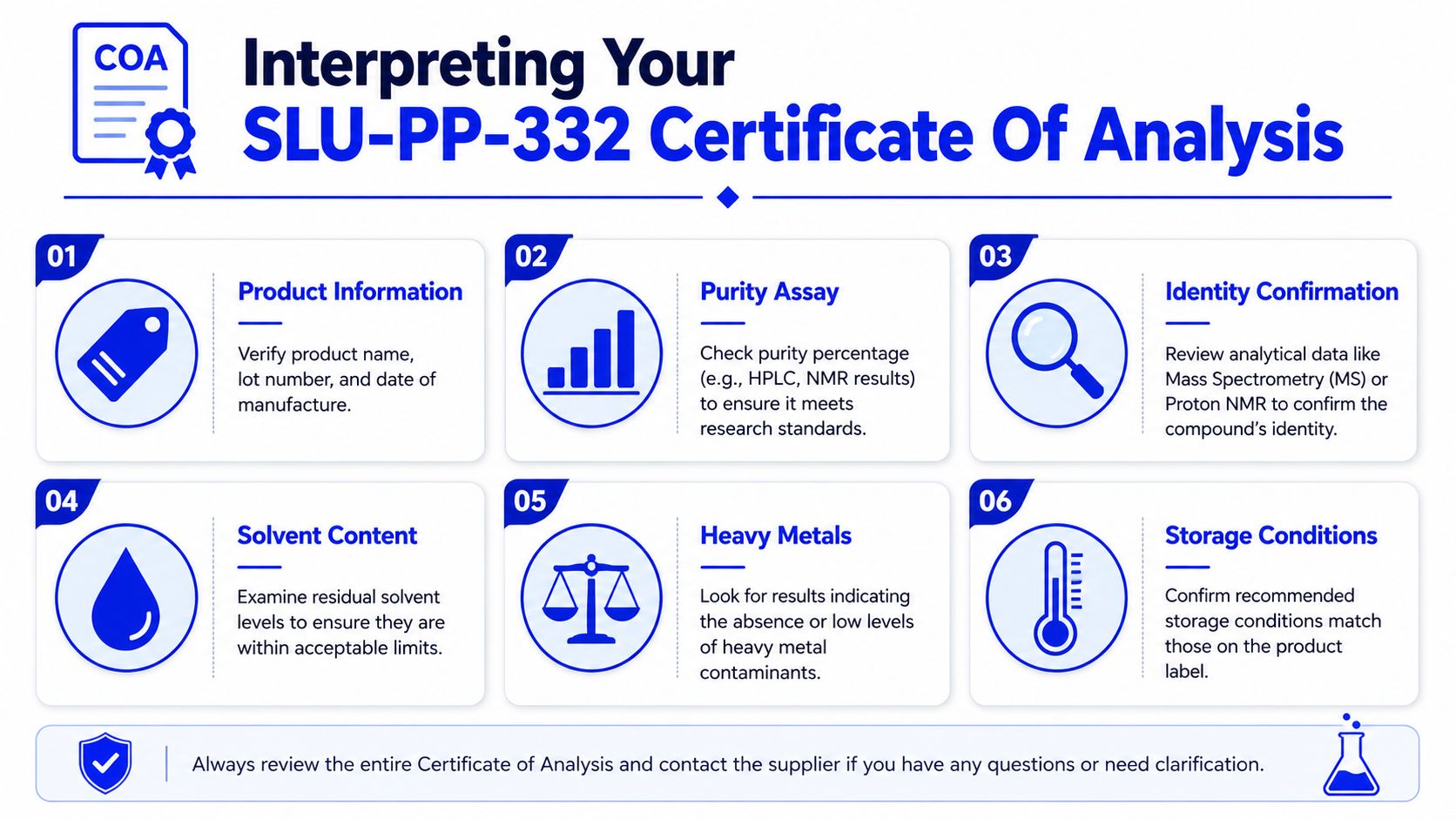
Start with the fields that tell you whether the document belongs to your vial.
A strong COA gives you traceability. A weak COA gives you marketing language.
You don't need to be an analytical chemist to reject a bad document. You need a checklist.
| COA element | What you want to see | Red flag |
|---|---|---|
| Lot match | Same lot on vial and document | No lot number or mismatch |
| Test method | Named analytical method | Purity claim with no method |
| Identity support | MS or similar confirmation | No identity data at all |
| Date clarity | Clear issue or test date | Undated file |
| Handling info | Storage or condition notes | Nothing beyond a logo |
A COA should let another researcher trace what was tested, when it was tested, and how it relates to the vial in hand.
For buyer awareness, this is one of the most practical filters you can use. Fancy branding doesn't improve a sample. Documentation does.
SLU-PP-332 should be handled as a research-use compound, not as a drug, supplement, or consumer wellness product. That distinction isn't legal fine print. It determines who should work with it, how it should be stored, and what claims should never be made about it.
At a minimum, trained personnel should use standard PPE and controlled handling procedures.
That includes:
Two failures show up repeatedly in research environments. One is treating a novel compound casually because the vial is small. The other is borrowing language from consumer peptide marketing and letting it shape bench behavior.
Neither belongs in a serious workflow.
If a team can't maintain chain-of-custody records, storage logs, and lot-specific documentation, they aren't ready to generate reliable data with a compound like this. Safety and compliance aren't separate from the science. They are part of the science.
A solid understanding of SLU PP 332 peptide dosage starts with accepting what the literature supports. The established reference point comes from mouse studies using 50 mg/kg twice daily, and there isn't an established human dosage in the cited evidence.
From there, the work becomes practical. Calculate each dose from current body weight, choose a concentration that reduces measurement error, handle reconstitution with discipline, and read the COA like a scientist instead of a shopper. Those steps do more for data quality than any speculative discussion about stacking or extrapolation.
SLU-PP-332 is interesting because it gives researchers a targeted way to study ERR-driven metabolic signaling. But the compound only becomes useful when protocol quality matches the ambition of the hypothesis.
If you're comparing research compounds, don't just ask whether a vendor lists purity. Ask whether the documentation, storage guidance, and lot traceability would hold up if another lab had to reproduce your work from your notebook.
If you're sourcing research materials for laboratory or preclinical workflows, Peptide Warehouse USA is worth a closer look. The company focuses on US-made research compounds with third-party documentation, COAs, and batch-specific testing designed to support traceability and consistent lab procurement. Learn more and explore options that fit a documentation-first research workflow.