No products in the cart.

A 99% purity headline may look decisive, but it doesn't establish what a peptide is, what else is in the vial, or whether the test applies to the batch being offered. For anyone assessing Soma Chems peptides, the useful question isn't whether a product page sounds confident. It's whether the supplier can provide documentation that supports the material's identity, composition, handling, and research-use status.
This is a procurement review, not a product endorsement or a guide to human use. The focus is on what available vendor records establish, what a certificate of analysis can and can't prove, and which checks help distinguish a documented research material from a polished listing.
A convincing storefront proves a design budget. It says nothing about the supply chain behind it, the laboratory that tested the material, or the lot a buyer would receive. That distinction drives this review. An independent supplier review reports that Soma Chems claimed at least 99% purity across its catalog, while that same review did not publish independently verified COA records for the vendor. A percentage repeated on product pages is a claim awaiting documents.
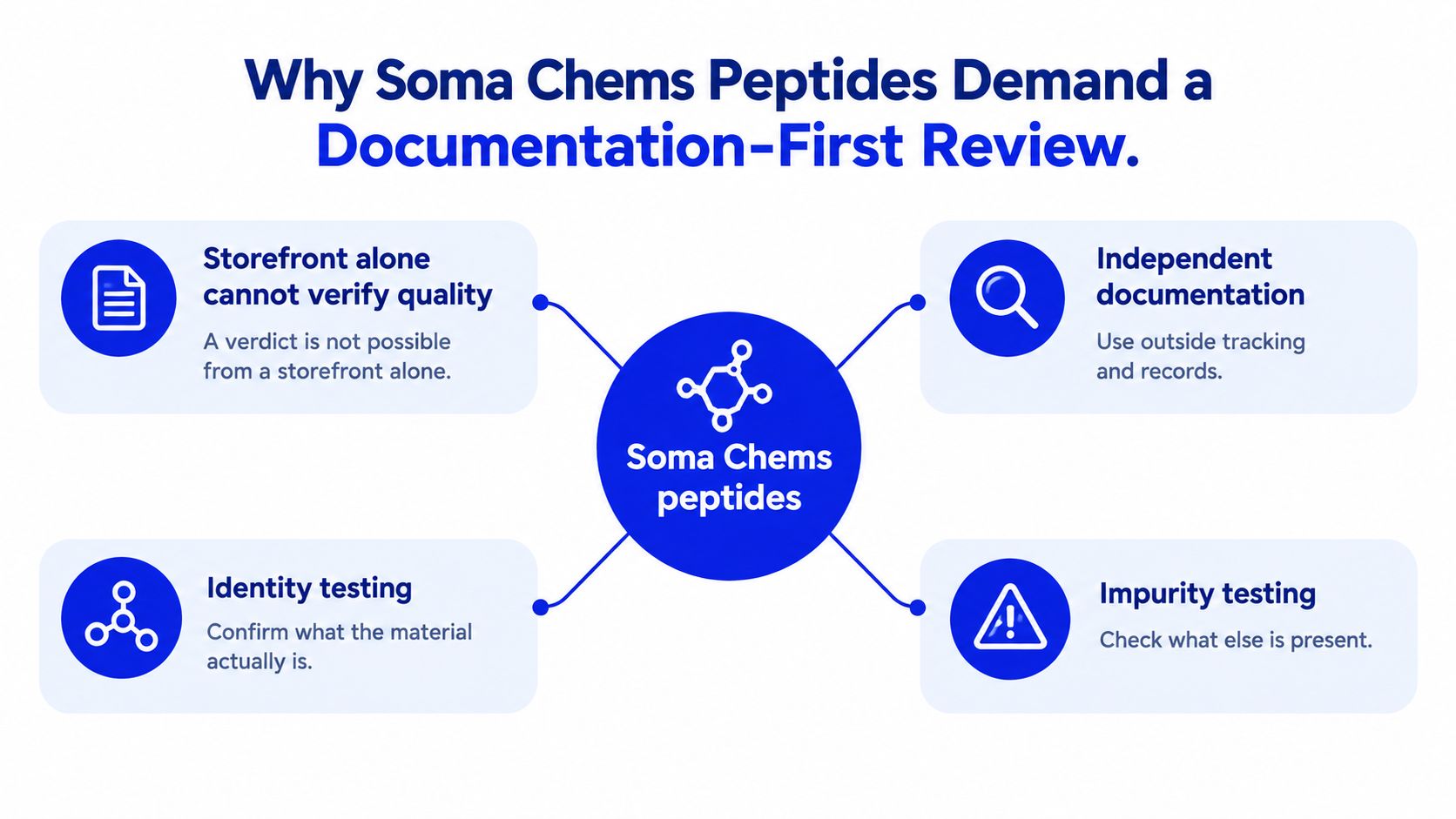
A defensible vendor assessment needs evidence across five dimensions: manufacturing arrangements, independent analytical testing, business identity, regulatory status, and lot-level traceability. A storefront can describe a catalog. It cannot verify one. For each product under consideration, the records that matter are tied to a specific lot rather than to a brand, a product family, or a marketing page.
The practical question is whether documents connect the material in hand to a defined batch, an identified manufacturer, and described test results. A product name and a purity number do not make that connection. Neither does a generic COA with no batch number, no test date, and no named laboratory.
This distinction carries weight for Soma Chems peptides because the public record is thin. Vendor-monitoring write-ups and archived storefront captures can establish what was listed and when. They cannot substitute for company disclosures or batch-level laboratory records, and a careful buyer weighs each type of evidence only for what it verifies.
Procurement rule: Treat a catalog claim as a request for documents, not as a batch result. Ask for records that identify the specific lot you would receive.
The aim throughout is a repeatable check: what can be verified before a research order is placed, and what remains assertion.
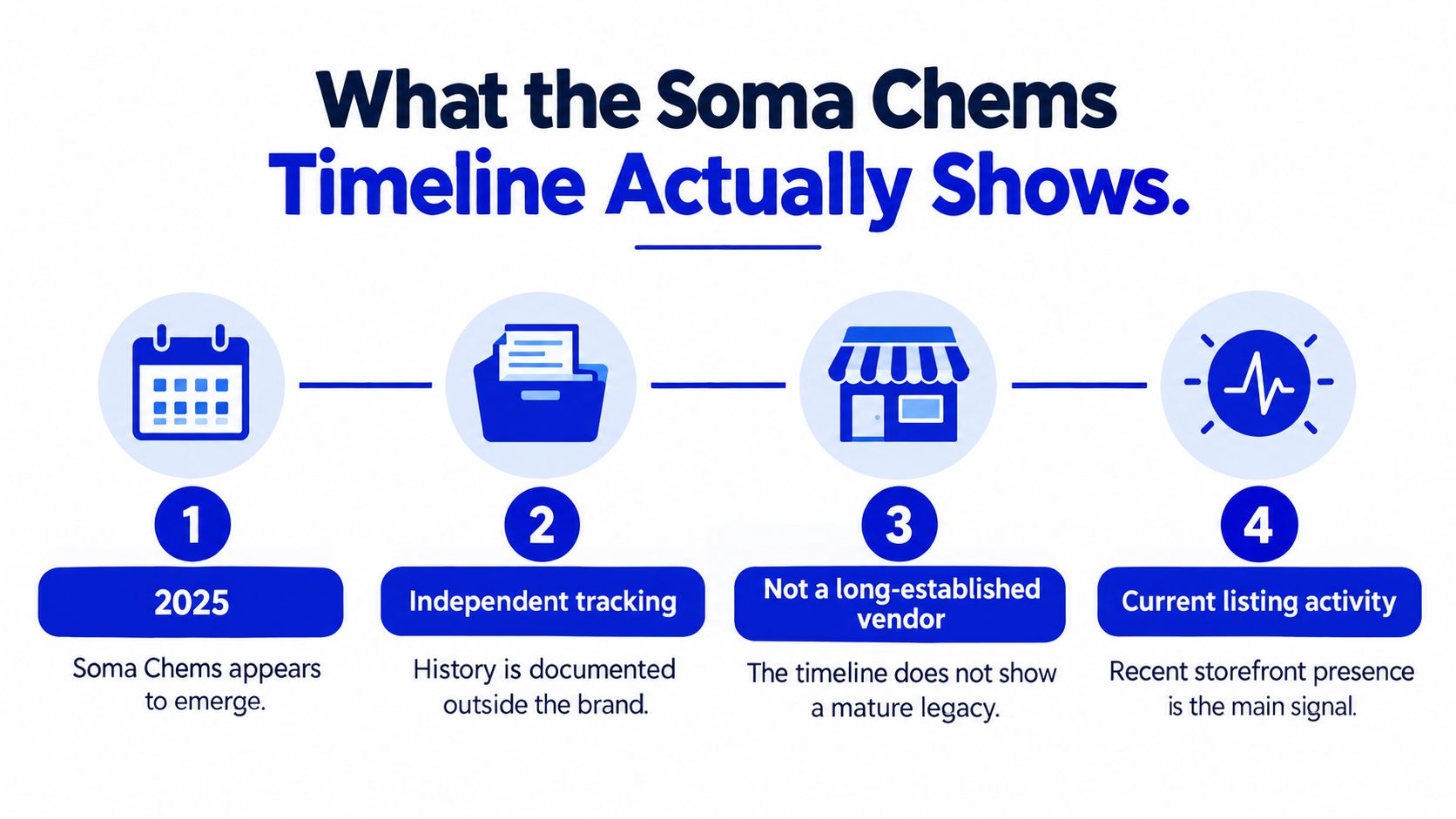
The available vendor-tracking record places Soma Chems among relatively recent entrants, not among manufacturers with a long independently documented history. One independent account describes the brand as emerging in 2025 and associates it with the earlier Amino Asylum operation. A separate review records the first archived store capture on July 21, 2025, while noting that ownership history and the relationship to the predecessor weren't fully clear. Independent vendor-tracking account of the reported timeline
The reported catalog included research peptides, SARMs, nasal sprays, liquids, aminos, blends, and nootropics, with products labeled for research use only. That list describes the reported range of offerings. It doesn't establish the quality of a particular lot, the identity of a product, or the company's manufacturing arrangements.
A recent storefront presence doesn't prove that a supplier is unreliable. It does mean buyers can't use a long record of independent operating history as a substitute for checking current documents. The public evidence described in vendor monitoring is largely based on website captures and supplier records, rather than audited corporate disclosures, peer-reviewed studies, or government registrations.
That context narrows the sound procurement approach. Confirm who made the material, who tested it, which batch the test covers, and whether the records can be traced back to the item offered. If the supplier's history is difficult to establish independently, the buyer has more reason to assess each lot on evidence rather than reputation.
The record supports a measured conclusion: Soma Chems appears to be a recent market entrant, and the available information doesn't establish a decades-long manufacturing history. It doesn't resolve ownership questions either. Those gaps don't answer whether a particular product meets a research specification, so that decision has to rest on current batch documentation and independent verification.
A useful COA does more than display a purity number. FDA guidance for active pharmaceutical ingredients offers a concrete checklist for evaluating batch documentation: identify the material and, where appropriate, its grade, batch number, and release date; list every test performed, its acceptance limits, and quantitative results; and show the document's date, authorized quality-unit signature, and original manufacturer's contact details. FDA guidance on COA content for active pharmaceutical ingredients
That guidance concerns APIs, so a research-material buyer shouldn't mistake it for proof that a vendor follows an approved drug-manufacturing pathway. It is still a useful documentation standard. The fields make it easier to judge whether a COA is specific, reviewable, and connected to the material being purchased.
| COA Field | What It Confirms | Risk If Missing |
|---|---|---|
| Material name and grade, where applicable | Identifies the item described by the report | The document may not apply to the product being considered |
| Batch number and release date | Connects the record to a defined lot and release point | The buyer can't reliably match the report to the shipment |
| Tests performed | Shows what properties the lab actually evaluated | A purity result may be presented without its test scope |
| Acceptance limits | States the criteria used to judge results | The reader can't tell what the result was compared against |
| Numerical results for quantitative tests | Provides the measured value, not just a pass statement | The result can't be independently assessed |
| Date and authorized quality-unit signature | Identifies when the document was issued and who authorized it | Review and accountability are unclear |
| Original manufacturer's name and contact details | Supports manufacturer traceability | The buyer may not be able to verify the source |
Check that the batch identifier on the COA matches the proposed lot, then compare the test names, limits, and results with the supplier's claims. A generic report without a matching batch number can't establish that the material in a future shipment was tested.
A COA is useful only when its scope and lot match the material under review.
Before ordering, ask who performed each test, whether the report applies to the exact lot being offered, and whether the supplier can provide the underlying analytical records. If the answer is only a percentage or a general assurance of third-party testing, the evidence remains incomplete.
HPLC purity is a chromatographic measurement. It reports how the detected material is distributed across peaks under a particular analytical method. It doesn't, by itself, prove that the main peak has the intended peptide sequence or that all relevant contaminants have been found.
That distinction matters because a sample may contain truncated sequences, residual protecting groups, stereoisomers, degradation products, or other impurities that a single purity figure doesn't fully characterize. Peptide-quality guidance recommends complementary methods because no one test establishes identity, composition, and potency at once. Review of peptide quality attributes and complementary analytical methods
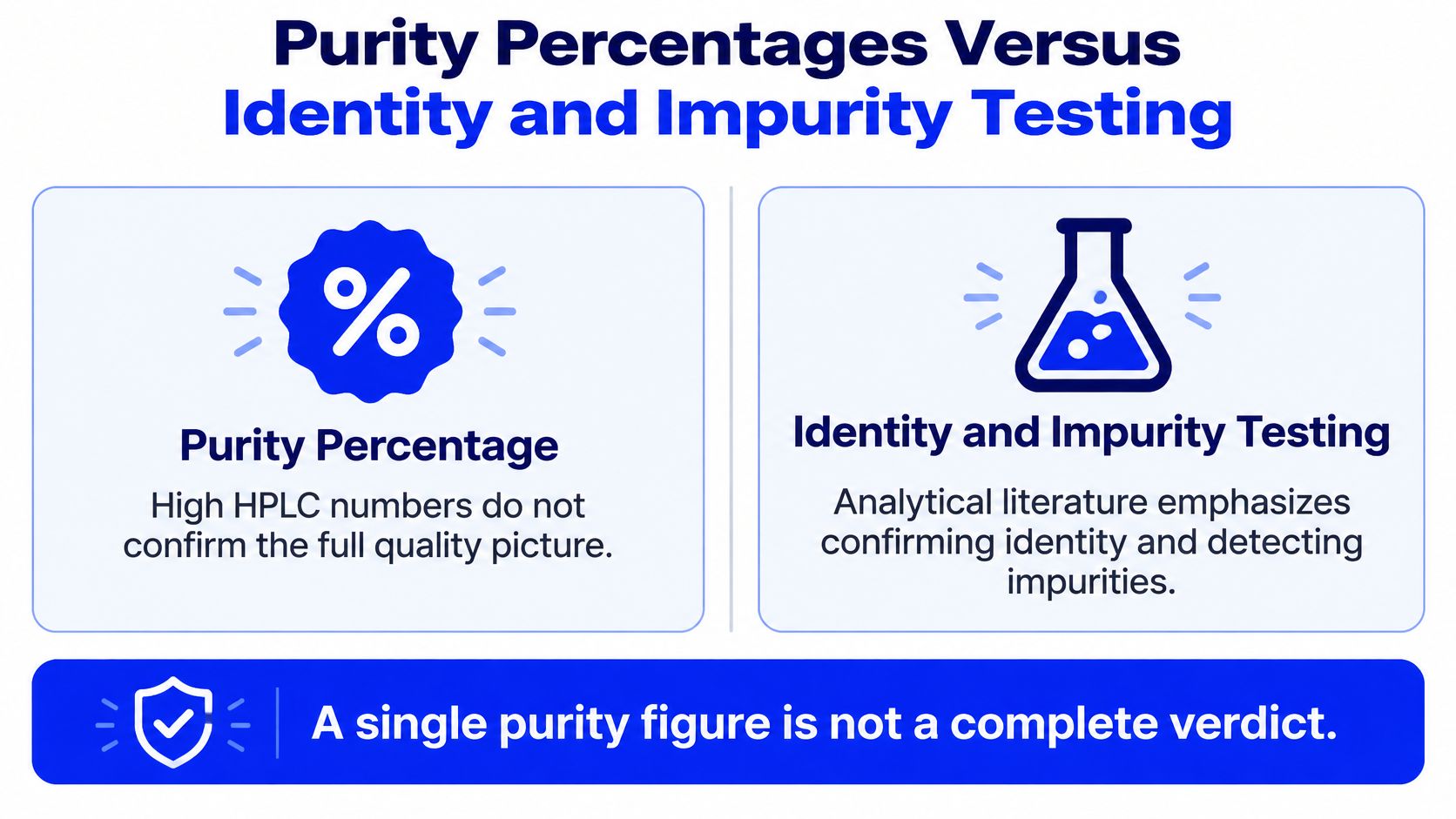
High-resolution mass spectrometry can support a molecular-mass check. Peptide mapping or sequencing can provide evidence about sequence identity. Impurity profiling can help characterize components beyond the primary product, while a functional bioassay may be relevant when the research question requires evidence about biological activity.
Each method answers a different question. The right package depends on the material and intended protocol, but a buyer should avoid treating one result as a universal substitute for the others. For consequential work, ask how the methods complement each other and whether the data are tied to the same lot.
The reported Soma Chems purity claim is at least 99%, but the independent review didn't provide independently verified COA records through its platform. That doesn't prove that a product fails a specification. It does mean a researcher can't treat the headline figure as independent confirmation of identity, impurity control, or the amount of peptide present.
Use the claim as a prompt for specific questions: What method generated the number? What identity test supports the named sequence? What impurities were assessed? Is there a batch-matched assay for peptide content? A supplier's willingness to provide clear answers is more informative than a standalone percentage.
A U.S. address is not an analytical file. Soma Chems sits in a broader research-chemical market rather than a peptide-only niche, with reported coverage across peptides, SARMs, nootropics, bioregulators, and related compounds, and with injectable, intranasal, and N-acetyl-modified spray variants such as Semax and Selank appearing in the range. That breadth can simplify sourcing, but it also raises the burden of proof: each SKU, format, and modification needs its own lot-matched evidence.
An acetylated spray should not inherit credibility from an injectable peptide, and a domestic claim should not stand in for a manufacturer name, batch record, or test method. Treat formulation, route, sequence, and lot as separate variables.
Use one evidence grid for every supplier:
When two files differ, record an absent item as a finding with its own risk. A missing manufacturer creates a different problem from an undisclosed impurity limit, and both change how much confidence the order deserves. A supplier reporting U.S. production can still fail this grid. A smaller catalog can pass it. The practical comparison is which vendor can show a retrievable chain from named product to tested lot before payment, and which one only describes quality after the checkout page.
An analytical package can lose practical value if the shipped item can't be connected to the tested lot or if handling conditions are unknown. Record the product name, lot number, arrival condition, and date received. If a temperature indicator or other shipment-monitoring record is provided, preserve it with the order file.
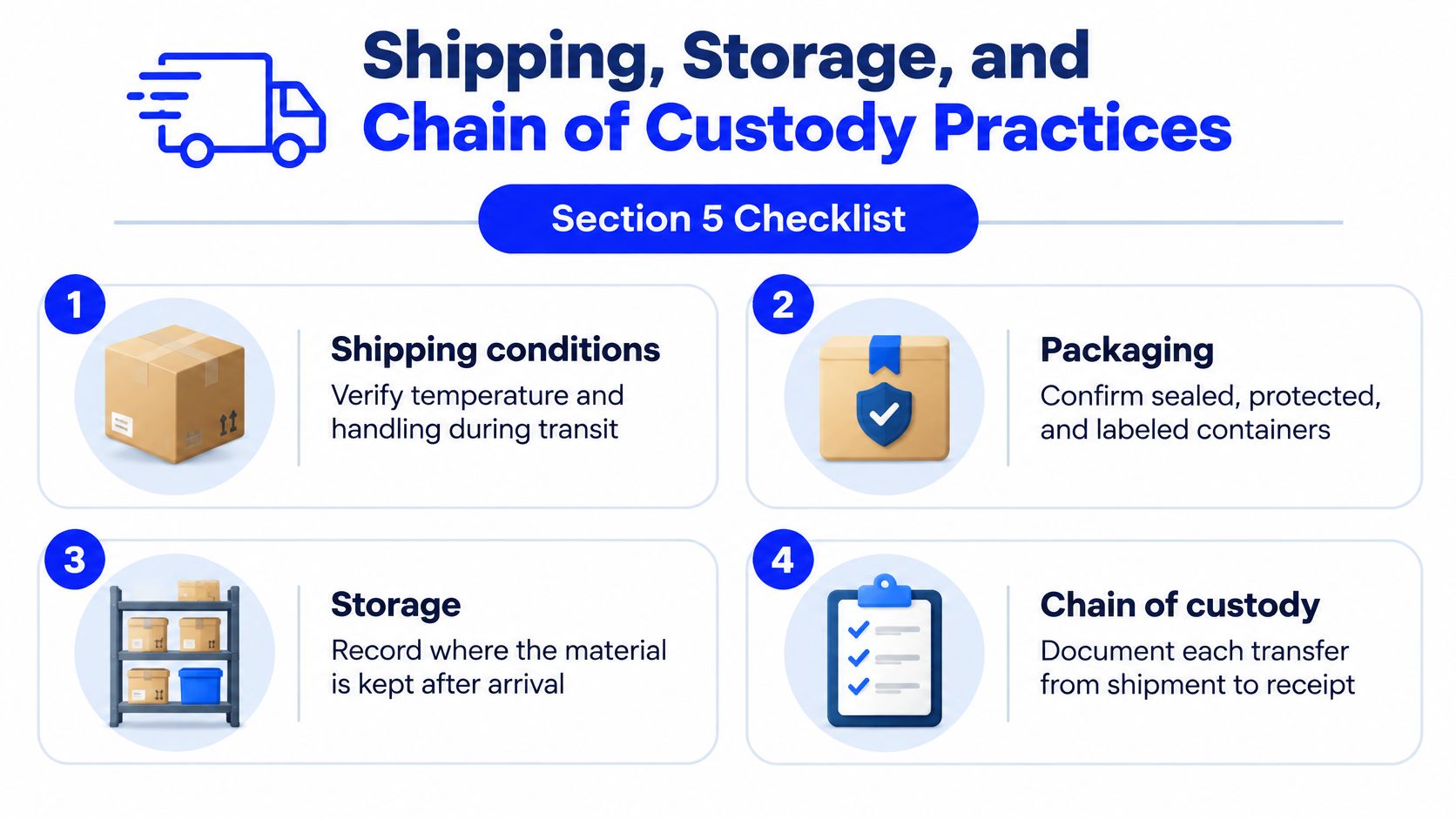
When the package arrives, compare the label and lot identifier against the COA and purchase record. Note damaged seals, unclear labels, or any mismatch before moving the material into storage. Keep supplier correspondence and shipping records with the lot file, so later users can trace how the material entered the lab.
Generic instructions to keep a product cool, dry, or protected from light may be a starting point, but they don't establish stability under a specific protocol. Ask whether stability data cover the intended storage and handling conditions. Don't assume that a storage statement validates a material for every duration or environment.
Before ordering, confirm the practical terms that affect custody and records:
A repeatable intake process helps researchers identify mismatches early and preserve the provenance of materials used in an experiment. It doesn't validate the material's suitability on its own, but it keeps the record complete enough for later review.
A research-use-only label describes the stated purpose of a product. It doesn't establish that the product is safe or suitable for human administration, and it doesn't make a research compound equivalent to an approved medicine. The cited regulatory explainer distinguishes research chemicals intended for laboratory, in-vitro, or animal work from FDA-approved medicines, and notes that compounding pharmacies operate under separate federal pathways. Overview of research chemicals and FDA-approved peptides
The distinction is not merely about wording. When a peptide is marketed for human treatment without the applicable approval, a supplier's COA can't fill the evidence gap. A COA may report properties measured in a sample, but it can't establish clinical dose equivalence, pharmacokinetics, immunogenicity, therapeutic benefit, or sterility assurance for human use.
A disclaimer doesn't necessarily neutralize claims elsewhere on a page that imply personal use. FDA enforcement material has characterized marketed peptide products, including tesamorelin research peptides and peptide blends, as unapproved new drugs when introduced for human use. FDA warning-letter material concerning marketed peptide products
For a compliance-oriented review, consider the whole context:
This boundary is important for readers searching for benefits of peptides. Consumer claims about BPC-157, TB-500, Selank, Semax, or PT-141 don't automatically translate into evidence for a controlled laboratory protocol. A research label should be treated as a limit on the stated use, not as a shortcut to human-use assurance.
A sound decision about Soma Chems peptides should rest on what the records establish, not on the design of the product page or the size of the catalog. Request a batch-matched COA, inspect the test scope and authorization, seek identity and impurity evidence beyond HPLC, verify manufacturer traceability, and check that labeling and claims stay within research-use boundaries.
The broader field shows why that distinction matters. A peer-reviewed review reports that, by 2020, more than 70 therapeutic peptide products had been approved as new chemical entities across the United States, Europe, and Japan, while more than 100 commercial peptide products were available globally for clinical indications. It also reports that over 75% of those approved products were administered by injection, reflecting the field's reliance on parenteral delivery for many peptides. Review of therapeutic peptide products and delivery routes
Those figures describe regulated therapeutic products, not research compounds sold under laboratory-use labeling. Approved medicines have undergone formal quality, safety, efficacy, and manufacturing review for defined indications. A research product's listing or certificate doesn't confer that status.
For a practical comparison, assemble one file per lot with the COA, identity and impurity results, manufacturer information, shipping record, receipt notes, and storage evidence. If a supplier can't answer basic questions about the batch or its testing, treat that as an unresolved procurement issue rather than filling the gap with a catalog claim.
Peptide Warehouse USA offers U.S.-made research materials with lot-level COAs, microbial and endotoxin reports, and stated purity levels up to 99.5%, along with shipping and returns information for procurement review. If you're comparing documentation standards, explore the catalog and records at Peptide Warehouse USA.