No products in the cart.


You've found two TB-500 listings that look almost identical. One costs twenty dollars less, the other includes a batch-specific certificate of analysis, clearer research-use labeling, and a traceable shipping process. The cheaper vial looks attractive until the decision shifts from unit price to regulatory exposure, material identity, chain of custody, and downstream research integrity.
A smart TB-500 buy is not a bargain hunt. It's a documented research transaction. Before you place an order, you should be able to verify what the material is, which batch was tested, who performed the testing, how the shipment will be handled, and whether the transaction fits your jurisdiction and intended use.
The checklist below is vendor-neutral. It focuses on the questions that separate a defensible procurement decision from an avoidable risk, without endorsing a specific supplier or treating online availability as proof of legitimacy.
The first mistake new lab buyers make is treating TB-500 as a normal catalog item. A product page may show a polished vial, a purity claim, and a checkout button, but those details don't establish that the material is correctly identified or suitable for your protocol.
Start by defining the purchase as a research-material qualification exercise. Your records should connect the product listing, order confirmation, batch number, certificate of analysis, shipping record, and receiving inspection. If those documents don't connect cleanly, the low price isn't a saving. It's an unresolved liability.
Use this order of priority:
Procurement rule: A cheaper product with weaker documentation isn't cheaper. It transfers cost and uncertainty to your laboratory.
A documented transaction also protects your downstream work. If an assay produces an unexpected result, you need enough information to determine whether the issue came from the protocol, storage, handling, or material quality. A generic PDF and an untraceable vial won't support that investigation.
The right question isn't “Where can I buy TB-500 for the lowest price?” Ask instead, “Which supplier gives me enough evidence to defend this purchase and interpret the resulting data?” That change in mindset is the foundation for every step that follows.
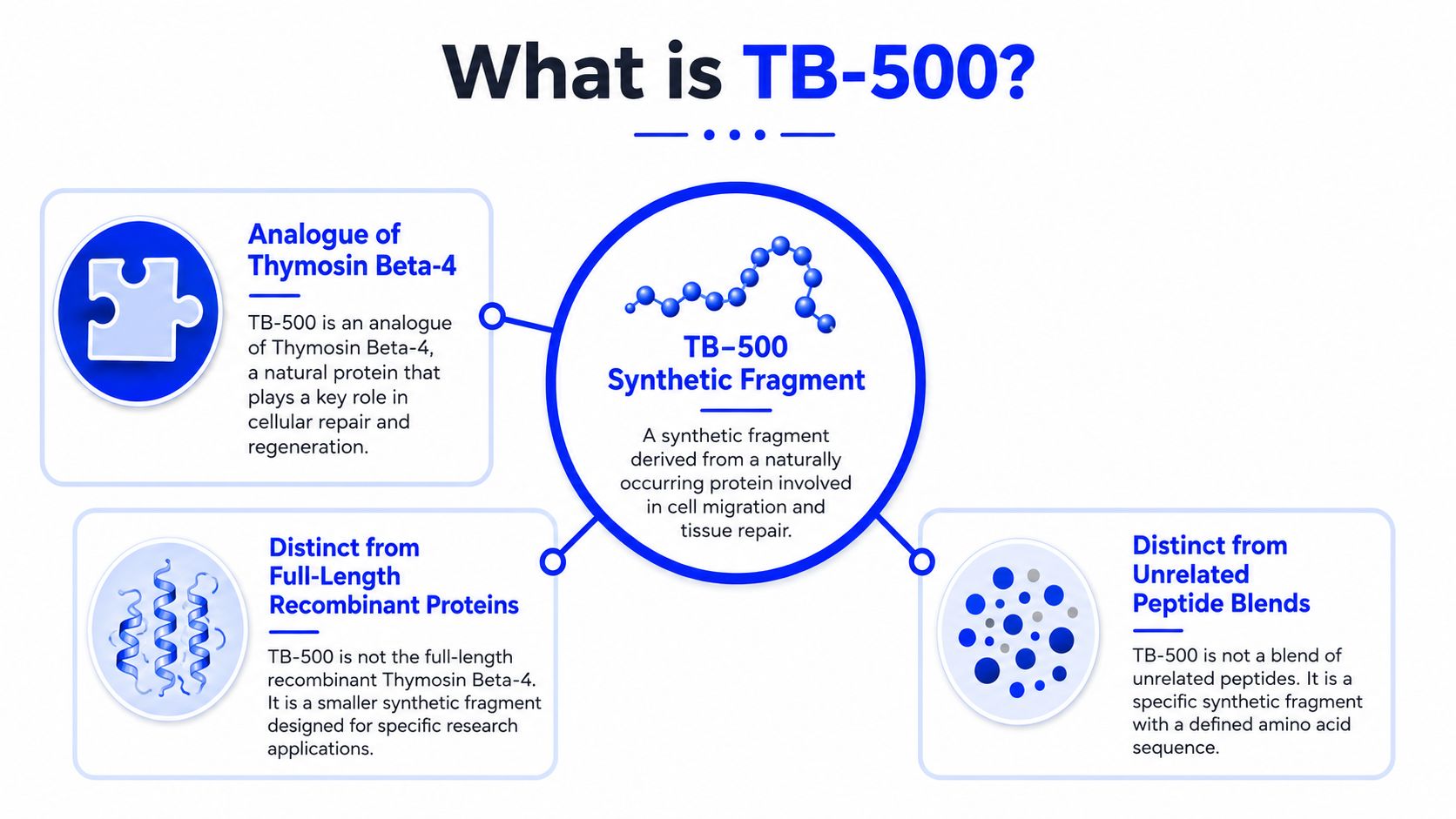
TB-500 is commonly used to refer to a synthetic fragment of thymosin beta-4, not the full-length parent protein. One analytically defined version was characterized in 2012 as the N-terminal-acetylated 17–23 sequence Ac-LKKTETQ-OH. Thymosin beta-4 itself is a 43-amino-acid protein, with historical research roots reaching back to its isolation from calf thymus and later purification work, as summarized by the historical overview of TB-500 development.
That distinction matters during procurement. A short synthetic fragment isn't interchangeable with a full-length recombinant protein, and neither should be confused with an unrelated blend that happens to include TB-500 in its marketing name. The product label, sequence description, molecular mass, and analytical report should all describe the same material.
The parent molecule's technical relevance comes from its actin biology. Thymosin beta-4 binds G-actin in a 1:1 complex, preserving a mobile monomer pool that supports cytoskeletal remodeling during cell migration and wound closure, according to this mechanism-focused thymosin beta-4 reference. Reviews also discuss signaling associations involving ILK/Akt and VEGF-related angiogenic activity.
That biology explains why researchers have examined thymosin beta-4-related materials in contexts involving endothelial migration, fibroblast activity, and tissue-repair models. It doesn't prove that a TB-500 listing reproduces the evidence generated with full-length thymosin beta-4.
For buyers, the practical implication is direct:
TB-500 is also not FDA-approved for any human therapeutic indication and doesn't appear in major FDA approval databases, according to this regulatory summary of TB-500. Treat it as a research compound, not as an approved medicine.
A product page shows only that a seller is offering material. It does not establish FDA approval, lawful compounding status, or suitability for human use. Independent coverage describes TB-500 as lacking an FDA-approved therapeutic indication and as having faced FDA compounding-risk scrutiny, as explained in this overview of TB-500 FDA status.
The transaction channel determines which records and responsibilities apply. An approved drug channel, a licensed compounding pharmacy, and a research-chemical supplier operate under different documentation, labeling, facility, shipping, and buyer requirements. Do not evaluate them as interchangeable sources.
| Channel | Typical Documentation | Labeling Requirement | Buyer Verification Step |
|---|---|---|---|
| Approved drug use | Approved labeling and prescribing documentation | Must match the authorized indication and label | Confirm the product appears in the relevant approval records |
| Compounding pharmacy distribution | Pharmacy and prescription-related records where applicable | Must identify the preparation and its intended lawful use | Verify the pharmacy, jurisdiction, and applicable compounding pathway |
| Research-chemical sale | Research-use disclaimer, product information, and analytical documentation | Must not present the material as an approved human medicine | Confirm the seller's stated use, restrictions, batch records, and shipping terms |
Human research on thymosin beta-4 remains limited and focused on early-stage work. A 2021 review described a Phase I program involving 54 healthy volunteers, with single-dose intravenous regimens from 0.05 to 25.0 µg/kg and a 10-day multiple-dose regimen at 0.5, 2.0, and 5.0 µg/kg. It reported that the material was well tolerated and safe in healthy people. The review also discussed 18 indexed thymosin beta-4 studies, including 2 recruiting, 11 completed, and 7 with results posted, as reported in the published review.
Those figures describe the broader thymosin beta-4 research program. They do not establish systemic TB-500 efficacy. Another review reports no controlled human clinical trials directly administering TB-500 as an investigational agent. The available human evidence instead concerns full-length thymosin beta-4 or ophthalmic research, as summarized by this evidence review.
Before checkout, ask four concrete questions: Is the product research-use only? Do restrictions apply in your location? What does the certificate cover? How will the seller handle customs or interstate shipping? These answers define the transaction you are considering.
A Certificate of Analysis is only useful if it identifies the exact batch you received and shows how the result was generated. Don't treat a logo, a signature, or a large purity number as a substitute for analytical detail.
Read the document in this order.
Look for HPLC and mass spectrometry, ideally with enough information to connect the reported result to the stated TB-500 fragment. HPLC can help assess the chromatographic profile, while mass spectrometry supports molecular-mass confirmation. A COA that reports only “peptide detected” doesn't provide the same level of assurance as a report that names the analyte and shows the relevant testing.
The report should include:
The batch number on the COA must match the vial and the order paperwork. If it doesn't, stop the receiving process and request clarification before the material enters inventory.
Purity should come from a chromatographic result, not from a product-page claim copied into a PDF. For this purchasing framework, anything above 98 percent purity from a verified COA is the pass threshold. Lower results should be priced and described accurately, not marketed as premium research material.
Next, look for residual-solvent testing. A meaningful panel should address solvents relevant to peptide synthesis and processing, including acetonitrile, methanol, and TFA. The report should also address heavy metals through a suitable method such as ICP-MS, where applicable.
Microbial and endotoxin results are separate from chemical purity. A high HPLC result doesn't automatically establish microbiological suitability. Look for clearly identified microbial and endotoxin testing, with results that can be interpreted against the laboratory's own acceptance criteria.
A COA without a matching lot number is not batch evidence. It is marketing material.
A report dated within 12 months, tied to the vial's batch number, and issued by an independent third-party laboratory is the minimum credible version for this screening process. In-house testing can add useful information, but it doesn't replace independent verification. An absent, cropped, unreadable, or recycled panel should be treated as a failed due-diligence check.
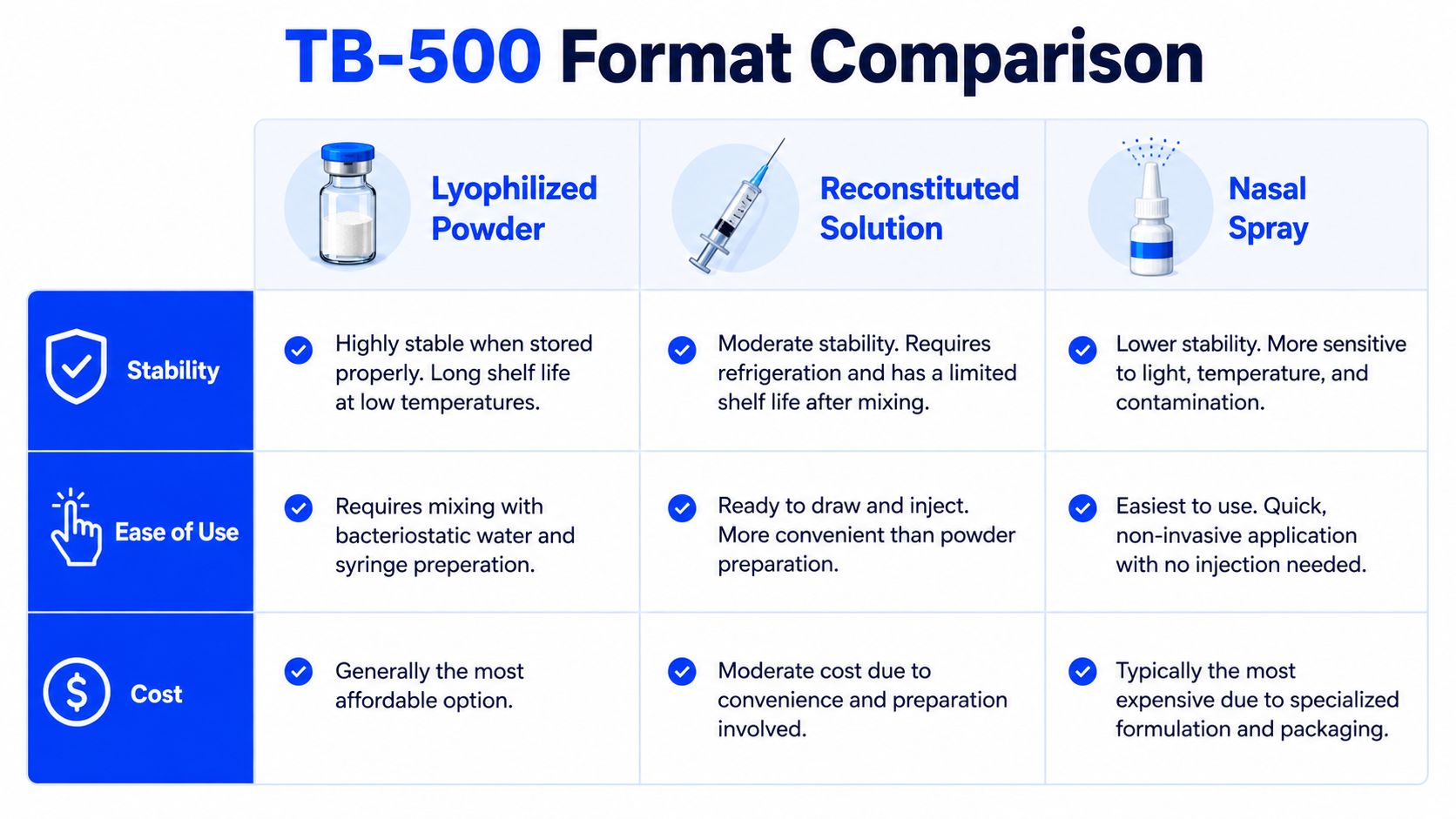
The format you buy should match the work your lab performs. TB-500 listings commonly appear as lyophilized powder, reconstituted solution, or pre-loaded nasal spray, and those formats create different handling questions.
| Format | Stability considerations | Handling profile | Best fit |
|---|---|---|---|
| Lyophilized powder | Usually preserves flexibility in storage and preparation, subject to the supplier's instructions | Requires controlled reconstitution and careful post-reconstitution handling | Labs that need bench control and protocol-specific preparation |
| Reconstituted solution | Easier to use immediately, but storage and handling conditions become more important | Greater exposure to handling and potential contamination during repeated access | Workflows that need a prepared solution and have validated storage controls |
| Nasal spray | Convenient presentation, but formulation and device details require review | Less suited to protocols that require direct control over preparation variables | Studies designed around that delivery format and its documented formulation |
For in-vitro work, lyophilized powder often gives the buyer more control over reconstitution variables and experimental preparation. A solution can reduce preparation steps, but the buyer must verify the solvent, concentration, storage instructions, container closure, and post-opening handling requirements.
A nasal spray should never be assumed to be equivalent to a powder. The device, excipients, concentration, and delivery format can affect how the material fits an analytical or preclinical protocol.
The quality threshold remains the same across formats. A verified COA showing purity above 98 percent is the minimum pass point for this buyer framework. Purity alone doesn't answer every question, but a lower result shouldn't receive premium positioning without a clear technical explanation.
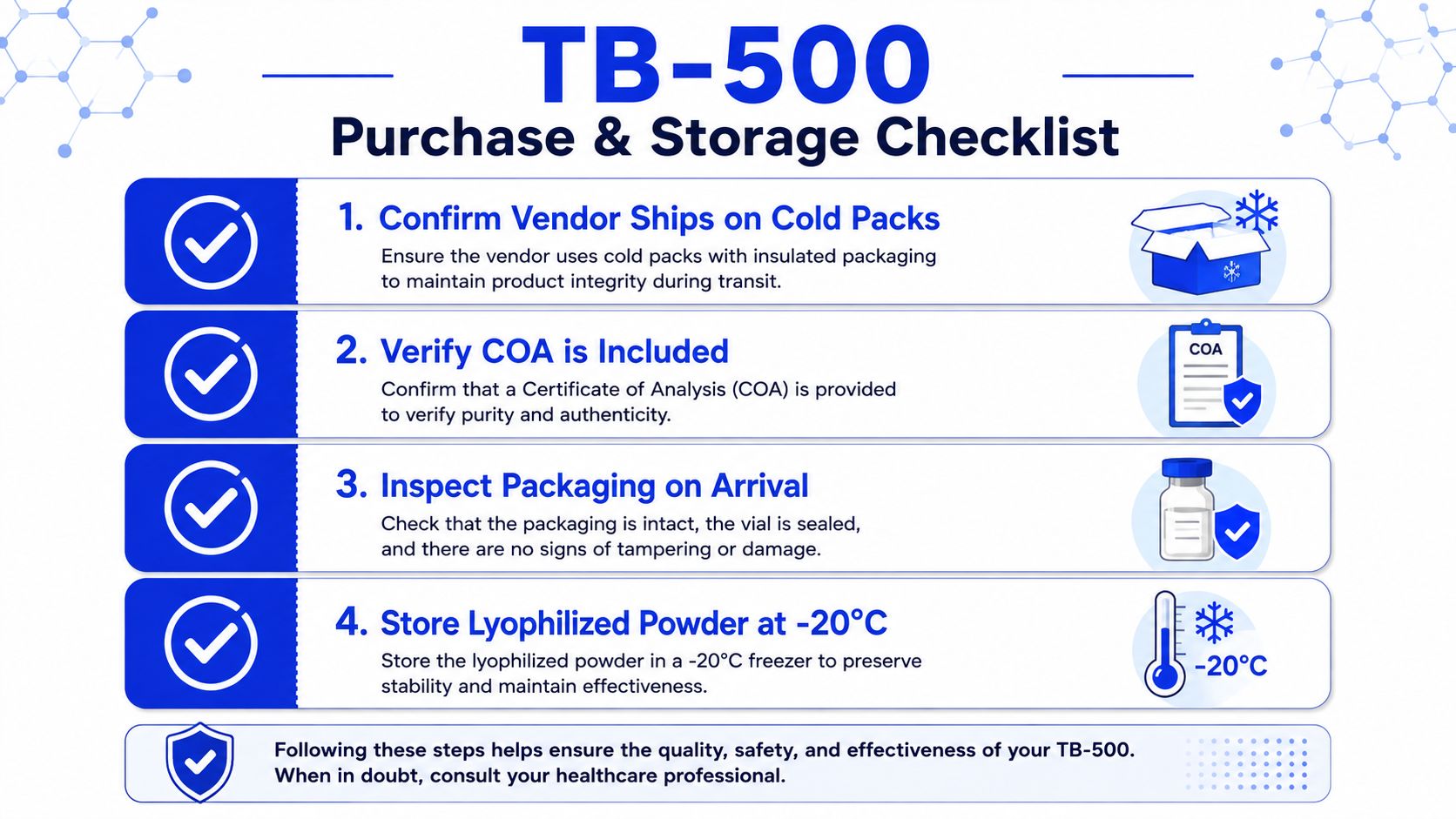
A good purchase can still fail if shipping and receiving aren't controlled. Treat the parcel as part of the research record, not as a delivery detail.
Confirm the following with the supplier:
On arrival, photograph the outer packaging and vial condition before opening the parcel. Record damage, leakage, broken seals, missing labels, or temperature concerns in the receiving log.
Match the vial's batch number to the COA, invoice, packing slip, and order record. If one document refers to a different lot, quarantine the material until the supplier resolves the discrepancy.
Store lyophilized vials at the labeled temperature. Move reconstituted material to refrigeration only when the applicable protocol or product documentation allows it. Don't create a storage rule from internet anecdotes when the supplier's batch documentation provides a different instruction.
Small operational systems matter across direct-to-consumer research supply businesses too. For readers evaluating recurring ordering infrastructure rather than a single lab purchase, Shopify subscriptions for DTC brands offers context on subscription workflows. That type of software isn't a substitute for scientific documentation, but it shows why account records, fulfillment status, and order tracking should remain visible.
Some warning signs deserve clarification. Others should end the transaction immediately. Procurement teams lose time when they treat every red flag as negotiable.
Walk away when the seller refuses to provide a batch-specific COA before payment or supplies a generic report with no matching lot number. Recycled laboratory headers, cropped screenshots, missing testing bodies, and unreadable result tables all weaken the document's value.
An anonymous domain, unverifiable business address, or checkout page hosted on a redirect domain should trigger a stop. Payment limited to cryptocurrency, without a formal invoice or clear order record, removes useful accountability from the transaction.
A professional storefront isn't proof of product quality. It does, however, make basic verification possible. If the seller can't explain who receives payment, where the material ships from, or how support handles a discrepancy, the buyer has no reliable escalation path.
A price far below comparable listings requires an explanation, not an automatic purchase. Bulk discounts that push research-grade material into gram-scale buying, listings that switch between unrelated compounds, and pages that blur TB-500 with full-length thymosin beta-4 are serious integrity concerns.
Binary decision rule: If two or more red flags appear, halt the purchase regardless of price or convenience.
Missing information isn't neutral. A supplier that doesn't show a COA, shipping policy, business identity, or intended-use restriction is asking you to accept uncertainty without giving you a way to measure it.
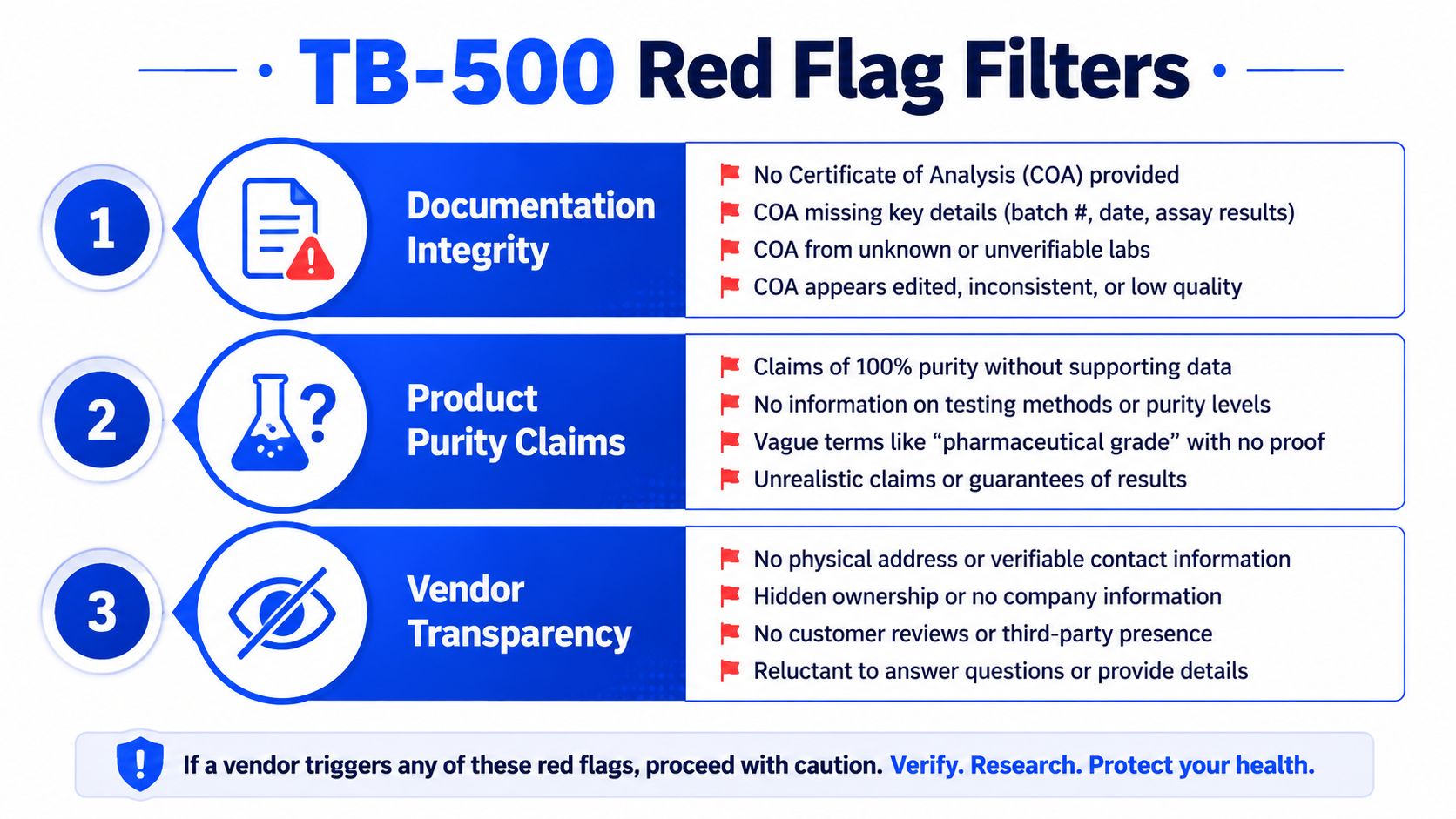
The same four gates work for TB-500, BPC-157, GHK-Cu, ipamorelin, and future compounds on your lab's list.
Run the gate before comparing price. The supplier that saves time through complete documentation and realistic fulfillment can reduce procurement friction without asking you to compromise your research record. A curated, vetted supplier directory can also serve as a time-saver when its checks are visible and independently repeatable.
Peptide Warehouse USA offers research peptides, including TB-500 in lyophilized powder and spray formats, with USA manufacturing, batch documentation, COAs, microbial and endotoxin reports, and stated purity levels up to 99.5% for research, laboratory, or analytical use only. Visit Peptide Warehouse USA to review the available options, confirm the documentation for the lot you're evaluating, and choose a purchase that fits your lab's compliance and storage workflow.