No products in the cart.


If you’re looking into TB-500 hair growth, you’re probably running into the same problem many careful readers do. The internet tends to jump from peptide buzzwords to bold claims without stopping to separate lab findings from human evidence.
That’s where this topic gets interesting. TB-500 sits in a real regenerative science conversation, but the strongest support behind the hair hypothesis comes from preclinical work tied to thymosin beta-4, not from established human hair-loss trials. That distinction matters if you’re trying to evaluate it seriously for laboratory or analytical use.
Hair biology is already complex. Follicles cycle, pause, shrink, recover, and respond to signals from blood supply, surrounding matrix, inflammation, and stem-cell behavior. If you need a quick refresher on that biology before diving deeper, the ArtNaturals guide to hair health offers a useful plain-English overview of the hair cycle.
TB-500 usually enters hair discussions through a side door. It wasn’t originally framed around cosmetic regrowth. It became interesting because researchers were already studying related biology in wound healing, tissue repair, cell migration, and regenerative signaling.

That origin story explains the hype. Hair follicles are miniature regenerative organs. They need cells to move at the right time, local tissue to remodel correctly, and enough vascular support to sustain an active growth phase. A peptide associated with repair biology will naturally attract attention from people studying follicle renewal.
What matters most is keeping the claim in bounds. TB-500 hair growth remains a research topic, not a clinically established human outcome. The relevant rationale comes from mechanistic and animal-linked evidence, and any discussion of use should stay within a for research purposes only framework.
Practical rule: If a compound’s hair narrative depends mostly on animal work, mechanism charts, and derivative reasoning from a parent peptide, treat it as a hypothesis under investigation, not a validated hair-loss solution.
TB-500 is commonly discussed as a synthetic fragment associated with thymosin beta-4, often shortened to TB4. That parent molecule is where the science starts, and skipping that background is where many articles lose accuracy.
TB4 is relevant because it has been tied to regenerative processes that biologists already recognize as important in healing tissues. Think of it less like a single-purpose hair signal and more like part of a broader repair toolkit.
One useful way to picture TB4 is as a traffic coordinator for cells. Tissues don’t heal just because a signal says “grow.” Cells also have to move into place, attach, remodel their surroundings, and respond to local structural cues. That’s why cell migration keeps coming up in this literature.
Another part of the story involves actin, a structural protein that helps cells maintain shape and move. If that sounds abstract, imagine scaffolding inside a tent. The material outside may matter, but the internal supports determine whether the structure can shift, stabilize, or rebuild. Researchers care about TB4-related biology because actin regulation connects to motion, repair, and tissue organization.
TB-500 gets attention in research settings because shorter peptide fragments are often discussed as tools that may be easier to work with in certain experimental contexts. The exact reason a lab chooses one peptide format over another depends on its model, handling preferences, and the question being asked.
That doesn’t mean TB-500 and TB4 are interchangeable in every scientific sense. It means the hair-growth hypothesis for TB-500 usually inherits its logic from TB4 biology.
A careful reader should keep three layers separate:
The key confusion point isn’t whether TB-500 sounds regenerative. It’s whether that regenerative profile translates into meaningful follicle outcomes in humans. That hasn’t been established.
For researchers, this distinction helps prevent category errors. A peptide can be scientifically interesting, mechanistically plausible, and still not be clinically proven for a specific endpoint like visible hair regrowth.
The strongest mechanistic case for TB-500 in hair research comes from how follicle growth depends on the local tissue environment. Hair doesn’t emerge from a passive pore. A follicle is a living structure that cycles through activity and rest, and that cycle depends on coordinated support from surrounding cells, vessels, matrix, and signaling pathways.
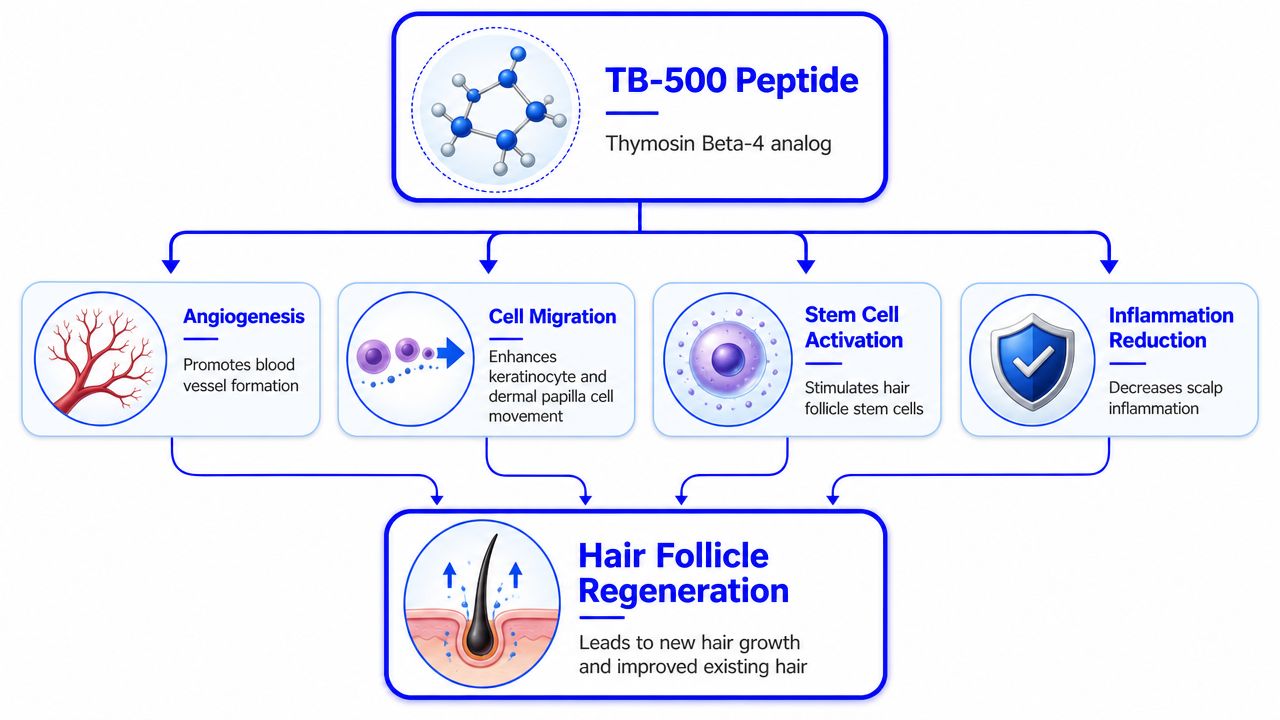
A frequently cited mechanistic summary states that TB-500’s proposed hair-growth mechanism is preclinical rather than clinical, with animal work summarized by secondary sources reporting new blood-vessel formation around follicles, increased keratinocyte migration, and stem-cell migration to the follicle base during the active anagen phase, which is the pathway linked to faster follicle cycling and regrowth in that preclinical framing, as described in the Peptides.org discussion of TB-500 and hair growth.
Those pieces matter because they align with what a growing follicle needs:
A related mechanistic thread comes from a PubMed-indexed 2003 study on thymosin beta-4. Researchers reported that TB4 stimulated hair growth in normal rats and mice, increased migration and differentiation of rat vibrissa follicle clonogenic keratinocytes at nanomolar concentrations, and found higher expression and secretion of matrix metalloproteinase-2, linking TB4 to extracellular matrix remodeling during the active hair-growth phase in that model, as reported in the PubMed record for the 2003 TB4 study.
That study is why people keep returning to this topic. It doesn’t prove TB-500 grows hair in humans. It does provide a biologically coherent reason researchers became interested in the broader TB4 to TB-500 axis.
A short visual summary can help orient the mechanism:
Mechanistic plausibility isn’t the same thing as outcome certainty. A pathway can look convincing on paper and still fail to produce visible or durable regrowth when moved into real-world human hair-loss patterns.
That’s especially relevant because not all hair loss is driven by tissue repair failure. Some forms are dominated by hormonal signaling, follicle miniaturization, metabolic regulation, or dormant-follicle reactivation problems. In those settings, a repair-oriented peptide may be supportive, peripheral, or mismatched to the main bottleneck.
The evidence base is narrow, and that’s the honest starting point. Much of the public conversation around TB-500 hair regrowth sounds more mature than the actual body of data.
The historical anchor is clear. The strongest evidence behind this topic comes from the parent peptide rather than from direct human hair studies of TB-500 itself.
Researchers reported in the previously cited 2003 TB4 study that thymosin beta-4 stimulated hair growth in normal rats and mice and increased migration of follicle keratinocytes. That preclinical finding became the main scientific basis for the modern TB-500 hair narrative.
The reasoning chain looks like this:
That chain is coherent, but it’s still an inference chain.
A research-oriented review notes that thymosin beta-4-related peptides have been associated with pathways such as VEGF and HGF upregulation, enhanced endothelial tube formation, increased capillary density, basement membrane remodeling, and Wnt signaling, all of which are relevant to follicle cycling. The same review also says that rigorous comparative studies with standardized quantitative outcomes are still needed to define effect sizes in vivo, and a later overview likewise says more clinical research is needed before those benefits can be applied to humans, as described in the research-oriented perspective on TB-500 and hair follicle renewal.
That caveat is the center of the whole discussion. Positive preclinical findings can justify further investigation. They can’t justify presenting TB-500 as a proven human hair-loss treatment.
Online anecdotes aren’t a substitute for controlled human hair studies. They don’t standardize hair type, hair-loss subtype, baseline follicle status, imaging method, or concurrent interventions.
For responsible research, that means avoiding two common mistakes:
This is also where compliance matters. Compounds sold for laboratory or analytical work should remain in that lane. If a product is not approved for human use, the absence of a clinical hair dataset is not a small footnote. It is a major limitation.
TB-500 should be approached as a research chemical for laboratory, analytical, or preclinical work only. It should not be framed as a consumer wellness item or a self-directed hair intervention.

“Research use only” isn’t decorative language. It defines the intended context of procurement, handling, documentation, and application. If a peptide lacks established human hair data, researchers should treat unknowns as real unknowns.
That caution is reinforced by expert reviews on thymosin beta-4-related peptides, which note that positive preclinical findings exist but rigorous comparative studies with standardized outcomes are still needed, and that more clinical research is needed before hair-related benefits can be applied to humans, as summarized in the earlier linked research-oriented review.
In practical terms, that means the full safety profile for hair-directed human use isn’t established through the kind of evidence standard that would support direct use claims.
A competent lab treats peptide handling as a chain of verification, not a guess.
Lab mindset: If you can’t trace the batch, read the documentation, and confirm the intended research status, you don’t really know what you’re working with.
Readers also get confused about side effects in this space. The problem is that discussion often drifts into anecdote. For a research-only compound without established human hair trials, anecdotal reports don’t define a reliable safety profile. They merely underline uncertainty.
A Certificate of Analysis, or COA, is the minimum document researchers should expect when evaluating a peptide lot. It doesn’t answer every question, but it tells you whether a supplier is giving you something testable, traceable, and specific.
Start with the basics. The document should identify the compound, batch or lot, and the analytical method used to characterize it. If those pieces are vague, the rest of the paperwork matters less.
Then look for the sections that help with decision-making:
Third-party testing matters because it reduces the conflict that comes with a seller judging its own product. According to publisher information, Peptide Warehouse USA supplies research peptides with third-party documentation that can include Certificates of Analysis, microbial reports, endotoxin reports, and stated purity levels up to 99.5% for supported lots, which is relevant for labs evaluating traceability and documentation standards.
Quality review also helps you compare purpose, not just purity. TB-500 belongs to a regenerative and tissue-repair discussion. Other hair research compounds may be aimed at hormonal modulation, vasodilation, extracellular matrix support, or follicle activation.
That difference matters when interpreting a COA. A clean report tells you the material is documented. It doesn’t tell you the mechanism is the right one for the biological question you’re asking.
A simple evaluation checklist helps:
| Checkpoint | Why it matters |
|---|---|
| Compound name matches listing | Prevents identity mismatch |
| Lot number appears on report | Supports traceability |
| Analytical method is named | Shows how the lot was assessed |
| Third-party documentation exists | Adds independence to quality review |
| Storage guidance is available | Helps preserve sample integrity |
TB-500 makes more sense when you compare it with the broader hair-loss field. It isn’t competing on the same conceptual ground as every other option.
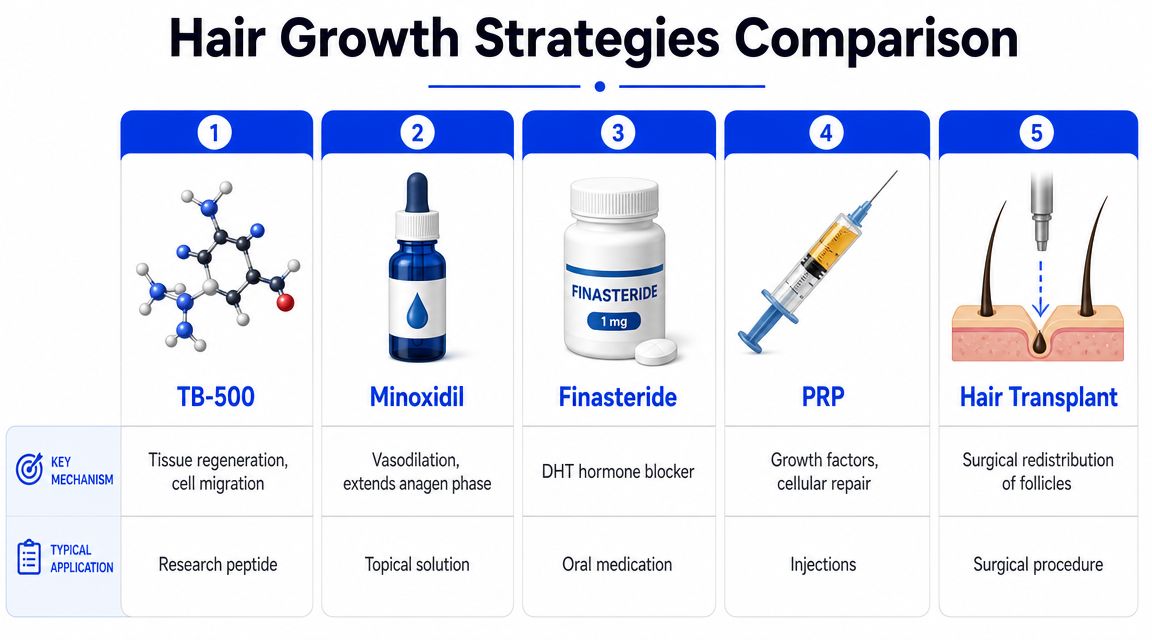
TB-500 is usually framed around tissue regeneration, cell migration, and angiogenesis-linked support. That’s different from the dominant logic behind familiar hair strategies.
For readers comparing pathways, the My Transformation for women’s hair loss gives a useful broader look at how different treatment categories are positioned in practice, especially for women evaluating multiple approaches.
Here’s a concise comparison:
| Compound | Primary Mechanism | Evidence Level for Hair | Status |
|---|---|---|---|
| TB-500 | Regenerative signaling, cell migration, tissue-repair logic | Preclinical and mechanistic | Research use context |
| Minoxidil | Vasodilatory hair-support mechanism | Established clinical use | Conventional treatment category |
| Finasteride | Hormonal pathway targeting DHT | Established clinical use | Conventional treatment category |
| GHK-Cu | Copper-peptide and tissue-support signaling | Research and broader cosmetic interest | Research and cosmetic discussion |
| PRP | Growth-factor enriched biologic approach | Clinical procedural use | Office-based treatment category |
Different mechanisms answer different questions. A follicle that lacks blood-flow support is not the same research problem as a follicle being suppressed by androgen signaling.
A second reason TB-500 deserves a careful comparison is that newer hair-loss pipelines are targeting problems beyond wound-healing logic. Recent coverage notes that PP405 and ET-02 are advancing in clinical phases, with reporting that PP405 has Phase 2a signals of increased hair density and favorable tolerability, while ET-02 has early Phase 1 data suggesting thicker hairs and wider shafts in weeks, as summarized in the Alvi Armani overview of breakthrough hair-loss options.
That doesn’t make TB-500 irrelevant. It changes how researchers should frame it.
If modern programs are moving toward dormant-follicle reactivation or metabolic targeting, then TB-500 may be better understood as a broad regenerative adjunct hypothesis rather than a primary answer to patterned hair loss. That’s the “what now” question many articles skip.
For a researcher, the practical takeaway is simple:
TB-500 remains a compelling research topic because the biology behind it is plausible. Its connection to thymosin beta-4, cell migration, vascular support, and tissue remodeling gives it a real mechanistic foothold in follicle science.
But the boundary is clear. The hair-growth case is still preclinical, and TB-500 should be treated as for research purposes only, not as a proven human hair-loss solution. For readers also exploring non-peptide consumer approaches, discover Morfose hair treatments offers a separate, broader hair-care perspective.
If your work involves peptide sourcing for laboratory or analytical applications, focus on documentation, batch traceability, and mechanism fit before anything else.
Researchers who want documented peptide options for laboratory use can learn more from Peptide Warehouse USA, including available catalog items, batch documentation, and research-use-only procurement information.