No products in the cart.



What does “10 mg” mean on a tesamorelin research vial? It may look like a dose, but it usually describes the total quantity of material in the container, not the amount validated for a single administration. That distinction affects purchasing, reconstitution calculations, documentation, and every downstream laboratory result.
This Tesamorelin Peptide 10mg Reference Guide 2026 explains how to read the label without turning a bulk vial specification into a human-use protocol. You'll learn how the clinical evidence relates to tesamorelin, what a certificate of analysis should show, why approved formulations aren't interchangeable, and how researchers can build a traceable handling workflow.
Could a 10 mg tesamorelin vial be mistaken for a human dose? Yes, if the label is read as an administration instruction rather than an inventory specification. The nominal mass identifies the stated quantity supplied in the container. It does not establish the concentration after reconstitution, the amount in a working aliquot, or the conditions suitable for a particular assay.
The clinical study evaluated 2 mg once daily, not a 10 mg bolus. The 10 mg label therefore describes bulk vial content, while the studied and approved clinical dose was 2 mg daily, as documented in the foundational randomized trial. Commercial FDA background helps explain the clinical terminology, but it does not convert a research vial into a validated human-use presentation.
Before preparing a working solution, a technician needs three documented inputs:
A 10 mg vial can yield different working concentrations under different laboratory methods. Dividing the label by an internet-derived injection amount bypasses the documentation needed for reproducible research.
Practical rule: Treat the label as an inventory specification first. Treat concentration as a calculated, recorded result.
For procurement, ask how peptide content, reconstitution volume, stability, and protocol conditions were established. “How many doses are in the vial?” has no defensible answer without those details. Commercial product instructions should not be transferred automatically to a research setup. The certificate of analysis and preparation record must support the calculation in use.
What does a 10 mg label mean when the supporting human trial evaluated a much smaller administered amount? The answer begins with a distinction between clinical evidence and vial inventory. A nominal research quantity is not a validated human dose, and the commercial history does not change that.
A randomized, placebo-controlled trial published in 2008 enrolled 412 adults with HIV-associated lipodystrophy and excess abdominal fat. 273 received tesamorelin and 137 received placebo for 26 weeks, while the study evaluated a daily 2 mg subcutaneous injection. The trial report is available from the New England Journal of Medicine trial report.
Researchers measured visceral adipose tissue, or VAT, with computed tomography rather than using body weight alone. At week 26, average VAT decreased by 27.8 cm² in the tesamorelin group, while the placebo group showed a 5.1 cm² increase, for a between-group difference of 32.9 cm². These results describe a regional body-composition effect, not a general weight-loss outcome.
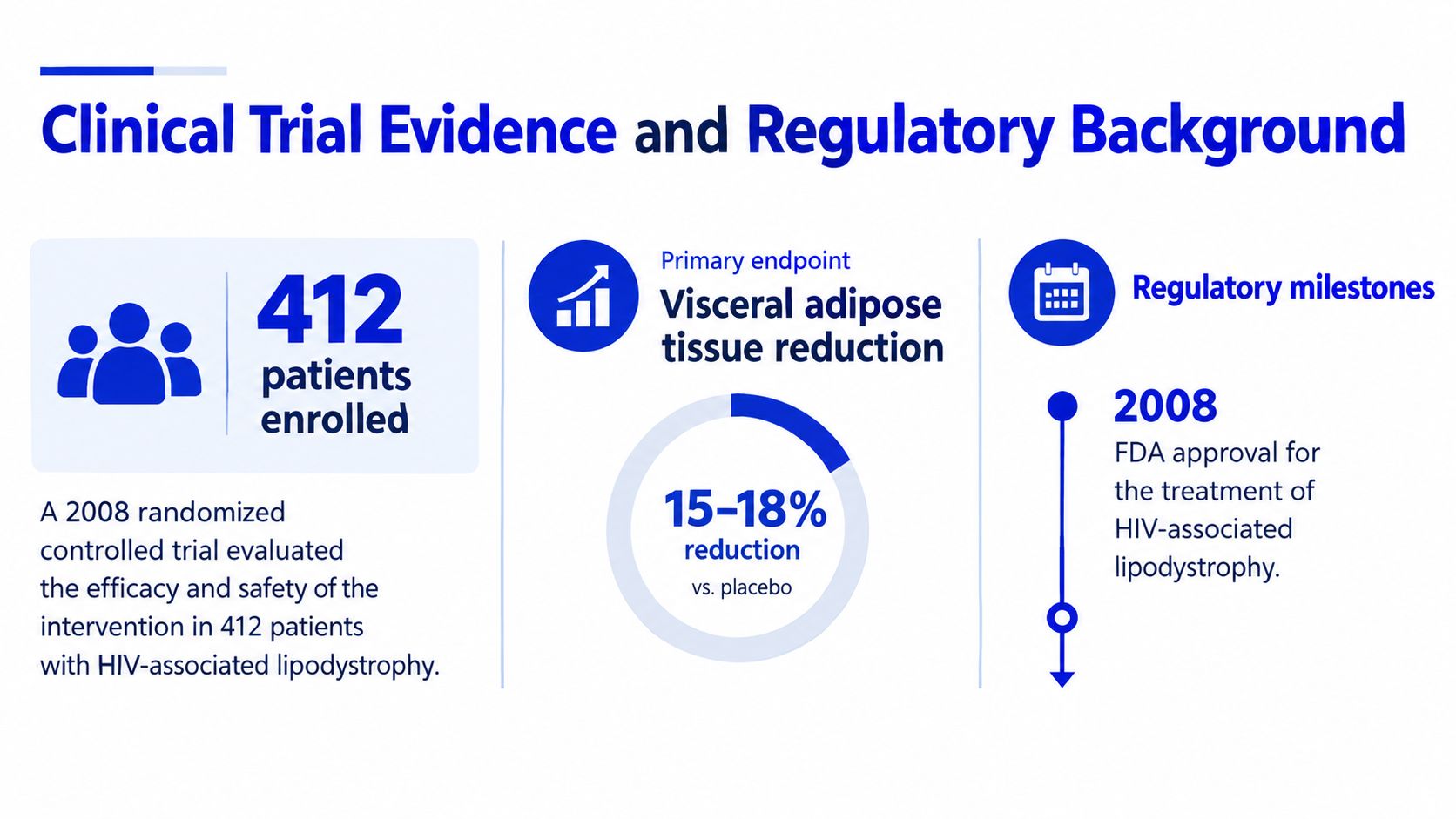
The study provides three practical reference points:
The FDA approved tesamorelin on November 10, 2010, as the first drug specifically indicated to reduce excess abdominal fat in HIV-infected patients with lipodystrophy. FDA labeling also stated that it was not indicated for weight loss, as summarized in the NCBI clinical review.
Phase III findings likewise focused on VAT. Published reviews described reductions concentrated in visceral tissue, including approximately 15% after 26 weeks and about 18% after 52 weeks. Other reported least-squares mean differences versus placebo were −19.6% in one 26-week trial and −11.7% in another. Those findings provide clinical context for tesamorelin, while the 10 mg label remains a bulk research-vial specification that must be interpreted through batch records and assay documentation, not treated as a patient dose.
A certificate of analysis, or COA, is the document that connects a vial to a specific batch. A product page may describe a nominal strength, but the batch paperwork should tell you what was tested, how it was tested, and which material the results apply to.
Start with identity and traceability. The document should match the product name, batch number, test date, and supplier information on the container and order record. If those identifiers don't align, pause the workflow until the discrepancy is resolved.
A useful review sequence looks like this:
Researchers handling a 10 mg presentation should verify the product-specific COA, peptide content versus total vial mass, sterility and endotoxin documentation, and validated reconstitution instructions, as emphasized in the FDA labeling documentation.
A missing batch number weakens traceability. An undated report makes it harder to connect testing to the supplied material. A purity statement without an identity result, assay basis, or microbial information may be insufficient for the intended experiment.
Don't treat a polished PDF as proof by itself. The laboratory record should preserve the COA, purchase record, vial label, preparation record, instrument outputs, and any deviations together.
What does a commercial tesamorelin vial specification tell a laboratory technician? It identifies a particular approved formulation, not a universal rule for every tesamorelin peptide 10mg research vial.
The original EGRIFTA product used a 1 mg-per-vial presentation with a recommended 2 mg daily dose. EGRIFTA SV used a 2 mg-per-vial presentation with a recommended 1.4 mg daily dose, according to the 2024 FDA label.
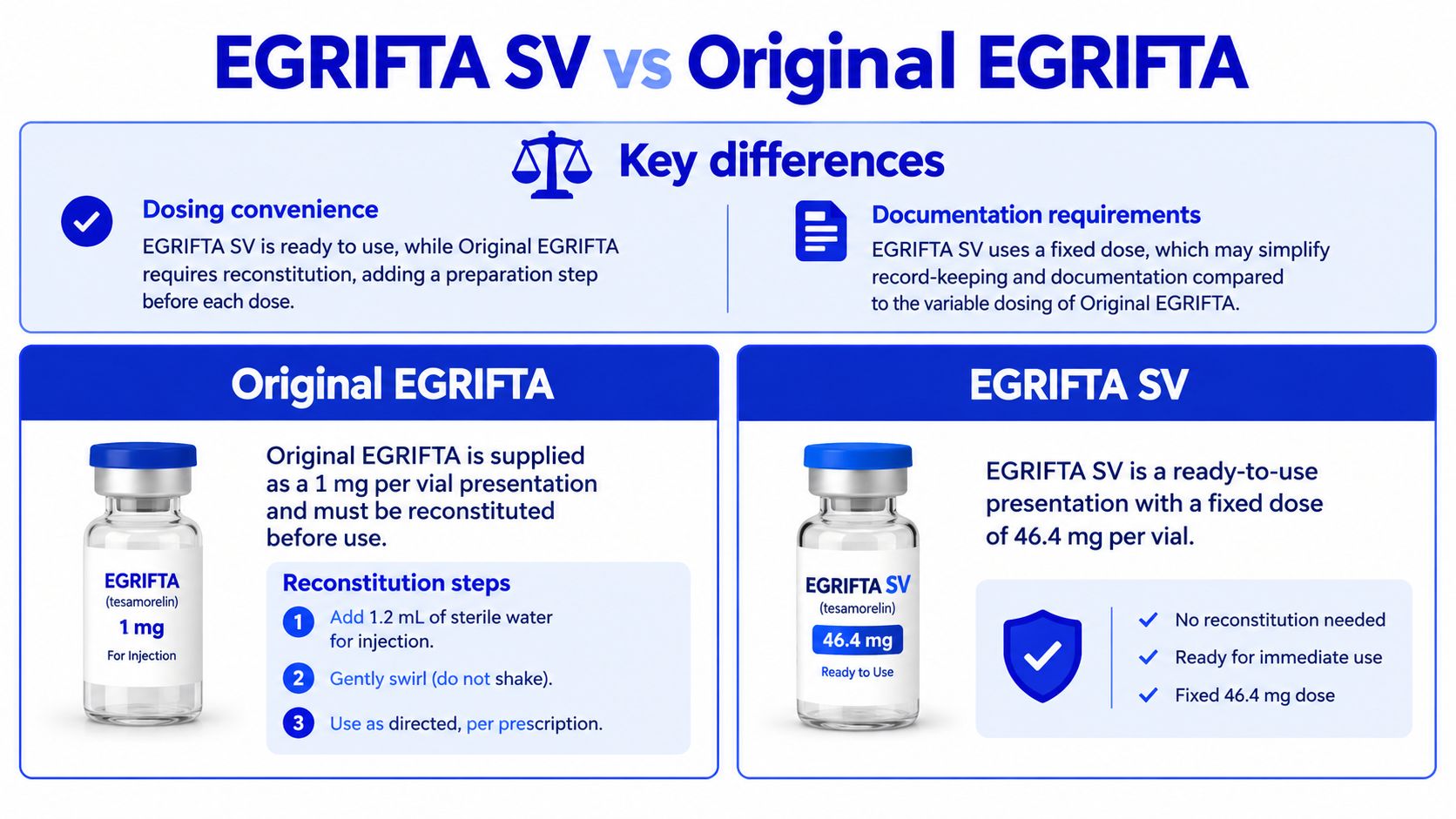
| Specification | Original EGRIFTA | EGRIFTA SV |
|---|---|---|
| Vial presentation | 1 mg per vial | 2 mg per vial |
| Recommended daily regimen | 2 mg daily | 1.4 mg daily |
| Documentation priority | Product-specific preparation and dosing information | Product-specific formulation and handling information |
These products show why vial mass, formulation, and dose must remain separate records. A nominal 10 mg research vial is a bulk material specification. It does not inherit either commercial product's excipients, solvent instructions, concentration, stability profile, or human-use regimen.
Record the formulation named in the protocol, rather than writing only “tesamorelin.” The COA and vial documentation should identify the research material independently, so an approved commercial label is not mistaken for its specification.
Reconstitution math begins with the assay-supported peptide quantity and the validated final solvent volume. The basic relationship is straightforward:
Concentration = peptide amount ÷ final solution volume
If a laboratory record confirms 10 mg of peptide content and a validated method produces 5 mL of final solution, the nominal concentration would be 2 mg/mL. If the same stated quantity were prepared to a final volume of 10 mL, the nominal concentration would be 1 mg/mL. Those examples illustrate the calculation only. They don't prescribe a solvent, volume, route, or human-use dose.
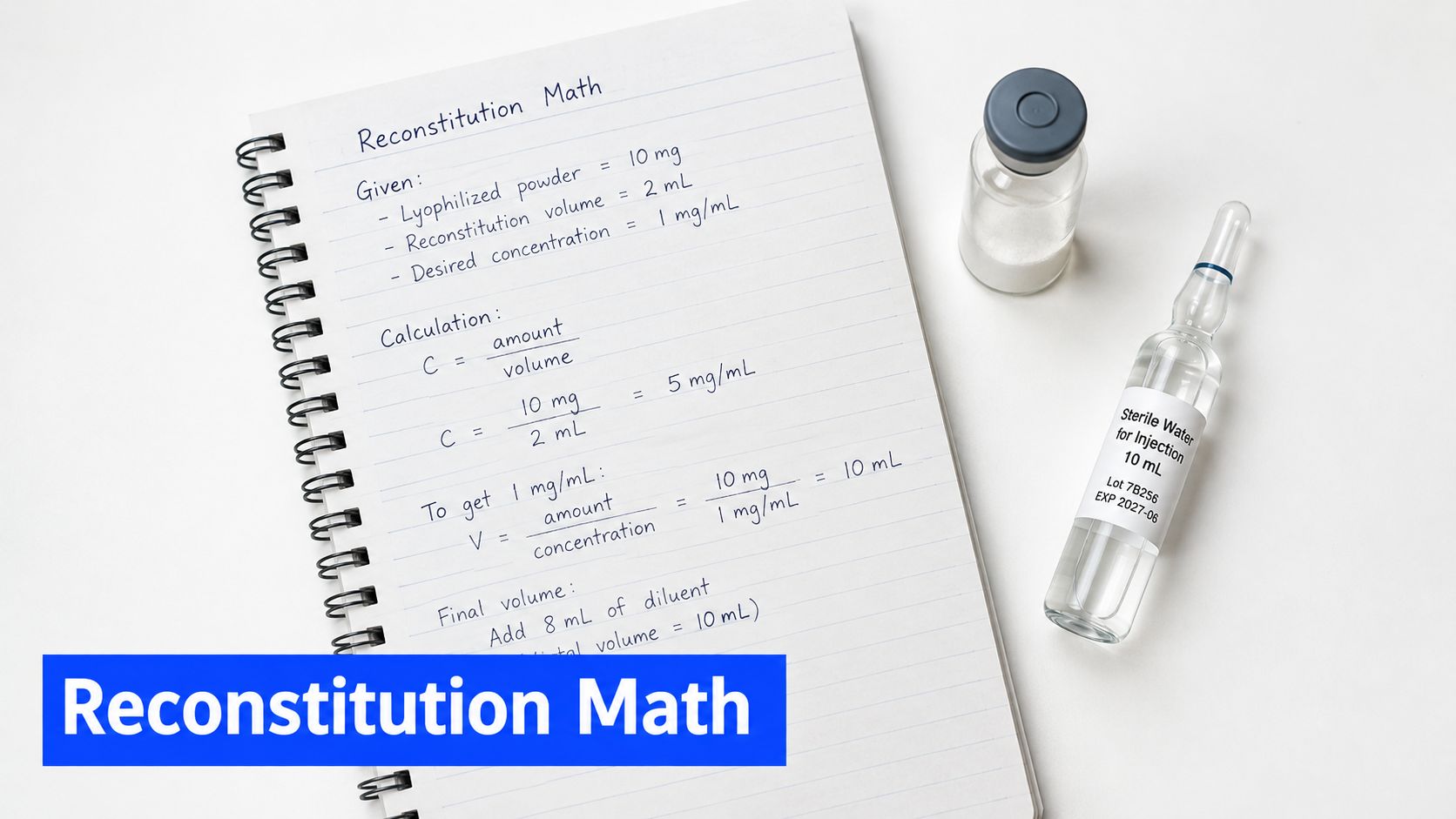
Record the following before preparing a solution:
The powder may not dissolve to the exact nominal volume after solvent addition. Dead volume, adsorption, transfer loss, and incomplete recovery can affect the practical concentration. A technician should follow the product-specific method and document observations rather than assuming the simple equation captures every source of variation.
A concentration calculation is only as reliable as the content assay, volume measurement, and preparation record behind it.
Commercial instructions for an approved product aren't interchangeable with a generic 10 mg research vial. Keep the preparation math attached to the batch record so another technician can reconstruct the working solution without relying on memory.
How should a laboratory treat a labeled 10 mg tesamorelin vial during storage? Treat the label as the nominal mass of a bulk research material, not as a human dose or a complete handling instruction. The product documentation or a validated internal procedure must define storage conditions, rather than a generic peptide chart copied from another material.
Keep the original, clearly identified container protected from light, humidity, temperature cycling, and unnecessary handling. These controls preserve the material and make later test results easier to interpret.
Before reconstitution, inspect the vial in a controlled preparation area. Record the lot, appearance, seal condition, and any visible irregularity. Quarantine material if the container is damaged or its identity cannot be confirmed.
Prepare only the amount needed for the approved workflow. Use appropriate sterile or contamination-controlled supplies, limit the vial's time outside storage, and minimize repeated punctures. If aliquots are prepared, label each one with the batch, measured concentration, preparation date, and storage condition. Record every freeze and thaw event so the sample history remains visible.
A reconstituted solution requires its own stability assessment. The storage period for lyophilized powder does not automatically apply after solvent addition. If supplier documentation does not establish solution stability, follow the laboratory quality system before using the solution for time-sensitive comparisons.
Clarity, unexpected particles, container damage, or unexplained assay drift are reasons to quarantine the material and investigate. A clear record separates handling problems from biological findings and supports later COA and batch review.
How can a laboratory distinguish a true sampling effect from a handling or timing error? Tesamorelin leaves the circulation quickly, so the dose-to-collection interval must be treated as a measured variable, not a schedule label. FDA-linked pharmacology data report a median time to peak plasma concentration of approximately 0.15 hours after subcutaneous administration. The mean elimination half-life was about 18.6 minutes after a single 2 mg dose and approximately 37.8 minutes after repeated once-daily dosing for 14 days, according to the tesamorelin pharmacology reference.
A collection taken soon after administration can describe a different exposure phase from a later draw. Record the actual administration and collection times independently. Calling a specimen “trough” without that interval leaves the result difficult to interpret, particularly when staff estimate the dose time after the event.
Before approving the protocol, define the variables that affect comparability:
Population can affect exposure as well. Available pharmacology data report an area under the concentration-time curve 34% higher in HIV-infected participants than in healthy subjects, while peak concentration was similar. Define the study population in advance and validate kinetic assumptions instead of transferring them automatically.
Finally, interpret the vial label correctly. A 10 mg nominal quantity describes the bulk mass of research material in the container, not a clinically characterized 10 mg administered dose. The experiment must establish its own controlled concentration, timing, matrix, and analytical rationale under applicable oversight.
What does a 10 mg label establish, and what does it leave unanswered? It identifies the nominal mass of material in a research vial. It does not establish a human dose, a clinical concentration, or authorization for administration.
Tesamorelin has an established U.S. indication for reducing excess abdominal visceral adipose tissue in adults with HIV-associated lipodystrophy. That authorization is specific to the approved product, formulation, indication, and labeling. It does not cover general weight loss, anti-aging, bodybuilding, or cosmetic fat reduction, and it does not convert every tesamorelin vial into an approved medicine.
A research-use-only vial belongs in laboratory, analytical, or preclinical work conducted under the responsible organization's procedures. Before purchase or use, document:
The practical rule is simple: treat the vial number as a mass specification, then verify what the batch record supports. A marketplace description cannot establish regulatory status. The product's role depends on its documentation and the context in which it is handled.
Should a supplier be judged by its purity headline or by the records supporting the vial? For tesamorelin peptide 10mg, the documentation should answer what the material contains, how the batch was tested, and whether the stated 10 mg describes bulk material rather than a human dose.
Review the supplier's record for:
Some US suppliers state purity levels up to 99.5%. That figure cannot replace a batch-specific COA, identity result, content assay, or handling documentation. Compare the full evidence package, much as a technician compares a sample label with its instrument record, instead of ranking vials by one prominent number.
Peptide Warehouse USA lists tesamorelin as lyophilized material for laboratory and analytical research use, with stated 99%+ purity, COA verification, US manufacturing, and endotoxin and microbial testing. Its catalog identifies the products as research chemicals not intended for human consumption. Researchers can explore Peptide Warehouse USA and compare the available batch records with institutional requirements.
Before ordering, ask direct questions. Can the supplier provide the lot-specific COA? Does the report name the testing methods and reporting basis? Are the preparation instructions supported for that exact presentation? Clear answers help distinguish a vial with a useful paper trail from one that merely appears suitable for laboratory work.
Before beginning analytical or preclinical work with tesamorelin peptide 10mg, complete a documented review. The vial quantity is only one entry in that record.
A clean checklist prevents the most common interpretation error: treating a 10 mg vial strength as a 10 mg dose. It also gives the next technician enough information to reproduce the preparation and evaluate any unexpected result.
Peptide Warehouse USA offers lyophilized tesamorelin for laboratory and analytical research use, supported by stated purity information and batch documentation such as COAs, microbial, and endotoxin reports. Visit Peptide Warehouse USA to review the available research presentation and documentation before planning your next tesamorelin workflow.