No products in the cart.


The median advertised research-market thymosin alpha 1 price is $7.05 per mg, with observed listings ranging from $3.50 to $16.20 per mg. These are advertised listing figures, not a fixed or universal price.
That spread makes the cheapest vial a poor starting point for procurement. A useful comparison asks how much material you're buying, what evidence supports the batch, and whether the supply channel fits your intended use.
For a laboratory buyer, the objective isn't to minimize the invoice. It's to identify the lowest defensible total cost for material that meets the research plan, documentation requirements, and applicable purchasing rules.
The opening benchmark comes from a market aggregation covering 62 in-stock listings across 55 vendors. That dataset also identified 18 vendors with laboratory-verifiable certificates of analysis and 17 with third-party certificates; for an equivalent 10 mg quantity, it reported a median-based cost of approximately $70.50, with the observed unit-price range translating to roughly $35 to $162, according to the research-market pricing aggregation.
Those figures establish a reference point, not a procurement specification. The documentation categories aren't evidence that every listing meets the same analytical standard, and the counts shouldn't be added together as though they necessarily describe mutually exclusive groups.
A vial price answers what a container costs. It doesn't, by itself, tell you whether the container represents a better purchase.
| Comparison field | What to record | What it helps you avoid |
|---|---|---|
| Advertised price | Displayed amount and currency | Comparing prices on different bases |
| Package contents | Milligrams per vial and vials per package | Mistaking a package price for a vial price |
| Normalized price | Advertised cost divided by labeled milligrams | Favoring a smaller vial because its ticket price is lower |
| Documentation category | Supplier-issued, third-party, or laboratory-verifiable | Treating every certificate as equivalent |
| Capture date | Date the listing was reviewed | Combining prices collected under different conditions |
The distinction between advertised cost per milligram and verified material suitability matters. Normalization improves the arithmetic, but it doesn't establish identity, quality, or authorization for human use.
The dataset describes research-market advertisements that can change with promotions, quantity discounts, shipping, and documentation. It isn't an official price schedule, and it shouldn't be presented as one.
My procurement interpretation is straightforward: a listing substantially below the reference deserves questions, not automatic rejection. A listing above it needs an explanation, not automatic acceptance.
Practical rule: Use the market median to identify questions worth asking. Use the specification and batch records to decide whether the answers are sufficient.
A reproducible comparison therefore preserves the original listing information. Without a date, package description, and verification category, another buyer can't reliably reconstruct why you considered a quote attractive.
A published bulk schedule illustrates why the lowest vial price and the lowest unit cost can point to different formats. The following figures come from the advertised thymosin alpha-1 bulk-pricing schedule, which also states that volume eligibility can depend on total kits across multiple compounds.
| Vial size | Price at 15 to 24 kits | Price at 100-plus kits | Cost per mg at 100-plus kits |
|---|---|---|---|
| 5 mg | $16 | $12 | $2.40/mg |
| 10 mg | $26 | $19 | $1.90/mg |
Read the smaller-format row first. Its vial price falls at the higher purchasing tier, but the buyer must still consider how much material each vial contains.
The larger-format row has a higher vial price in both tiers. Yet the normalized comparison favors that format at the highest tier: under the cited schedule, the lower-strength option carries approximately a 26% higher cost per milligram.
The table answers a narrow question: which listed format offers the lower advertised cost for the labeled quantity? It doesn't answer whether your laboratory should place a bulk order.
Before applying the schedule, ask the supplier to clarify:
These questions matter because a pricing table isn't a complete purchase agreement. A favorable tier is useful only if the supplier confirms that your intended order qualifies.
The schedule also doesn't establish equivalence in purity, assay accuracy, residual solvents, endotoxin burden, stability, or traceability. Treat it as a purchasing benchmark, then assess the material against the laboratory's requirements.
A sensible decision can favor the more expensive vial. If the smaller format fits the protocol and avoids unused inventory, its higher unit price may be acceptable. Conversely, the larger format becomes more compelling when the planned work can use the contents and the documentation supports the application.
Organize supplier review around claims, sourcing, and supporting records. The diagram provides a useful hierarchy for those questions, but it shouldn't be read as proof that any factor carries a fixed price premium.
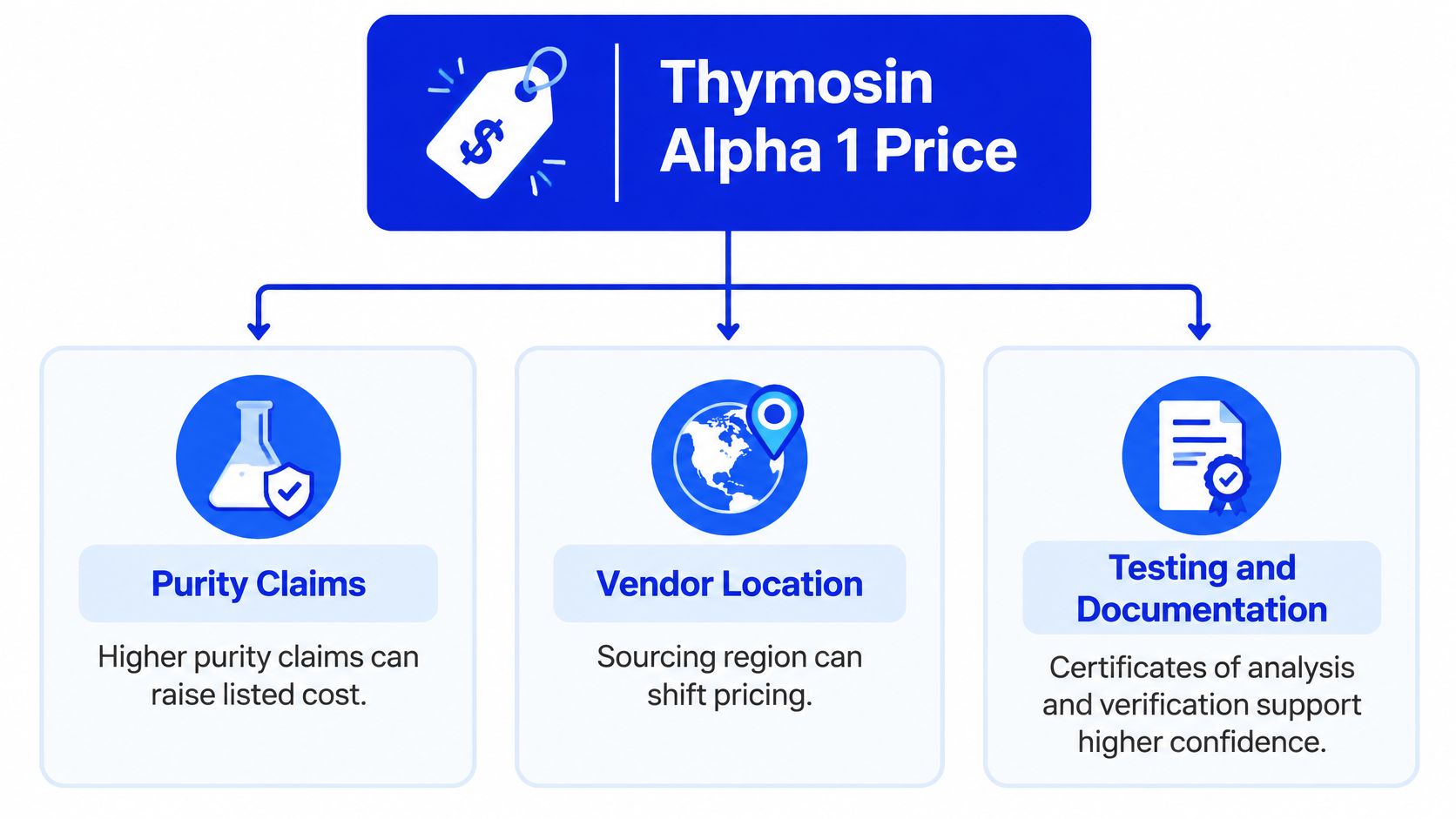
Start with the analytical properties your study requires. Then ask whether the supplier's reports address those properties.
A headline purity statement shouldn't replace review of identity, quantity, and application-specific testing. The bulk comparison above establishes why a price advantage alone can't resolve those questions.
Use the following hierarchy when reviewing a listing:
This approach treats documentation as evidence with a defined scope. It doesn't assume that a larger collection of reports automatically makes a product suitable.
Record where the supplier operates, where the material is manufactured, and where the shipment will originate. Those are separate questions, and the answers should come from the supplier rather than from assumptions about its branding.
The available pricing figures don't isolate a location-specific premium. It would therefore be misleading to claim that domestic or overseas sourcing is cheaper based on this evidence.
Instead, request the delivery terms and identify who is responsible for any applicable importation requirements. Compare those terms against the laboratory's procurement policy.
A sourcing claim is useful when it resolves a purchasing question. It isn't a substitute for a batch record.
For internal budgeting, define total delivered cost as the quoted material price plus applicable delivery, handling, and purchasing charges. If further analytical work is necessary before the material can enter your study, budget that separately and include it in the approval decision.
That produces a more useful distinction than cheap versus expensive: a quote is either complete enough to evaluate, or it still contains unresolved costs and requirements.
Research materials and patient-specific treatment belong in separate purchasing comparisons. The channel diagram makes that separation explicit.
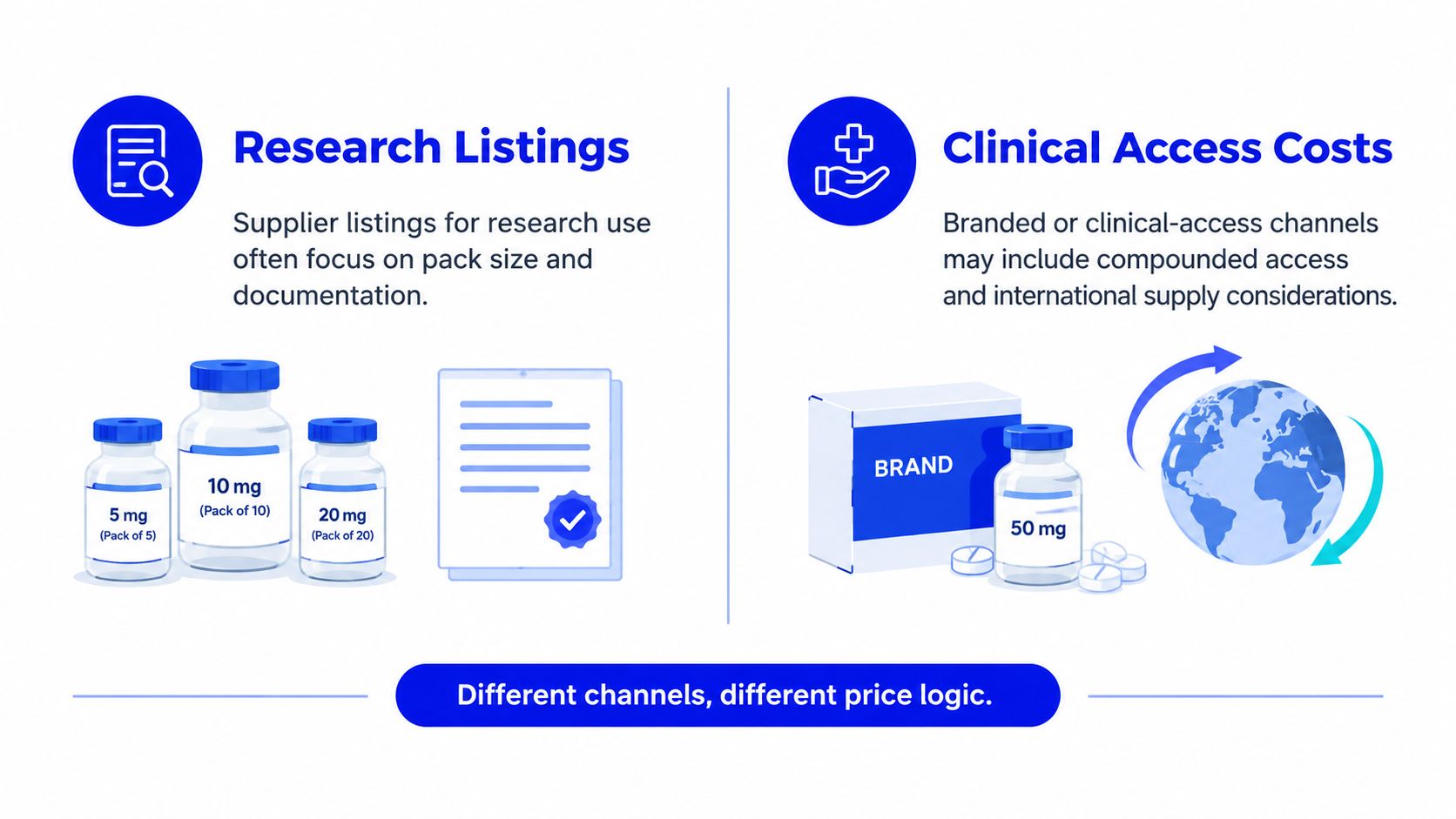
One market summary reports U.S. compounded access at approximately $100–$400 per month, using an example regimen of 1.6 mg twice weekly, and internationally marketed branded Zadaxin at more than $600 per month. Under that summary's assumptions, monthly quantity is approximately 12.8–13.9 mg, implying about $7.20–$31.25 per mg for the compounded figures and more than roughly $43 per mg for the branded figure, as outlined in the clinical-access pricing comparison.
These are historical, market-specific estimates. The regimen is included only to explain the cost calculation, not as dosing guidance or a statement that access is currently lawful or available.
| Supply channel | What the advertised amount represents | Main comparison limit |
|---|---|---|
| Research supplier | Material offered for laboratory or analytical use | Doesn't establish suitability for human treatment |
| Compounded-access estimate | A channel-specific monthly cost assumption | Doesn't establish current legal availability or complete fees |
| Branded international supply | A marketed product in a particular distribution setting | Doesn't establish access rights in another jurisdiction |
The summary identifies brand positioning and regulated distribution as features behind the branded premium. It doesn't quantify how much of the difference each feature explains.
The branded premium reflects a different distribution context, not proof that a research listing and a clinical product are interchangeable.
A separate research-versus-treatment cost comparison identifies prescription access, formulation, dispensing, storage, sterility controls, testing, shipping, and clinical oversight as potential components of the difference. It also reports that thymalfasin has approval in more than 30 countries, while no thymosin-alpha-1 drug product has FDA approval in the United States.
Approval abroad doesn't establish approval in the buyer's jurisdiction. Likewise, an advertised compounded price doesn't, by itself, establish a lawful route to treatment.
For a laboratory purchase, exclude clinical monthly estimates from the supplier-ranking sheet. Keep them as market context, with their assumptions clearly labeled.
For a treatment-related inquiry, don't substitute a research-material price for a patient-specific quotation from an appropriately authorized professional. The two figures answer different questions, even when they can both be expressed per milligram.
The right package size depends on how the laboratory expects to use the material. The following hypothetical scenarios illustrate purchasing decisions, not reported case studies or validated experimental protocols.
A researcher wants to evaluate whether thymosin alpha-1 warrants further work in an assay. The immediate requirement is limited, and the team hasn't committed to a larger experimental series.
The buyer should estimate the planned material requirement with the researcher, including preparation needs and justified allowances. A bulk discount shouldn't create an experimental program that the laboratory hasn't approved.
Choice rule: Favor a package that supports the approved exploratory work without committing unnecessary funds to uncertain follow-up.
That can justify accepting a higher normalized price. The relevant comparison is the cost of completing the planned work, not the lowest unit price available at any order size.
Another laboratory expects to conduct related experiments over time. Its buyer needs to consider both quantity and how the team will handle lot transitions.
Ask the scientific lead whether the work requires material from the same lot and whether later batches will need additional review. Then ask the supplier what it can reserve or supply, without treating an informal availability statement as a guarantee.
Choice rule: Prefer the package and supply arrangement that support the research sequence, not merely the current discount.
A procurement manager is collecting requests across several compounds. The cross-compound eligibility described in the earlier schedule may make consolidation worth evaluating, but only after the supplier confirms the order qualifies.
The manager should compare the combined quote with the purchases the laboratory would otherwise make. Adding an unnecessary compound solely to obtain a lower tier can undermine the apparent saving.
Budget test: Would the laboratory still need every item if the volume incentive disappeared?
Choice rule: Consolidate genuine requirements when the confirmed terms improve the overall purchase. Don't expand the cart just to make the unit-price column look better.
Across these scenarios, procurement should follow the research plan. It shouldn't determine the plan through package-size incentives.
A lower quote can be reasonable when the material meets the study's requirements and the documentation supports the decision. Paying more requires a specific justification, not a general appeal to the benefits of peptides.
Keep the laboratory application in view when evaluating a vial.

The 2025 TESTS randomized trial enrolled 1,106 adults with sepsis across 22 Chinese centers and found no reduction in 28-day mortality, with a hazard ratio of 0.99, 95% confidence interval of 0.77–1.27, and p=0.93, as described in the evidence review covering TESTS and ongoing oncology research.
That result directly challenges a broad argument that clinical effectiveness automatically justifies a premium. It doesn't prove that the compound lacks possible relevance in every disease, laboratory model, or experimental setting.
The same review describes active phase II studies evaluating thymosin alpha-1 alongside or before immune-checkpoint therapy in hepatocellular, lung, and gastric cancers. Those investigations represent an emerging research direction, not established clinical value.
The procurement implication is narrower than either a positive or negative sales claim: evidence must match the intended use.
The accompanying video is additional media, not a substitute for reviewing the trial evidence.
Keep exploratory laboratory work, preclinical immunology, approved prescription use in relevant countries, and unapproved human use in the United States in separate decision categories. The regulatory distinctions discussed earlier remain relevant regardless of price.
A defensible premium should resolve a concrete requirement:
A lower price still makes sense when those requirements are satisfied without unnecessary extras. A higher price makes sense when the buyer can identify the additional requirement it meets.
Neither price nor a purity claim establishes effectiveness. For procurement, the strongest justification is a documented connection between the expenditure and the approved research objective.
A buying decision should leave an audit trail another colleague can follow. The checklist below starts with comparable listing information, then moves to evidence and approval.
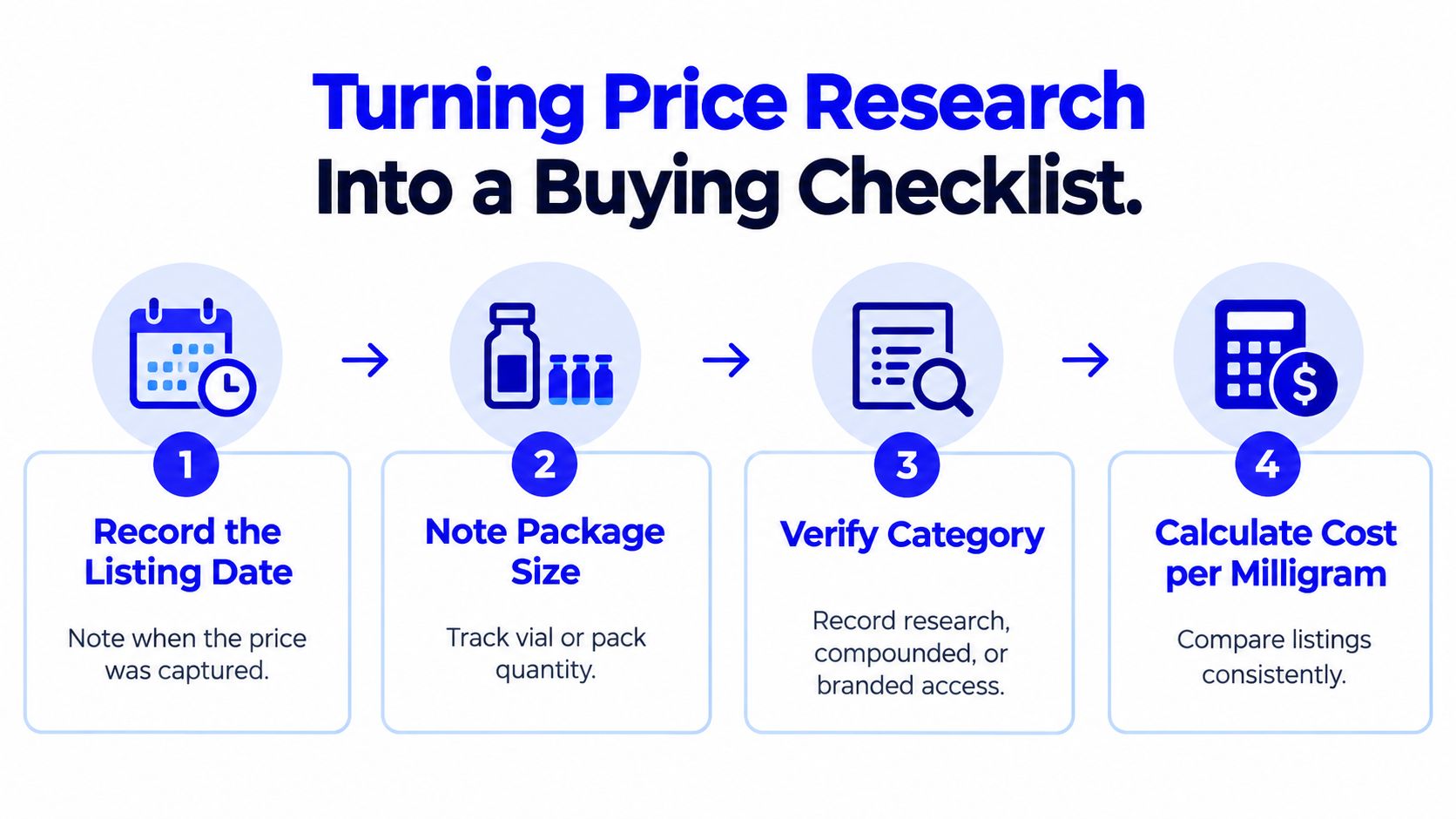
Capture the listing. Record the review date, supplier, currency, package size, and applicable volume tier. Preserve the quotation or listing so the decision doesn't depend on a page that may later change.
Classify the channel. Mark the entry as research material, a compounded-access estimate, or branded supply. Don't rank unlike channels as interchangeable procurement options.
Calculate the normalized price. Divide the relevant material cost by the labeled quantity. Keep shipping and other charges visible rather than obscuring them within an unexplained unit figure.
Request lot-specific evidence. Obtain the applicable certificate of analysis and relevant independent reports. Record whether verification is complete, pending, or unavailable.
Confirm the complete order terms. Ask about package contents, lot allocation, dispatch arrangements, delivery charges, and order tracking. Have the supplier resolve discrepancies in writing.
Check the intended-use boundary. Confirm research-use labeling and review the purchase against institutional policy and the rules applicable to your jurisdiction. A disclaimer doesn't replace that review.
Write the selection rationale. Explain why the chosen quote fits the study, including any reason for accepting a higher price. Identify unresolved limitations rather than treating them as satisfied.
The final comparison should make uncertainty visible. A pending certificate and an independently verified report shouldn't receive the same status because both suppliers display a documentation badge.
The defensible purchase is the one you can explain. Your file should show what the laboratory needed, what the supplier offered, which evidence was checked, and why the total expenditure was reasonable.
If a quote remains incomplete, request the missing information before selecting it. That is a more reliable response than assuming either the lowest price is risky or the highest price is justified.
Peptide Warehouse USA offers U.S.-manufactured research peptides with certificates of analysis, microbial and endotoxin reports, and order tracking, providing an option to evaluate against this procurement checklist. Visit Peptide Warehouse USA to explore research-use options and review the available batch documentation before comparing a quotation with your laboratory's requirements. Its products are for research, laboratory, or analytical use only, not human consumption.