No products in the cart.

You're probably comparing peptide suppliers with a real deadline hanging over you. A study is scheduled, reagents are allocated, and the peptide that looked interchangeable on paper suddenly isn't. One lot arrives with clean documentation. Another arrives with a generic COA, no clear lot match, and no way to confirm whether the vial in your hand is the same material shown in the report.
That's where most buyer guides fall short. They focus on purity claims, catalog size, or price, but they miss the harder questions that affect reproducibility: Who verified the batch? Does the COA trace to the lot label? Is the supplier operating inside the limits of research-use compliance, or leaning on language that creates risk later?
The peptide market is big enough now that casual sourcing has become expensive. The global peptide therapeutics market reached USD 140.9 billion in 2025 and is projected to expand to USD 294.6 billion by 2033, while semaglutide and tirzepatide alone generated about $70 billion in combined global sales in 2025 according to Grand View Research's peptide therapeutics market analysis. That scale attracts serious manufacturers, but it also attracts inconsistent documentation, copied testing language, and confusion between research-grade sourcing and regulated patient-use channels.
This guide looks at top peptide companies through a stricter lens. You'll get an anonymized comparison matrix, a practical framework for vendor review, and a clear checklist for procurement teams that need traceability, not marketing.
A research team places a routine peptide order to keep a study on schedule. The vial arrives on time, the purity number looks acceptable, and the product page matches the sequence requested. Two days later, the delay starts. The COA does not clearly tie to the lot on the label, the chromatogram lacks enough context to verify who ran the test, and support replies with generic language instead of batch-specific answers.
The market for peptide synthesis is no longer small. In the specialized sector of peptide synthesis and manufacturing, the market was valued at USD 3.8 billion in 2025 and is forecast to reach USD 7.0 billion by 2035, growing at a 5.2% CAGR from 2026 to 2035 according to Roots Analysis on peptide therapeutics manufacturing.

Market growth expands choice, but it also increases variance in documentation quality, testing discipline, and sourcing controls. A larger supplier field makes polished storefronts easier to confuse with controlled operations. Procurement teams in other fragmented categories face the same pattern, which is why frameworks that optimize your marketplace presence can also improve how buyers compare peptide vendors.
Procurement failures usually look administrative before they look scientific.
A batch may still be usable, yet create uncertainty at each checkpoint. The paperwork is incomplete. Storage history is vague. Import declarations or handling details are missing. None of those issues changes the peptide sequence, but each one weakens the audit trail your lab may need later if results are questioned, a batch behaves inconsistently, or a reorder arrives with different performance.
Practical rule: If your team has to rely on seller reassurance where lot-level records should answer the question, the vendor review process is too weak.
Manufacturing methods have improved as the category has scaled. As noted earlier in the same Roots Analysis report, faster synthesis techniques and higher crude purity have made production more accessible for research-grade supply. That lowers barriers to making peptides. It does not lower the risk created by weak release controls, incomplete third-party verification, or poor chain-of-custody records.
Many buyers can source a target sequence. The more useful comparison is whether the vendor can prove how that material was tested, handled, and documented after synthesis.
Often, hidden compliance risk emerges. A supplier may advertise high purity while omitting details that matter more during review: whether the batch record is traceable, whether the COA reflects the lot being sold, whether testing was internal or independent, and whether shipping conditions match the peptide's stability requirements. These gaps do not always show up on a product page, but they affect reproducibility, reordering confidence, and the defensibility of your procurement decision.
A stronger evaluation asks four direct questions:
Reliable peptide procurement protects more than a single order. It reduces avoidable repeat testing, limits sourcing risk that hides behind acceptable purity numbers, and gives the lab a documented basis for approving one vendor over another.
A common procurement failure starts after a lab approves a peptide that looks acceptable on paper. The product page shows high purity, the COA appears polished, and the price clears budget review. Then intake raises questions the supplier cannot answer cleanly: who ran the testing, whether the documents match the shipped lot, whether storage conditions were controlled, and whether the material was imported or relabeled in a way that weakens traceability.
Those problems rarely appear in headline purity claims. They show up in the supplier's process.
For research-grade peptides in 2026, a stronger baseline is dual verification, meaning HPLC purity data plus mass spectrometry confirmation of molecular identity, documented on a lot-specific COA from an ISO 17025-accredited third-party lab according to FormBlends' guidance on peptide company standards.
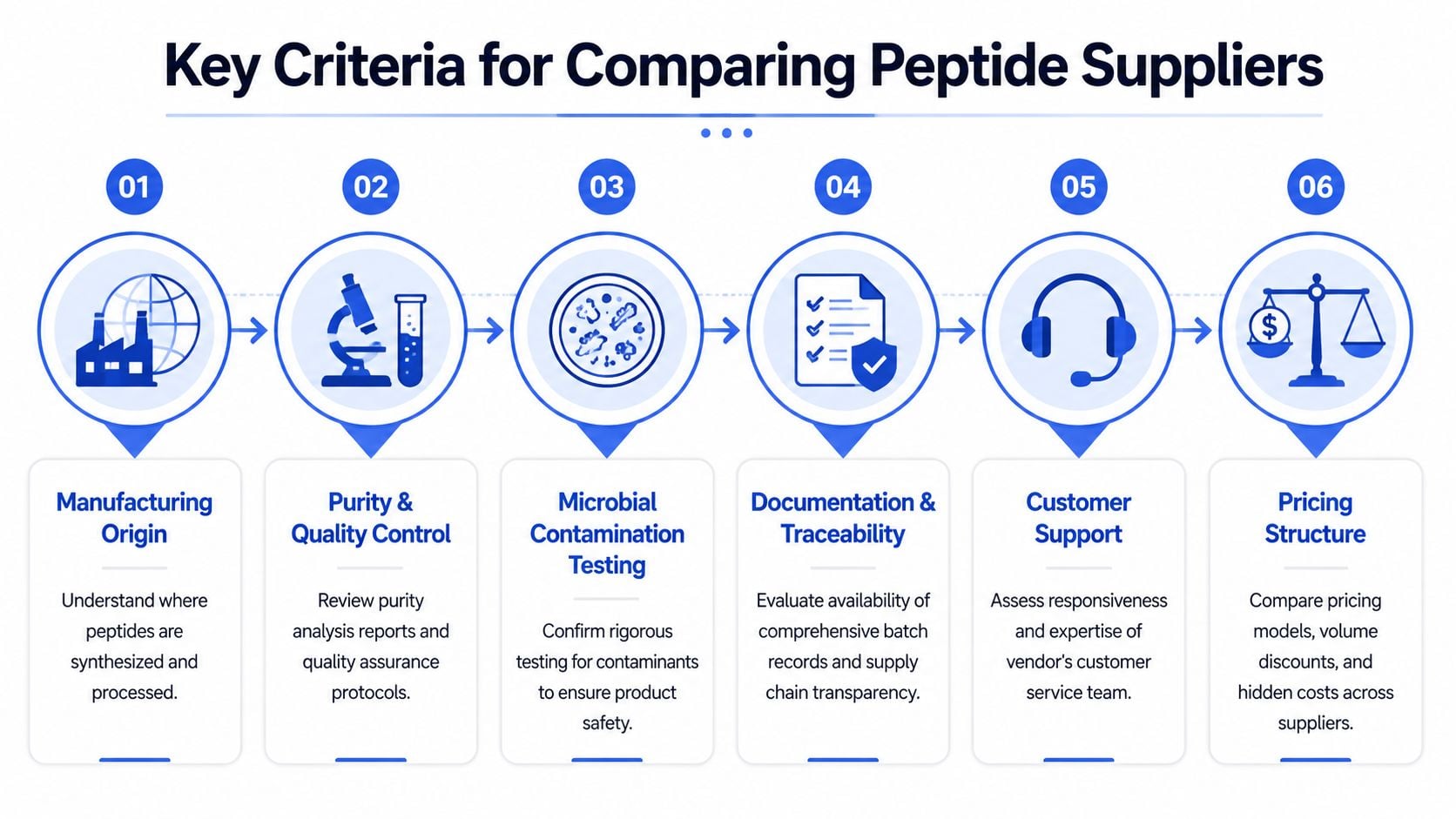
A supplier review gets sharper when each document answers a specific risk question. Purity data addresses composition. Identity data addresses whether the compound is the stated sequence. Accreditation and lot matching address whether the evidence can support a purchasing decision if the batch is questioned later.
Use four checks:
Lot-specific COA
Request the COA for the exact lot being sold. A sample report or undated template has limited value.
Independent HPLC and MS data
HPLC alone does not confirm identity. MS or LC-MS closes that gap.
Accreditation details for the testing lab
ISO 17025 does not remove all risk, but it gives buyers a clearer basis for comparing testing practices and document control.
Visible lot traceability across records
The lot number on the vial, label, COA, and any supplemental report should align exactly.
The hidden compliance issue is often not missing data. It is mismatched data. A vendor may provide a valid COA, but if the lot number, test date, or product naming format does not line up with the shipped material, the file becomes much harder to defend during internal review.
After you review documents, it helps to see the workflow visually.
Many buyers group these together. They should not.
A peptide can test well and still come from a supplier with weak sourcing controls. That risk is higher when a company resells imported material, relabels bulk inventory, or gives little visibility into where synthesis ended and domestic fulfillment began. None of those facts automatically disqualify a vendor. They do change the level of documentation a careful buyer should request.
A practical review looks at both dimensions:
| Criterion | What to check | Why it matters |
|---|---|---|
| Analytical verification | Presence of independent purity and identity testing | Confirms the material matches the supplier's claim |
| Lot traceability | Exact match across label, COA, and support records | Reduces relabeling and documentation risk |
| Supply chain clarity | Whether the vendor discloses synthesis origin, testing location, and fulfillment model | Exposes gaps hidden by domestic branding |
| Storage and shipping control | Packaging method, temperature protection, and handling instructions | Poor handling can affect material quality before receipt |
| Contamination support | Availability of endotoxin or microbial reports where relevant | Helps labs with stricter intake or downstream screening requirements |
| Support quality | Direct, specific answers to technical questions | Evasive responses often signal weak internal controls |
| Price context | Whether lower pricing reflects scale, lower overhead, or reduced testing depth | Prevents false savings that create rework later |
This is the point many comparison guides miss. Purity is an output. Procurement risk sits in the chain of custody behind it.
One factual example is Peptide Warehouse USA, which states that each lot is supported by third-party COAs plus microbial and endotoxin reports for research, laboratory, and analytical use. That does not settle the vendor review by itself, but it gives buyers more than a marketing purity figure to compare.
A useful supplier scorecard should therefore rate vendors across three separate questions: whether the peptide tested well, whether the records are defensible, and whether the sourcing path is clear enough to survive internal scrutiny. Suppliers that score well on only the first question often look stronger online than they do in procurement.
A lab receives two peptide orders with similar purity claims. One clears intake in minutes because the lot number, COA, and identity data align cleanly. The other stalls because the paperwork is generic, the testing lab is unclear, and no one can confirm where synthesis ended and resale began.
That gap is what a useful supplier comparison should measure.
The matrix below compares seven supplier profiles on documentation quality, sourcing transparency, and intake risk. The names are anonymized because procurement teams need a decision tool, not another popularity ranking. As noted earlier, stronger vendors usually show batch purity and identity with separate methods, but the larger difference often sits in traceability and disclosure discipline.
| Supplier | Origin | Purity | COA Testing | Endotoxin Testing | Pricing Tier | Support Rating |
|---|---|---|---|---|---|---|
| Supplier A | U.S.-based manufacturing | Dual-verified, high stated purity | Lot-specific HPLC + LC-MS from independent lab | Available on request or by lot | Premium | Strong |
| Supplier B | U.S.-based fulfillment, outsourced synthesis | HPLC-forward with identity support | Batch COA present, identity confirmation less visible | Limited visibility | Mid | Moderate |
| Supplier C | International synthesis, domestic resale | Purity emphasized in marketing | COA available, traceability inconsistent | Not clearly disclosed | Budget | Moderate |
| Supplier D | U.S.-based small-batch operation | Dual-verified, lot matched | Independent HPLC + LC-MS, clear lot labeling | Available for stricter procurement workflows | Mid to premium | Strong |
| Supplier E | Mixed sourcing model | High stated purity | Documentation varies by product family | Not consistently shown | Budget to mid | Variable |
| Supplier F | Custom synthesis oriented | Strong documentation depth | Batch-specific HPLC + identity confirmation, technical support available | More likely available for custom work | Premium | Strong |
| Supplier G | High-volume catalog reseller | Purity claims prominent | Generic or representative reports more common | Rarely highlighted | Budget | Fast but shallow |
Supplier A, D, and F perform well for a reason that does not show up in a headline purity figure. Their records appear built for review by someone other than the seller. Lot numbers match. Identity confirmation is visible. Testing appears tied to a specific batch rather than to a product template.
That matters because hidden compliance problems rarely begin with a failed assay. They begin with an intake question the supplier cannot answer clearly.
Supplier C and G show a common risk pattern in lower-cost channels. The offer looks simple, the catalog is broad, and the main quality claim is easy to compare. But if the synthesis origin, testing location, or report specificity stays vague, the buyer inherits the verification work. For internal research teams, that can erase the savings from a lower unit price.
Supplier B and E sit in the middle. These profiles may be workable for less sensitive procurement, but their mixed disclosure model creates inconsistency. One product family may have solid records while another relies on thinner documentation. That is a sourcing risk in itself, because approval times become unpredictable.
A practical reading of the matrix looks like this:
Price should be read the same way. A lower quote can still be the expensive option if your team has to chase missing lot data, re-review substitute paperwork, or quarantine material until questions are resolved. If you're trying to understand true peptide value, compare the labor cost of documentation review alongside the vial price.
One useful signal is response precision.
Ask three direct questions: Is the COA lot-specific? Was identity confirmation run on that lot? Who performed the testing? Strong suppliers usually answer each point in one sentence. Weaker suppliers often respond with general quality language, which is often a sign that compliance controls are thinner than the site presentation suggests.
This is also where a factual mention such as Peptide Warehouse USA can be useful in a broader article context. A vendor that states it provides third-party COAs plus microbial and endotoxin reporting gives buyers a clearer basis for comparison than a purity claim alone. The relevant test is still consistency across lots, disclosures, and support responses.
The main conclusion is simple. The best supplier profile is not the one with the strongest headline. It is the one that can withstand procurement review without forcing the buyer to fill in missing parts of the chain of custody.
The biggest mistake buyers make is assuming that high purity settles the question. It doesn't.
People frequently ask how to distinguish between research-grade and compounded-pharmacy-grade peptides for personal use, but published discussion rarely explains the legal and safety implications clearly, as noted in this analysis of peptide company trust and compliance. That confusion spills back into research procurement because some vendors use quality language that sounds regulatory without placing the product in a regulated patient-use channel.
A peptide can be well-tested and still be sold only for research use. Those are separate issues.
If a supplier is a research chemical vendor, third-party COAs do not convert that product into an FDA-approved human-use product. Buyers who miss that distinction may think they are evaluating only quality, when they're also stepping into a legal and category-definition problem.
Red flags in this area include:
You can learn a lot from how a vendor answers ordinary questions.
Use this screening list before purchase:
If a vendor can't explain its own documents in plain language, your procurement team shouldn't have to explain them for the vendor.
A polished storefront can hide a thin operation. In peptide sourcing, weak traceability often shows up before weak chemistry does.
Different labs don't need the same supplier profile. The right fit depends on where your project carries risk.
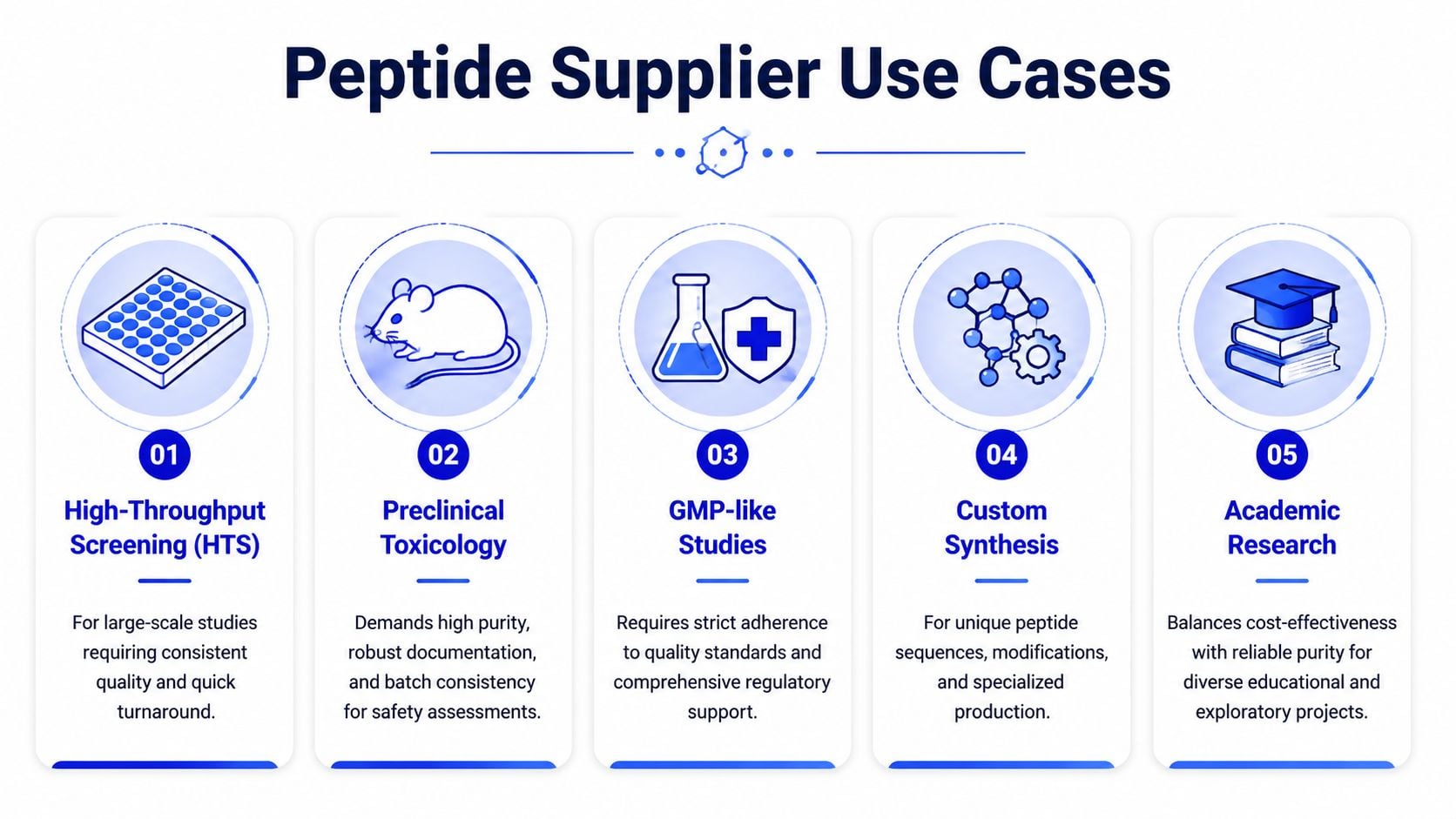
A key rule here is that GMP certification is only the baseline. What separates stronger vendors is post-certification performance, including batch-specific testing, documented traceability, and cold-chain logistics, as explained in All About Peptides on top peptide suppliers.
An early-stage screening workflow often values quick access, broad availability, and decent documentation that can pass internal intake without a long back-and-forth.
In that setting, the best fit is usually a supplier profile like Supplier B or Supplier G from the matrix. These vendors tend to move quickly and keep ordering friction low. The tradeoff is that your team may need to accept lighter documentation or follow up for deeper records.
This works when the research question is exploratory and the lab can tolerate more vendor variability.
Preclinical work and tightly controlled internal studies need more than "good enough" paperwork.
For those cases, Supplier A, Supplier D, or Supplier F are better fits because they align with the practical demands that matter after delivery:
Academic buyers often sit in the middle. They need value, but they also need enough documentation to keep a principal investigator or procurement office comfortable. For that environment, mid-tier suppliers with clear lot matching and accessible support usually offer the best balance.
Custom synthesis is its own category. Labs ordering unique sequences should favor vendors that can discuss sequence verification, modifications, and release documentation clearly. Catalog breadth isn't the priority there. Communication quality is.
The cleanest procurement systems use a short checklist before every new supplier approval and before every reorder. That keeps the process consistent even when staff changes or product lines expand.
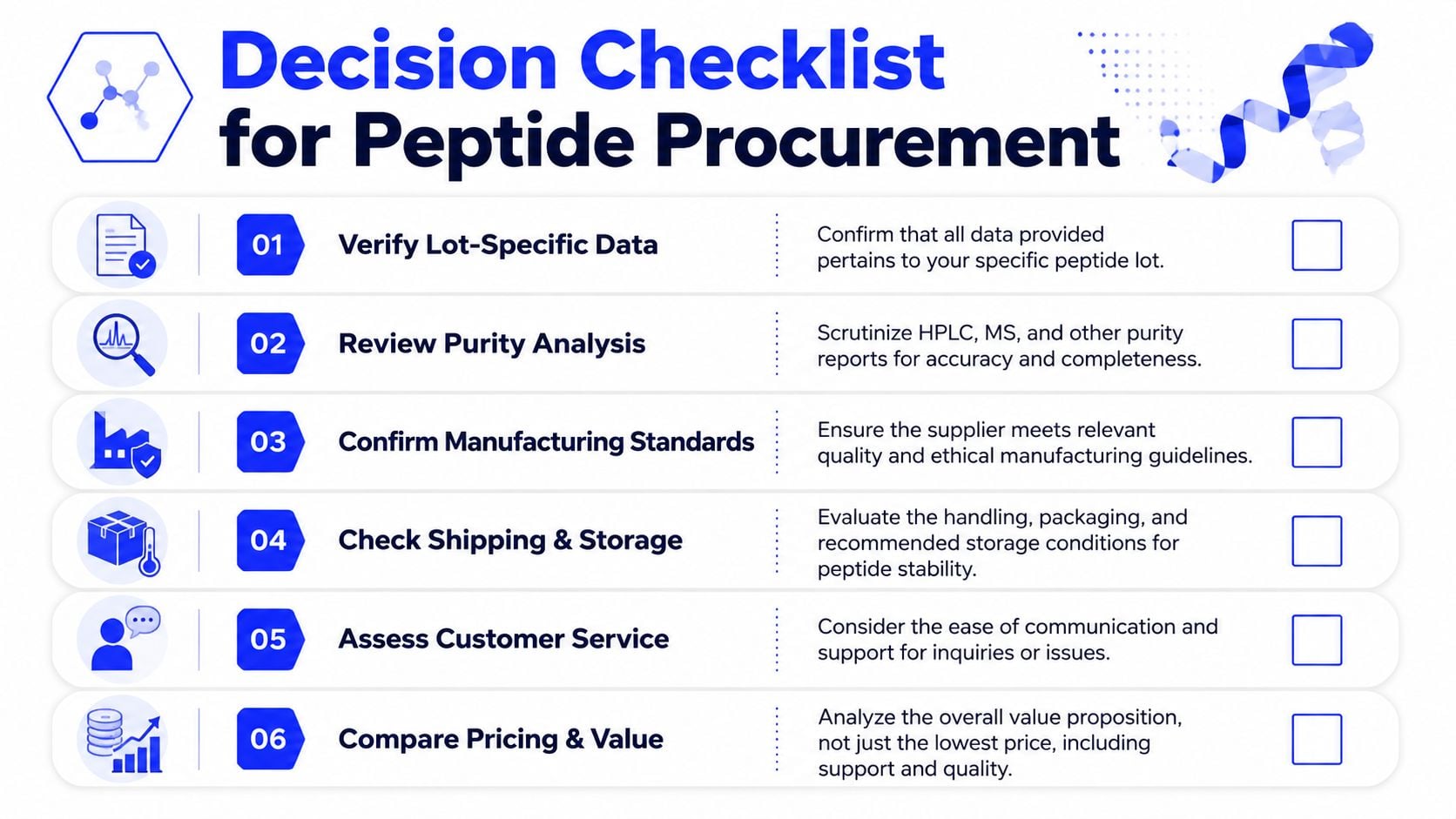
Use this list before you place the order:
The second order is where supplier discipline becomes visible.
Look for continuity, not just availability:
| Reorder check | What good looks like |
|---|---|
| Documentation consistency | Same testing depth and formatting across lots |
| Lot traceability | No ambiguity between product label and COA |
| Support quality | Direct answers without repeated escalation |
| Handling confidence | Clear packaging and storage instructions |
| Value | Price still makes sense after documentation and support are considered |
The top peptide companies aren't just the ones with attractive purity claims. They're the suppliers that make validation easy, maintain traceability from batch to batch, and avoid category confusion that creates risk later. That's what protects experiments, internal approvals, and long-term sourcing confidence.
If you're reviewing suppliers and want a research-use option with U.S.-made sourcing, lot-based documentation, and clear category positioning, learn more at Peptide Warehouse USA. Explore options carefully, compare COA depth against traceability, and treat procurement as part of research quality, not a separate admin task.