No products in the cart.



If you've seen claims about a transdermal BPC-157 cream or patch, the first thing to challenge is the assumption that anything placed on skin automatically reaches the bloodstream. That shortcut confuses topical use with transdermal delivery, and for a peptide this large, that difference decides whether a product is a local formulation or a systemic delivery system.
Transdermal BPC-157 is best understood as an active-delivery problem, not a simple skin-product question. The four takeaways that matter are the size barrier, the preclinical-only evidence, the formulation gap, and the regulatory ceiling. Once those are clear, the rest of the conversation gets much easier to evaluate.
A cream on the skin can do two very different things. It can act locally, where it's applied, or it can try to move a compound through intact skin and into systemic circulation. Those are not interchangeable outcomes, even if the packaging uses the same word.
A useful way to think about it is a passport stamp. The stamp proves where someone entered, not what they were allowed to do inside the country. In the same way, a topical application proves contact with skin, not delivery into blood or tissue at a meaningful dose.
For BPC-157, that distinction matters because the molecule is large, the available evidence is early, and the regulatory position is still restrictive. The practical questions are simple, even if the science is not: can it cross skin, what was tested, what formulation was used, and what evidence exists in people?
Practical rule: if a product page says “topical” or “transdermal,” read those as two separate claims until the formulation data proves otherwise.
Many buyers assume a patch, gel, or spray is automatically transdermal. In peptide research, that's a risky assumption because route of administration changes everything about exposure, absorption, and interpretation.
The rest of this topic turns on one question, did the peptide just touch skin, or did it cross it?
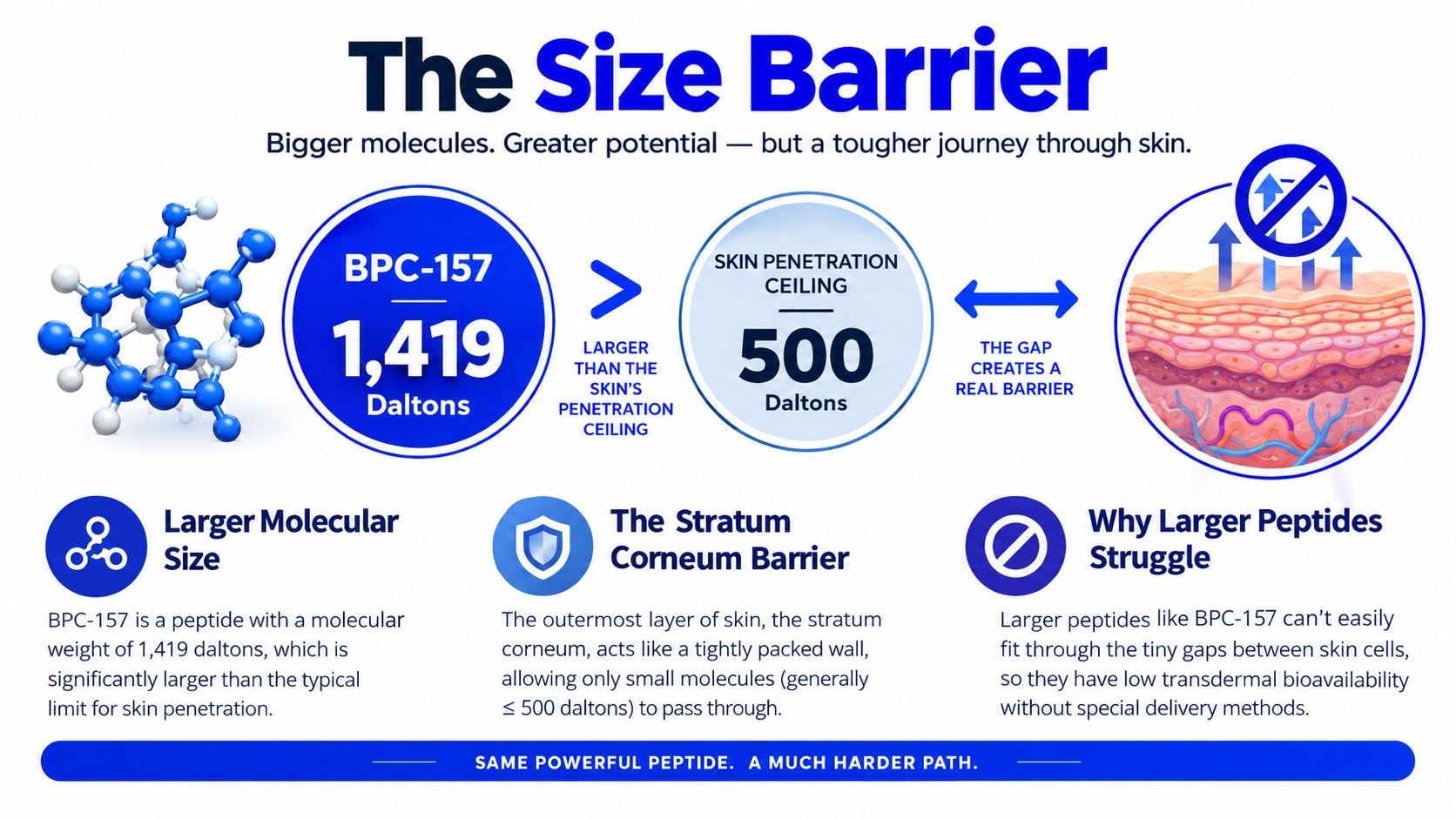
The barrier is physical first. BPC-157 is approximately 1,419 daltons, far above the commonly cited 500-dalton guideline for passive skin permeation, so routine diffusion through intact stratum corneum is unlikely (MDPI review). Skin is not a sponge. The outer layer works more like a selective sieve, and large peptides usually do not pass because they were placed in a cream or gel.
Size matters more than packaging here. A compact molecule may sometimes cross if the formulation is favorable. A 1,419-Da peptide sits in a different permeation class, so formulation polish cannot compensate for the size mismatch.
That is why transdermal BPC-157 should prompt a delivery question, not a marketing assumption. If a product claims systemic exposure, the evidence has to show how the peptide crossed intact skin and how much reached the target compartment.
A researcher should ask four concrete questions:
Without those measurements, “absorbed” remains a label claim, not a demonstrated outcome.
The animal literature does exist, but it needs careful reading. These studies focused on local injury models, not intact-skin systemic delivery, so the results speak to wound repair inside a controlled injury, not to routine absorption through normal human skin.
One rat alkali-burn model used topical BPC-157 at 200 to 800 nanograms per milliliter twice daily for 18 days, and researchers reported changes in wound closure, granulation tissue, re-epithelialization, and dermal remodeling. A separate mouse thermal-burn model used a vehicle containing 1 microgram per gram of BPC-157 (PMC review).
These protocols describe local wound response under laboratory conditions. They do not show that a topical consumer patch on intact human skin produces the same tissue exposure or the same outcome.
That distinction matters because burn models use highly controlled injuries, animal skin is not human skin, and application to damaged tissue is different from passive movement across intact skin. The evidence is useful as a research signal, but it does not establish human transdermal efficacy.
A local wound result is not the same as a systemic delivery result.
Some of the summarized animal work involved small groups, which makes overreading the findings easy. These studies answer a narrower question than most product pages imply, and the narrower question is whether topical BPC-157 can influence healing in a specific injured model.
It supports cautious hypothesis generation around:
It does not support claims of proven human absorption, generalized healing, or system-wide benefits from an ordinary topical product.
If a developer wants a peptide this size to cross skin, passive diffusion is usually not enough. Reviews point to four active enhancement platforms that could, in theory, help peptides move across intact skin: microneedle arrays, iontophoresis, sonophoresis, and chemical permeation enhancers (PMC review).
Microneedles make tiny controlled channels in the stratum corneum. Iontophoresis uses a mild electrical current to encourage movement of charged compounds. Sonophoresis uses ultrasound to increase permeability. Chemical permeation enhancers alter the skin barrier so more material can pass through.
| Method | Mechanism | BPC-157 Evidence |
|---|---|---|
| Microneedle arrays | Creates microchannels through the barrier | No peer-reviewed BPC-157 transdermal flux or bioavailability data |
| Iontophoresis | Uses electrical current to assist transport | No peer-reviewed BPC-157 transdermal flux or bioavailability data |
| Sonophoresis | Uses ultrasound to increase permeability | No peer-reviewed BPC-157 transdermal flux or bioavailability data |
| Chemical permeation enhancers | Alters the skin barrier chemically | No peer-reviewed BPC-157 transdermal flux or bioavailability data |
The critical point is not that these methods are impossible. It's that published analyses report no established BPC-157 transdermal flux, delivered dose, skin-reservoir behavior, systemic bioavailability, or pharmacokinetics for any of them (PMC review).
If you're reviewing a protocol or a supplier claim, that absence matters more than the platform name. A method can sound advanced and still fail to prove actual delivery.
For a general primer on skin-based device concepts, researchers often use educational resources such as ProMD Health Bethesda experts to understand how microneedling changes the barrier, but that still isn't BPC-157-specific evidence.
A serious transdermal claim needs laboratory proof, not a label. The minimum standard starts with Franz diffusion-cell testing and a full mass balance across donor, skin, and receptor compartments (academic review).
Then the assay has to confirm the intact peptide, not just fragments. LC-MS/MS is the right kind of tool for that job because it can verify identity after permeation instead of assuming anything that appears in a signal trace is still the active sequence.
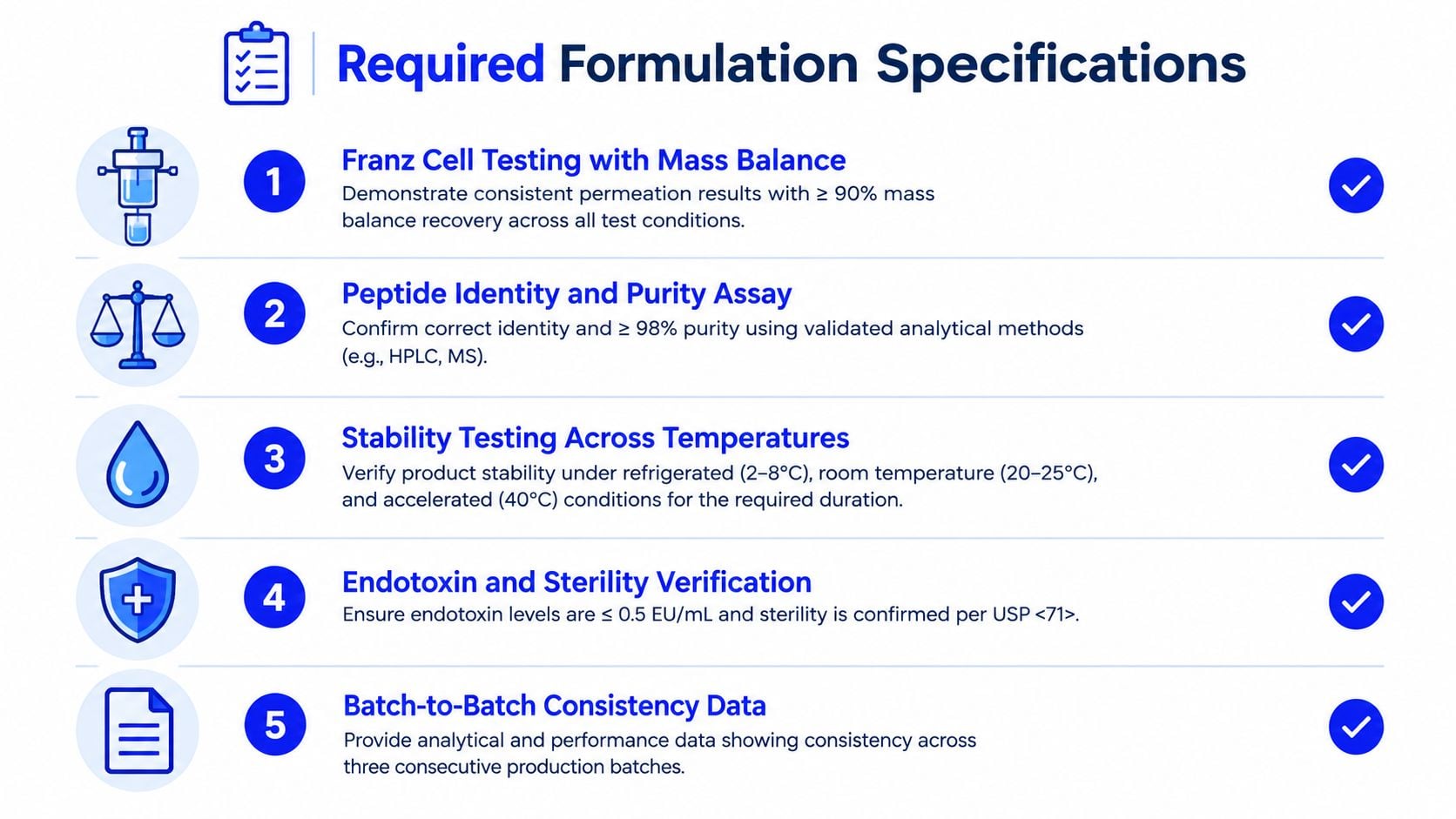
A product can look stable on paper and still fail in practice. If the peptide degrades in the vehicle, adsorbs to the container, or fragments during permeation, the label claim no longer matches the chemistry.
Researchers should push the conversation away from marketing language and toward measurable endpoints. If the vendor can't show them, the transdermal claim is still just a claim.
A wound-healing effect in animals does not automatically mean a human systemic delivery effect. That gap is the main error behind many consumer claims, especially when a product is described as a transdermal BPC-157 solution.
Preclinical pharmacokinetics help show why. Formal work in rats and beagle dogs found a plasma half-life of less than 30 minutes, with intramuscular bioavailability of 14% to 19% in rats and 45% to 51% in beagle dogs. Those figures come from non-transdermal settings, so they do not tell you what happens after skin application.
Treat “absorption” as a measurement claim. Without formulation-specific flux data, the word says nothing about whether the peptide crossed skin, stayed in skin, or degraded before it mattered.
Claims about systemic healing, fat-loss delivery, anti-aging effects, or muscle-growth delivery from a passive topical product should stay in the hypothesis category until human evidence is available.
Practical rule: if a claim depends on blood exposure, it needs blood data, not just a product description.
When you see “topical,” ask whether the claim is:
That filter keeps local skin effects separate from true skin-to-blood delivery. It also prevents a lab from treating an interesting wound model as proof of a validated transdermal route.
The regulatory picture is still narrow. A recent FDA review reports no human studies administering BPC-157 through a transdermal route, and says BPC-157 is not an ingredient in an approved product in any country (FDA review). Other clinical summaries describe it as an experimental compound, which matches the broader pattern that most of the evidence remains preclinical.
That matters for procurement because the route on the label should match the route in the data. If a supplier is selling a research-use material, ask for the Certificate of Analysis, the batch or lot number, the assay method behind any purity claim, and the date of the report. A third-party purity report is more useful than a marketing statement because it lets you see who measured what, and whether the numbers refer to the actual lot being shipped.
A laboratory or analytical use only designation should be explicit. If the documentation is vague about intended use, the burden shifts back to the buyer to verify how the material is meant to be handled.
Peptide Warehouse USA is one example of a research-use supplier that positions its catalog around documented lots and lab-only use, so it fits the kind of sourcing review researchers should perform. Before ordering, confirm the batch documentation is current, the lot identifier matches the vial, and any purity or identity claim is tied to the exact product you will receive.
The safest purchase decision matches the evidence level, not the sales page.
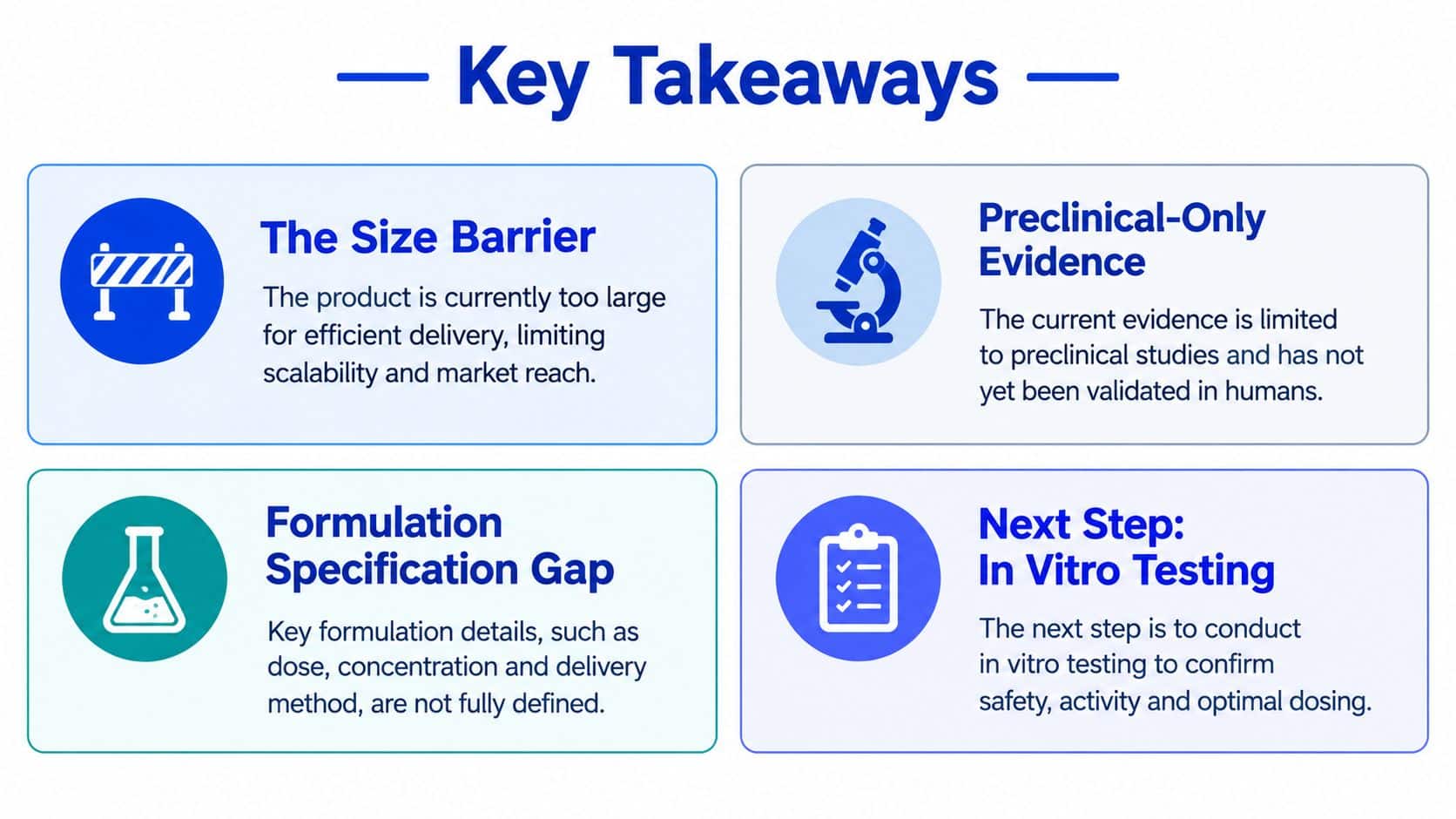
The practical issue is route verification. A skin-applied peptide can show local activity without proving transdermal delivery, so the next request to a vendor should focus on evidence, not wording. Ask for a Certificate of Analysis, the exact lot number, the analytical method behind any identity or purity claim, and a dated report tied to the vial you will receive.
A useful submission package should also include Franz-cell outputs, mass balance, skin deposition, and intact-peptide confirmation by LC-MS/MS. If the report cannot show those elements, treat the product as an unverified topical material rather than a demonstrated transdermal system.
For a passing packet, the sample format matters too. Request the raw files or clearly labeled summaries, the vehicle composition, and the stability condition used for the finished formulation. A lab that can provide those items gives researchers a cleaner basis for deciding whether the material fits a topical screen or a true delivery study.
Peptide Warehouse USA is one research-use supplier that presents batch documentation and lab-only positioning, so it can be part of that sourcing review.