No products in the cart.


What does KPV peptide do, exactly? In research settings, it acts like a tiny but highly targeted anti-inflammatory signal, and that's what makes it interesting to lab buyers who want a peptide with a clear mechanism instead of a vague wellness story. KPV is a tripeptide made from lysine, proline, and valine, and its relevance comes from how it behaves in intestinal, epithelial, and immune models rather than from any broad cosmetic or anabolic promise (KPV structure overview).
That matters because many people hear “peptide” and assume the effect must be large to matter. KPV is the opposite, a very small fragment that researchers study for how it enters cells, interrupts inflammatory signaling, and shows up in colitis and barrier-focused models. If you're comparing peptides as a buyer or a bench researcher, this guide will help you separate structure from mechanism, and mechanism from overstatement.
If you want a broader look at how peptide choices are discussed across use cases, peptide treatments for joint pain is a useful companion read because it shows how buyers often compare peptide categories before they narrow down a research target.
KPV peptide is studied for anti-inflammatory activity, especially in gut and epithelial models, where researchers look at how it affects intracellular inflammatory pathways after uptake into cells. It's not being studied as an anabolic, a pigmenting agent, or an approved human drug. It's a small research fragment that gives scientists a cleaner way to ask whether the C-terminal end of alpha-MSH still carries meaningful biological activity.
A helpful way to think about KPV is that it answers a narrower question than alpha-MSH does. Alpha-MSH has a wider biological footprint, while KPV lets researchers isolate a short sequence and see whether that three-amino-acid piece is enough to change inflammatory signaling. That makes it attractive in bench work where you want a simple compound with a mechanistic readout, not a broad, multi-effect hormone.
Practical rule: If a peptide's main value is mechanism, not spectacle, KPV is the kind of molecule researchers use to test pathway logic.
Readers often ask what does KPV peptide do because the name sounds too small to be meaningful. In practice, that small size is the point, and it helps explain why KPV keeps showing up in barrier repair and inflammation-control discussions. A solid overview of downstream wound-repair thinking is also useful, especially when comparing peptide classes, and the stages of wound healing resource gives that context without turning KPV into a clinical promise.
KPV is a tripeptide made of three amino acids, lysine, proline, and valine. It is the C-terminal fragment of alpha-MSH, which means it comes from the tail end of a larger hormone rather than existing as a completely separate molecule. That structural fact is one reason researchers pay attention to it, because a very short sequence can still preserve a measurable biological signal. KPV structure fact
KPV represents the smaller end fragment of alpha-MSH, while the parent peptide carries a wider set of functions, including anti-inflammatory, antimicrobial, and fever-reducing effects. Researchers studied KPV after alpha-MSH investigations and asked whether the shorter fragment kept the anti-inflammatory side of that biology while shedding sequence features tied to melanocortin receptor binding and pigmentation-related effects. The result is a peptide that is treated as a focused research tool rather than a general alpha-MSH substitute.
The value of KPV is not only its size. A smaller peptide can be easier to interpret in cell systems, because receptor binding, transporter entry, and downstream signaling can be separated more cleanly than with a larger parent molecule. In practice, that makes KPV useful for mechanism mapping, especially when the question is whether anti-inflammatory behavior survives in a minimal sequence.
KPV's research value comes from what it keeps, not from what it leaves behind.
A later review also framed KPV as retaining anti-inflammatory properties while lacking the melanocortin receptor sequence linked to pigmentation effects, which is why it continues to attract interest as a cleaner experimental probe rather than a broad hormone analog. That structural simplification is the bridge to the next question, how such a tiny peptide can still influence intracellular signaling.
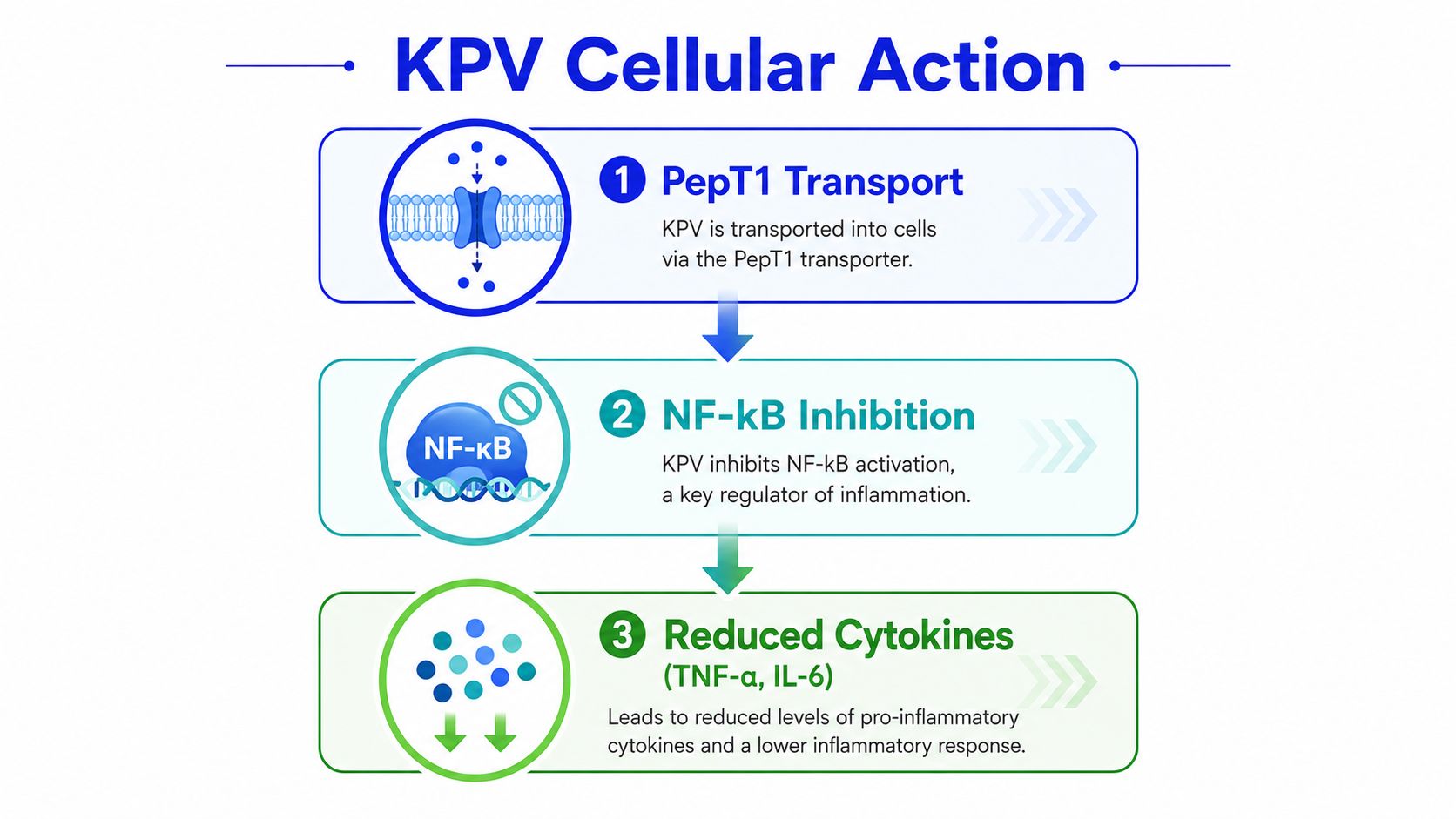
KPV does not need to be a large molecule to matter if it can get into the right cells and change the right pathways. In intestinal models, KPV shows nanomolar-range anti-inflammatory activity, inhibits NF-kB and MAP kinase signaling, and reduces secretion of TNF-alpha, IL-1 beta, and IL-6 after PepT1-mediated uptake (intestinal model data). That sequence is the core of the mechanism. First the peptide gets in, then it alters signaling, then the cytokine output changes.
PepT1 is a peptide transporter found in immune and intestinal epithelial cells, and one body of work concluded that KPV uses that transporter to enter cells. That's important because transporter expression can determine which tissues are sensitive to the peptide during inflammation. If PepT1 isn't available, the cell may not see the same effect, which is why KPV isn't best understood as a floating signal. It's a signal with a route.
The intracellular part of the story matters just as much. Published work describes inhibition of NF-κB and MAP kinase pathways, along with disruption of p65RelA nuclear translocation in later inflammatory models. Those are upstream control points, so the lab readout isn't just “less inflammation” in a vague sense. It's a specific change in how inflammatory genes get turned on.
A bench team studying KPV usually looks for a few linked outcomes:
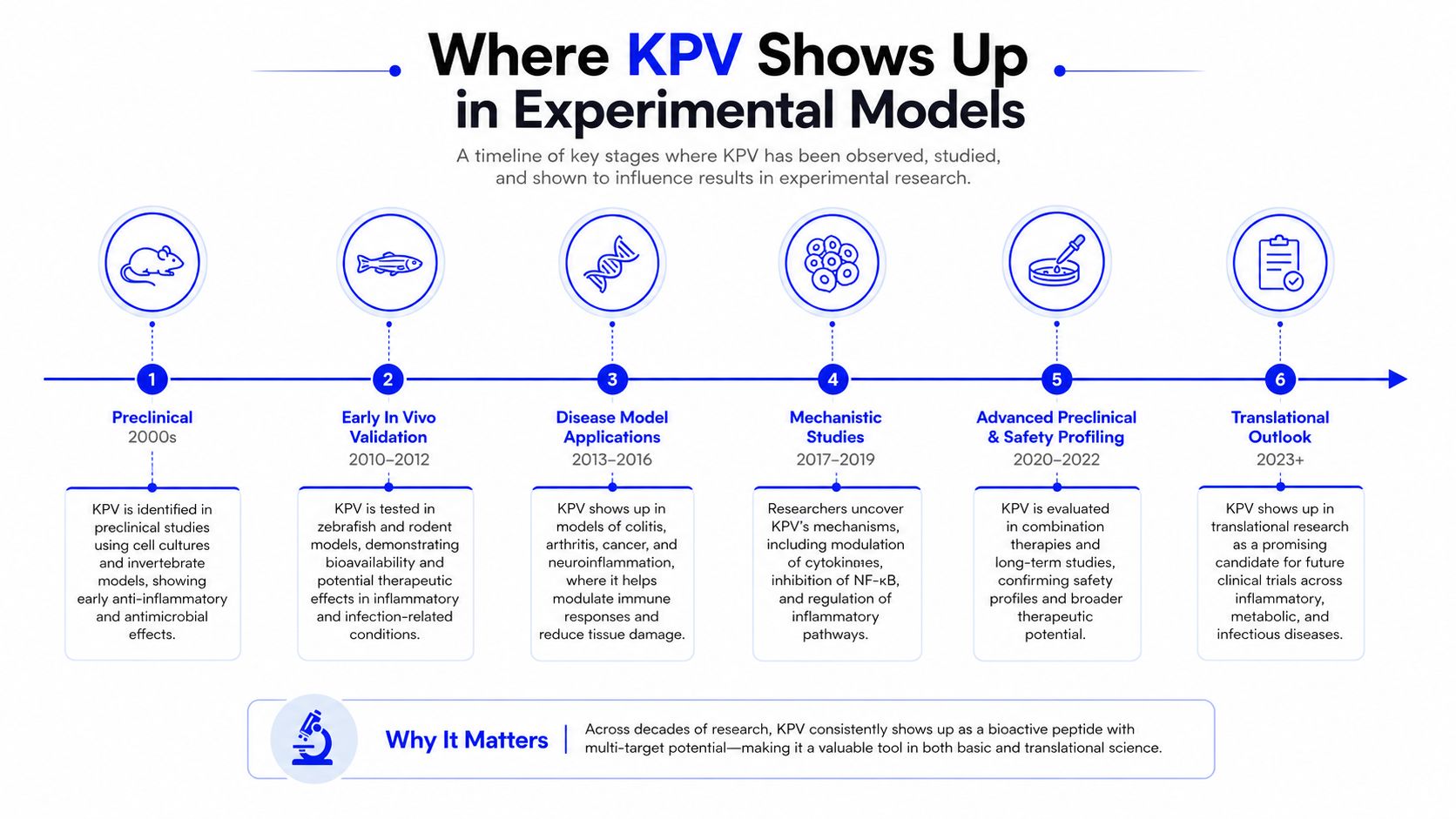
In a 2007 study, researchers reported that nanomolar concentrations of KPV inhibited those signaling pathways, reduced pro-inflammatory cytokine secretion, and lowered the incidence of DSS- and TNBS-induced colitis in animal models (2007 study). That matters because it links molecular mechanism to an in vivo result, not just a dish-based observation.
For lab work, the useful question isn't whether KPV sounds anti-inflammatory. It's whether the assay shows transporter entry, pathway inhibition, and a downstream cytokine change in the same direction.
What does KPV seem to do across the research literature, once the mechanism is separated from the hype? The clearest answer is that the peptide has three research pillars, but they are not equally developed. The strongest evidence sits in anti-inflammatory models, especially intestinal and epithelial systems. Wound healing and antimicrobial work are still part of the picture, yet they fit better as adjacent lines of inquiry than as fully established claims.
Here is a clearer way to compare them.
| Research Pillar | Typical Model | Primary Mechanism | Evidence Strength |
|---|---|---|---|
| Anti-inflammatory | Intestinal, epithelial, lung, and colitis models | PepT1 uptake, NF-kB and MAP kinase inhibition, cytokine reduction | Strongest |
| Wound healing | Barrier repair and epithelial regeneration models | Inflammation control that supports repair conditions | Emerging |
| Antimicrobial | Alpha-MSH related peptide discussions and broader peptide screens | Linked historically to the parent sequence, less central for KPV itself | Limited |
The anti-inflammatory pillar is the one researchers keep returning to because the path from mechanism to readout is the clearest. KPV is linked to specific signaling changes and to animal outcomes in gut models, so the question in bench work is not whether inflammation goes down. It is whether uptake, pathway inhibition, and downstream cytokine shifts all line up in the same assay system. A peptide this small matters because a short sequence can still sit at an upstream control point, much like a narrow valve can change the flow through a larger pipe.
In wound repair studies, the focus usually shifts to epithelial recovery and barrier support. That makes sense because the relevant readouts are often things like re-epithelialization, reduced inflammatory burden around the wound edge, and whether the tissue environment becomes more permissive for repair. For researchers, the practical question is whether KPV changes the inflammatory setting enough to support the stages of wound healing rather than whether it acts like a classic growth factor.
The antimicrobial connection is more historical than central. Alpha-MSH as a parent molecule has antimicrobial relevance, but KPV's research identity is driven mainly by inflammation control and barrier-focused work. That distinction matters for buyers and bench teams alike, because it keeps expectations aligned with the literature instead of folding every possible peptide effect into one label.
A simple way to keep the three pillars straight is this:
Where does a short tripeptide show up often enough to matter in bench work? KPV appears most often in models where inflammation and barrier stress overlap, because that is where a small peptide can reveal how uptake, transport, and downstream signaling fit together.
The clearest starting point is the gut, where DSS and TNBS colitis systems are used to probe inflammatory injury and recovery. In those settings, KPV's PepT1-dependent uptake matters because it shows that tissue response can depend on transporter expression, not just on how much peptide is present. That makes the model useful for asking why a tiny sequence can behave differently across tissues that look similar on paper but do not express the same transport machinery.
The 2007 animal work reported that oral KPV lowered the incidence of DSS- and TNBS-induced colitis and reduced inflammatory signaling in parallel (2007 study). For gut researchers, the point is not just that inflammation went down. It is that one small peptide linked a signaling shift to a disease-model shift in the same experimental system, which helps separate a mechanistic readout from a purely symptomatic one.
KPV also shows up in respiratory and epithelial inflammation work, including inflammatory lung disease models. Reviews and later studies described it as suppressing local and systemic immune responses and interfering with p65RelA nuclear translocation. That matters because lung models often test whether a treatment can calm inflammatory signaling in a tissue that is under constant environmental stress, and KPV gives researchers a way to ask whether the same pathway logic seen in the gut also appears in airway or epithelial settings.
KPV is also relevant in epithelial stress assays, where the question is whether the peptide changes how a barrier responds to injury, cytokine exposure, or disrupted cell layers. These models are useful because they let researchers separate transport behavior from gross tissue outcomes. A monolayer assay, for example, can show whether KPV changes inflammatory signaling or barrier integrity before any larger tissue response becomes visible.
Key measurements include NF-kB pathway readouts, epithelial recovery markers, permeability changes, and injury-associated cytokine signals. Those endpoints help show whether KPV is acting like a simple anti-inflammatory add-on or like a peptide that depends on the right transport context to produce a measurable effect.
KPV also appears in discussions of epithelial repair because its research identity sits close to barrier repair and inflammation control. That does not make it a universal healing compound. It means scientists look at it in systems where epithelial integrity, inflammatory tone, and transport biology overlap, which is exactly the kind of setup where a short peptide can be informative even if it is not broadly acting across every model.
The broader takeaway is straightforward. KPV is most useful where researchers want to study a small peptide in tissues that already express transport and inflammatory machinery. It is less useful as a generic peptide to apply across unrelated models and expect a broad response. That is why its strongest footprint stays in rodent and cell-based work, with the most informative readouts coming from models that combine epithelial stress, inflammatory signaling, and barrier function.
KPV is usually handled as a lyophilized powder, and that means the obvious storage rules still matter, even though the molecule is tiny. Keep it cool, dry, and away from light, then reconstitute it with a sterile aqueous diluent when you're ready to run the experiment. Small peptides can still be fragile, especially if they're exposed to moisture, repeated temperature swings, or careless pipetting.
A few habits help preserve consistency across runs:
Think of KPV like a precise reagent, not a rugged powder that can sit anywhere. A short peptide can still lose consistency if it's treated casually, and that can blur your downstream readouts in cytokine assays or inflammation models.
Bench rule: if the handling is sloppy, the mechanism can look weaker than it really is.
For procurement, researchers also pay attention to product documentation, expected purity claims, and how the supplier states storage and reconstitution guidance. Those details don't prove biology, but they do help a lab keep the material consistent enough to test biology well.
KPV is sold for research, laboratory, or analytical use only, and that is the right frame for evaluating it. Later reviews reported that it could show a stronger anti-inflammatory effect than alpha-MSH in some settings and could reduce colitis incidence in vivo, which is why it is treated as a preclinical peptide centered on barrier repair and inflammation control (review). That is a research signal, not a human-use claim.
A good supplier should make the following easy to verify:
Documentation matters because KPV is usually being bought to support a defined assay, not just to fill a vial. If a vendor cannot show how the lot was tested, the peptide may still look fine on paper while giving a lab uneven results in cell or animal work. That is why the purchase decision should follow the same logic used in mastering device validation, where the focus is on traceable inputs, repeatable checks, and records that support the intended workflow.
Peptide Warehouse USA is one research supplier that lists KPV-containing peptide products alongside COAs and batch documentation, which makes it a relevant option for labs that want traceable research material. The buyer's job is to verify the paperwork, match the product to the assay, and keep the use case firmly in the research lane.
If you are building a KPV workflow, start with a supplier that treats documentation, consistency, and research-only use as part of the product, not an afterthought. Peptide Warehouse USA offers research peptides for laboratory and analytical work, and you can visit Peptide Warehouse USA to review current options, documentation practices, and product details before you place an order.