No products in the cart.



You're in a supplier portal, a peptide catalog is open, and the RUO label is everywhere, on the page, the COA, maybe even the vial. That's where the confusion starts for a lot of researchers and buyers. What does Research Use Only mean is not just a labeling question, it's a compliance question about what the product is for, what it is not for, and what the label legally permits.
Research Use Only, or RUO, is a restriction on intended use. It does not mean a product is approved, validated, or safe for people. In FDA terms, RUO products sit in the laboratory research phase of development, and they are not represented as effective diagnostic products. The required labeling for many in-vitro diagnostic RUO products must prominently state, “For Research Use Only. Not for use in diagnostic procedures.” FDA's RUO overview makes that boundary clear.
A researcher looking at a peptide catalog can easily misread RUO as a quality stamp. It isn't one. The label tells you where the product sits in its development and what it cannot be sold as, especially when the product could otherwise be confused with a clinical tool. That's why RUO matters so much in procurement, because commercial presentation can look polished even when the legal lane stays narrow.
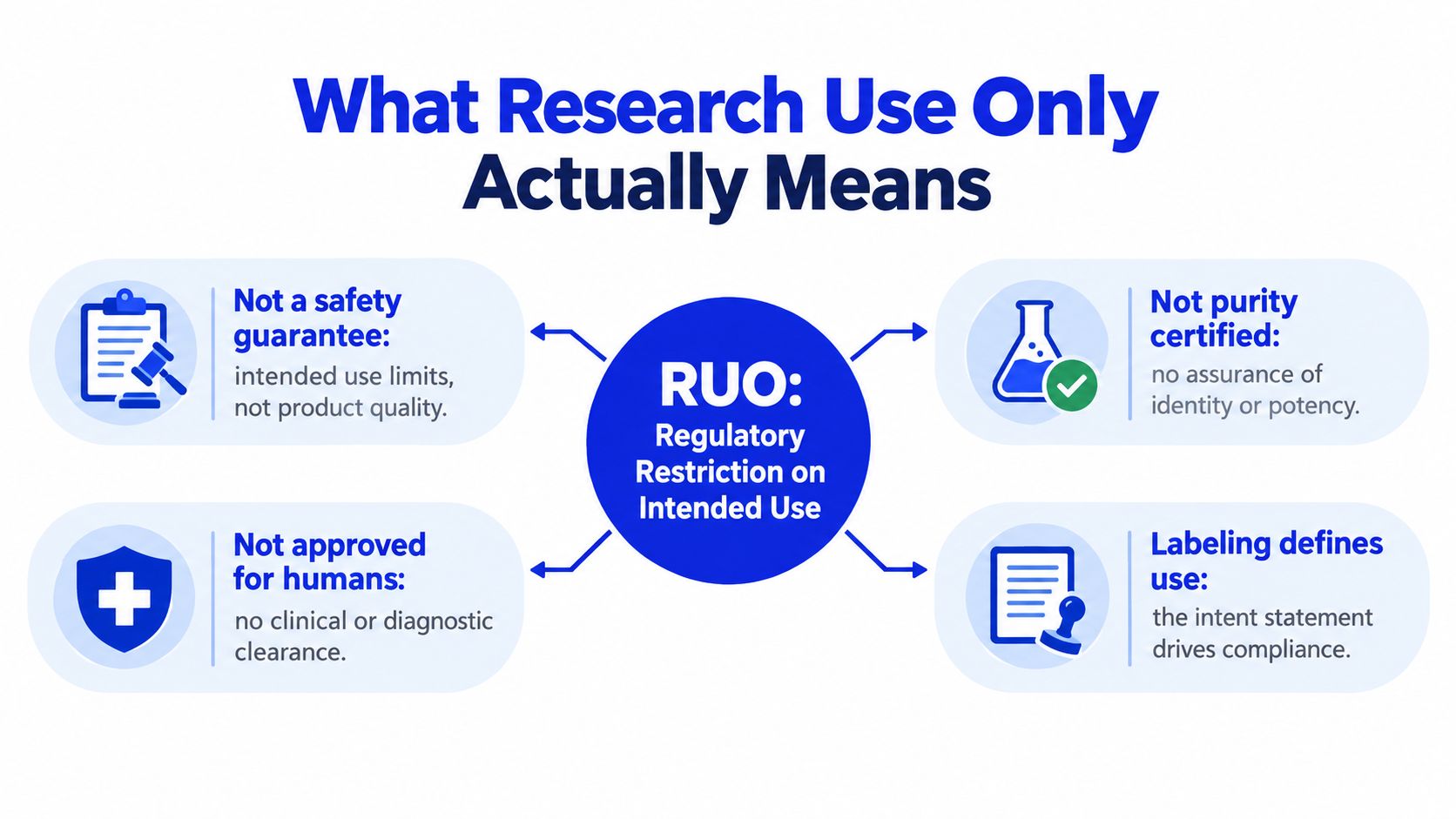
Practical rule: if the only thing you know is that a material is RUO, you still do not know whether it is appropriate for a specific protocol, a specific lab environment, or any human application.
That's the key idea. RUO is a compliance marker first, and a product-quality statement only if the surrounding documentation proves quality for a specific research purpose.
The FDA draws a hard line between products used to explore science and products used to make healthcare decisions. RUO products belong in the first category. Devices and drugs intended for diagnosis, patient management, or therapy belong in the second. That distinction keeps exploratory work separate from products that can influence treatment, dosing, or a patient record.
The regulatory logic is simple. If a product is still in research, it can support method development, assay characterization, or preclinical study. If it is being sold or promoted for diagnosis or patient care, the product moves into a different legal category. FDA guidance explains that RUO labeling is meant to prevent use in clinical diagnosis, patient management, and non-exempt clinical investigations under 21 CFR Part 812. That is why the label alone can't rescue a product if the surrounding conduct points toward clinical use.
For laboratories, that means the whole record matters, not just the carton. Marketing copy, support emails, invoices, and website language all need to stay aligned with research use. If a company describes a material as suitable for laboratory or preclinical research, that's one thing. If the same company implies human benefit, diagnosis, or treatment, the intended use can change in FDA's eyes.
The separation also protects the laboratory itself. A procurement team that buys RUO materials for bench work needs traceability, clear handling rules, and a way to keep those materials out of clinical workflows. A clinic or diagnostic lab needs different controls because the risk profile is different. The FDA's framework forces that distinction to stay visible.
Compliance note: RUO is not a blanket exemption from oversight. It is a narrow statement about development stage and intended use, and the actual distribution record has to match it.
That's the reason senior lab managers keep asking the same question during sourcing reviews. Not “Does the page say RUO?” but “What activity is the product being sold for?”
The most dangerous mistake is treating RUO like a personal-use disclaimer. Buyers sometimes assume that if a peptide is sold for research, then self-administration or informal experimentation must be acceptable. It isn't. FDA enforcement shows that disclaimers such as “not for human consumption” do not control when websites, labels, or sales materials point toward diagnosis, treatment, mitigation, cure, prevention of disease, or changes to body structure or function. In those cases, products can be regulated as drugs, including potentially unapproved new drugs under section 505(a) of the FD&C Act, as reflected in FDA's warning-letter approach for products marketed with human-use intent FDA warning letter on RUO and human-use claims.
A label saying Research Use Only does not do any of the following:
That's where peptide buyers get tripped up. A product can be sold in a research lane and still be marketed in a way that makes it look like a consumer wellness product. Regulatory agencies look at the full picture, not just the wording on one line of the label.
If a seller uses RUO correctly, the surrounding content stays in research language. That means no therapeutic promises, no dosage directions for people, and no clinical performance claims. If the same product page starts leaning into outcomes people want, the disclaimer loses force fast.
The label describes the scientific lane. The marketing record shows whether the seller stayed in that lane.
That distinction matters for readers comparing catalogs, because two vendors can both print RUO on the page while only one keeps the whole presentation consistent with research use.
A Certificate of Analysis is useful, but it has a limited job. It can show batch-specific measurements such as identity, purity, sterility, endotoxin, or stability. Those data help researchers judge reproducibility and lot consistency. They do not convert an RUO compound into an approved drug, medical device, diagnostic, or human-use product.
That difference gets overlooked in peptide procurement all the time. A strong COA can support a decision to use a material in a controlled laboratory protocol. It can also help teams compare vendors on documentation discipline and batch traceability. What it cannot do is replace the approval pathway needed for clinical use. Regulatory authorization still depends on intended use, manufacturing controls, clinical evidence, and the correct approval route.
If a supplier shows high analytical detail, that's a good sign for research validity. If the supplier uses that data to imply human efficacy, the document is being used outside its proper lane. The same applies to third-party testing. Independent testing can improve confidence in a batch, but it still doesn't establish legality for human administration.
A careful buyer should look for:
For researchers working with liquids and handling-sensitive materials, practical lab hygiene matters too. A useful handling reference is bacteriostatic water guidance for lab best practices, which helps illustrate why storage and contamination control matter in the research environment.
Useful test: if a document proves quality, it should answer “what is this batch?” not “what can this batch legally do in humans?”
That line keeps researchers grounded. COAs support research confidence, but they don't create approval where none exists.
Responsible sourcing starts before the order is placed. A lab buyer should treat RUO materials like controlled research inputs, not casual catalog items. That means checking the supplier, checking the documentation, and checking the intended use against the actual protocol.
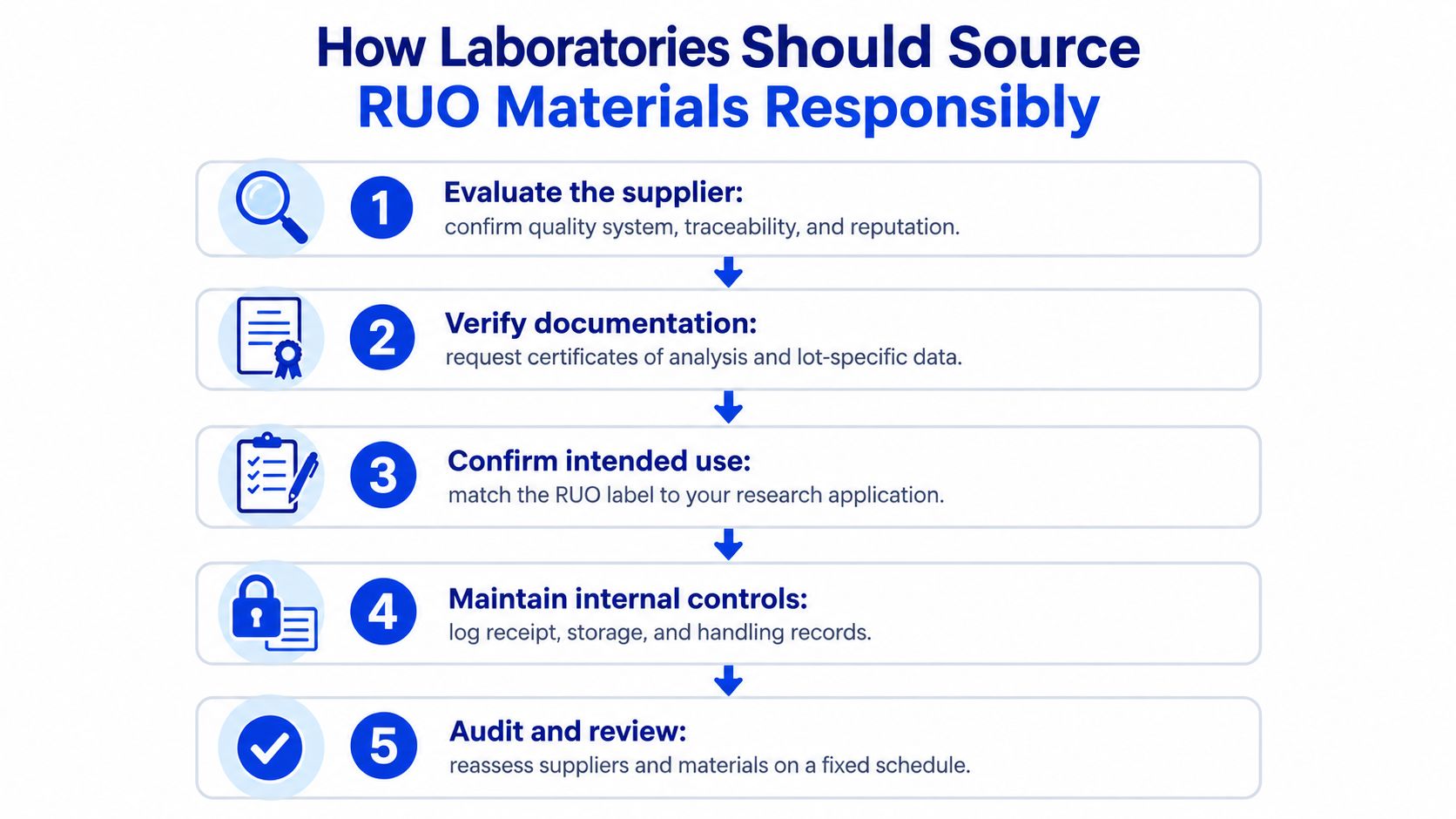
The point is not just compliance for compliance's sake. It's to make sure a research material doesn't drift into a clinical workflow by accident. That's how labs get exposed to avoidable risk.
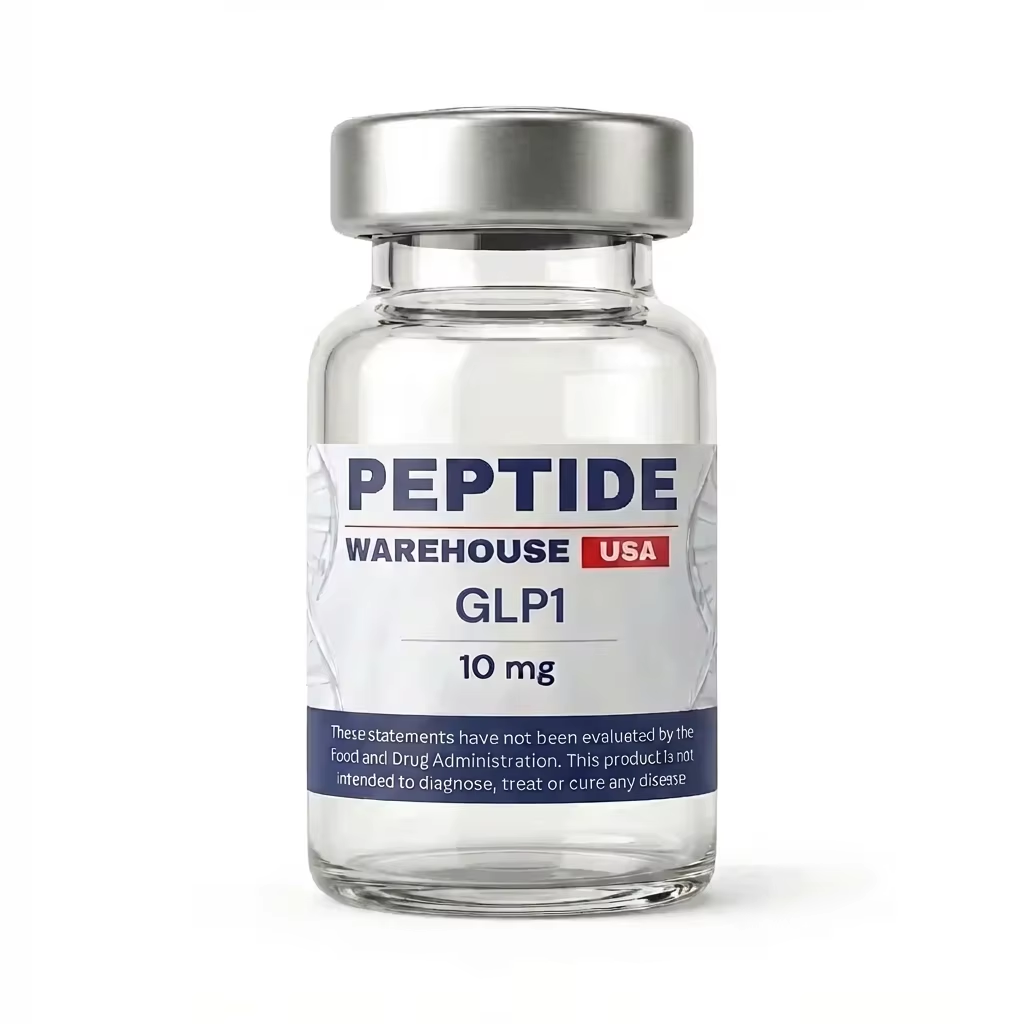
For teams comparing sourcing practices, it helps to look for suppliers that keep the same standard across the whole purchase path. Peptide Warehouse USA is one example of a research-chemical supplier that positions products for laboratory use only and supports that with batch documentation and research framing. Used correctly, that kind of sourcing model belongs in procurement conversations, not patient-care conversations.
The embedded training video below gives a useful visual reminder of how research handling should be approached in practice.
RUO and IUO are related, but they're not the same. RUO covers products still in laboratory research. Investigational Use Only, or IUO, applies to product testing before full commercial marketing, and the labeling must state that performance characteristics have not been established. The distinction matters because both terms describe development stage, but they sit at different points in the path toward a clinical product.
International sourcing adds another layer. In the European Union, RUO products cannot be intended by the manufacturer for a medical purpose. EU guidance also makes clear that a product meant for research use only is not meant to be a medical product. At the same time, the EU framework warns that improper labeling can make an unapproved device misbranded. EU IVDR text shows why the exact wording and the actual intent both matter.
For procurement teams, the lesson is simple. The same words may appear on products that sit under different national rules for chemicals, biologics, medical devices, and drugs. A label that seems familiar in one market can create problems in another if the documentation doesn't match the local regulatory logic.
RUO is not a universal passport. It's a narrowly defined label that has to survive scrutiny in the market where the product is sold.
Research Use Only means the product is restricted to research use, not approved human use. That's the simplest and most important takeaway. The label describes intended use, but it doesn't guarantee safety, purity, or clinical legitimacy.
For laboratories, the right habit is to pair strong sourcing discipline with clear internal policy. Keep RUO materials segregated, restrict access, and document every lot that enters the lab. If a vendor can't keep its claims in the research lane, that's a procurement signal, not a footnote.
If your team is sourcing research peptides and wants documentation that stays aligned with laboratory use, review the product pages, lot records, and COA structure carefully. Then compare options from a supplier that keeps the research boundary clear, and visit Peptide Warehouse USA to explore research-only sourcing options that fit a controlled lab workflow.