No products in the cart.


GHK-Cu is a naturally occurring copper(II)-bound tripeptide made from glycyl-L-histidyl-L-lysine, with a reported molecular weight of 403.93 g/mol and molecular formula C14H24N6O4Cu. It matters in aging and tissue-repair research because it was first isolated from human plasma in 1973, and its plasma concentration declines from about 200 ng/mL at age 20 to roughly 80 ng/mL by age 60, a drop of about 60%.
If you’ve read a few peptide articles and still aren’t sure whether GHK-Cu is a skincare ingredient, a wound-healing compound, or an experimental research molecule, that’s a real gap in how this topic is usually explained. Most summaries collapse very different evidence tiers into one story.
That shortcut creates confusion. A cosmetic ingredient used in topical formulas isn’t the same thing as a clinically established therapy, and a promising preclinical signal isn’t the same thing as strong human evidence. GHK-Cu sits right in that gray zone, which is why it deserves a more careful explanation.
So, what is GHK-Cu in practical terms? It’s a small naturally occurring peptide complex in which the tripeptide GHK binds copper(II), creating a form that researchers study for tissue remodeling, skin biology, antioxidant effects, and inflammation-related signaling.
That definition sounds compact, but the implications are broad. In peptide research, small molecules often matter because they don’t just sit in tissues as raw material. They can influence how cells respond to stress, repair, and structural turnover.
A useful way to place GHK-Cu is to see it at the intersection of peptide signaling and cosmetic science. If you want a broader nontechnical refresher on how peptides show up in skincare products, Skinsation’s guide to peptides in skincare gives helpful context.
GHK-Cu attracts attention because it appears in normal human biology, yet it’s also studied as a designed research input with signaling effects that may differ from free copper alone.
Three ideas help clear up the confusion early:
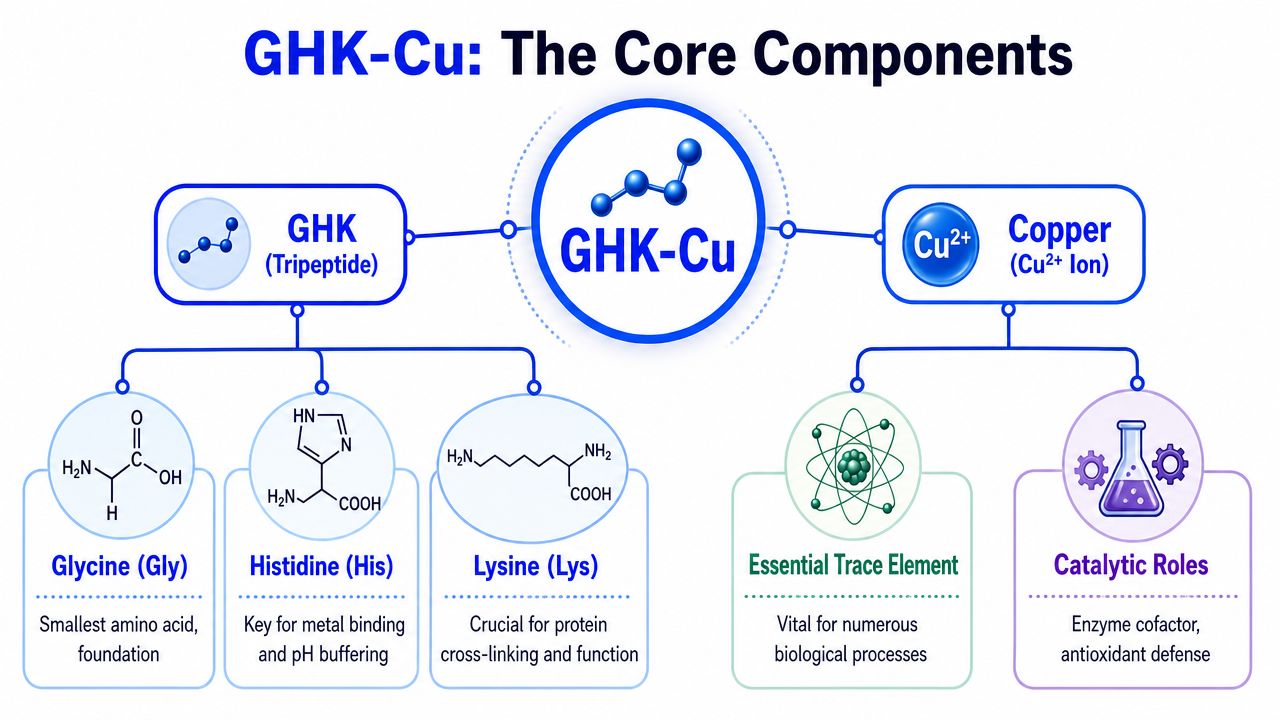
A peptide is just a short chain of amino acids. In this case, GHK stands for Gly-His-Lys, shorthand for glycine, histidine, and lysine.
That matters because each amino acid contributes something to the behavior of the whole molecule. Histidine is especially important in metal binding, which helps explain why this tripeptide can coordinate copper in a biologically relevant way.
Researchers often explain peptides as messengers or signal carriers. That’s a fair analogy here. GHK isn’t acting like a bulk nutrient. It’s better understood as a small bioactive sequence that can participate in signaling processes when paired with copper.
Copper is an essential trace element, but free copper ions aren’t the same thing as a controlled peptide-bound complex. The key point is binding. Once copper is chelated by GHK, the resulting complex has different biological behavior than unbound copper would.
According to the Peptpedia entry on GHK-Cu, GHK-Cu is a naturally occurring copper-binding tripeptide first isolated from human plasma by Pickart in 1973, and its plasma concentration declines from about 200 ng/mL at age 20 to roughly 80 ng/mL by age 60, a drop of about 60%. That age-related decline is one reason the molecule became central to aging and regenerative research.
The easier analogy is a delivery truck. Copper on its own can be reactive. GHK binds it, carries it, and presents it in a form that researchers think may support more controlled biological interactions.
A few practical distinctions help:
Practical rule: When people talk about GHK-Cu, they aren’t usually talking about copper supplementation. They’re talking about a peptide-copper complex with distinct research behavior.
This distinction also explains why many readers get tripped up by marketing language. A copper peptide in a topical formula, a lab-grade peptide standard, and an experimental research compound can all involve the same core molecule, but they don’t represent the same use case.
The most useful way to understand GHK-Cu is as a signaling complex, not as a simple nutrient. Technical descriptions note that copper chelation improves biological stability versus free copper ions, which is why GHK-Cu is studied as a coordinated complex rather than as plain copper delivery.
From a chemistry standpoint, GHK-Cu is a copper(II)-bound tripeptide composed of glycyl-L-histidyl-L-lysine with a reported molecular weight of 403.93 g/mol and molecular formula C14H24N6O4Cu, and commercial research lots are often specified at ≥99% purity by HPLC/MS in technical product literature such as the Apex Laboratory GHK-Cu specification.
That technical framing sounds abstract, but it tells you something important. Researchers don’t focus on GHK-Cu because it’s a source of copper in the dietary sense. They focus on it because the peptide-bound form may change how cells interpret and respond to the presence of copper.
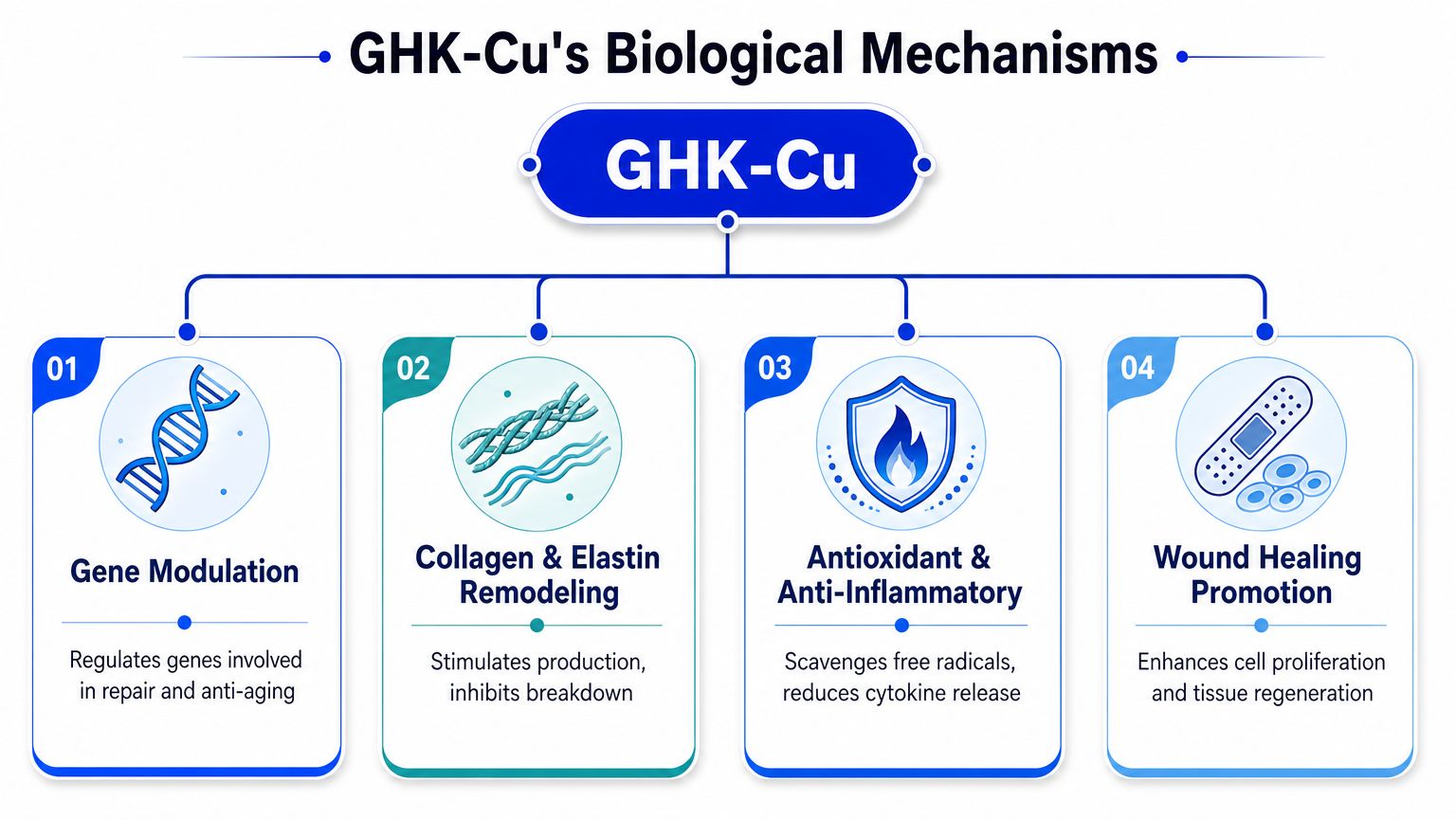
Mechanistically, the literature repeatedly circles around a few themes. These aren’t all equally proven in humans, but they form the core scientific rationale for studying the compound.
A useful way to think about this is to separate direct action from downstream response. GHK-Cu doesn’t function like a filler material that becomes collagen itself. Instead, researchers study whether it influences the cellular environment in ways that support repair and remodeling.
The phrase “how it works” should be read carefully with GHK-Cu. For many applications, the mechanism is biologically plausible and experimentally supported, but not yet clinically settled.
That distinction matters because online articles often jump from “supports remodeling in preclinical work” to “proven anti-aging treatment.” Those are not equivalent statements.
The main question most readers really want answered isn’t just what GHK-Cu is. It’s where the evidence is strongest, where it’s still preliminary, and where discussion has run ahead of the data.
The cleanest way to approach that is by application area.
This is the most established public-facing use case. In skincare, GHK-Cu is often discussed under ingredient naming conventions such as copper tripeptide-1. That doesn’t mean it’s a clinically established anti-aging therapy. It means it has a recognized place in cosmetic formulation and in skin-focused research.
The nuance is important. Cosmetic use can be established from a product-category perspective while human therapeutic evidence remains limited.
A 2022 NIH review notes that GHK-Cu has promising anti-inflammatory and tissue-remodeling effects, but strong evidence is still largely preclinical and more extensive human clinical trial data is needed before it can be established as a therapeutic agent, as described in this NIH review of GHK and GHK-Cu research.
That creates a sensible evidence ladder for skin-related questions:
| Application context | What can be said carefully |
|---|---|
| Topical cosmetic ingredient | It is commonly discussed in skincare and studied for skin remodeling-related effects |
| Human therapeutic claim | Clinical support remains preliminary |
| Research interpretation | Promising, but not the same as clinically established treatment |
The science gets interesting, but also where overstatement happens fast. Wound-healing research around GHK-Cu is one of the most biologically compelling areas, especially because tissue repair involves coordinated signaling, inflammation control, and matrix remodeling.
But the evidence tier matters. The stronger support here comes from in vitro and animal work, not from large human trials. That doesn’t make the findings unimportant. It means they should be interpreted as research signals rather than settled clinical practice.
Evidence boundary: Promising wound-healing data does not automatically translate into approved human therapeutic use.
Researchers interested in repair biology usually care about GHK-Cu for reasons like these:
For a visual overview of how this topic is often framed in educational media, this explainer is a useful supplement:
Hair-related discussion around GHK-Cu is common online, but it’s often the least carefully framed. The idea usually comes from broader themes in skin and tissue biology, then gets extended into follicle-support claims.
That doesn’t mean the topic is baseless. It means the claim strength is often weaker than the marketing tone suggests. The safest interpretation is that hair and follicle support remain part of the broader preclinical and exploratory conversation, not a fully established clinical conclusion.
A straightforward way to think about all three use cases is this:
How much confidence can you place in a GHK-Cu experiment if the starting material is poorly documented? For this peptide, sourcing affects interpretation. If identity, purity, or handling are uncertain, any downstream result becomes harder to explain.
That matters especially for GHK-Cu because the broader literature already spans different evidence tiers. Topical cosmetic use is relatively established at the ingredient level. Wound-healing and tissue-repair questions remain more research driven, with much of the interest still preclinical. More exploratory applications are even less forgiving of weak material quality, because small uncertainties in the reagent can blur already tentative findings.
A useful starting point is simple. Confirm what the material is, how it was characterized, and whether the lot can be traced.
Technical references commonly describe GHK-Cu as a copper(II)-bound tripeptide with molecular formula C14H24N6O4Cu. Suppliers often report purity using methods such as HPLC or mass spectrometry, because a vague label claim does not tell you how the material was assessed.
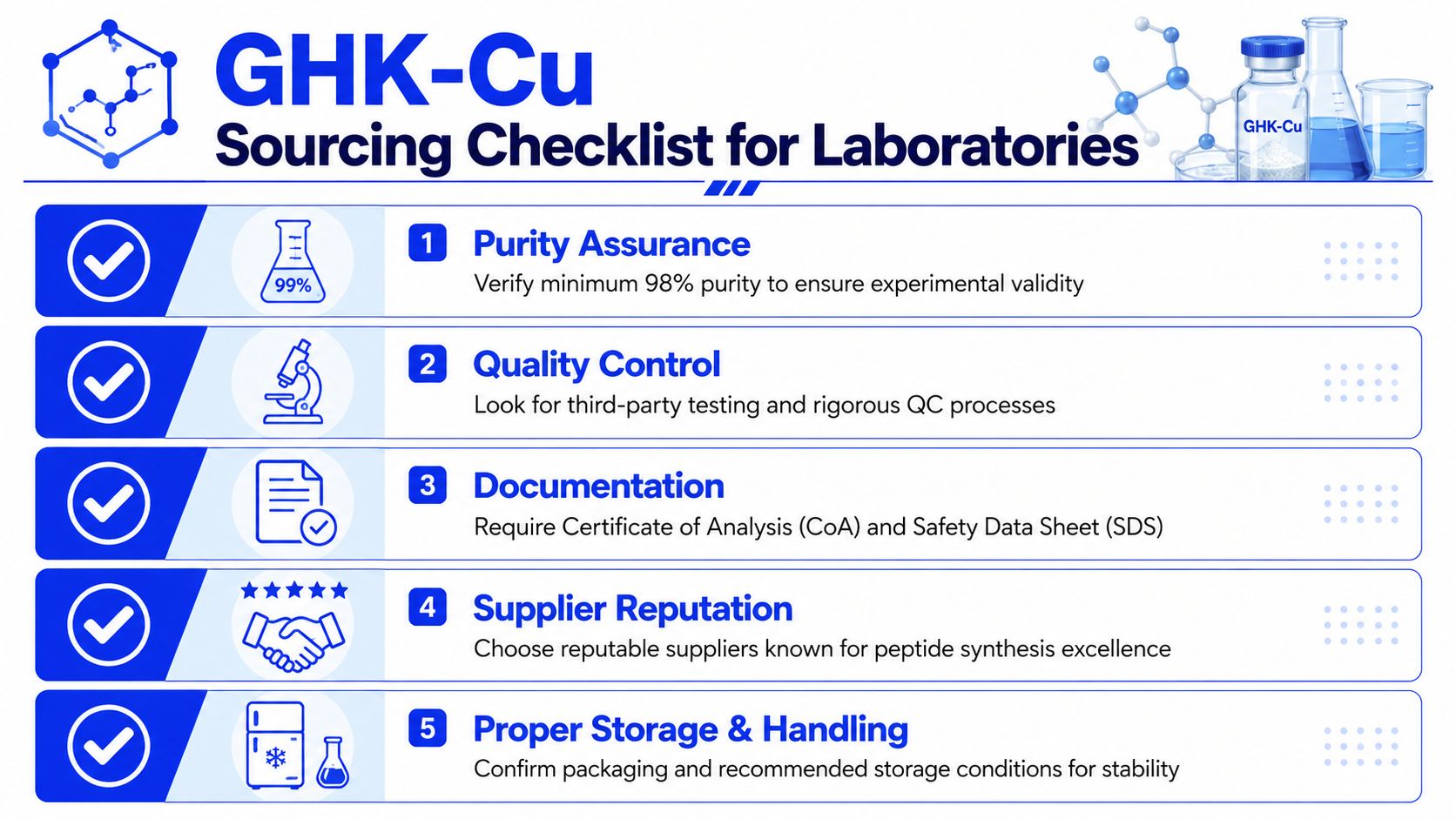
A Certificate of Analysis should answer practical questions, not just provide a document number. In effect, it serves as the reagent’s passport.
A lot without usable analytical paperwork introduces avoidable uncertainty. If an assay gives an unexpected result, you need to know whether the biology changed or the input material did.
Peptides are less like fixed hardware and more like sensitive reagents. Their value depends on how consistently they are handled from receipt to use.
Lyophilized material can lose reliability if exposed repeatedly to heat, moisture, or poor reconstitution practice. The problem is not only degradation. It is loss of reproducibility across runs, operators, or time points.
A short checklist is more helpful than broad advice:
The aim is reproducibility.
If one experiment uses a well-documented lot stored under controlled conditions, and another uses a vial with incomplete records or uncertain handling history, those are not meaningfully the same starting materials.
A disciplined buying framework helps keep that distinction clear:
| What to check | Why it matters |
|---|---|
| Purity specification | Supports consistency across experiments |
| COA availability | Shows the lot was characterized |
| Analytical method listed | Lets you evaluate how purity was measured |
| Storage guidance | Helps preserve material quality |
| Clear intended use language | Reinforces research-only positioning |
Research-grade GHK-Cu should be treated as a laboratory material, not a therapeutic product. That distinction is straightforward but important, particularly in a field where cosmetic use, preclinical repair research, and more experimental claims are often discussed together as if they carry the same level of support.
GHK-Cu is best understood as a naturally occurring copper-peptide complex with strong relevance to tissue remodeling and repair-related biology. It has real scientific interest because it sits at the junction of peptide signaling, copper coordination, and regenerative research.
The most important takeaway isn’t that GHK-Cu is “proven” for every use people discuss online. It isn’t. The better takeaway is that the molecule has a credible research foundation, while the strength of evidence changes sharply by application.
For topical cosmetics, the concept is well established in product language and ingredient use. For wound-healing and broader regenerative questions, the most persuasive support still comes from preclinical work. For hair and other consumer-facing claims, the discussion is often more confident than the human evidence warrants.
That distinction is what makes good peptide education different from hype. If you’re reading about the benefits of peptides, it’s worth asking not only what a compound is supposed to do, but also what level of evidence supports that claim.
GHK-Cu should also be approached within the right regulatory frame. Research-grade materials are not the same thing as approved drugs, and laboratory suppliers are not offering medical advice or products for human consumption.
If you’re studying the benefits of peptides and need documented research materials, Peptide Warehouse USA offers laboratory-use compounds with supporting documentation such as COAs. You can learn more, review available options, and explore sourcing details that fit analytical or preclinical work.