No products in the cart.


You've just opened a fresh shipment, and the paperwork looks clean enough at first glance. The label says the peptide is for research use only, the batch number matches, and the seller included a COA. The central question is simpler and more important: what is microbial testing telling you about whether that material is fit for your lab work?
For anyone buying research peptides, microbial documentation is not a box to tick and forget. It's the part of the file that helps you separate a controlled lot from one that could distort cell culture behavior, complicate downstream analysis, or force you to repeat work. That's why microbial testing sits at the center of quality control, not at the edge of it.
A researcher receives a new peptide vial on Monday morning. The lot looks intact, the documentation is attached, and the project team wants to move fast. Before anything goes into a plate, flask, or assay, microbial verification has to answer one thing, whether the material is clean enough to support the work without introducing a hidden variable.
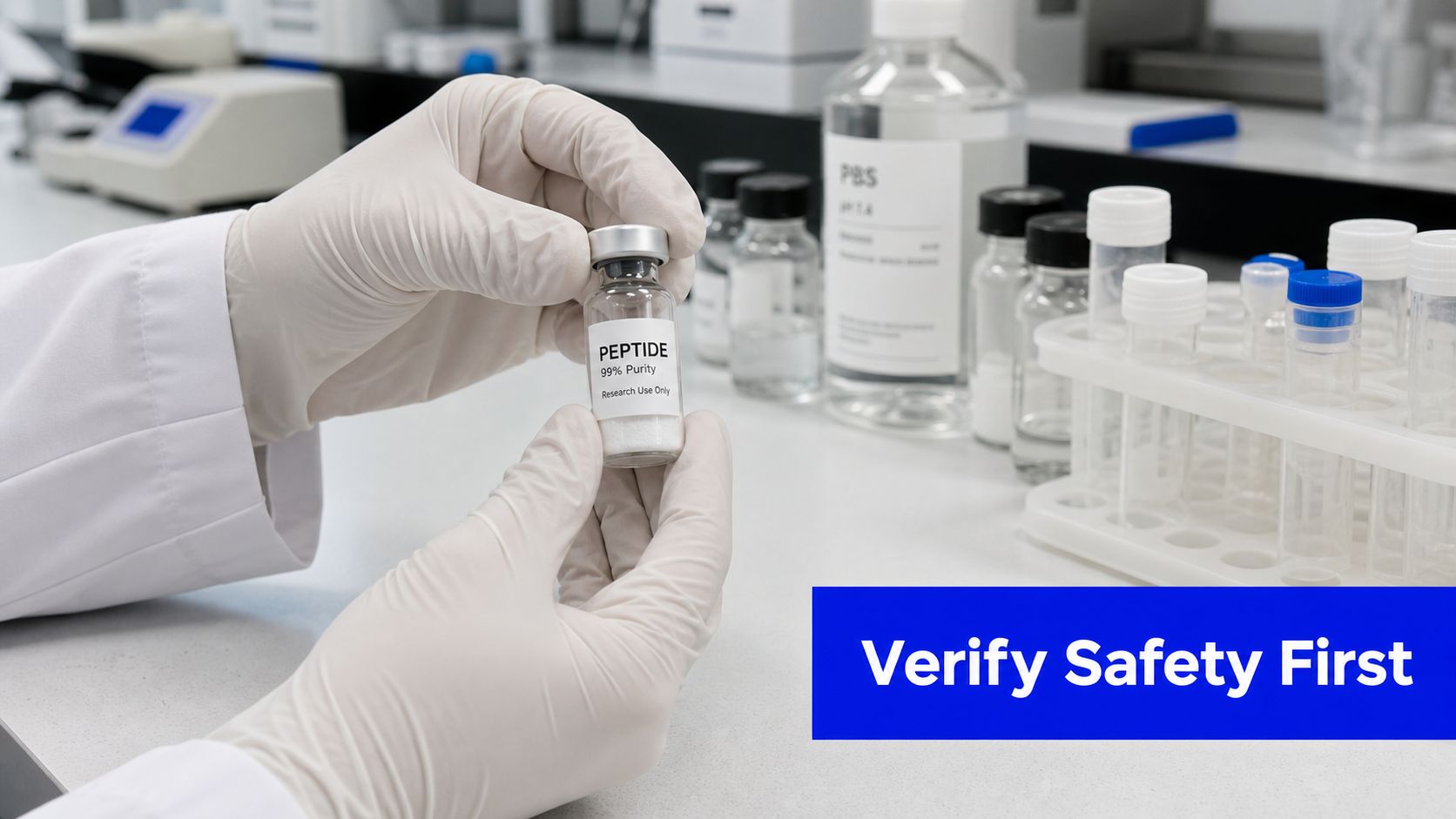
Microbial contamination can distort results in ways that are hard to trace later. If a culture behaves oddly, the obvious blame often lands on media, technique, or incubation, but the problem may have been present in the incoming material. That's why microbial testing supports not just safety, but research integrity.
Peptide buyers usually care about three things at once, product fit, documentation, and consistency. Microbial testing sits across all three because a COA is only useful if the underlying results are specific, readable, and aligned with the intended use. A sterile injectable-style workflow demands different evidence than a nonsterile research compound used in analytical or preclinical work.
Practical rule: If the product context changes, the microbial standard changes with it.
That's where many procurement reviews go wrong. Teams see “tested” on a document and assume the question is closed, but the underlying question is whether the test matches the risk profile of the product. Historical microbial testing developed from the observation of microorganisms in the 17th century, then became a distinct science through Pasteur's work in 1857 and Koch's work in 1882, and that same logic still applies today, identify the organism, understand the risk, then decide what action the result supports. Microbial testing history and scientific milestones
A contaminated peptide lot doesn't just threaten one experiment. It can consume staff time, waste consumables, and force a full investigation that should never have been necessary. In practical QC terms, microbial documentation helps answer whether the shipment belongs in the lab at all, or whether it needs more review before release.
For buyers, that means one shift in mindset, the COA isn't a formality, it's part of the decision record. A supplier that treats microbial testing seriously gives you a lot more than a line item, it gives you confidence that the product was checked against a defined standard instead of a vague promise. If you're comparing vendors, that difference matters immediately.
A peptide lot can look fine on paper and still raise very different microbial questions depending on how it will be used. That is why microbial testing is a family of tests, not one single assay. A sterile injectable, a nonsterile research material, and a product with a preservative system all need different evidence. If a buyer asks for the wrong report, the answer can sound reassuring while missing the underlying risk.
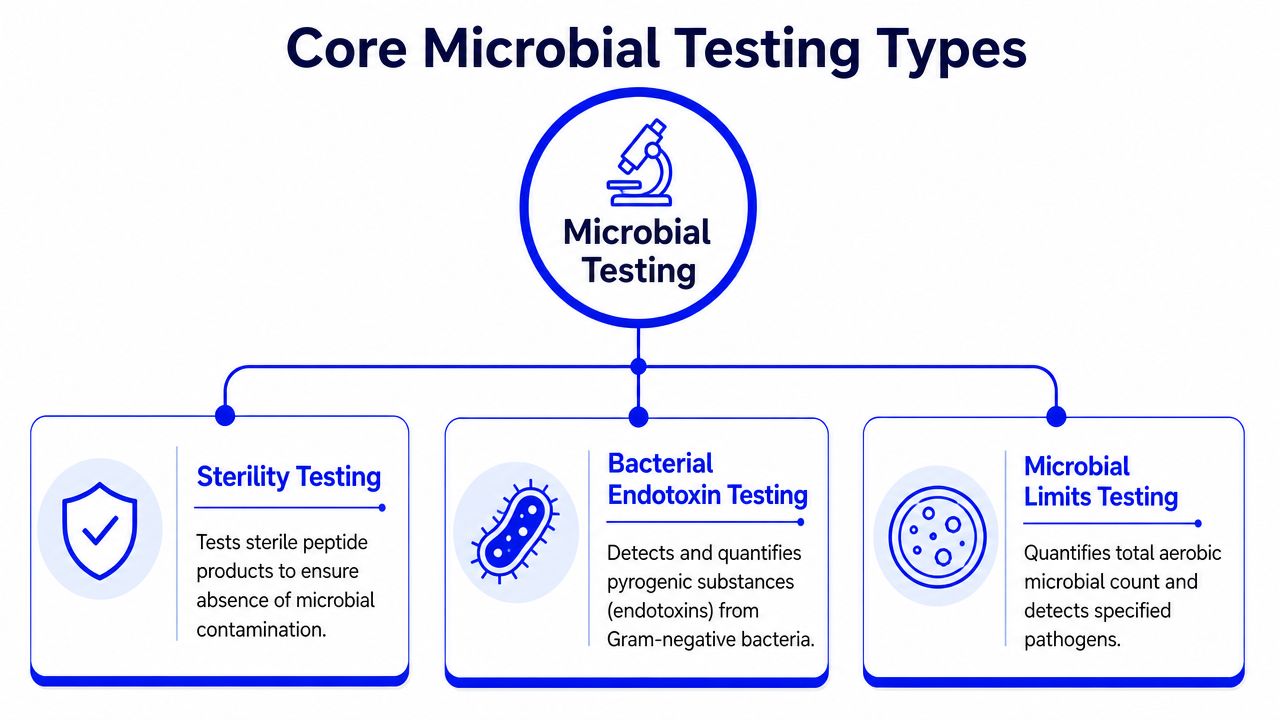
Sterility testing is used for sterile products to check whether viable microorganisms are present. For peptide products, that matters when the material is sold or documented as sterile, because the question is whether growth appears under the test conditions, not whether the sample looked clean at receipt. A sterility result gives a different kind of confidence than a basic contamination screen, and buyers should read it that way.
Bacterial endotoxin testing, or BET, looks for pyrogenic substances from gram-negative bacteria. It does not answer the same question as sterility testing, and that distinction matters in procurement reviews. A lot can appear acceptable on one front and still carry a separate safety concern on another. The pharmacopeial testing framework for nonsterile and sterile products sets out that separation clearly, which is why BET is often treated as its own release criterion. The pharmacopeial testing framework for nonsterile and sterile products
Microbial limit testing, or MLT, is used for nonsterile products to measure total microbial burden and, where relevant, specified organisms. It fits products that are not expected to be sterile, but still need a controlled microbial profile. For peptide buyers, the useful question is whether the result stays inside the stated specification and whether the organism profile matches the product's intended use.
Preservative efficacy testing checks whether a product's preservative system can control microbial growth over time. The cited review describes inoculating the product with known microorganism concentrations of 10^5–10^6 CFU/mL and measuring reduction on days 7, 14, and 28. That shows how microbial testing can evaluate product behavior over time, not just give a one-time snapshot. If you need to find virus testing insights, find virus testing insights.
| Method | Speed | Detects Viable Organisms | Best For |
|---|---|---|---|
| Sterility testing | Slower | Yes | Sterile products that need absence-of-growth evidence |
| Bacterial Endotoxin Testing | Fast relative to culture | No | Pyrogen risk screening |
| Microbial Limit Testing | Moderate | Yes | Nonsterile products with specification limits |
| Preservative Efficacy Testing | Time-based | Yes | Products where preservative performance matters |
The practical takeaway is straightforward. A supplier does not earn trust by choosing the most complex method, it earns trust by choosing the method that answers the right question for the product in front of you. For a clean procurement file, the test type should match the product type, the product claim, and the risk you are trying to control.
Buyers often ask for “the microbial test,” as if one test covers everything. It doesn't. The method matters because it changes what the lab can see, how fast the result arrives, and whether the answer reflects live contamination or only biological residue.
The broader literature notes that microbial testing now includes culture-based, genomic, biochemical, and membrane-filtration approaches, while newer work has expanded into shotgun sequencing and multi-omics tools such as metatranscriptomics, metaproteomics, and metabolomics. Those tools can reveal more detail, but they don't automatically replace older methods for every procurement decision. Microbial testing methods and modern multi-omics approaches
Culture-based methods still matter because they show whether organisms are viable. That distinction is critical when the business question is live contamination, not just the presence of microbial DNA. A molecular assay can be faster, but faster isn't the same as more useful if you need to know whether something can grow.
Membrane filtration is another useful example. It's often preferred when labs need to concentrate microorganisms from large liquid volumes, but the workflow can take more hands-on time. That trade-off is exactly why method choice should be visible in the documentation, not buried in a generic “tested” line. The buyer needs to know what was concentrated, what was measured, and what the assay can legitimately claim.
More advanced methods are useful when the question is detailed microbial profiling. They're not always the right answer when the question is viable contamination.
Endotoxin assays are different again. They're useful when the concern is pyrogenic risk, not viable count, so they belong in a separate decision lane. In procurement terms, the primary task is not to ask which method sounds strongest, it's to ask which method best fits the product and the release decision.
find virus testing insights can be helpful if you're comparing nucleic-acid methods and want a plain-language refresher on how amplified molecular detection differs from classic culture logic. That kind of comparison is useful because the same confusion shows up across microbial and viral workflows, method choice changes the meaning of the result.
| Method | Speed | Detects Viable Organisms | Best For |
|---|---|---|---|
| Culture-based testing | Slower | Yes | Viable contamination and enumeration |
| Membrane filtration | Moderate | Yes | Large liquid volumes that need concentration |
| Molecular methods such as PCR or sequencing | Faster | Not always | Rapid profiling and identification |
| Endotoxin assays | Fast relative to culture | No | Pyrogen detection |
The procurement habit to build is simple, read the method before you read the result. A low count from the wrong assay can be less helpful than a slower result from the right one. That's especially true in regulated or quality-sensitive settings, where the documentation has to stand up to review.
A supplier's compliance file should do one simple job, make it clear which standard was used, why that standard fits the product, and how the result was judged. In peptide sourcing, that matters more than memorizing chapter numbers, because procurement teams need to see whether the test path matches the material being bought.
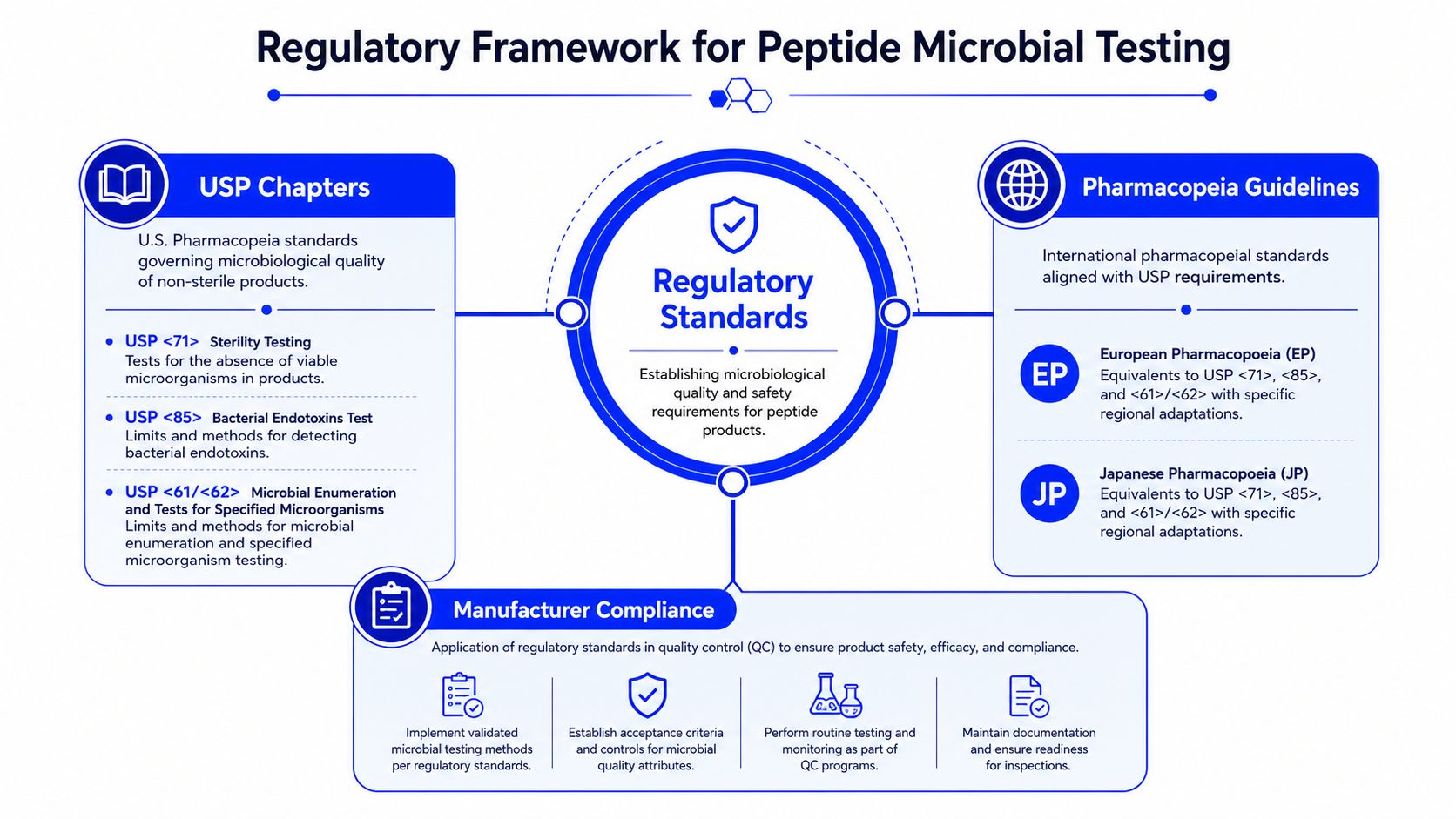
The practical pharmacopeial framework usually separates sterile products, nonsterile products, and pyrogen risk into different expectations. A microbial file should show more than a passing reference to compliance, it should show which test aligns with the product's claim and how the result was interpreted. Pharmacopeial testing chapters and application logic
USP chapters are often cited as shorthand for the testing logic behind the report. USP <71> is the sterility testing chapter, USP <85> addresses bacterial endotoxins, and USP <61>/<62> are commonly used for microbial enumeration and specified microorganisms in nonsterile contexts. If a buyer does not memorize the numbering, that is fine. What matters is whether the report points to a recognized framework rather than an improvised method set.
The same idea appears in other pharmacopeias through comparable chapters and monographs. Global suppliers may reference EP or JP equivalents instead of USP language, and the buyer still needs to know that the method basis is recognized, documented, and appropriate for the product. If a vendor cannot explain which standard drove the test selection, the documentation is incomplete.
A useful way to read the chapter reference is to ask, “What decision does this method support?” Sterility testing supports a different claim from endotoxin testing, and both differ from enumeration or specified-organism work. That distinction is the practical gap many reports leave out, even though it is the part a procurement reviewer needs most.
A good microbial file shows that the manufacturer did not treat testing as an afterthought. It should connect the product type, the chosen method, and the acceptance logic in a way that a reviewer can follow without guessing. That is especially important for research materials where the buyer still wants release confidence, even if the product is not being sold as a finished medical device or drug.
The same review also notes that preservative efficacy testing uses known inoculum levels and timed observations, which shows how pharmacopeial methods connect to actual manufacturing decisions instead of abstract compliance language. Preservative efficacy testing parameters
For buyers comparing environmental or contamination-related claims across documentation, the accuracy of mold air testing is a useful reminder that the wording of the method matters as much as the result. A report can look polished and still leave you unsure whether the test matches the claim.
For a procurement specialist, the compliance question is straightforward. Does the test type match the claim, and does the report show that the supplier used a recognized standard to support that claim? If the answer is yes, the file is much easier to defend.
Most COAs are written to look reassuring. The challenge is separating reassuring formatting from useful detail. A clean layout doesn't help if the report leaves out the test method, the acceptance limit, or the actual result you need to compare against the specification.
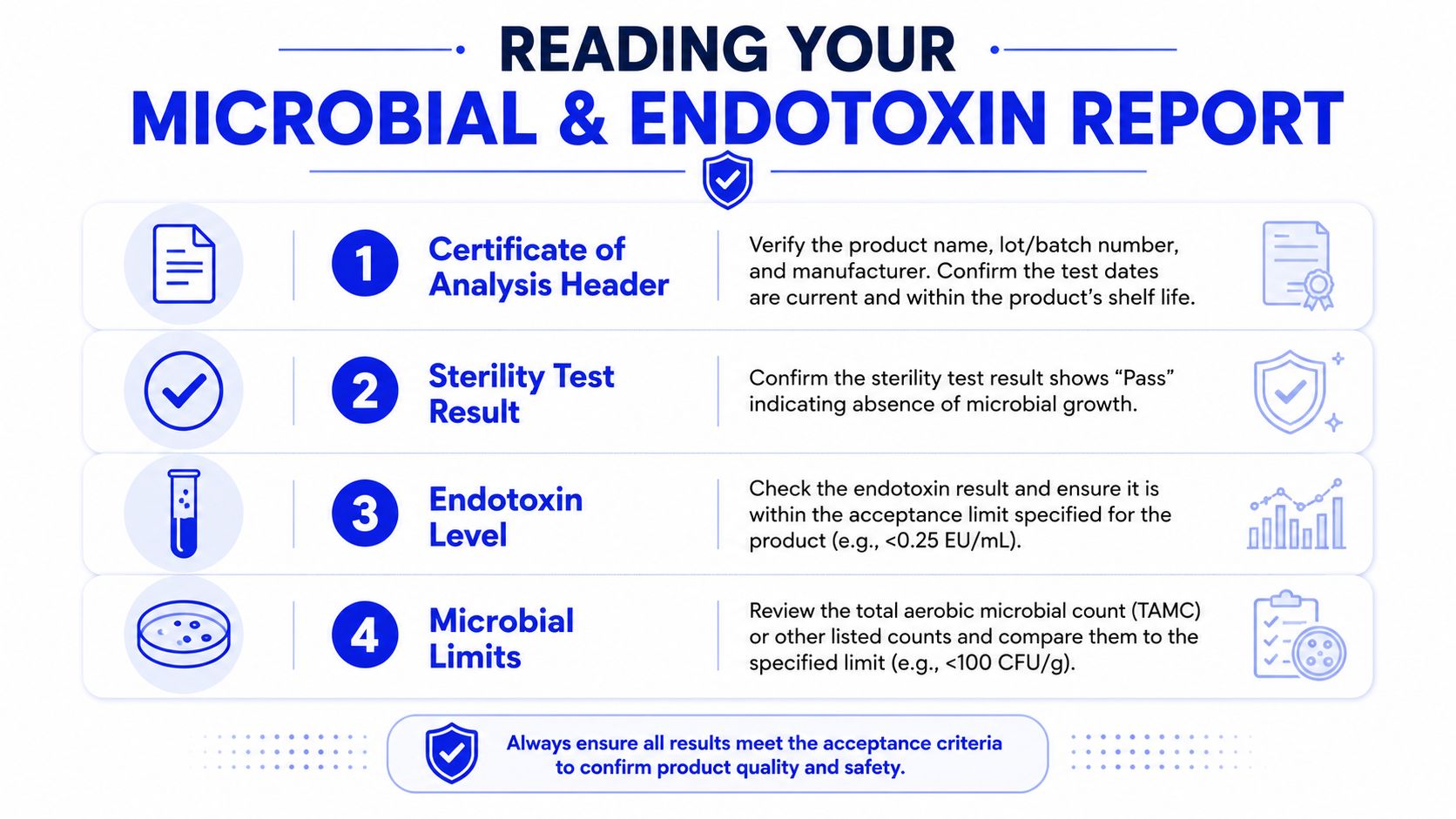
The top of the report should tell you what product was tested, which lot was tested, and when the testing occurred. If those basics are missing or vague, stop there and request clarification. A microbial result is only meaningful when you can tie it back to a specific batch, a specific date, and a specific testing method.
The next thing to check is whether the report clearly separates sterility, endotoxin, and microbial limits. Those are different questions, so a report that compresses them into one generic “passed QC” line is less useful than one that spells out each test. That separation also helps you spot whether the supplier is trying to use one result to imply more than it proves.
CFU, or colony-forming units, tells you how microbial burden is being expressed. EU, or endotoxin units, tells you about endotoxin measurement, not viable growth. If the unit doesn't match the question you're asking, the result may be accurate and still not solve your procurement problem.
A useful habit is to compare the reported value with the stated acceptance limit on the same page. If the report gives a value but no limit, you can't interpret it confidently. If the result is close to the limit, that's not automatically a failure, but it does deserve a closer look at sample handling, method sensitivity, and whether the result was reviewed by a qualified lab.
Borderline numbers need context, not assumptions. A result near the limit can be a release question, a retest question, or a documentation question, depending on the method and the product.
Missing test sections are a red flag, especially when a supplier claims broad quality control but only shows partial data. So is vague wording like “meets standards” without naming the standard. If the report came from a third-party lab, check that the lab identity is visible and that the report format is traceable enough for your internal recordkeeping.
For a related perspective on how people judge environmental testing claims, the discussion on the accuracy of mold air testing is a useful reminder that sampling context matters as much as the number itself. That idea carries over directly here, because a microbiological result always depends on the method, the sample, and the decision threshold.
Finally, don't let an attractive COA replace a real review. If the report can't tell you what was tested, by whom, against which limit, and for which lot, it isn't helping your procurement decision nearly as much as it should. A readable report is the difference between confident intake and avoidable uncertainty.
Microbial verification works best when the sample itself is handled correctly. A lab can't rescue a badly collected specimen, and a buyer can't fix a weak COA after the fact. That's why the process starts before the assay and continues through the way the report is filed.
The USDA food sampling guidance is clear that microbiological analysis requires aseptic sampling to avoid contamination, and if multiple analyses are planned, the aliquot for microbiological testing should be taken first. That small operational detail matters because it reduces the chance that handling steps for other tests contaminate the microbiology sample. Micro-sampling and testing guidance
Timing affects credibility. The Institute of Food Science and Technology states that, ideally, chilled samples should be analysed within four hours of sampling, while common microbiology cultures often take 24 to 48 hours for results, and antibiotic susceptibility testing may need another 24 to 48 hours. Those timelines help set realistic expectations, especially for buyers who want fast release without misunderstanding why some tests can't be rushed. Microbiological analysis timing and turnaround
For a procurement checklist, that means asking a few specific questions before you place the order:
The strongest suppliers make the documentation easy to read because they know buyers need to evaluate more than purity. A useful COA tells you how the product was tested, what the result means, and whether the result supports the product's intended research use. That's especially valuable when you're comparing lots or deciding whether a borderline result is acceptable for your application.
Peptide Warehouse USA is one option that provides third-party documentation for its research peptides, including microbial reports and COAs, which makes it easier to review lot-level traceability before purchase. If you're evaluating suppliers with that same standard in mind, visit Peptide Warehouse USA to review their documentation approach and compare it against your own QC checklist.