No products in the cart.



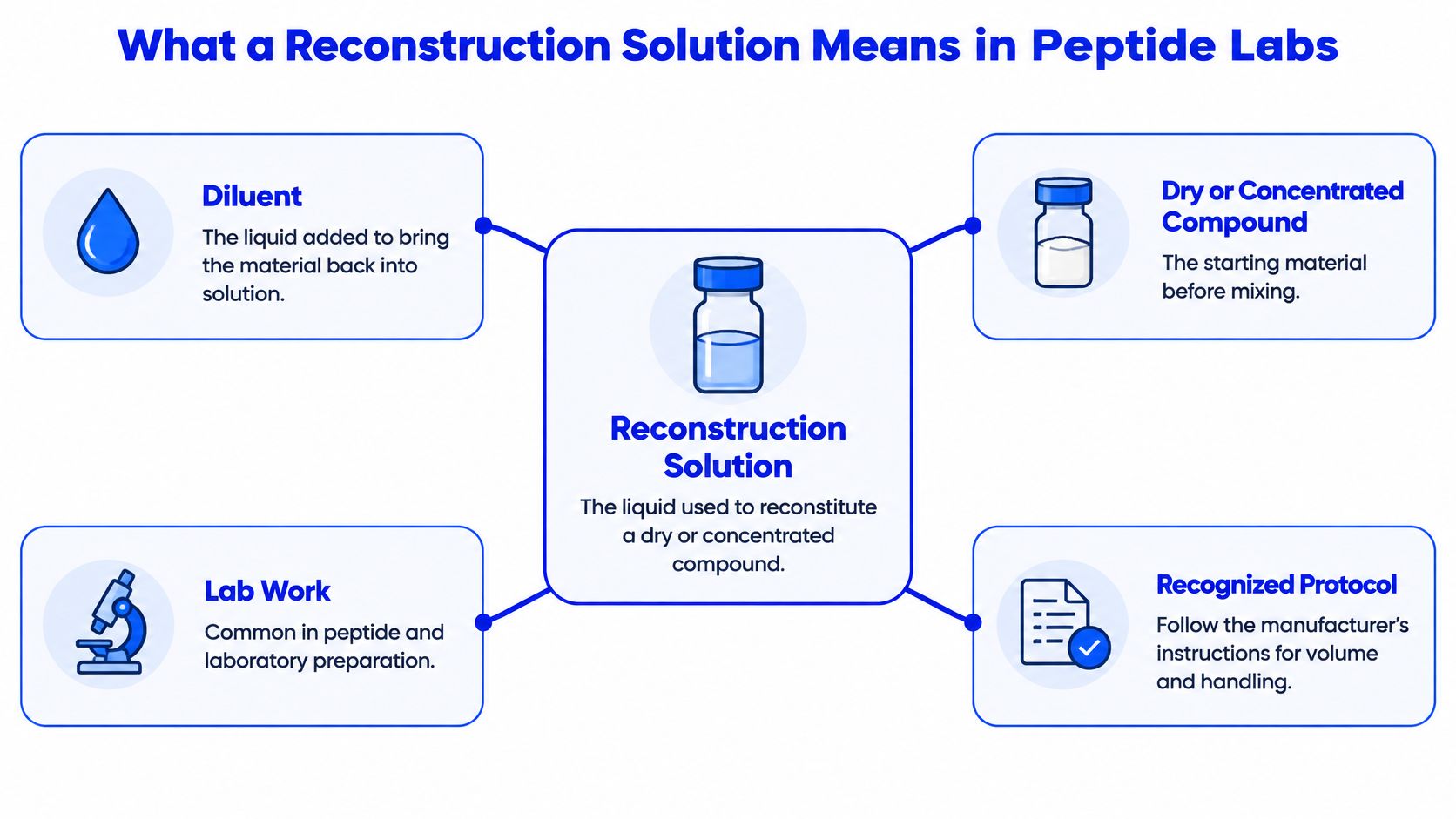
A reconstruction solution is the liquid used to reconstitute a dry or concentrated compound, and the recognized lab term is reconstitution.
If a liquid dissolves a peptide and looks clear, does that tell you it's suitable for your experiment? Not by itself. The compound, diluent, preparation method, and supporting documents each answer a different question.
For those looking up “what is reconstruction solution,” the first challenge is terminology. The phrase can describe laboratory preparation, medical reconstruction, or even software reverse engineering, but those meanings aren't interchangeable.
In peptide laboratories, people sometimes say reconstruction solution when they mean reconstitution diluent. Reconstitution means adding an appropriate liquid to a dry or concentrated material to make a preparation suitable for a defined workflow.
Think of adding water to a concentrate. The analogy explains the physical step, but laboratory work requires more control: choosing the wrong liquid can change solubility, stability, or the analytical result.
The following concept map separates these parts.
The United States Pharmacopeia's compounding overview.pdf) includes “reconstituting other than as provided in the manufacturer's labeling” within its definition of nonsterile compounding. That distinction matters: changing a labeled preparation method isn't another way to perform the same task.
Suitability belongs to the complete setup, not the liquid alone. The compound, diluent, intended concentration, storage conditions, and stated research use must agree with the manufacturer's instructions or an appropriately validated laboratory protocol.
In software engineering, a reconstruction solution means a reverse-engineering workflow that recovers implicit architecture from source code, binaries, configuration files, runtime traces, and documentation, then validates the model against observed behavior, as described in Towards Reconstructing Architectural Models of Software Tools by Runtime Analysis. No laboratory liquid is involved.
In medicine, reconstruction concerns rebuilding structure or function. For laboratory searches, purchasing records, and preparation logs, use reconstitution to avoid mixing these unrelated meanings.
A misleading claim often begins with a vocabulary shortcut: a compound associated with a healing pathway becomes a reconstruction treatment. Biological activity, however, doesn't establish a validated medical outcome.
Medical reconstruction addresses a specific structural or functional problem. A clinician explaining a joint illustrates that different context.

Reconstruction may involve surgery, biomaterials, tissue engineering, cell-based therapy, or a combination product. It doesn't necessarily regenerate the original tissue: restoring a structure and growing replacement tissue are different objectives.
Before accepting language about repair, regeneration, or the benefits of peptides, ask:
The FDA guidance on regenerative medicine therapies describes a broad category including cell therapies, therapeutic tissue-engineering products, human cell and tissue products, and combination products, and explains the need for approval or licensure before consumer marketing and FDA oversight of clinical investigation before approval.
That framework doesn't turn every peptide into a regenerative medicine therapy. A claim must fit the actual intervention and its evidence, rather than borrowing credibility from a related scientific field.
Keep that distinction in mind when evaluating explanations presented through video.
A laboratory finding can justify further investigation without justifying a claim that a product reconstructs human tissue.
Use this comparison to identify the main differences between diluents. It's a reference for reading labels, not permission to substitute one liquid for another.
| Diluent | Typical composition | Common lab use | Key limit |
|---|---|---|---|
| Bacteriostatic water | Sterile water containing 0.9% benzyl alcohol as a preservative | Multi-use vial with repeated withdrawals | Preservative present; follow the labeled beyond-use date |
| Sterile water for injection | Sterile water, no preservative | Single-use reconstitution | No preservative; use promptly after opening |
| Bacteriostatic sodium chloride | 0.9% sodium chloride solution with benzyl alcohol preservative | Isotonic diluent for multi-use work | Preservative present; confirm the label |
| Preservative-free sodium chloride | 0.9% sodium chloride solution without preservative | Isotonic single-use diluent | Single-use only; no preservative |
| Dilute acetic acid | Acetic acid in water at a labeled concentration | Solubilizing some peptides in protocols | Concentration must come from the protocol |
Bacteriostatic water and sterile water for injection aren't interchangeable names. The former contains a preservative; the latter doesn't.
A preservative can inhibit bacterial growth under specified conditions, but it doesn't sterilize a contaminated preparation. It also doesn't establish compatibility with every peptide, analytical method, or container.
The planned withdrawal pattern matters. A workflow involving repeated access needs an appropriately labeled container and handling procedure, not just a liquid whose name includes bacteriostatic.
A saline diluent introduces dissolved salt, while an acid-containing diluent changes the chemical environment. Either can affect the preparation and the assay used to measure it.
Say a researcher is preparing a peptide for chromatography. A diluent that dissolves the material successfully may still interfere with the analytical method, so both preparation compatibility and assay compatibility need checking.
Dilute acetic acid belongs only in protocols that specify it. Neither the acid concentration nor the volume should be improvised because another peptide dissolved well under similar conditions.
Selection rule: Choose the diluent specified for the compound and workflow, not the vial that happens to be available.
Volume is another separate decision. Adding more liquid lowers the nominal concentration, but it doesn't establish that the compound has fully dissolved or remained stable.
For each diluent vial, record the name, lot, opening date, and labeled beyond-use date. Keep those records attached to the preparation log so another researcher can reconstruct what was used.
A clear liquid isn't necessarily a microbiologically suitable liquid. A preparation can look transparent, remain sealed, and still contain contamination that you can't detect by eye.
Likewise, a certificate displaying a high purity result doesn't answer every quality question. You need to know which sample was tested, which method was used, and what the result measures.
Sterility testing checks for microbial growth under the test conditions. Endotoxin testing measures bacterial endotoxin against an applicable limit; neither result substitutes for the other.
The Washington Department of Health's USP sterile-compounding addendum states that Category 2 injectable compounded sterile preparations made with nonsterile components require endotoxin testing when their assigned beyond-use date requires sterility testing, and Category 3 preparations made with nonsterile components also require endotoxin testing. The same document specifies calculating an applicable limit under USP <85> for the intended human administration route when no official monograph supplies one.
These are requirements within a defined sterile-compounding framework. They aren't a shortcut for converting a research preparation into an injectable product.
The Massachusetts sterile-compounding rules require applicable sterility testing under USP <71> and prohibit dispensing preparations requiring that testing before negative results arrive; they also require applicable endotoxin assays under USP <85>, with results within limits before dispensing.
That example shows why a quality-control result must connect to a release decision. A report filed somewhere in a supplier's document library is less useful than a report clearly identifying the tested lot and its applicable acceptance criteria.
Keep these questions separate:
Passing a laboratory test doesn't establish regulatory authorization. Nor does an authorization claim replace the need for appropriate manufacturing and quality controls.
| Document or test | Question it answers | What it cannot show |
|---|---|---|
| HPLC purity report | How much of the sample is the target compound relative to separated impurities | Sterility, endotoxin status or safety for use |
| Mass spectrometry identity | Whether the measured molecular mass matches the expected molecular weight | Purity level or contamination |
| Endotoxin report | Whether bacterial endotoxin falls within a stated limit | Sterility or identity |
| Sterility test | Whether microbial growth was detected in the tested sample | Purity or identity |
| Certificate of analysis summary | Lot number, report date, laboratory and methods used | Research-use limits unless read with the labeling |
High-performance liquid chromatography separates components and produces a purity profile. The reported result is specific to the method and its interpretation; it shouldn't automatically be treated as a complete measurement of everything present in the vial.
Mass spectrometry supports identity by checking molecular mass. A matching mass is useful evidence, but it doesn't by itself establish sequence, exclude every impurity, or answer microbiological questions.
Read a certificate as a set of defined test results, not a general promise of safety.
Before accepting a report, check:
The guide to reading peptide certificates of analysis explains why a reported purity of 98% or 99% describes a particular analytical result, not proof of sterility, endotoxin status, safety for human use, or fitness for injection.
Preparation should begin with a written procedure, suitable equipment, and a defined research purpose. These handling principles support trained laboratory work; they aren't instructions for preparing a research chemical for human administration.
Chemical hazard information belongs in this review too. Safety Space's explanation can help you understand the purpose of MSDS sheets, including how safety documentation supports decisions about protective equipment, spills, exposure, and storage.
A safety sheet serves a different purpose from a certificate of analysis. It helps workers manage hazards rather than proving the quality of a particular lot.
This visual checklist reinforces the preparation workflow.
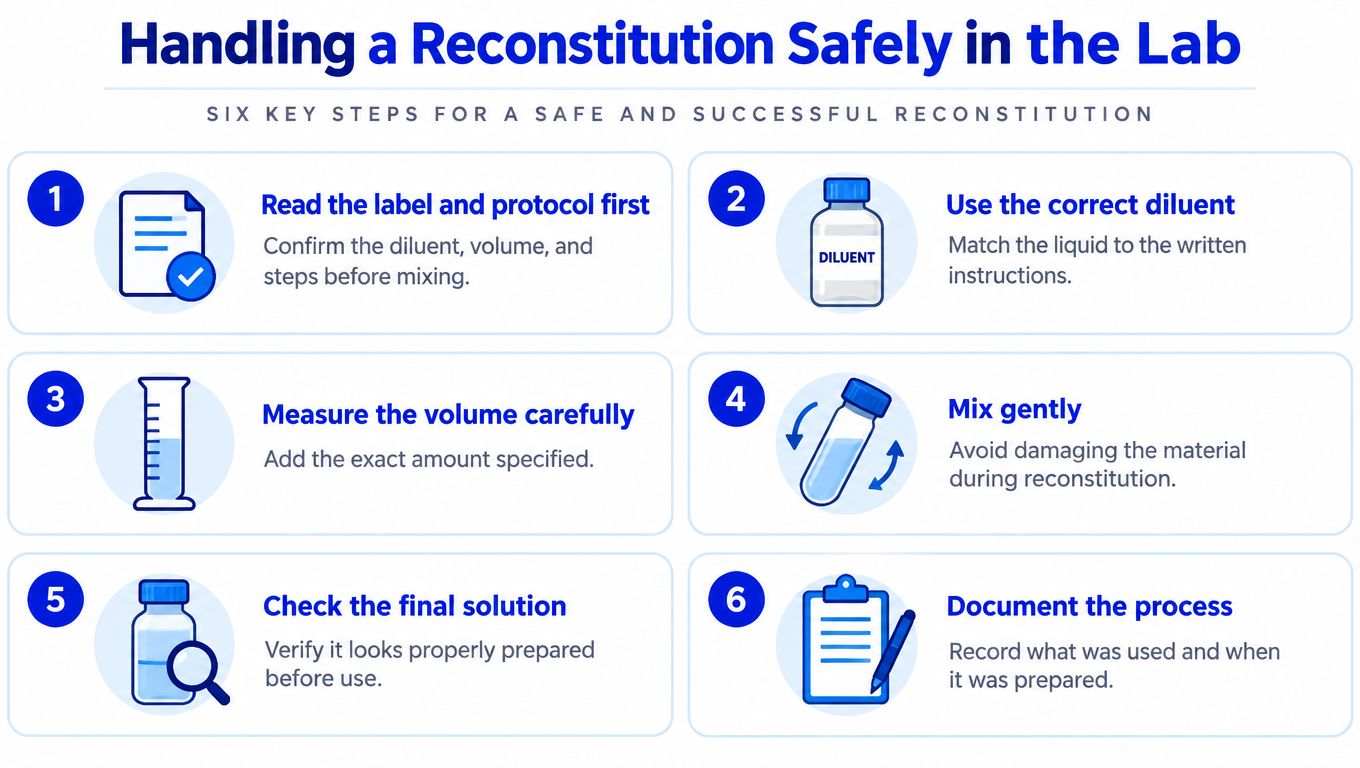
A satisfactory visual check is only an appearance check, not clearance for use. These habits reduce avoidable preparation errors, but they don't replace appropriate testing or expand a product's permitted use.
A dependable setup is one you can explain from the records without guessing. Before beginning, make sure the materials, documents, and planned experiment agree.
If any item is unresolved, pause preparation rather than filling the gap with an assumption. A calculation can establish a nominal concentration, but it can't resolve missing compatibility information or an unidentified lot.
For researchers comparing blended compounds, our GLOW BLEND at Peptide Warehouse USA combines BPC-157, GHK-Cu, and TB-500 and is supplied with COAs. Explore options by reviewing the lot documents and intended laboratory application before deciding; our products are for research, laboratory, or analytical use only, not human consumption.
A research compound isn't a clinically validated treatment merely because its ingredients appear in discussions of healing, muscle recovery, or anti-aging. Check the regulatory status of a claim before using it to guide a decision.
The label, the protocol, and the documents determine the next step, not the wording of a marketing page.
We offer research peptides and related compounds supported by lot documentation to help laboratories evaluate identity, quality, and traceability. Visit Peptide Warehouse USA to explore research-only options and review the available documents against your reconstitution protocol before purchasing.