No products in the cart.


Those asking what is TB-500 peptide often assume they're inquiring about a single compound. In practice, they're often mixing up two related but different things: TB-500 and thymosin beta-4. That mix-up matters because a research paper about the native protein doesn't automatically answer questions about the synthetic fragment sold for laboratory work.
If you work with peptides, that distinction changes how you read mechanisms, judge preclinical evidence, and set up experiments. It also changes how you think about regulation, documentation, and handling. A useful TB-500 explainer has to start with identity first, not hype.
What exactly is TB-500. A standalone peptide with its own evidence base, or a shorthand label for thymosin beta-4. That question sits at the center of much of the confusion around this compound.
For research purposes, TB-500 is typically described as a synthetic heptapeptide, Ac-LKKTETQ, linked to a short active-region sequence associated with thymosin beta-4. In practical terms, researchers are not dealing with the entire native biomolecule here. They are working with a smaller constructed fragment intended for experimental study.
That distinction shapes how the literature should be read. A fragment can preserve part of a parent molecule's biological behavior while losing other features that depend on full sequence length, folding, binding context, or distribution in a model system. A useful lab analogy is cutting a tool down to one working edge. The remaining piece may still perform one task, but it no longer represents the full tool.
New researchers often run into the same three errors:
Practical rule: Before interpreting any peptide study, verify whether the authors examined the endogenous peptide, a synthetic fragment, or a modified analogue.
TB-500 draws interest in preclinical work because fragment-based compounds can help narrow a biological question. If a full peptide participates in several interacting processes, a shorter sequence may let investigators test whether one region contributes to cell migration, cytoskeletal organization, or repair-related signaling under controlled conditions. That makes TB-500 less of a catch-all regenerative label and more of a targeted experimental probe.
Precision matters from the first sentence of a study design. Once the identity of the compound is blurred, the rest of the discussion usually drifts with it. Sequence, source material, formulation, and model all need to stay aligned before any mechanistic claim deserves serious weight.
What, exactly, is being studied when a paper or product page says "TB-500"? That question matters more than the name suggests, because TB-500 and thymosin beta-4 are related terms, not interchangeable identities.
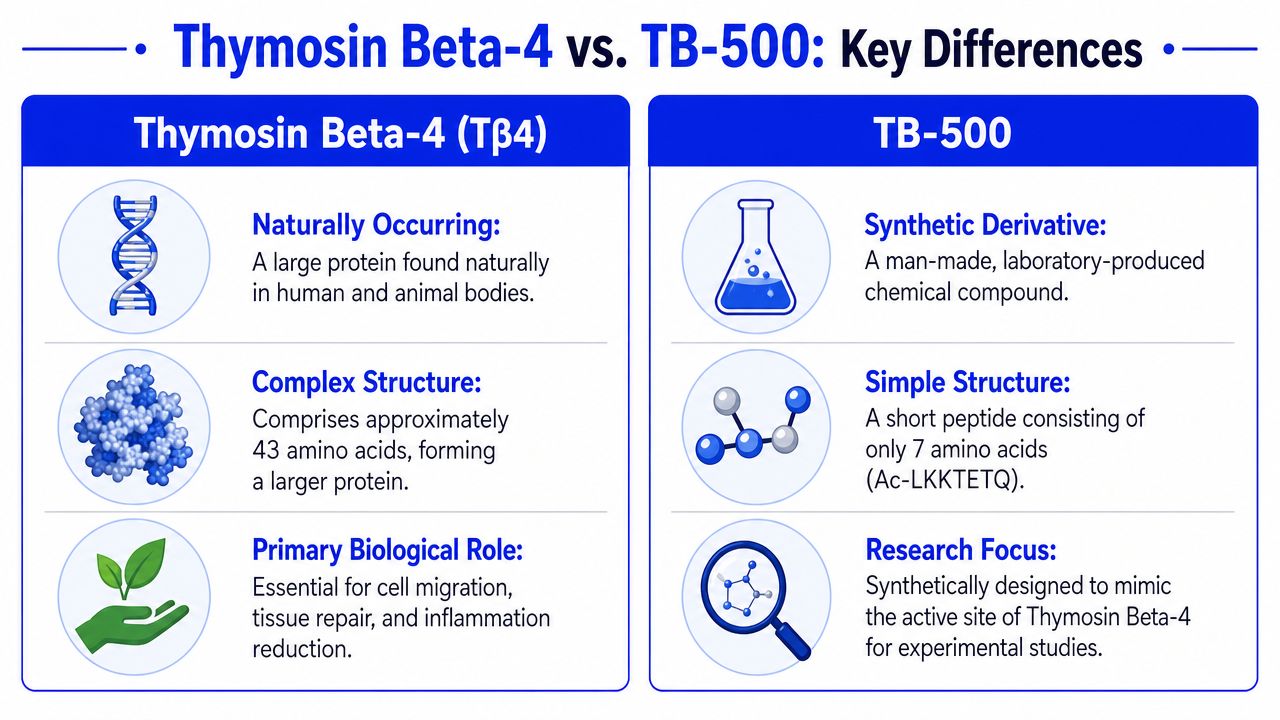
The core distinction is straightforward. Thymosin beta-4 refers to the native biological peptide. TB-500 refers to a synthetic fragment or analogue associated with an active region of that parent molecule and used in experimental settings.
That difference affects how a researcher reads evidence.
If a study examined the full native peptide, its findings reflect the behavior of the complete structure in a biological system. If another study examined TB-500, the test article was a shorter synthetic construct with different structural scope. Those are not the same starting materials, so they should not be treated as if they generate interchangeable conclusions.
A new lab member can use a simple rule here. Check the exact molecule before reading the result. Sequence, length, formulation, and study model all shape what the paper can support.
A full peptide carries more structural context. A fragment isolates one region that researchers suspect may contribute to a narrower function. In practical terms, that means a paper on thymosin beta-4 may involve broader biological activity than a paper on TB-500, even if both are discussed under the same repair-related umbrella.
Confusion frequently stems from marketing language. Labels such as "healing peptide" compress several separate questions into one vague claim. Research writing works better when the identity stays exact: Was the experiment performed on endogenous thymosin beta-4, a synthetic fragment identified as TB-500, or some other analogue?
Here is the distinction in a compact format:
| Compound | What it is | Research context |
|---|---|---|
| Thymosin beta-4 | Native peptide found naturally in biological systems | Studied as the full parent molecule |
| TB-500 | Synthetic fragment or analogue derived from a functional region | Used as a narrower preclinical research tool |
A fragment may retain scientific interest without reproducing the full biological identity of the parent peptide.
That single point prevents a lot of downstream confusion. Once the names are blurred, readers may transfer mechanistic claims, safety assumptions, or study outcomes from the parent molecule to the fragment without enough evidence. In preclinical research, the better habit is narrower and stricter: identify the exact compound first, then interpret only the data attached to that compound.
What, exactly, is TB-500 at the molecular level, and why does that distinction matter in a preclinical paper? The answer starts with precision. TB-500 is discussed in research settings as a short synthetic peptide sequence, not as the full thymosin beta-4 molecule. That difference matters because a fragment can be experimentally useful without reproducing the entire behavior of its parent protein.
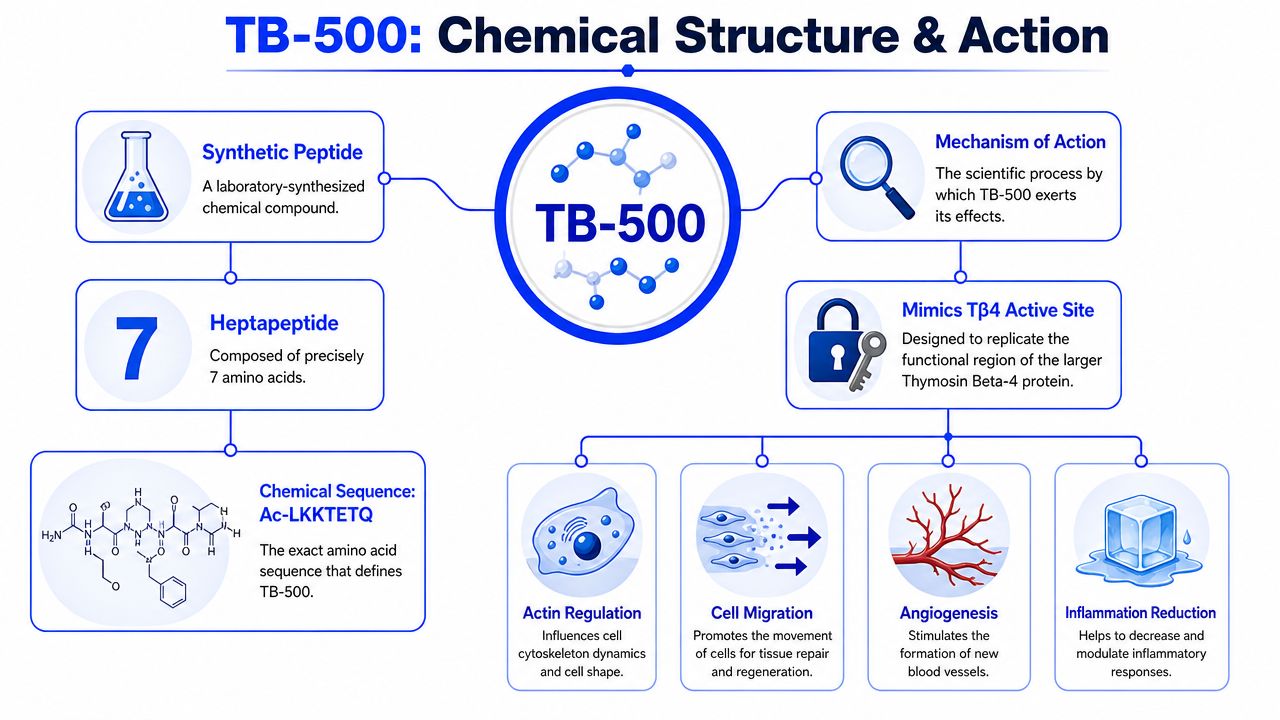
TB-500 is commonly described in technical materials as the synthetic heptapeptide Ac-LKKTETQ. A heptapeptide contains seven amino acid residues. In lab terms, that makes TB-500 a compact sequence model rather than a full-length peptide system.
Each part of the notation carries meaning:
That small size shapes how researchers should read the literature. A short synthetic fragment is easier to define chemically, but it also supports narrower claims. If a study measures an effect using TB-500, the result belongs to that defined sequence under those assay conditions. It should not be transferred automatically to the native full-length protein.
The main mechanistic theme linked to TB-500 is interaction with actin-related biology. Actin is a core cytoskeletal protein involved in cell shape, intracellular structure, and directed movement. Those functions become relevant in preclinical models where investigators are tracking how cells reorganize under stress, after injury, or during matrix remodeling.
That point often causes confusion, so it helps to separate levels of evidence.
At the molecular level, researchers are usually discussing actin dynamics. At the cellular level, they are often measuring migration, spreading, or structural reorganization. At the tissue-model level, they may be examining broader repair-associated patterns. Those are related questions, but they are not interchangeable.
Researchers commonly frame TB-500 around several linked processes:
A useful lab rule is to match the wording to the assay. If an experiment measured migration, the result supports a migration-related statement. If it measured actin polymerization or cell morphology, the claim should stay at that level. Broader language can sound impressive, but it weakens scientific accuracy.
Lab mindset: Treat TB-500 as a defined experimental peptide with pathway-level interest, not as a shortcut term for every effect reported for thymosin beta-4.
This is also where marketing language tends to blur the chemistry. Descriptions such as "repair peptide" or "healing peptide" compress several biological processes into one label. A stricter research description is more useful. TB-500 is a synthetic peptide fragment studied in preclinical systems for relationships to actin-associated behavior, cell movement, and related structural signaling pathways. That phrasing stays close to what the compound is, how it is discussed mechanistically, and what experimental designs can test.
Why does TB-500 keep appearing in research discussions? Because the biology tied to its parent system intersects with several core themes in experimental repair models. Those themes usually involve movement, structure, and signaling rather than a single dramatic effect.
In preclinical conversations, TB-500 is often grouped with compounds explored for tissue-repair pathways. The interest comes from its association with cell migration and actin-related behavior, both of which matter when researchers study how cells reorganize around damaged tissue.
That doesn't mean there's a simple one-to-one story such as “compound in, healing out.” Tissue repair is a coordinated process involving multiple cell types, extracellular matrix behavior, inflammatory signals, and local mechanical conditions. A peptide that influences one part of that network may still behave differently across models.
For lab planning, that has two implications:
A migration assay, a morphology readout, and a tissue-level histology model don't answer the same question.
Another area of interest is the possibility that TB-500 may influence pathways relevant to inflammatory response in preclinical settings. Researchers often care about this because inflammation and repair are tightly coupled. Too little signaling can stall a response. Too much can distort tissue remodeling.
This is one place where language often drifts into hype. In a disciplined summary, it's more accurate to say that TB-500 is explored in research contexts where modulation of repair-associated biology is relevant, rather than claiming a fixed outcome across systems.
Keep “anti-inflammatory” language tied to the actual model used. A cell assay, an animal model, and a human clinical endpoint are not interchangeable.
A compound can look promising in a tightly controlled experimental setup and still remain uncertain outside that setup. That's normal in preclinical science.
TB-500 is also discussed in relation to angiogenesis, or the formation of new blood vessels, alongside cellular migration. These ideas are biologically connected. Repairing tissue often requires both cellular repositioning and changes in local support systems.
In practical terms, researchers may find TB-500 interesting when designing studies around:
The main scientific value here isn't that TB-500 has already answered the field's questions. It's that it sits at an interesting intersection of structural biology and repair signaling.
That's why a cautious reader should treat TB-500 as a preclinical research subject, not as a settled therapeutic category. The peptide is interesting because it helps frame experiments around movement and organization inside biological systems. It's not interesting because the science is finished.
What changes when a peptide is sold for research only rather than recognized as an approved therapeutic? For TB-500, that distinction defines the boundaries of responsible scientific discussion.
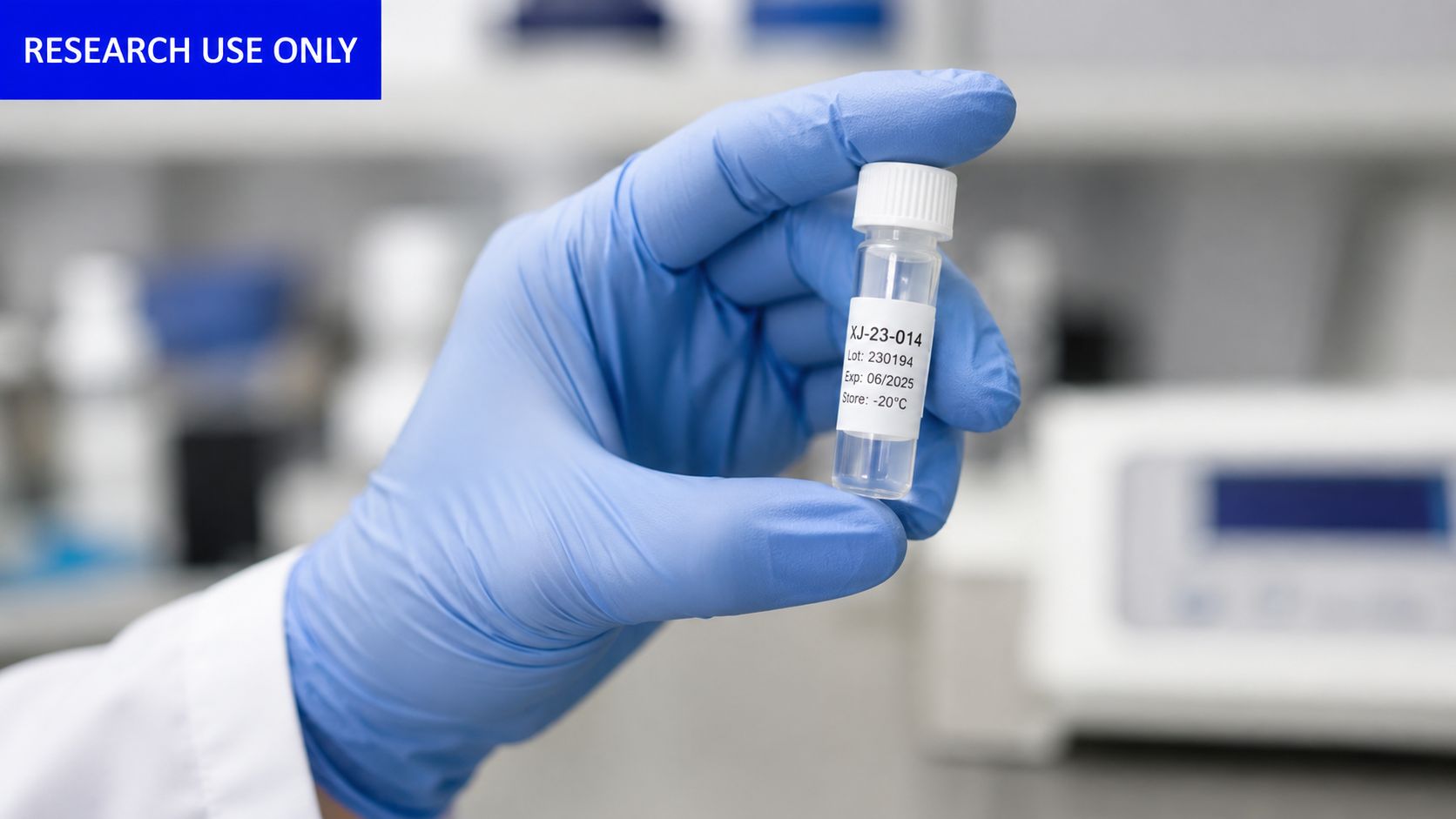
TB-500 is discussed in a regulatory context that is stricter than ordinary supplement-style marketing suggests. In practical terms, researchers should treat it as an experimental peptide with no approved human use status, and they should avoid borrowing safety assumptions from studies of native Thymosin Beta-4. Those are different materials. A fragment and a full-length endogenous protein do not share an automatic regulatory or toxicology profile.
That distinction causes confusion because the names sound related. In the lab, the cleaner analogy is a shortened tool bit versus the full instrument it came from. The shared origin matters for hypothesis generation, but it does not erase differences in identity, manufacturing, validation, or permitted use.
Research-only labeling has concrete consequences.
It means discussion should stay inside experimental boundaries such as peptide identity, assay conditions, storage controls, batch records, and model-specific observations. It also means language about treatment, benefit, dosing, or safety in humans is outside the supportable evidence base for TB-500 as a synthetic research peptide.
For laboratories, institutions, and purchasers, that affects several routine decisions:
A careful researcher keeps each claim attached to the model that produced it.
TB-500 also appears in discussions about anti-doping compliance. That matters because prohibited-list attention places the compound in a more sensitive oversight category than casual peptide advertising implies.
For readers who prefer a visual overview before reviewing policies, this short video summarizes the broader topic:
The scientific takeaway is straightforward. A compound associated with doping controls, absent approved human use status, and marketed for laboratory use should be handled as a research material under controlled documentation practices. That framing cuts through hype and keeps TB-500 in its proper category: a subject of preclinical investigation, not a validated medical product.
Once identity and regulation are clear, the next question is practical. How do you source TB-500 in a way that supports usable lab results?
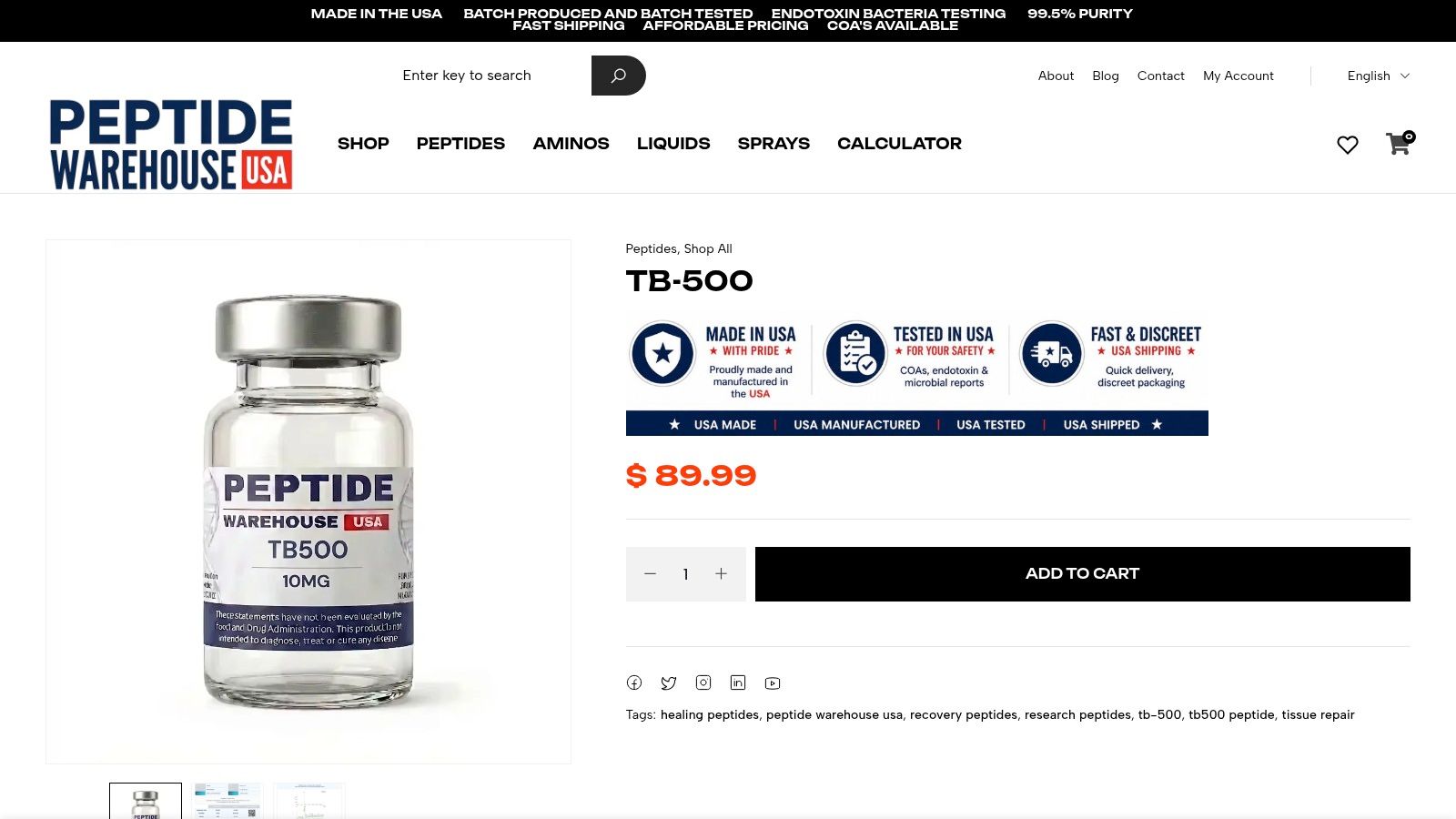
For any research peptide, quality starts with paperwork before it starts with experimentation.
Look for suppliers that provide:
One example is Peptide Warehouse USA, which states that its catalog is intended for laboratory, analytical, and preclinical applications and provides third-party documentation for lots. That kind of documentation matters more than marketing language because it supports reproducibility.
A quick screening table can help:
| Checkpoint | Why it matters |
|---|---|
| COA available | Confirms you can review lot-specific identity data |
| Batch labeling | Supports traceability in notebooks and inventory systems |
| Research-only disclaimer | Helps align procurement with regulatory expectations |
| Storage guidance | Protects peptide integrity during handling |
Once material arrives, poor handling can undermine good sourcing.
Labs typically focus on a few basic habits:
Small handling errors often look like biological variability until you audit the workflow.
Because protocols differ by assay type, institution, and solvent system, researchers should follow their internal laboratory SOPs and the manufacturer's product documentation rather than relying on generalized peptide folklore. Good peptide work is usually quiet, methodical, and heavily documented.
The clearest answer to what is TB-500 peptide is also the most useful one. TB-500 is a synthetic fragment, not the full native thymosin beta-4 protein. In research settings, it's discussed for its relationship to actin regulation, cell migration, and tissue-repair pathways. It should also be viewed within its real status as a research-only compound, not an approved human therapeutic.
That combination of identity, mechanism, and regulatory context helps cut through a lot of low-quality peptide content. For serious readers, the key habit is simple: match every claim to the exact compound studied.
Key scientific citations and technical references
If you're sourcing peptides for laboratory or preclinical work, explore Peptide Warehouse USA for research-focused compounds, lot documentation, and product details that can help support traceable experimental workflows.