No products in the cart.



Testagen is a synthetic tetrapeptide bioregulator with the sequence KEDG and molecular formula C17H29N5O9, developed for research into hormonal regulation and testicular function. It isn’t exogenous testosterone, which means researchers study it as a signaling compound rather than a direct hormone replacement.
Most confusion around what is testagen starts there. People search for a “testosterone peptide,” then run into mixed information about hormones, fertility, thyroid effects, and even unrelated products with a similar name.
The clearer way to understand Testagen is to treat it like a research tool for studying biological regulation. Instead of adding testosterone from the outside, the peptide has been investigated for how it may influence upstream endocrine signaling and gene expression in relevant tissues. That difference matters a lot for anyone reading peptide literature, comparing compounds, or evaluating sourcing for lab work.
What if the goal isn’t replacing a hormone, but studying how the body regulates it in the first place?
That question gets to the heart of what is testagen. In peptide research, Testagen is discussed as a short-chain bioregulatory peptide associated with endocrine and reproductive function, especially in models involving the pituitary and testes. Researchers are interested in it because it sits in a different category from common supplements, anabolic agents, and prescription testosterone products.
For a motivated non-specialist, the easiest mental model is this: testosterone replacement adds the output. Testagen research looks at whether a peptide can influence the control system that helps generate that output.
That distinction also helps avoid a common mistake. Testagen is often lumped together with “test boosters,” or confused with branded testosterone delivery products that happen to use a similar name. Neither framing is accurate.
Testagen is best understood as a research peptide tied to endocrine signaling, not as a synonym for testosterone and not as a consumer wellness supplement.
Researchers usually care about three things when they evaluate a compound like this:
Those are the questions worth answering carefully, especially because the literature around peptide bioregulators can be dense, technical, and easy to misread.
A peptide bioregulator is a very small chain of amino acids studied for its ability to send a precise biological signal. If you want a plain-language analogy, think of it less like a hammer and more like a note slipped under the right office door. The effect depends on where the message lands and how the receiving cell responds.
Many compounds in endocrine research work by pushing a receptor hard or by supplying a hormone directly. Bioregulators are discussed differently. They’re studied as molecules that may help influence cellular behavior at a more selective level.
Testagen is identified as KEDG, a tetrapeptide built from four amino acids. It has been described as a synthetic peptide bioregulator rather than a hormone, steroid, or standard anabolic compound.
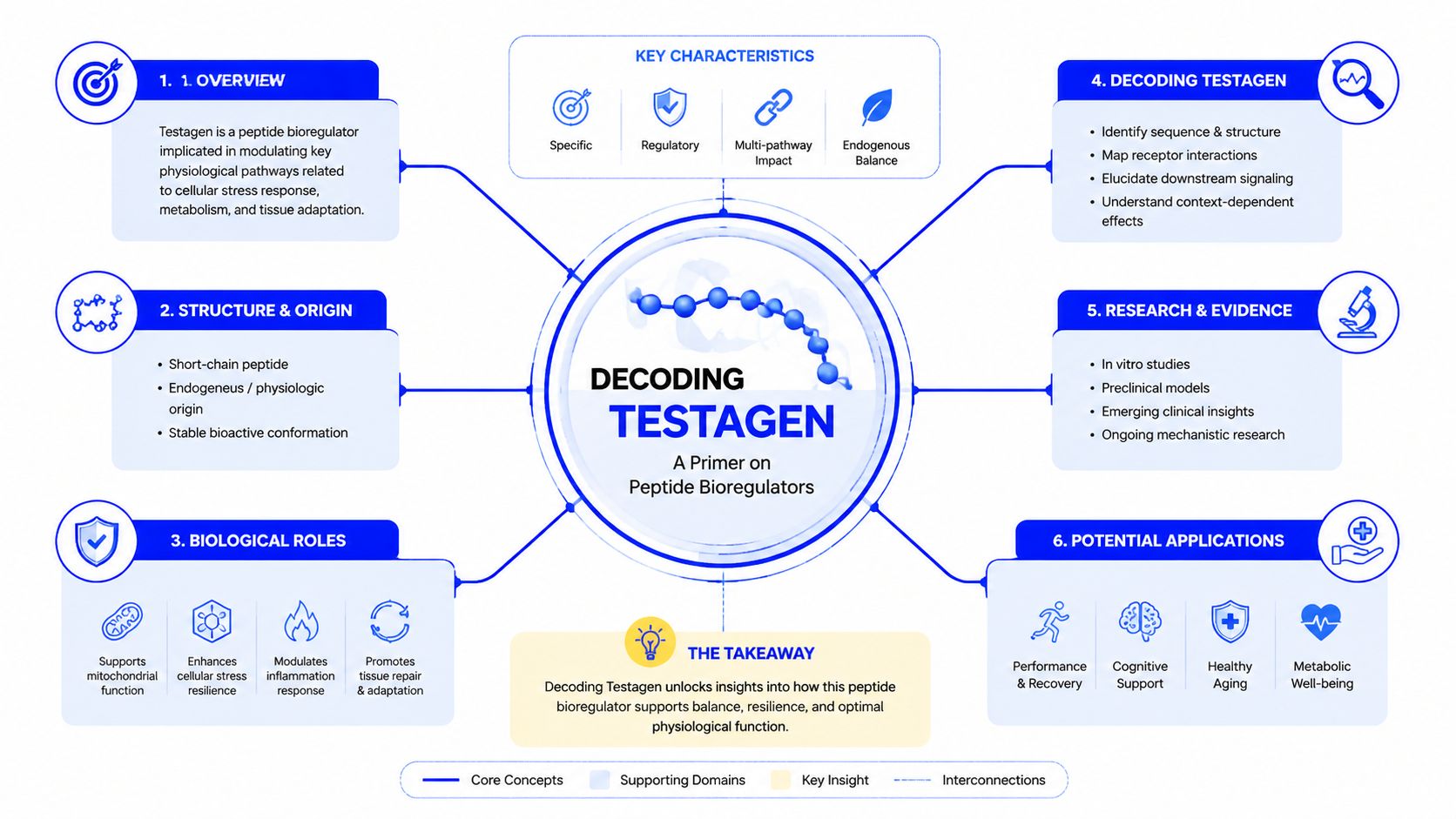
Testagen didn’t appear out of nowhere. According to the Khavinson peptide program overview on Newtropin, Testagen was developed from testicular tissue extracts in Russia during the late 20th century as part of a peptide research program that has produced over 20 bioregulatory peptides since the 1970s.
That historical detail matters because it tells you what family of ideas Testagen belongs to. It comes from a research tradition focused on organ-specific peptide signaling, where short peptides are investigated for tissue-targeted regulatory effects.
A few defining features help separate Testagen from more familiar compounds:
Practical rule: If a product description talks mostly about “boosting testosterone” but never clearly identifies KEDG or explains peptide bioregulation, it may be describing something else.
This is one reason the keyword “what is testagen” causes so much confusion online. The same word can point either to a research peptide or to unrelated testosterone-delivery products. For researchers, sequence and mechanism matter more than branding.
If the identity of Testagen is straightforward, the mechanism is where things get more interesting.
The core idea is that Testagen has been described as acting at the level of gene expression, not solely by acting like a replacement hormone. That puts it in a very different scientific category from compounds that flood the body with an external androgen.

Testagen penetrates cell and nuclear membranes, binds histones and DNA, and modulates gene expression in the anterior pituitary. In that description, this activity upregulates thyroid-stimulating hormone (TSH) release, which then cascades to increased T3 and T4 and supports normalization of pituitary-gonadal axis function.
That’s a dense sentence, so it helps to unpack it in plain language.
Cells don’t only respond to outside signals. They also regulate which genes are “open” for use and which are relatively quiet. Histones and chromatin are part of that packaging system. When researchers say a peptide may bind histones and DNA, they’re talking about a possible role in influencing how the cell reads its own instructions.
A simple flow looks like this:
| Step | Research description |
|---|---|
| Cell entry | The peptide is described as crossing cell and nuclear membranes |
| Nuclear interaction | It binds histones and DNA in research models |
| Pituitary signaling | It may modulate gene expression in the anterior pituitary |
| Hormonal output | TSH release rises, with downstream effects on thyroid hormones |
| System-level effect | Pituitary-gonadal function may move toward normalization |
That model is why Testagen attracts interest in endocrine research. It suggests a route where a small peptide may influence the regulatory layer above hormone production.
A useful comparison is thermostat control. TRT supplies heat directly. Testagen research asks whether a peptide can affect the thermostat circuitry.
That doesn’t mean the peptide is established for human therapeutic use. It means researchers study it as a modulator of endocrine signaling.
The distinction isn’t semantic. It changes the whole research question.
With exogenous testosterone, the main question is how outside hormone exposure changes circulating levels and feedback loops. With Testagen, the question is whether a short peptide can alter the signaling environment that shapes endogenous function.
That’s also why Testagen shows up in discussions about thyroid, pituitary, and gonadal interplay. The proposed mechanism isn’t narrow. It touches control points that sit upstream of the final hormone output.
Once you understand the mechanism, the next question is obvious. What are researchers trying to learn from Testagen?
The answer is mostly about endocrine regulation, male reproductive function, and the broader idea of tissue-specific peptide signaling. In the literature and product-facing research summaries, Testagen is often discussed in relation to hormonal balance rather than brute-force hormonal replacement.
Historical reports from Russian geroprotective programs are part of why the peptide still gets attention. The Exploring Peptides summary states that Testagen was shown to enhance male reproductive function in infertility treatments and reduce prostatic inflammation in chronic prostatitis cases by up to 40% in observational studies.
That doesn’t make it a proven therapy. It does explain why research interest has persisted.
Common research themes include:
A compound becomes more valuable in research when it asks a useful question. Testagen asks whether some forms of endocrine decline might be studied through regulation of signaling and gene expression, not just through replacement of missing output.
That leads to several practical applications in preclinical or analytical work:
Pituitary-focused studies
Researchers can examine how a short peptide influences endocrine command signals upstream of gonadal function.
Testicular signaling models
Because Testagen is associated with testicular peptide research, it fits naturally into studies of tissue-specific regulation.
Multi-axis hormone research
The peptide’s proposed link to TSH, T3, and T4 makes it relevant for researchers who don’t want to treat testosterone as a standalone variable.
The real value of Testagen in research isn’t that it “acts like testosterone.” It’s that it may help researchers study how endocrine systems coordinate themselves.
Some readers also encounter Testagen in discussions of vitality, body composition, or lean mass preservation. Those areas are usually framed through the peptide’s endocrine effects and its potential relevance to maintaining function under stress, not through direct anabolic action like a steroid.
That’s an important boundary. The research interest is mechanistic and regulatory first.
This comparison matters because many readers arrive with the wrong baseline. They assume Testagen is another route to the same destination as testosterone replacement therapy.
It isn’t.
TRT delivers exogenous testosterone. Testagen is discussed as a peptide bioregulator studied for its ability to modulate upstream endocrine processes. Those are different research categories, and they create different expectations around signaling, feedback, and fertility implications.
One verified point appears consistently in Testagen coverage: it is positioned as a non-suppressive alternative to exogenous testosterone replacement therapy, while TRT is described as suppressing natural production in up to 70% of users long-term. That distinction was covered earlier in the source literature and is central to how the peptide is framed in endocrine research.
For readers interested in the fertility side of hormone suppression, Hera Fertility sperm health resources offer useful background on how testosterone therapy can intersect with sperm count concerns.
| Attribute | Testagen (Peptide Bioregulator) | Testosterone Replacement Therapy (TRT) |
|---|---|---|
| Primary role | Studied as a regulatory peptide | Used to deliver testosterone directly |
| Mechanism | Modulation of signaling and gene expression | Hormone replacement |
| Position in endocrine pathway | Upstream or regulatory | Downstream, direct hormone input |
| Effect on natural production | Framed as non-suppressive in peptide literature | Associated with suppression of endogenous production |
| Research appeal | Endocrine homeostasis and tissue regulation | Serum testosterone replacement and symptom management |
| Conceptual model | Support the control system | Replace the output |
A plain-language summary helps.
Researchers don’t compare Testagen and TRT because they’re the same. They compare them because they sit on opposite sides of the modulation-versus-replacement divide.
Testagen should be discussed with a strict research-use lens.
It isn’t presented here as an FDA-approved medication for human consumption. If someone is evaluating it, the appropriate context is laboratory, analytical, or preclinical work. That boundary isn’t legal fine print. It’s the foundation for interpreting everything else about the compound.
With peptides, purity and documentation are part of experimental validity. If the peptide identity is uncertain, the rest of the data becomes harder to trust.
Synthetic sourcing for Testagen has been reported with 95.6-99.21% HPLC purity and low endotoxin profiles below 0.5 EU/mL. That kind of documentation matters in settings like in vitro pituitary cell cultures or rodent endocrine assays, where contamination or batch inconsistency can distort results.
A careful sourcing checklist usually includes:
In practical terms, peptide handling should be boring, consistent, and documented. That’s good science.
Researchers also benefit from understanding how hormones are discussed in other delivery formats, because confusion often starts when people blur distinct categories of products. For example, a consumer-facing discussion of contraceptive patch side effects is useful as a contrast case. It shows how delivery systems for hormones are framed very differently from research peptides, even when both involve endocrine topics.
Treat Testagen the way you’d treat any specialized research compound. Verify identity, confirm batch documentation, and keep human-use assumptions out of the interpretation.
If a seller can’t clearly explain purity, endotoxin status, storage, and intended research-only context, that’s a quality signal in itself.
No. Testagen is discussed as a peptide bioregulator, while testosterone is a hormone. That difference changes the mechanism completely.
Testosterone replacement introduces exogenous hormone. Testagen research focuses on whether a short peptide can influence upstream signaling and gene expression tied to endocrine function.
No, and this is one of the biggest sources of confusion.
As explained in the Testagen KEDG versus Testagen TDS clarification, the bioregulatory peptide Testagen (KEDG) is different from Testagen™ TDS®, which is a transdermal testosterone delivery system. The peptide is described as acting epigenetically, while the TDS is a method to deliver exogenous testosterone.
That means a search result may use the word “Testagen” while talking about an entirely different type of product.
In research settings, Testagen is commonly discussed as a lyophilized peptide that requires proper storage, reconstitution, and measurement under controlled conditions. Exact handling depends on the supplier’s specifications and the study design.
Researchers typically care about:
Because the name pulls together three different conversations at once:
Once you separate those three, the topic becomes much easier to understand.
Testagen is best defined as KEDG, a synthetic tetrapeptide bioregulator studied in endocrine and reproductive research. The key point isn’t hype about “boosting testosterone.” The key point is mechanism.
In research models, Testagen is discussed as a peptide that may influence gene expression and upstream hormonal signaling, especially at the pituitary level. That makes it conceptually different from TRT, which works through direct hormone replacement.
It’s also important to keep the naming issue straight. Testagen the peptide is not the same thing as topical testosterone systems that use a similar brand name.
Training context often shapes how people interpret peptide and hormone discussions, even when the compound itself belongs strictly in research settings.
The strongest takeaway is simple. If you want to answer what is testagen accurately, start with sequence, mechanism, and research context, not marketing language.
Researchers who want a reliable, research-only supply chain can learn more about Peptide Warehouse USA, where high-purity peptides are offered for laboratory, analytical, and preclinical applications with third-party documentation and clear batch traceability.