No products in the cart.


You’re probably here because you’ve seen “thymosin” used as if it were one thing, while product pages, forums, and papers seem to mean different molecules. That confusion is common. In peptide research, names that sound similar can point to very different compounds, with very different evidence behind them.
If you’re asking what is thymosin, the short answer is that it refers to a family of naturally occurring peptides linked to immune regulation and, in other forms, tissue-related biology. The longer answer matters more. Researchers need to distinguish thymosin alpha-1 from thymosin beta-4, separate broad biological interest from actual clinical evidence, and understand what quality markers like a COA can and can’t tell you in lab work.
Your body is always running maintenance. Immune cells scan for threats, damaged tissue gets patched, and signaling molecules coordinate who acts, when, and how strongly. Most of that work happens below the level of awareness, but it depends on highly specific biochemical instructions.
Peptides are part of that instruction system. They’re short chains of amino acids, and many of them act like targeted messengers rather than blunt-force switches. In research, that’s one reason peptides attract so much attention. A small molecule can influence a narrow biological pathway without behaving like a large structural protein.
Thymosin sits right in that territory. It isn’t a single, catch-all substance. It’s a peptide family associated with important biological functions, especially immune regulation in the case of thymosin alpha-1, and cell movement and tissue-related processes in the case of thymosin beta-4.
Practical rule: If a paper, supplier listing, or discussion just says “thymosin,” stop and identify the exact form before drawing any conclusions.
That step prevents a lot of downstream confusion. A claim about T-cell modulation doesn’t automatically apply to tissue repair research, and a finding about a peptide fragment doesn’t automatically apply to the parent molecule. For research purposes only, those distinctions aren’t semantic. They determine whether an experiment is designed around the right compound, the right endpoint, and the right expectations.
The name “thymosin” comes from the thymus, the small organ involved in immune development. That origin is why many people first encounter thymosin in discussions about T cells and immune signaling. But the term is broader than many readers expect.
A useful way to think about thymosins is as conductors rather than bricks. They don’t form the body’s structure. They influence how cells behave, communicate, and respond.
That’s especially helpful when you’re trying to answer what is thymosin in plain language. In peptide biology, function often comes from signaling, not bulk. A relatively compact sequence can still have meaningful regulatory effects.
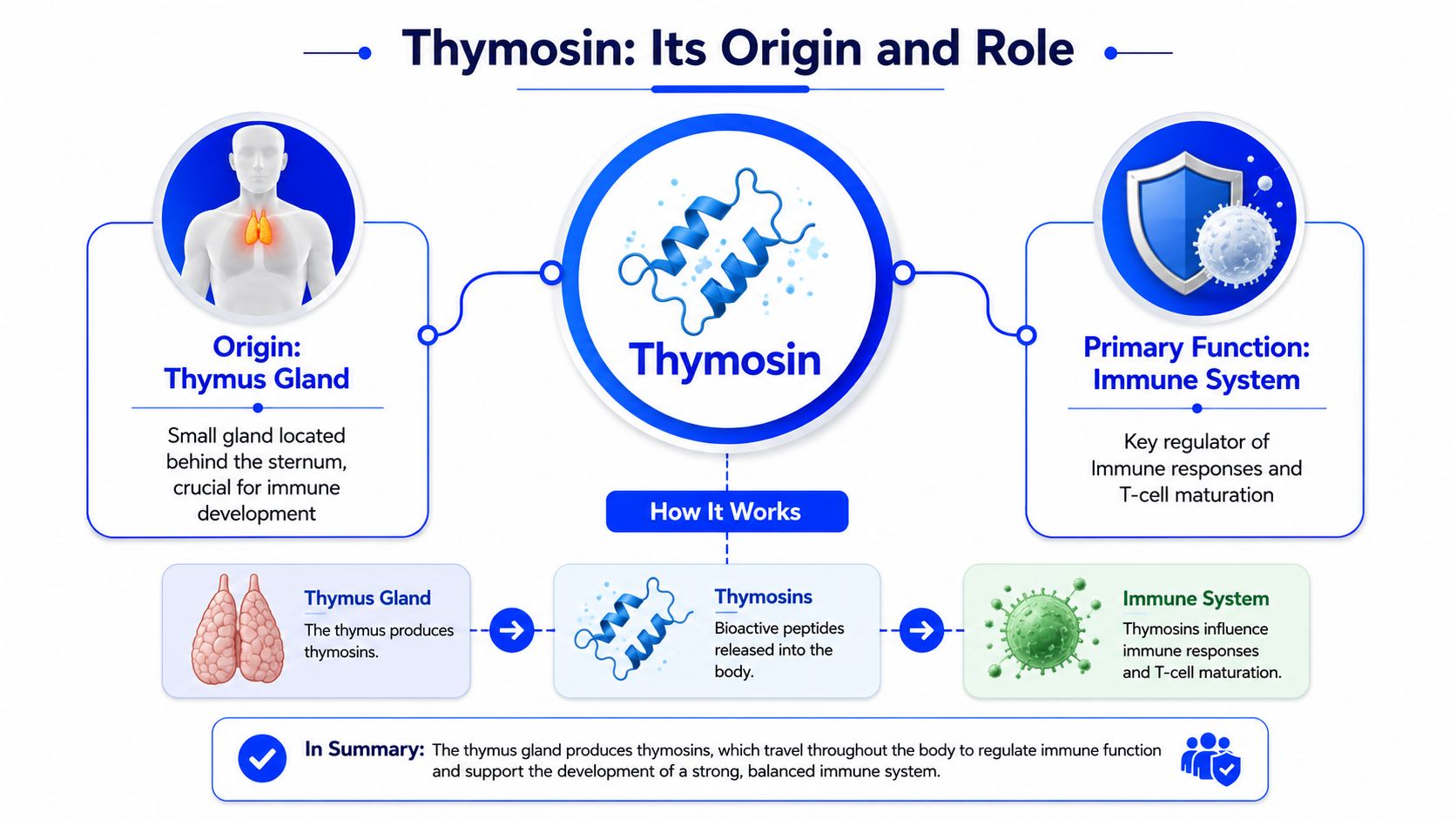
For thymosin alpha-1 specifically, the structure is unusually important to understanding the molecule. A review on thymosin alpha-1 structure and biology describes it as a 28-amino-acid thymic peptide with a molecular weight of about 3,108 Da and an isoelectric point of 4.2. The same review notes that it is produced by cleavage of prothymosin α, has an acetylated N-terminus, and lacks disulfide bonds and glycosylation.
Those details aren’t just chemistry trivia. They help explain why thymosin alpha-1 behaves like a compact immunomodulatory peptide rather than a large hormone-like structural protein.
For researchers, that has practical implications:
A quick visual summary can help anchor the basics before moving into the different forms.
Thymosin is best understood as a family label. The research question only becomes clear when you specify which thymosin you mean.
When people ask what is thymosin, they usually mean one of two research paths. One centers on thymosin alpha-1, which is tied to immune modulation. The other centers on thymosin beta-4, which is more often discussed in tissue-related and cell migration contexts.
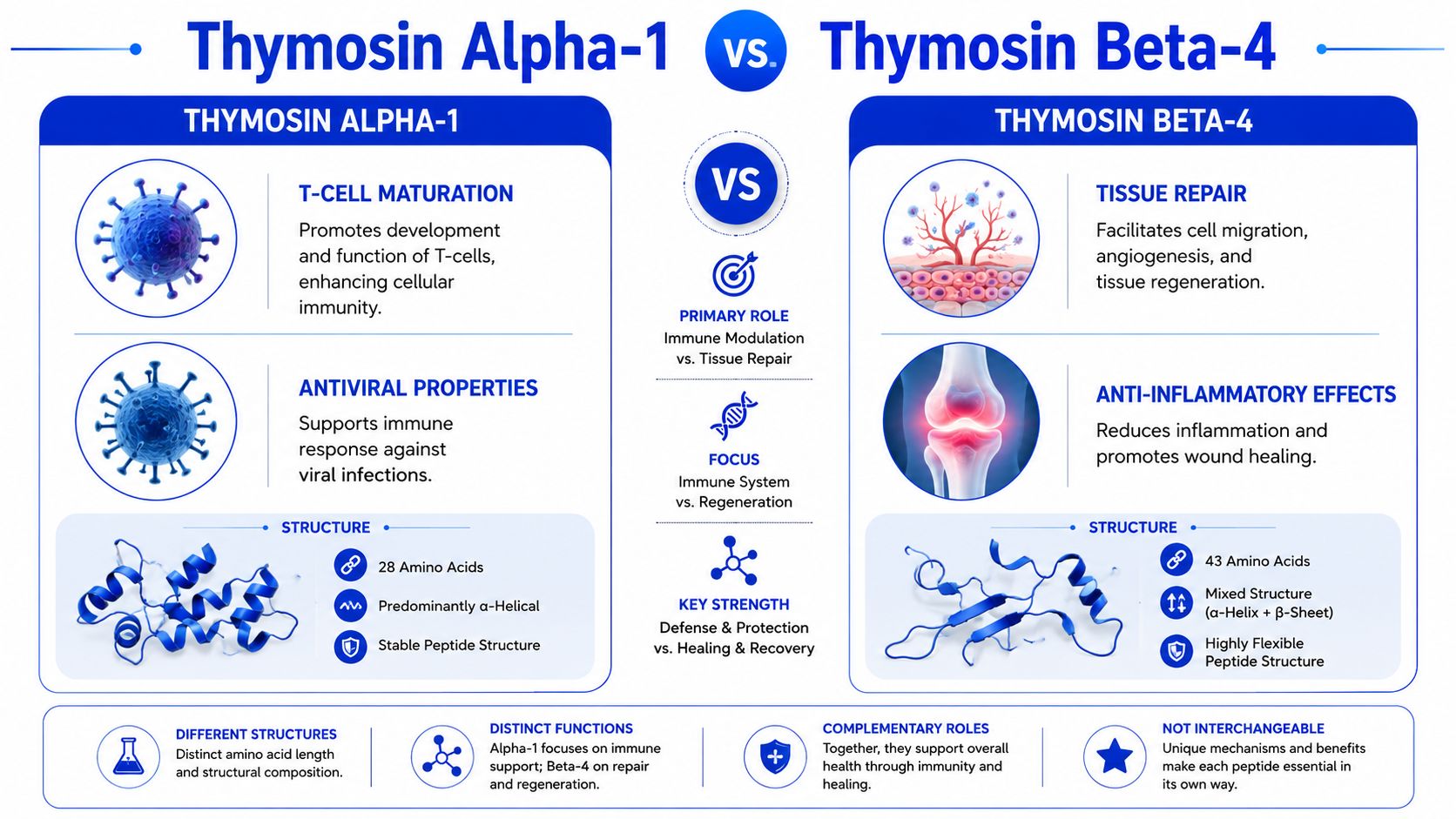
Thymosin alpha-1, often abbreviated Tα1, is the better-defined molecule from a human clinical perspective. It is a 28-amino-acid peptide naturally occurring in the thymus and is best known for its immunomodulatory role in T-cell development and function. A review on thymalfasin and thymosin alpha-1 reports that its synthetic form, thymalfasin (Zadaxin), is approved in more than 35 countries and, in one clinical-trial record, in 37 countries, including use for hepatitis B and vaccine-response enhancement.
That history matters because it gives Tα1 a very different status from many research peptides that circulate mainly through non-clinical markets. It has real regulatory and trial history in multiple countries, even though that doesn’t mean every modern use claim is well supported.
Thymosin beta-4, or Tβ4, tends to be discussed in a different biological frame. Researchers usually encounter it in connection with cell migration, actin interactions, wound models, and tissue-response questions.
The key point is conceptual. Tβ4 is not just “another version” of thymosin alpha-1. It belongs to the same broader naming family, but it is studied for different reasons and should not inherit Tα1’s immunology-focused evidence base by default.
A lot of confusion starts when a supplier page, article, or online discussion collapses these compounds into one umbrella story. That creates three common mistakes:
For research planning, it helps to think in a side-by-side way:
| Research question | More likely peptide of interest |
|---|---|
| T-cell development and immune modulation | Thymosin alpha-1 |
| Cell migration and tissue-response models | Thymosin beta-4 |
Research mindset: Start with the mechanism you want to investigate, then choose the peptide. Don’t start with the family name and work backward.
A researcher scanning thymosin papers can reach two very different conclusions from the same literature. One conclusion is that thymosin alpha-1 has meaningful human data in selected indications. The other is that broad, catch-all claims about “thymosin” usually collapse distinct molecules, endpoints, and study contexts into one vague story.

Among thymosin-related compounds, thymosin alpha-1 has the strongest clinical trail. A review in the World Journal of Gastroenterology discussing thymalfasin in chronic hepatitis B describes randomized trial evidence in which thymosin alpha-1 was associated with higher virologic response rates than untreated controls in some study settings. That matters because it places Tα1 in a different evidence category from peptides that are discussed mainly through mechanisms, supplier summaries, or animal models.
Researchers should still read that evidence narrowly. Hepatitis B is not a stand-in for sepsis, oncology, or general immune support. A positive signal in one disease area shows that a peptide may have clinically relevant activity under specific conditions. It does not validate every downstream claim attached to the thymosin name.
A separate review noted earlier in the article also describes thymalfasin research across hepatitis, HIV, melanoma, and immune dysfunction, with reported effects on T-cell function and inflammatory signaling. Those findings are scientifically interesting. They are also indication-specific, endpoint-specific, and tied to the alpha-1 form rather than to the entire thymosin family.
The easiest way to misread thymosin research is to treat all evidence as if it sits on one continuous ladder, from cell culture to human outcomes. In practice, the ladder has gaps.
For example, thymosin alpha-1 has been studied in severe infection and sepsis, but later-stage clinical results have not consistently shown the kind of outcome benefit that marketing language often implies. That split between biological plausibility and clinical performance is common in peptide research. It is one reason careful groups separate “mechanistic interest” from “proven therapeutic effect” in their notes, purchasing decisions, and study design.
This is also where the distinction between alpha-1 and beta-4 becomes practical rather than semantic. If a paper discusses T-cell differentiation, cytokine balance, or adjunctive immune modulation in human disease, the compound is usually thymosin alpha-1. If a claim shifts toward cell migration, actin dynamics, or tissue-response models, the relevant molecule is more likely thymosin beta-4. Mixing those tracks produces bad comparisons and weak experimental planning.
For research purposes only, the useful question is not whether “thymosin works.” The useful question is which thymosin, in what model, for which endpoint, and with what level of evidence.
A practical reading framework helps separate real signal from category confusion:
That last point gets overlooked. A COA is a quality-control document, not a shortcut to scientific validation. For labs working with research peptides, it functions more like an instrument calibration record than a proof-of-concept paper. It helps establish what material was supplied. It does not settle what that material will do in a disease model.
A lot of confusion in this field starts after one true statement. A peptide exists. A paper reports an effect. A supplier posts a purity figure. From there, readers sometimes infer that the whole category is established. A more careful conclusion is smaller and more useful. Thymosin remains scientifically interesting for research purposes only because specific forms show specific signals under specific conditions.
Another frequent source of confusion is the relationship between thymosin beta-4 and TB-500. These names are often used loosely, but they are not interchangeable in a strict research sense.
Thymosin beta-4 refers to the full peptide commonly discussed in tissue-related biology research. TB-500 is generally described in research circles as a synthetic peptide fragment associated with thymosin beta-4 activity.
That distinction matters because a fragment is not the same thing as the full parent molecule. Even when two compounds are related, researchers should not assume identical behavior, identical stability, or identical evidence coverage.
| Attribute | Thymosin Beta-4 (Tβ4) | TB-500 |
|---|---|---|
| Full name | Thymosin Beta-4 | TB-500 |
| Structure | Full peptide form commonly referenced in Tβ4 research | Synthetic fragment associated with Tβ4-related research use |
| Primary research focus | Cell migration, actin-related biology, tissue-response questions | Often selected when researchers want a fragment-based tool related to Tβ4 biology |
| Key distinguishing features | Broader parent molecule concept | Fragment-based approach, which may not map perfectly to the parent compound’s full biology |
Researchers usually care about this distinction for three reasons.
First, mechanism. A fragment may capture one active region without reproducing the complete biological profile of the full molecule.
Second, literature fit. If a paper studied Tβ4, that doesn’t automatically validate TB-500 as a direct stand-in.
Third, experimental interpretation. When outcomes differ, the reason may be the model, the assay, or the fact that the compounds are related but not identical.
If your protocol cites thymosin beta-4 literature, confirm whether your purchased material is the full peptide or a fragment analog before you start the study.
A common research failure starts before the first sample is run. The label says thymosin, the vial looks clean, and the paperwork seems adequate. Then the study becomes hard to interpret because the lot documentation is thin, the material was handled inconsistently after reconstitution, or the named compound was not matched carefully to the protocol.
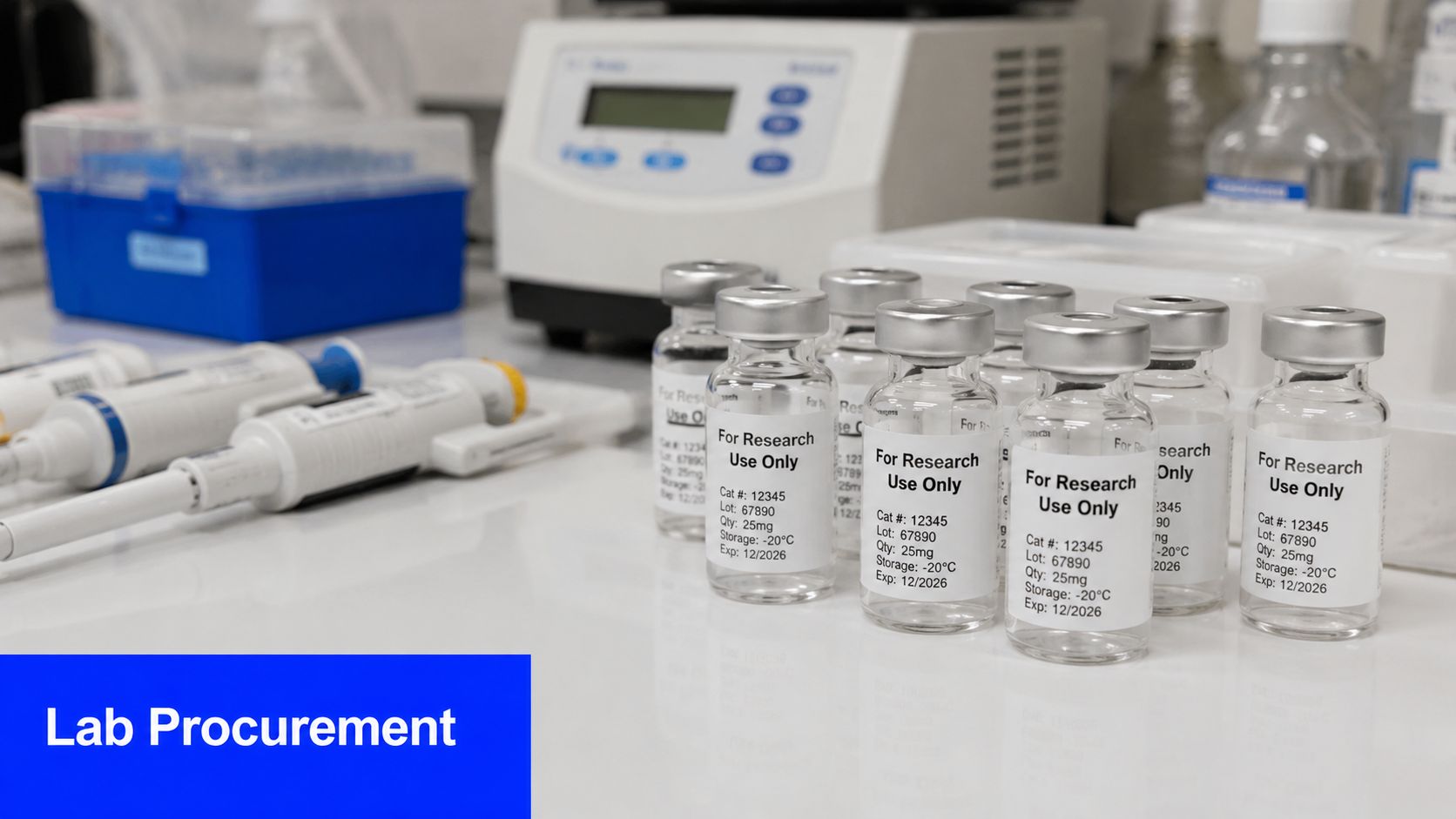
For thymosin research, procurement is part of method control. That matters even more here because “thymosin” is not one molecule. A lab ordering Thymosin Alpha-1 for an immune-focused design is making a different choice from a lab ordering Thymosin Beta-4 for cell migration or tissue-response work. If the form, batch record, or storage history is unclear, the experimental question becomes unclear too.
A Certificate of Analysis, or COA, is one of the first documents to review before material enters the workflow. It helps a researcher confirm that the vial in hand matches the peptide named in the protocol, not just a similar-sounding product category.
The most useful COAs answer four practical questions:
A COA is a lab document, not a conclusion. It supports identity and traceability, but it does not prove biological performance in your assay system. Researchers still need fit-for-purpose validation inside their own methods.
Peptide Warehouse USA, for example, states that its research-use lots are accompanied by third-party documentation such as COAs, microbial reports, endotoxin reports, and stated purity data. That type of record is useful for screening vendors and documenting chain of custody for research use only.
Peptides behave less like inert powders and more like sensitive reagents. Small handling differences can change stability, concentration confidence, and reproducibility across runs.
Several practices have an outsized effect on data quality:
One final point is easy to miss. Good documentation cannot rescue poor handling, and careful handling cannot fix uncertain identity. Researchers need both. That is how procurement stays connected to experimental interpretation rather than becoming an afterthought.
Thymosin isn’t one simple compound. It’s a peptide family, and that distinction shapes everything that follows. Thymosin alpha-1 stands out for immune-focused research and a real clinical history. Thymosin beta-4 belongs to a different line of inquiry centered on tissue and cell-response biology. TB-500 adds another layer of confusion because it is discussed as a related fragment, not the same molecule.
The evidence base also demands restraint. Thymosin alpha-1 has meaningful clinical signals in some settings, but not universal success across all indications. That’s why the most useful question isn’t just what is thymosin. It’s which thymosin, studied for what purpose, under what evidence standard, using what quality controls.
Researchers who want documented, research-use-only peptide materials can explore the Peptide Warehouse USA catalog to learn more about available compounds, batch documentation, and procurement options for laboratory work.