No products in the cart.

The most common advice about where to buy research peptides online is to find a supplier with a Certificate of Analysis and compare prices. That's not enough. A supplier's website and COA are claims to verify, not proof that the material in your shipment meets your laboratory's requirements.
A defensible purchase starts before checkout and ends after receiving inspection. You need a supplier screen, lot-specific analytical evidence, a marketing review, and a receiving plan that keeps unsuitable material out of your experiments. Research materials aren't medical products, and procurement documentation doesn't make them appropriate for personal use.
Search rank tells you who spends on marketing. The suppliers worth your budget are the ones whose claims you can verify, so begin with manufacturer and distributor websites and established laboratory catalog vendors, where the route to documentation is clear. Marketplace listings and social-media ads deserve the strictest screening, because identifying the seller accountable for a given lot number is harder there.
The risk is documented. The World Health Organization estimated in 2017 that roughly 1 in 10 medical products circulating in low- and middle-income countries was substandard or falsified, drawing on nearly 50,000 samples from 88 countries, and it names online and informal markets as common distribution channels.
Reviews of online pharmacies show the same pattern: a large share of storefronts fail recognized credential checks, and a long domain history or polished storefront does little to separate a legitimate seller from a rogue one. Those reviews cover medical products rather than research chemicals, so their figures can't be quoted as peptide-market data. What transfers is the screening lesson that appearance is a weak proxy for legitimacy.
The vetting order itself isn't unique to peptides. Colorado Cultures' guide to compare bulk mycology suppliers applies the same sequence in a different procurement category: identify the seller, request documentation, then compare terms. The analytical requirements differ; the vetting order stays the same.
A shortlist keeps the work proportional. Three to five candidates is enough to examine each supplier's record properly instead of skimming an unworkable list.
Every candidate that survives this screen earns a full document review. One that fails here doesn't get rescued by a good price.
Most buyers compare price first. A bargain paired with a 99% purity claim should instead prompt questions: a percentage alone doesn't establish identity, concentration, stability, sterility, or suitability for your experiment.
Use the same assessment for every candidate. Score each checkpoint as verified, unresolved, or failed, and record the supporting document rather than relying on a favorable overall impression. Don't average a failed identity check against good shipping service.
| Checkpoint | Good sign | Red flag |
|---|---|---|
| Lot-specific COA | Lot number matches the vial, invoice and COA | Generic COA reused across lots, or none provided |
| Identity method | Two orthogonal methods such as LC-MS and RP-HPLC | Only a purity percentage with no method named |
| Purity data | Chromatogram with method conditions and impurity resolution | 99% claim with no chromatogram |
| Endotoxin and microbial reports | Lot-linked results when the experiment requires them | Not offered, or not traceable to the lot |
| Manufacturing origin | Named manufacturing partner and batch-testing statement | Vague origin language such as sourced globally |
| Chemical details | Sequence, salt form and nominal quantity on the listing | Sequence or quantity missing |
| Storage and shipping | Stated storage conditions and temperature-controlled handling appropriate to the material | No storage guidance |
| Documentation support | Named contact for COA and order questions | No way to request records |
Temperature control should match documented material requirements. Expensive cold shipping isn't automatically better if the supplier can't explain the required conditions or substantiate the handling arrangement.
The reason to insist on lot-level evidence is practical. Drugs.com's review of peptide safety describes a forensic analysis of ten frequently seized products in Belgium, in which some samples contained as little as 5% of the labeled compound, and arsenic and lead were detected among the samples. Those products came from illegal internet pharmacies, so the finding doesn't establish the quality of every research supplier.
Flag these problems while reviewing listings and correspondence:
Practical rule: When two or more warning signs appear, pause the purchase. Request lot-specific records and the analytical laboratory's name, and leave if the answers remain vague.
This is a purchasing rule, not a validated risk score. A serious failure, such as incompatible identity evidence, can justify rejection on its own.
At Peptide Warehouse USA, we provide high-purity research peptides backed by third-party testing, including COAs, endotoxin reports, and microbial reports. Our products are made in the USA, batch produced, and batch tested. Apply every checklist row to our product pages and the actual lot documentation rather than treating those statements as substitutes for verification.
Keep the completed assessment with each order. A familiar product name and stated concentration never verify the contents.
A Certificate of Analysis is a starting document, not a release decision. Before reviewing one, define the analytical attributes your experiment needs so you can distinguish missing information from information that isn't relevant to the intended work.
USP technical guidance on synthetic peptide quality recommends at least two orthogonal identity methods, such as LC-MS or LC-MS/MS combined with RP-HPLC, because a single chromatographic peak cannot reliably establish sequence, stereochemistry, or molecular identity.
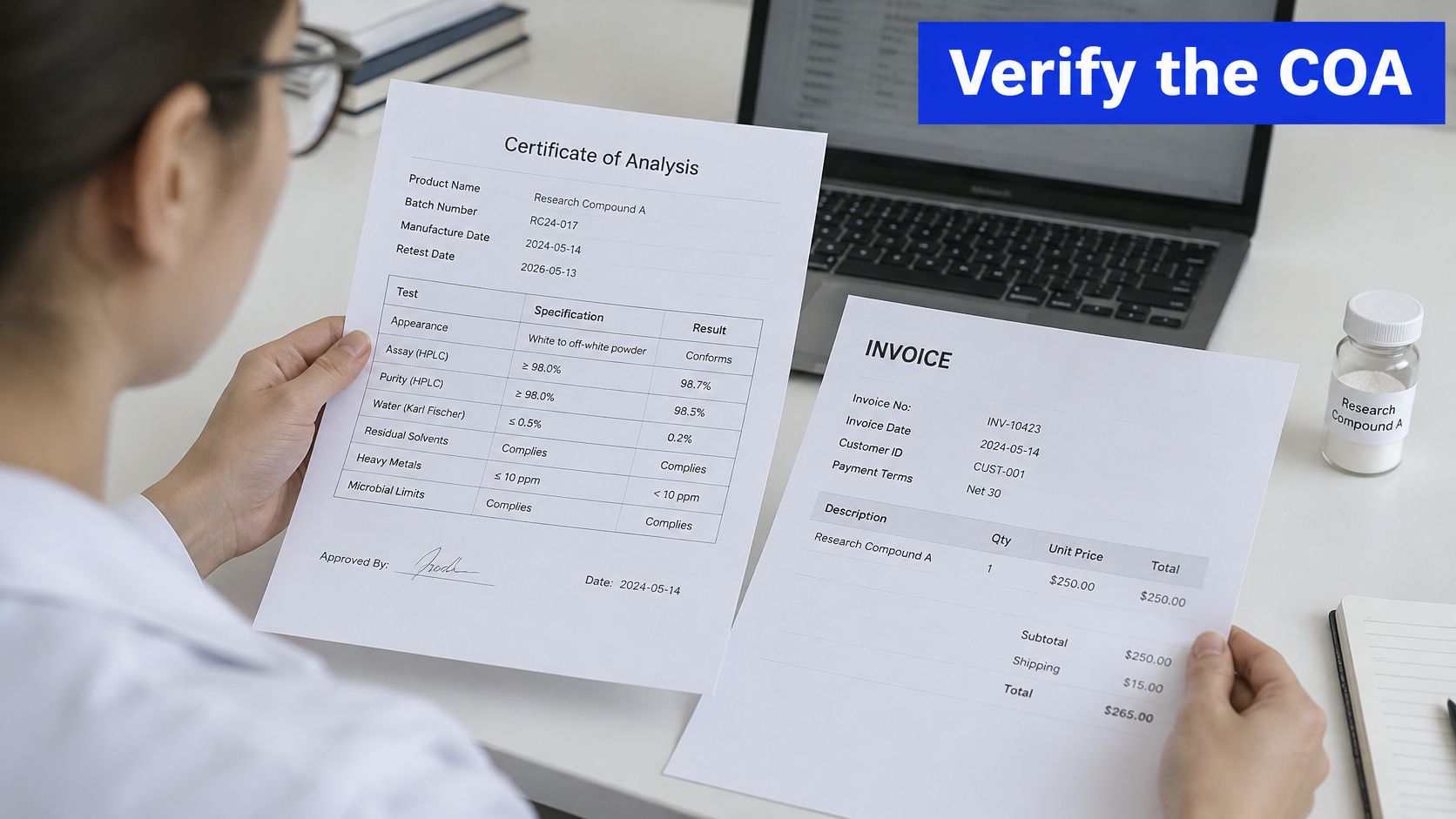
The most common mistake is accepting a familiar percentage without examining what the method measured. Identity asks whether the material is the intended compound; purity describes its composition under the conditions of a particular analysis.
A reused COA, an unexplained method, or a missing chromatogram leaves a different gap, and each needs its own resolution. For experiments sensitive to stereochemistry or composition, additional approaches may include chiral analysis, peptide mapping, amino-acid analysis, or counter-ion quantification.
A complete COA should let a reviewer connect the material, the method, the result, and the acceptance decision without guessing.
At a glance, look for the product identifier, exact lot, laboratory attribution, testing dates, specifications, results, methods, and supporting analytical records. “Pass” is useful only when the document explains what passing means.
A research-use-only label isn't a legal safe harbor. Regulators can consider the entire sales experience, including product descriptions, instructions, accessories, and customer communications, when evaluating intended use.
McDermott's analysis of peptide enforcement explains why dosing guidance, injection instructions, calculators, and related supplies can undermine laboratory-only positioning. Audit the surrounding content, not just the disclaimer at the bottom of the page.
| Page element | Consistent with research use | Warning sign |
|---|---|---|
| Product description | Identity, sequence form, quantity and lot data | Dosing amounts, schedules or treatment outcomes |
| Use statement | Explicit laboratory-only and not-for-human-use wording | Wording that implies personal or clinical use |
| Add-on items | Laboratory consumables only | Reconstitution kits, syringes or injection supplies |
| Calculators or guides | No human dosing tools | Dose calculators or injection instructions |
| Account and age controls | Age gate and account requirement | Open checkout with no eligibility check |
| Health claims | Specific, documented analytical claims | Healing, fat-loss or anti-aging promises without evidence |
Read product descriptions carefully. A listing that gives a sequence and analytical specification serves a different purpose from one describing a personal treatment schedule.
Check whether the use statement agrees with the rest of the site. A laboratory-only footer doesn't resolve contradictory promises elsewhere.
Evaluate accessories in context. Reconstitution materials have laboratory applications, but a bundle presented as a ready-to-inject personal-use kit sends a different signal.
Likewise, distinguish an analytical calculation tool from a calculator that recommends human doses. Account requirements and age gates can support eligibility screening, but neither establishes product quality or regulatory approval.
The FDA's guidance on promoting compounded drugs states that compounded drugs aren't reviewed by the agency for safety, effectiveness, or quality before marketing, and sellers can't describe them as FDA-approved or generic equivalents of approved drugs. A research supplier, pharmacy, and drug manufacturer shouldn't be treated as interchangeable categories.
Health claims also need evidence. The FTC Health Products Compliance Guidance requires a reasonable basis for health-related advertising, including competent and reliable scientific evidence where appropriate. Testimonials about the benefits of peptides don't replace substantiation for healing, fat-loss, or anti-aging claims.
Our products are sold for research, laboratory, or analytical purposes only and aren't intended for human or veterinary consumption. Treat that policy as a boundary, not medical authorization.
Laboratory procurement is separate from self-experimentation. Anyone seeking treatment, weight management, or another personal health outcome needs an appropriately authorized medical and pharmacy pathway, not a research-chemical vendor.
A good purchasing decision can still produce unusable material if nobody controls receiving. Assign responsibility before ordering so a delivery doesn't move directly from the loading area into an experiment.
Use the purchasing workflow as a record of decisions, not a shipping checklist.
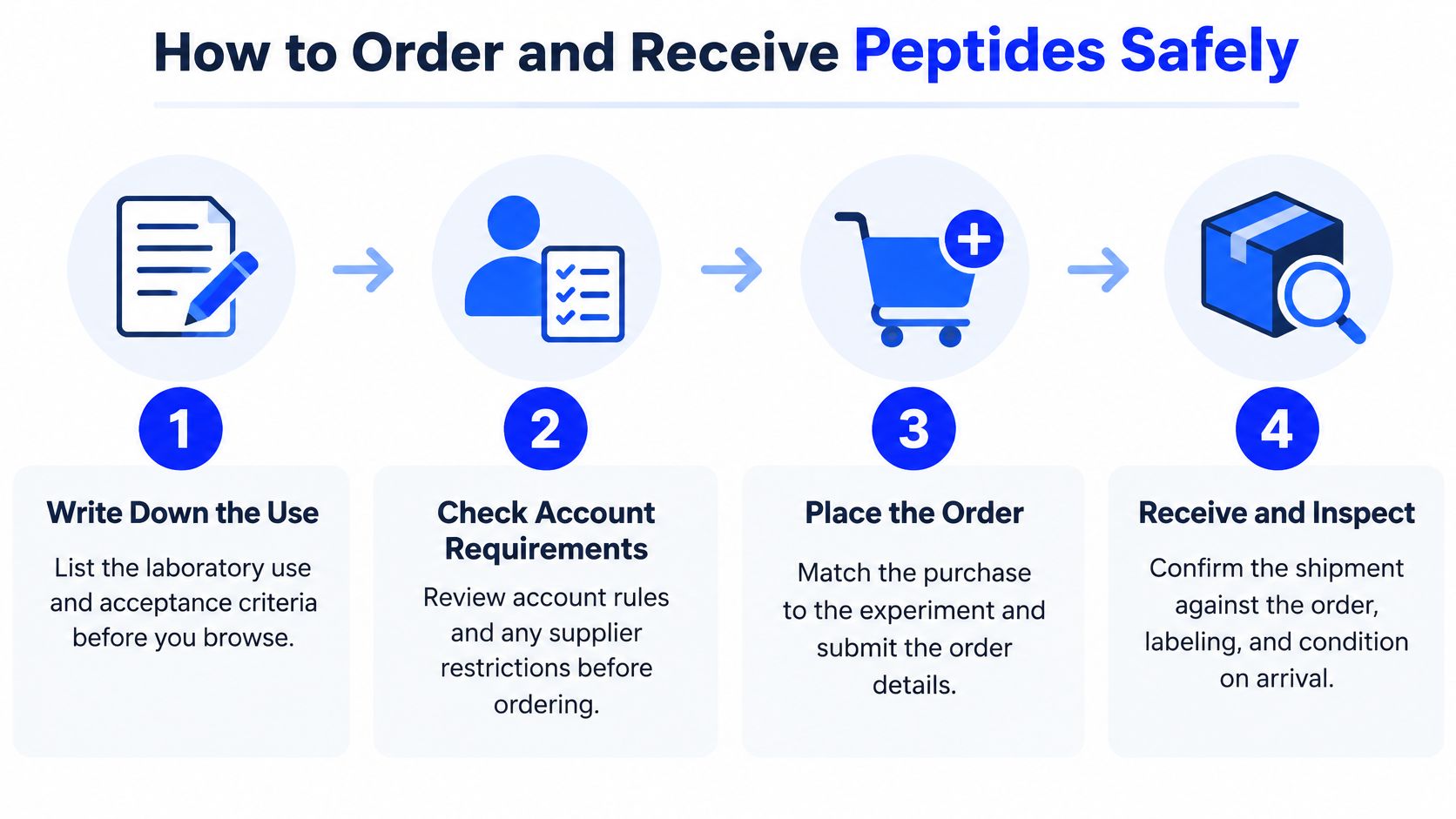
Tamper evidence helps you assess package integrity, but an intact seal doesn't establish chemical quality. Packaging Panda's explanation of protecting products from warehouse to doorstep provides useful context for recognizing the role of tamper-evident packaging during transit.
If packaging is damaged, photograph it before unpacking further. Preserve the shipping label and packaging, document the discrepancy, and keep the material on hold while the responsible reviewer determines whether it can be accepted.
International buyers need additional checks before payment. Confirm import declarations, customs classification, and applicable local controlled-substance rules with your institution's import or compliance team; domestic shipping availability doesn't establish permission to import.
A clean receiving record identifies who received the shipment, when it arrived, which lot arrived, its condition, its storage location, and who authorized release. It also records unresolved discrepancies and their disposition. That's what makes the material traceable after the shipping box is gone.
A supplier earns the order only when the lot-level assessment, marketing review, and receiving plan all pass. Don't let a helpful sales reply replace technical evidence, and don't let complete paperwork excuse contradictory intended-use claims.
Keep the decision record beside the supporting documents so another reviewer can check your conclusion.

Peptide Warehouse USA is a research chemical supplier, not a compounding pharmacy or outsourcing facility. Our stated purpose is supplying materials for research, laboratory, or analytical work, and the statements on our website haven't been evaluated by the U.S. Food and Drug Administration.
Before purchasing, confirm the allocated lot's COA, purity method, and relevant endotoxin report. Match those records to your laboratory's requirements rather than relying on a general catalog description.
Our support team assists with non-medical, non-clinical questions about product availability, documentation, and order status. We don't provide medical advice, dosing instructions, or treatment guidance.
For blended compounds, make sure the documentation addresses the components your experiment depends on. A blend name alone isn't enough to define an experimental input.
A research peptide is only as trustworthy as the paperwork tied to the lot in your hands.
Use the accompanying video as supplementary content, not as a replacement for document review.
The purchasing decision should be straightforward: approve documented material that meets predefined requirements, hold unresolved material, and reject material that fails them. Keep your completed checklist on file so the next purchase starts with a repeatable process rather than a fresh search.
Peptide Warehouse USA offers research peptides supported by third-party COAs, endotoxin reports, and microbial reports for laboratory procurement. Visit Peptide Warehouse USA to learn more about the current catalog, explore options that match your lab's documentation needs, and contact our team with non-medical documentation questions before ordering.