No products in the cart.

Most buying guides rank tesamorelin by price and a purity percentage. That advice fails the first test a careful buyer should run.
If you are looking for where to buy tesamorelin online, you are not shopping a supplement. Tesamorelin is a prescription injectable with a narrow labeled use, and a product page does not change that status. The useful question is whether the listing is an FDA-authorized medicine or laboratory material with a different legal status.
A low price, a high purity banner, or fast shipping cannot answer it. The checks below run in order: legal pathway, supplier channel, lot documentation, shipping and customs, then price as a warning rather than a score.
A common shortcut says the safest listing is the one with the lowest price or the highest purity number. That shortcut treats a regulated medicine like a commodity powder. It isn't.
An online product page does not rewrite the legal category of the item in the vial, and it does not create a new approved use. People comparing storefronts still need to know who may sell the product, to whom, and for what purpose. Until those points are clear, a checkout button is just a form.
Price and purity answer the wrong question first. A discount can mean a different product, a different seller type, or missing controls. A purity percentage, even a high one, describes a lab result on a sample. It does not show that the item is the FDA-authorized medicine, that a clinician evaluated the buyer, or that a licensed pharmacy dispensed it.
People who want weight-loss medicines sometimes look for safe online access to weight-loss prescriptions through services that still require a prescription and a real pharmacy relationship. That model is a useful contrast. A page that offers tesamorelin with no evaluation and no pharmacist is not the same kind of pathway.
Use this order, and stop when a check fails.
Practical rule: If a seller cannot show what the product is, who may receive it, and which documents travel with the lot, a low price is not a bargain. It is a missing file.
Online sellers often market across borders while permission stays local. A listing that is lawful to host in one country does not tell you whether you may import, possess, or use the item where you live. A trustworthy answer names the product, the buyer's purpose, and the jurisdiction before it names a vendor.
Channel fit comes before a certificate review. Shipping and customs come before you treat two prices as comparable. Research-use buying gets its own routine at the end, separate from any prescription path.
The buying decision starts with the label, not the advertisement.
The FDA approved Egrifta in 2010 as a prescription growth-hormone-releasing-factor analog for reducing excess abdominal fat in adults with HIV-associated lipodystrophy. Current labeling for Egrifta SV and Egrifta WR states the medicine is not indicated for general weight management because its effect is weight-neutral, and it also notes that long-term cardiovascular safety has not been established, per FDA labeling for Egrifta.
That population limit is the point shoppers miss. Ads for bodybuilding, anti-aging, or routine fat loss do not widen the approval. This is not medical advice. A licensed clinician decides whether the labeled use fits a specific patient.
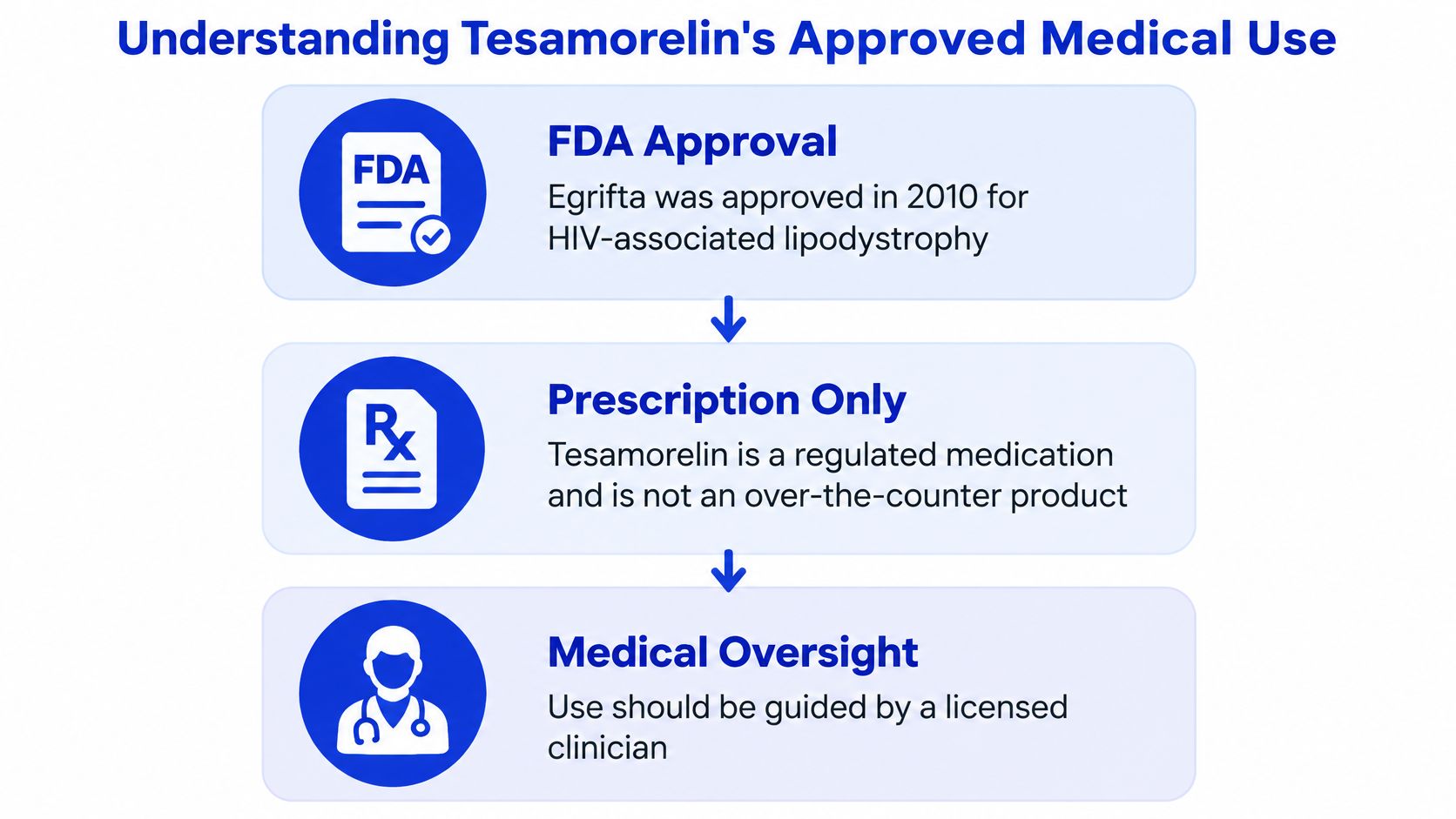
The chart is the hierarchy in plain form. Approval is narrow, the product is prescription-only, and a clinician stays in the loop. A catalog page that skips any of those three is describing something else.
The same active ingredient does not mean the same product. Current EGRIFTA labeling distinguishes EGRIFTA SV, a 2 mg per vial formulation, from EGRIFTA, a 1 mg per vial formulation. The products differ in dosage, the number of vials needed to prepare a dose, reconstitution, and storage. The labeling says the formulations are not substitutable.
EGRIFTA SV is reconstituted with the supplied sterile water for injection and given once daily by subcutaneous abdominal injection. A generic "tesamorelin for sale" title hides those differences. On a legitimate medicine pathway you should be able to read the brand or formulation, vial strength, included diluent, storage, expiration, and dispensing directions.
Research-use-only labeling is a sales designation for laboratory, analytical, or research work. It is not a quieter version of Egrifta. A lower price or a high purity claim does not establish therapeutic equivalence, sterility suitable for injection, correct concentration, or lawful human use.
Readers comparing how peptide marketing drifts from labeled indications can use this UK guide to weight loss peptides as a separate explainer. The benefits of peptides discussed in a research catalog are not the same thing as an approved clinical outcome in a defined patient group.
A product page that uses the name tesamorelin without naming the formulation is not yet a medicine you can evaluate.
Keep the approved product and the research material in separate notes. Mixing them is how buyers end up comparing a dispensed injectable with a lyophilized powder as if they were one SKU.
Channel comes before brand preference. Four routes show up in search results, and only some of them can lawfully supply an approved medicine in the United States.
The FDA's guidance on buying medicines online lists signs of a legitimate online pharmacy. It should require a doctor's prescription, provide a U.S. physical address and telephone number, employ a licensed pharmacist for questions, and hold a license with a state board of pharmacy. The agency warns against sites that sell prescription medicines without a prescription or advertise prices that appear too good to be true. You can check a pharmacy through the relevant state board and the FDA's BeSafeRx resources.
| Channel | Legal pathway | Documentation to request | Main risk |
|---|---|---|---|
| Licensed U.S. pharmacy | Dispenses an approved prescription product after a valid prescription | Pharmacy license, pharmacist access, U.S. address and phone, exact formulation and expiration details from the dispenser | A site that looks like a pharmacy but skips the prescription |
| Clinician-directed care | A licensed clinician evaluates whether the labeled use applies, then sends a prescription to a licensed dispenser | Visit record, prescription, and the pharmacy's license | Marketing that never involves a real prescriber |
| Research-chemical supplier | Sells material for laboratory, analytical, or research use only, not as a medicine | Lot-specific COA, assay method, microbial and endotoxin reports, storage terms, research-use statement | Treating research material as a substitute for Egrifta |
| Unverified marketplace or overseas seller | Often no clear lawful pathway for a U.S. patient or a documented lab buyer | Frequently none you can verify | Misbranded goods, customs refusal, or human-use claims on an unapproved product |
Licensed pharmacy. This is the pathway when a clinician has prescribed an approved tesamorelin product. You are receiving a dispensed medicine, not a catalog powder. Confirm the exact brand, because the formulations are not substitutable, as covered above.
Clinician first, then a dispenser. Some people start with a clinic website rather than a pharmacy. The lawful sequence is still evaluation, a prescription when appropriate, and a licensed pharmacy. A questionnaire that ends in a shopping cart is not that sequence.
Research-chemical suppliers. Laboratories sometimes need the compound as a research material. Peptide Warehouse USA is a U.S. research-chemical supplier that manufactures in the USA, publishes third-party certificates of analysis plus endotoxin and microbial reports, and states purity up to 99.5%. It sells only for laboratory, analytical, or research use. It is not a compounding pharmacy, and its products are not for human consumption. That channel fits a lab buyer. It does not fit someone seeking the approved medicine.
Unverified or overseas listings. If there is no prescription control, no pharmacist, and no verifiable license, the listing fails the FDA's signs of a legitimate pharmacy. Cross-border storefronts add import rules that a domestic pharmacy fill does not.
Match the channel to the purpose. A lab procurement file and a patient's prescription are not interchangeable paperwork.
Individuals who are not in a clinical or laboratory setting should not try to close that gap with a research-use disclaimer. The disclaimer does not authorize injection or human use.
Once the channel fits, read the paperwork as if you will have to defend the purchase later.
A certificate of analysis should name the material, the lot number, the assay method, the identity result, the purity result, and the date of testing. An independent COA for that lot matters more than a sitewide banner that says "third-party tested." If the lot on the PDF does not match the lot you will receive, the PDF documents a different batch.
FDA enforcement on sellers that bypass safeguards points to a concrete risk. Products outside those safeguards may be contaminated, counterfeit, contain variable amounts of active ingredient, or contain entirely different ingredients. A missing method or a missing lot is not a small paperwork gap.
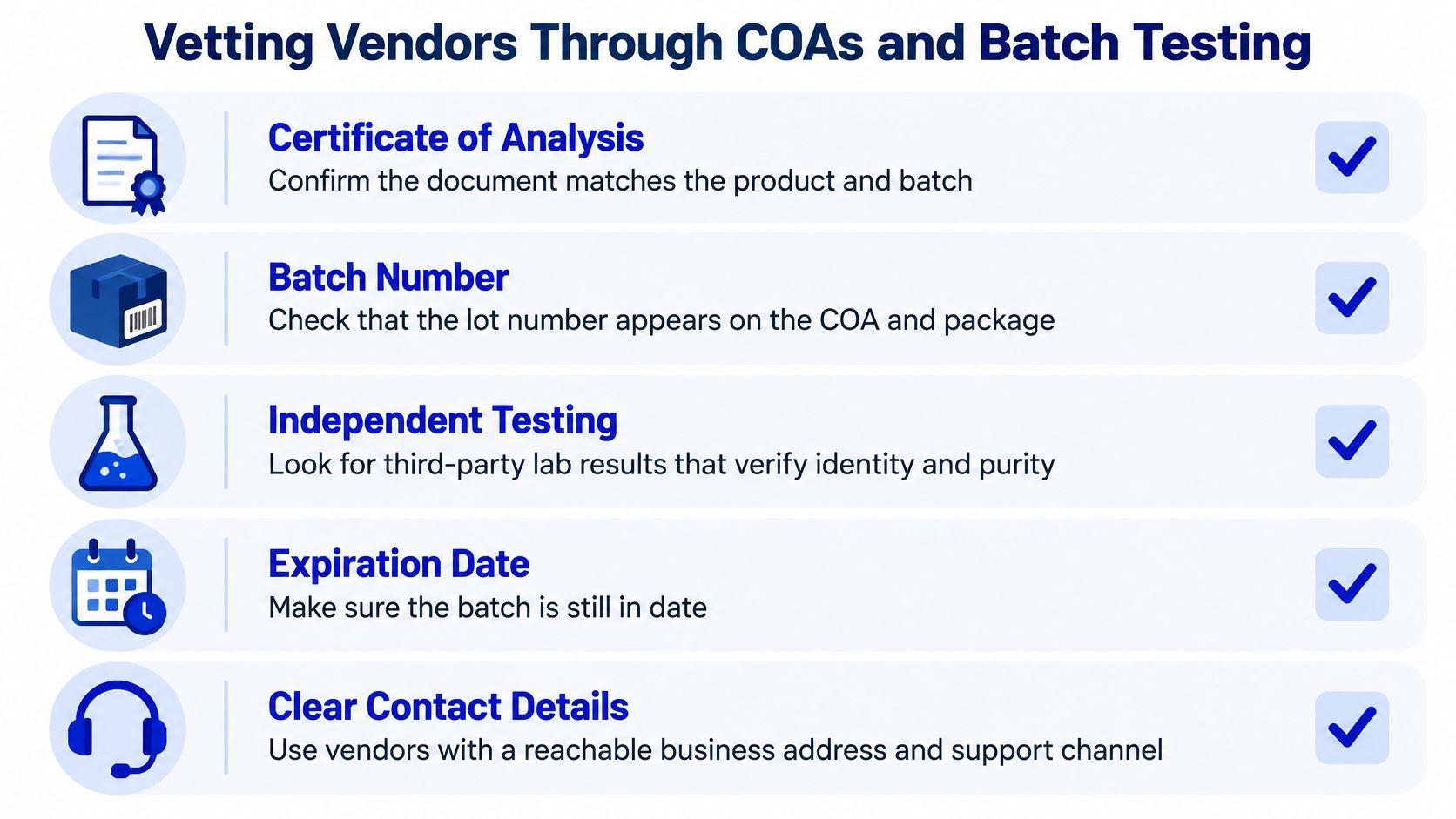
Use the checklist as a gate, not a slogan. The COA has to match the product and the batch. The lot number has to appear on both the report and the package. Independent testing should speak to identity and purity. The batch should still be in date. The business should have a reachable address and a support channel.
Analytical identity testing answers a chemistry question. Clinical-grade manufacturing, FDA approval, and lawful human use are different questions. A clean chromatography result does not turn research material into Egrifta, and it does not replace a prescription.
Microbial results, endotoxin results, and a written chain of custody sit beside the COA. Together they show how that lot was tested and handled. Separately, none of them is a clinical safety file.
People comparing how method and sample handling change a lab result can read about understanding medical grade blood testing. The same habit applies here. Ask who ran the test, which method they used, and whether you can tie the report to your vial.
U.S. manufacturing can make records easier to chase, because the seller and support sit in one jurisdiction. International sourcing can still be legitimate for a laboratory if the lot file is complete. Origin does not replace lot-specific testing. A domestic address with no COA is weaker evidence than a complete third-party report you can match. Neither one is a pharmacy license.
Before you order, request this set and keep copies:
Drop the vendor if support sends a generic certificate, refuses the lot number, or describes the material as suitable for personal use while labeling it research only.
Documents describe the lot. Shipping decides whether that lot arrives intact and whether you were allowed to receive it.
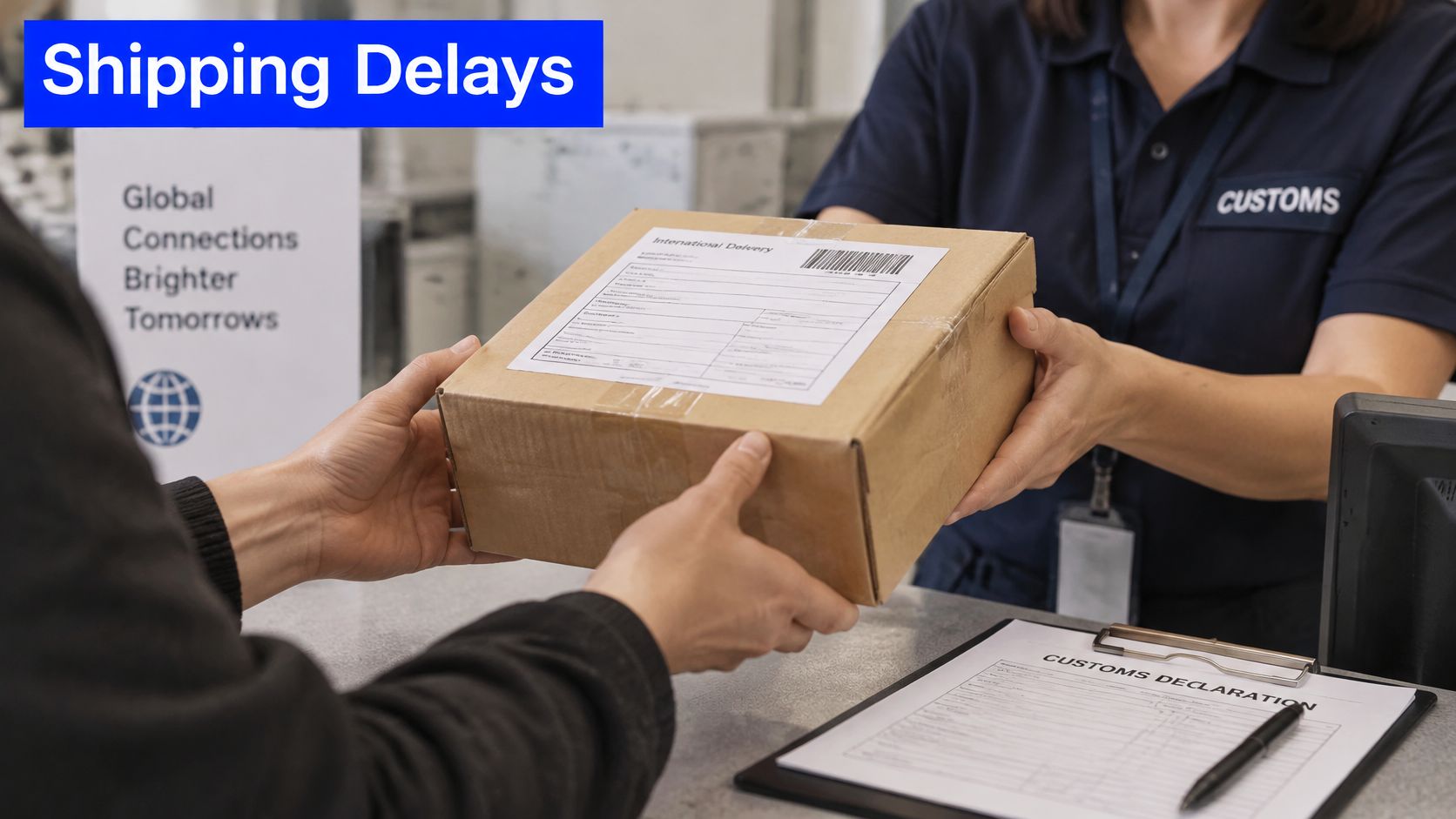
A domestic pharmacy dispense and a cross-border parcel are different risk profiles. Customs can hold, open, or refuse a package. Time in transit and storage conditions can matter for a lyophilized peptide even when the certificate looked acceptable at release. Regulatory status is jurisdiction-specific. A product that a seller may offer in one country may be unlawful to import or possess in another.
Look for limits, not slogans.
If the policy is silent on temperature and on where the company will ship, assume those risks sit with you.
The short briefing below walks through why buyers confuse research listings with approved medicines, which is the same mix-up that shows up when a parcel crosses a border.
After delivery, compare the label, the lot, and the documents you saved before checkout. If they do not match, do not "fix" the file by accepting a new certificate generated after the dispute. That pattern breaks traceability.
Institutions should write the receiving step into the procurement record. Note who opened the package, what lot was printed, and whether conditions on arrival matched the seller's instructions. Someone expecting a prescription medicine should receive it from a licensed dispenser, not from an anonymous international parcel.
Transparent pricing is not the same thing as the cheapest price.
A seller is transparent when you can see vial strength, formulation or research-material status, which documents are included, and what shipping adds. An unusually low number with those fields blank is a warning, not a deal. The FDA's caution about prices that look too good to be true, noted with the pharmacy signs above, applies here as a screening habit.
Clinical data can show when an ad has left the evidence. In the CADTH review of randomized trials, tesamorelin produced greater reductions in visceral adipose tissue than placebo at week 26, with reported differences of -19.6% in the LIPO-010 trial and -11.7% in the CTR-1011 trial, as summarized in the CADTH clinical review. Those figures measure visceral fat in a defined trial population. They are not guaranteed total-body weight loss.
They also do not transfer to healthy buyers, compounded products, nasal products, or research-grade material sold without clinical oversight. A vendor that turns those trial differences into a promised personal result is going past the data.
Compare offers only when strength, documentation, and legal status match. A lower price on an unnamed powder is not the same item, cheaper.
Price gaps deserve a question, not automatic loyalty to the low number. Ask what was removed to reach that price. It might be testing, the correct formulation, licensed dispensing, or a real business address. If the seller cannot answer, leave the listing.
Put the earlier checks into one written routine. Laboratories and institutions can do this before the first purchase order. Someone hoping for the approved medicine should leave this routine and go back to a clinician and a licensed pharmacy.
A workable record has five lines.
Research-use-only wording does not make a product appropriate for injection. It does not create FDA approval, and it does not prove clinical-grade manufacturing. Analytical results on a lot, and short-term trial findings on visceral fat, also do not settle long-term safety or what happens after treatment stops. Those questions belong with the prescriber and the label, not with a catalog.
Drop a supplier when the lot cannot be matched, when human-use claims sit next to a research disclaimer, when pharmacy signs are missing on a medicine listing, or when the shipping policy hides destination limits and storage.
If your purpose is laboratory procurement, review the supplier's COAs, shipping policy, and account and returns information, and keep that file with the purchase record. If your purpose is the approved medicine, speak with a licensed clinician and fill any prescription through a licensed pharmacy you can verify.
The defensible answer starts with the legal pathway and ends with documents you can check. Price is last, and it never repairs a failed check.
Peptide Warehouse USA supplies U.S.-made research peptides, including tesamorelin as lyophilized research material, with third-party COAs and microbial and endotoxin reports for laboratory buyers who need a documented research channel rather than a prescription medicine. If your work is analytical or preclinical, explore options and learn more about how those lot files are presented before you procure. Visit Peptide Warehouse USA to review the research-use listing, shipping information, and support contacts.