No products in the cart.

A peptide order rarely looks risky on paper. The quote is approved, the sequence matches the request, and a Certificate of Analysis sits in the folder. Then the assay drifts, the response curve flattens, and the team starts troubleshooting instruments, media, and protocol steps when the actual problem was upstream.
That's where most labs lose time with wholesale peptide suppliers. The failure usually isn't a missing document. It's accepting documentation without verifying whether the data is authentic, batch-specific, and meaningful for the work being done. For procurement teams, QA staff, and lab managers, their primary task is not collecting paperwork. It's proving that the lot in hand is the lot that was tested, shipped correctly, and suitable for research use.
This guide focuses on that verifier's mindset. It covers how the supply chain works, how to read beyond surface-level COAs, how to separate cold chain risk from batch purity risk, and how to build a practical approval checklist that protects both budgets and data quality.
When a peptide lot underperforms, the damage spreads fast. Assays have to be repeated, controls get questioned, and teams burn through sample, labor, and project time before they isolate the source of variation. In most labs, that's far more expensive than the line-item cost of the vial itself.
This is why choosing wholesale peptide suppliers is a quality decision first and a purchasing decision second. A vendor can look acceptable at checkout and still introduce risk through weak purification standards, vague documentation, non-specific COAs, or poor shipping control. The problem is that many of those failures are invisible until the material is already in use.
The pressure on sourcing is increasing because the broader market is expanding. The global peptide therapeutics market was estimated at USD 49.68 billion in 2026 and is projected to reach USD 70.20 billion by 2031, growing at a 7.16% CAGR, according to Mordor Intelligence's peptide therapeutics market analysis. More demand means more suppliers, more intermediaries, and more variation in how quality claims are presented.
Practical rule: If a supplier makes evaluation easy, that's useful. If a supplier makes verification easy, that's valuable.
Labs that buy well usually treat peptide procurement like vendor qualification in any regulated or quality-sensitive environment. They ask what was tested, who tested it, what lot was tested, how it was shipped, and whether the record trail holds together without guesswork.
The benefits of peptides in research depend on consistency. Reliable sourcing protects dose-response fidelity, analytical confidence, and repeatability across experiments. A good supplier doesn't just sell material. They reduce uncertainty at every handoff.
The peptide supply chain looks simple from the outside. It isn't. Each handoff introduces a chance for variation, delay, or data loss. Understanding that chain helps buyers identify where wholesale peptide suppliers are functioning as real quality gatekeepers and where they're acting as resellers.
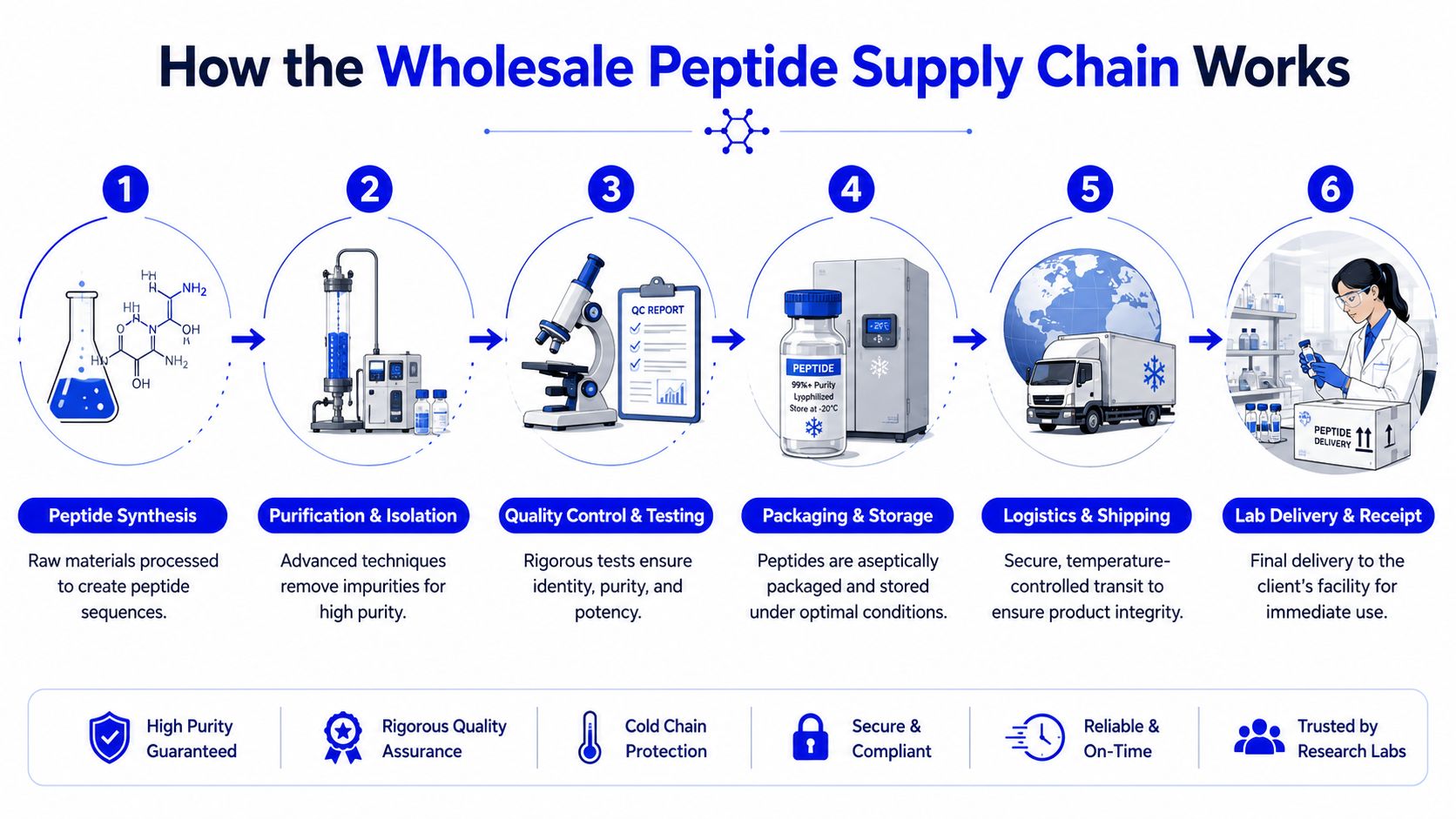
The process starts with synthesis. Raw materials are assembled into the target peptide sequence, then purified and isolated. After that comes analytical testing, batch release, packaging, storage, shipping, and receipt by the lab.
That front end matters because the synthesis side of the industry is substantial and still growing. The global peptide synthesis market was valued at USD 3.8 billion in 2025 and is projected to reach USD 4.4 billion in 2026, according to Roots Analysis on peptide therapeutics manufacturing. That growth is tied to strict production and testing protocols, which is exactly why buyers should ask how a supplier manages batch production rather than assuming every source works to the same standard.
A competent flow usually looks like this:
The wholesaler's role isn't just inventory. The wholesaler should be controlling documentation flow, lot traceability, storage, and release discipline. That includes making batch-specific records easy to review before purchase, not only after a problem appears.
In practice, the strongest suppliers standardize a few things that weaker ones treat casually:
For operations teams trying to reduce handoff failures, broader process thinking helps. A useful reference on how structured workflows reduce breakpoints is this supply chain automation guide, especially for teams mapping where approval, release, and shipping data tend to fragment.
The safest procurement system is the one where the lab can reconstruct the lot history without asking three different people for three different files.
A peptide arrives with a clean-looking COA, a high purity claim, and a batch label that appears in order. Then a scientist asks for the chromatogram, the mass spectrum, and the lab that generated them. If the supplier cannot produce those records quickly and tie them to the shipped lot, the review has failed.
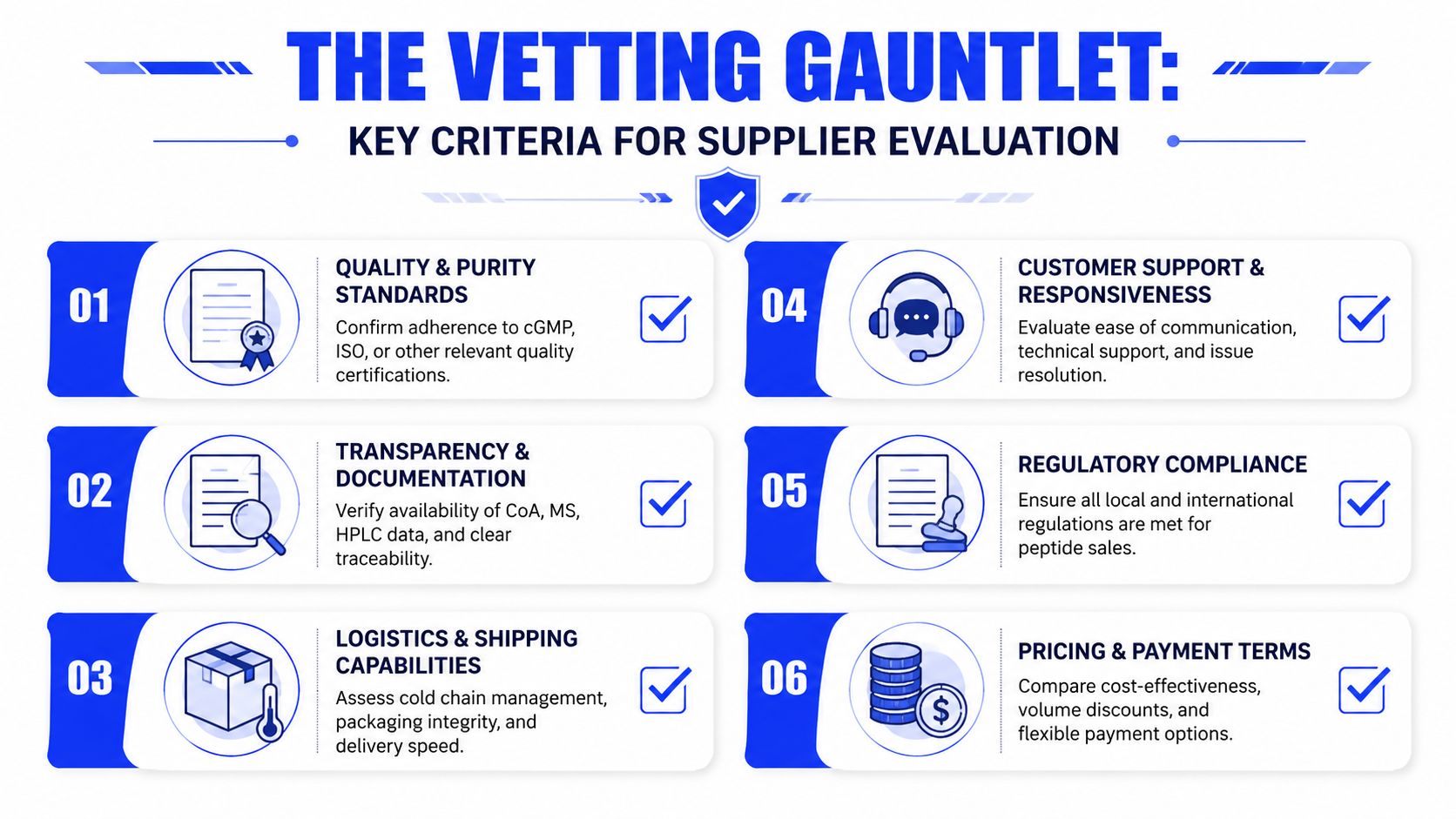
That is the difference between collecting documents and verifying them. A supplier qualification process should test whether the paperwork can withstand technical review, lot reconciliation, and audit questions. Generic PDFs are easy to send. Batch-level evidence is harder to fake.
Many buyer guides understate that risk. Alibaba's overview of peptide sourcing warns that generic or supplier-generated COAs are a common fraud signal. For procurement teams, that shifts the standard. The question is not whether a COA exists. The question is whether the COA matches the lot, whether the underlying data exists, and whether the named lab and methods can be checked.
A batch-specific COA should be available during qualification, ideally before funds are committed. At minimum, it should state the peptide name, molecular formula, molecular weight, purity result, testing date, batch or lot reference, and the laboratory responsible for the analysis.
That is only the first pass.
For a meaningful review, ask for the data behind the summary. HPLC traces and mass spectra tied to the same lot matter more than a polished one-page certificate. Missing retention times, absent integration settings, cropped chromatograms, or no instrument information are common signs that the document was prepared for sales support rather than scientific review.
Use a simple verification screen:
Red flags usually appear in the mismatches.
| COA feature | Strong signal | Weak signal |
|---|---|---|
| Lot reference | Unique and batch-specific | Missing or generic |
| HPLC data | Trace, retention time, integration details | Single purity line only |
| MS data | Lot-specific spectrum | Mention of MS without report |
| Lab identity | Named testing lab | “Internally tested” only |
Suppliers that cannot provide supporting analytical records are asking the buyer to accept unsupported claims.
Third-party testing only has value if the third party can be identified and the work can be checked. For research peptides, suppliers should be able to name the outside lab, describe the methods used, and provide batch-linked reports for identity and purity testing. The standards outlined in this reference on why third-party testing matters for research peptides are a reasonable baseline for what buyers should request.
In practice, I look for two things first. Is the laboratory accredited for the type of testing claimed, and do the report identifiers stay consistent from COA to raw data attachment? If either answer is unclear, the supplier has more explaining to do.
Purity claims also need context. A reported HPLC percentage without the chromatogram, wavelength, and integration approach does not tell the full story. Suppliers selling into serious research environments should be ready to provide chromatograms and explain how they handle minor peaks, co-elution risk, and acceptance thresholds. A batch that barely clears an internal cutoff may still be a poor fit for quantitative work or assay development.
If a supplier says “third-party tested,” ask for the lab name, the report date, and the raw analytical attachment tied to that lot.
Teams under formal QA oversight can adapt proven methods from regulated supplier qualification. This article on managing vendor risk in regulated environments is useful for building a review process that tests evidence quality, document control, and vendor response discipline.
Traceability determines whether one order can be compared to the next with confidence. A supplier should be able to connect production date, batch record, analytical report, inventory status, and release decision to the same lot number. If those records sit in separate systems and cannot be reconciled, the buyer inherits the failure risk.
This review should stay practical:
Marketing language needs the same scrutiny. “Research grade” has no value unless the supporting records show what standard was applied and how the lot met it. As discussed in Peptides Lab UK's research-grade peptides guide, purity bands have direct implications for experimental suitability. Buyers should confirm the supplier's internal release threshold, not rely on broad quality language.
A good supplier makes verification routine. A weak supplier makes it slow, fragmented, and dependent on trust.
A clean COA doesn't protect a peptide during transit. Labs often discover that too late, after they've approved the batch on paper and started troubleshooting unexplained assay behavior. Shipping is its own control point, and wholesale peptide suppliers should be evaluated on that basis.
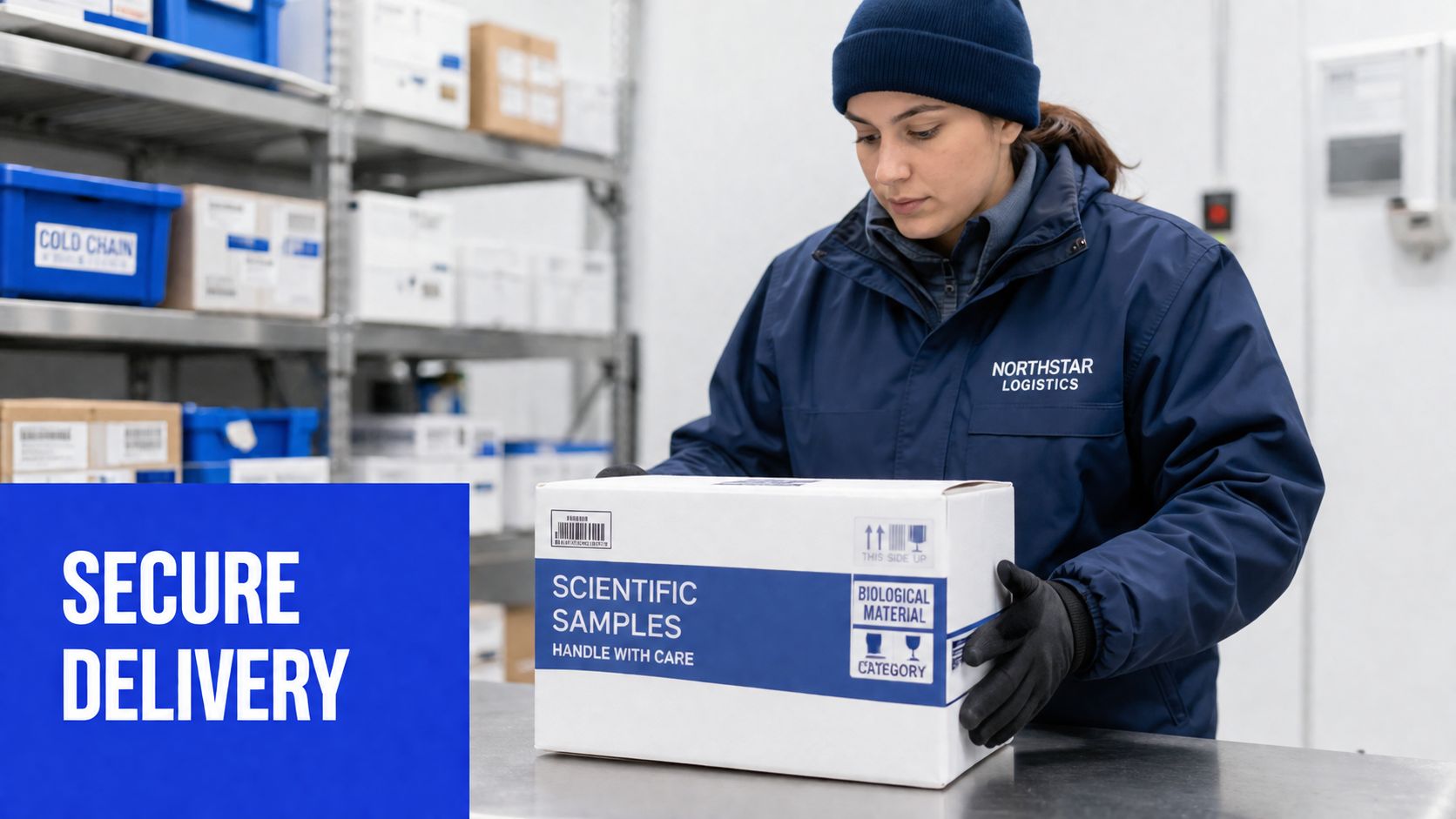
Buyer guides often blur purity and delivery into one question. That's a mistake. As noted in PepVi's guide on choosing a peptide provider, buyer guidance often ignores that peptides can degrade rapidly outside a controlled cold chain, and emerging trends show increased temperature violations in shipments. For labs, that means a pure batch can arrive as a compromised batch.
Ask shipping questions as if you were qualifying a separate vendor, because functionally that's what you're doing:
Even basic shipping materials matter when they support insulation strategy and physical protection. Procurement teams comparing packaging formats may find it useful to review standard transit container options such as a cardboard carton box, then assess whether the supplier's actual packaging setup is adequate for scientific material rather than ordinary parcel handling.
High purity at release does not guarantee high integrity at receipt.
Receiving shouldn't be a simple sign-off. It should be a brief verification event. The team opening the shipment should know what to inspect and what creates a quarantine hold.
A practical receipt protocol includes:
That process doesn't need to be complicated. It needs to be consistent.
A lot of supplier confusion starts with language. Labs, resellers, and procurement teams may use the same words while meaning different things. That creates risk in quotes, product listings, and order approvals.
Some of the most common terms are commercial, not analytical.
A buyer should also separate “in stock” from “available.” A product page may show availability while the actual lot is pending release, waiting on testing, or being split across multiple orders.
Regulatory language matters just as much. Legitimate research suppliers don't blur those boundaries.
For Research Use Only means the material is sold for laboratory, analytical, or preclinical applications and not for human consumption. A credible supplier should state that clearly, avoid medical claims, and align product presentation with that limitation.
FDA-related language around impurities is also relevant when buyers assess how seriously a supplier treats analytical control. Under FDA guidance for synthetic peptide drug applications, all impurities above 0.10% of the active pharmaceutical ingredient must be individually identified, and regulatory approval is blocked for any new impurity exceeding 0.5%, with HPLC used for purity assessment and mass spectrometry for identity confirmation, according to this PR Newswire report summarizing FDA peptide impurity thresholds.
That doesn't turn a research purchase into a drug filing requirement. It does show how seriously impurity profiling is treated when stakes are high. Buyers can learn from that standard even when they're sourcing for non-clinical work.
A few simple interpretation rules help:
“Research use only” is a boundary, not a marketing phrase.
“Third-party tested” is incomplete if the third party is unnamed.
When labs and suppliers use the same terms precisely, purchasing gets faster and disputes get rarer.
A new lot arrives, the label matches the PO, and the COA looks clean at first glance. Then someone notices the chromatogram image has no batch identifier, the test date predates the listed manufacture date, or the mass spectrum appears recycled from another product. That is the point of a supplier checklist. It is not paperwork for its own sake. It is a way to catch preventable risk before material enters a study.
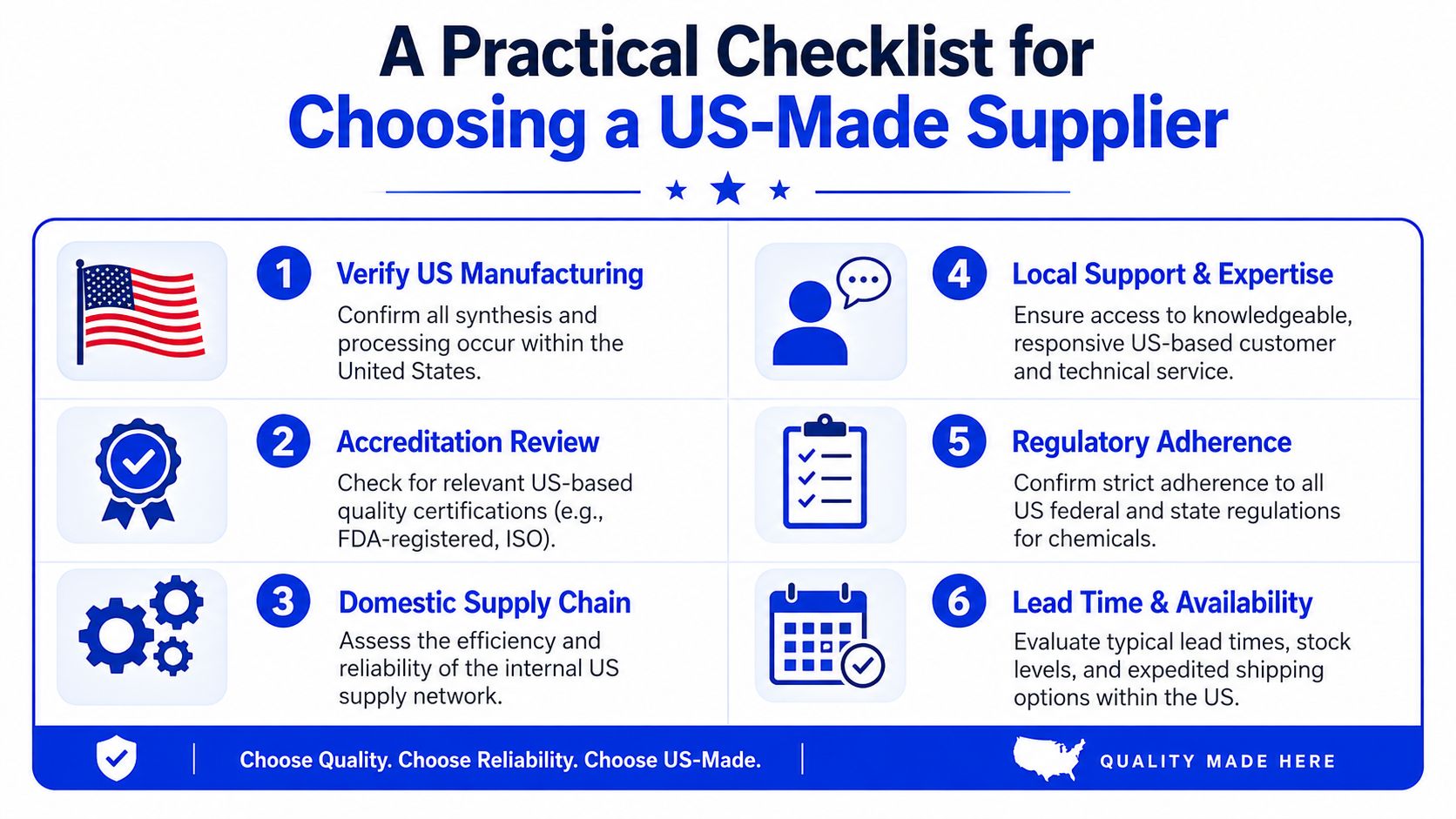
For U.S.-based sourcing, the screen should do more than confirm a domestic address. It should verify where the material was made, who released the lot, which analytical records belong to that lot, and whether shipping and storage controls protect the product after release. Buyers who stop at document collection miss the harder question. Are the documents authentic, complete, and technically credible?
Start with what the supplier is willing to show before a call or purchase order. Suppliers that expect scrutiny usually make qualification easier. Suppliers that rely on trust signals and broad claims usually create more work for QA.
Use this first-pass screen:
A clean PDF is not enough. Verify whether dates line up, whether the chromatogram includes the lot reference, and whether the formatting stays consistent across products. Reused templates are normal. Reused analytical data is a problem.
The technical call should answer operational questions, not produce reassurance. Ask for specifics that can be checked later against documents and shipped material.
Useful questions include:
Purity acceptance should match the intended use. For some screening work, one threshold may be acceptable. For quantitative assay development or reference material use, tighter internal limits are usually justified. The key point is alignment. If the supplier cannot explain its release standard or treats purity as a marketing line rather than a controlled specification, stop the review there.
One practical check works well here. Ask the supplier to walk through one recent lot record from synthesis to release to shipment. Strong suppliers can do that without improvising.
Supplier approval should follow evidence, not confidence. I prefer a two-level decision: approve the supplier, then approve each lot against your incoming document and shipping review. That approach reduces friction with good vendors while protecting the lab from a weak batch.
A simple internal decision path looks like this:
| Decision point | Approve | Hold or reject |
|---|---|---|
| COA quality | Batch-specific, dated, and complete | Generic, undated, or missing key fields |
| Raw data | Available, legible, and matched to the lot | Missing, cropped, or inconsistent with the COA |
| Testing attribution | Lab and method identified | Source of testing unclear |
| U.S. manufacturing claim | Scope of domestic production explained | Claim limited to packaging or fulfillment, with no clarity |
| Shipping controls | Packaging, storage, and excursion handling documented | Controls vague or undocumented |
A hold is often the right decision when the problem is verification, not chemistry. If the supplier can clarify a lot number mismatch, replace an incomplete record, or explain an analytical anomaly, the batch may still be usable. If explanations keep changing, remove the lot from consideration and reconsider the supplier as well.
A failed peptide lot rarely announces itself at purchase. The problem shows up later, when an assay drifts, a repeat study does not match the first run, or a team loses time sorting out whether the issue came from the material, the method, or the paperwork. Procurement decisions should prevent that scenario, not document it after the fact.
The practical standard is verification. A supplier may provide a COA, chromatograms, and a domestic manufacturing claim, but those records still need to match the exact lot you are buying and make technical sense when reviewed by someone who understands peptide release data. That is the difference between collecting files and controlling risk.
Good wholesale peptide suppliers reduce review time because their records hold up under scrutiny. Lot identifiers stay consistent across the COA, analytical data, label, and shipping record. Methods are named clearly. Testing attribution is visible. Packaging and transit controls are documented well enough for a lab to decide whether the material remained within acceptable conditions from release to receipt.
Weak suppliers shift that burden onto the buyer. The lab spends more time chasing missing pages, asking who performed the testing, resolving date conflicts, and interpreting vague claims about purity or origin. That extra work is not administrative noise. It increases the chance that a questionable lot gets accepted because the team is under schedule pressure.
For QA leads, procurement teams, and lab managers, the most useful habit is simple: verify one lot as if it were going into a high-consequence study. Ask for the full release package. Check whether the data are batch-specific, legible, and internally consistent. Confirm that the supplier can explain any anomaly without changing the story.
Peptide Warehouse USA supports laboratory, analytical, and preclinical procurement with U.S.-made research peptides, batch-specific documentation, and a research-use-only compliance posture. If you are evaluating suppliers through the lens of traceability, third-party verification, and shipping control, include those standards in your review and choose partners who make lot verification straightforward.