No products in the cart.


You’re probably in one of two situations right now. Either you’re comparing peptide suppliers and every site says “lab tested,” or you already have a Certificate of Analysis in front of you and you’re trying to decide whether it proves anything.
That’s where 3rd party tested peptides matter. The phrase gets used as a trust signal, but its actual value isn’t the label itself. It’s the documentation behind it, the test methods used, and whether you can verify that the report belongs to the exact batch you’re considering.
Most buyers stop at “COA available.” A careful buyer goes further. You check the lot number, the lab name, the purity method, the identity test, and whether the paperwork looks batch-specific instead of generic marketing collateral. If you want a broader primer on how independent verification works across supplements and related products.
3rd party tested peptides are peptide products evaluated by an independent laboratory rather than only by the manufacturer. That outside lab checks whether the material matches the label claims, usually by confirming purity and identity with established analytical methods.
For a researcher, that distinction matters because peptides aren’t judged by appearance. A white lyophilized powder can look perfectly fine and still contain impurities, degradation products, or the wrong compound. You need data, not packaging.
A reliable verification package usually centers on a Certificate of Analysis, often called a COA. The COA should connect the result to a specific lot or batch and show what was tested, when it was tested, and which lab performed the work.
A supplier can say “third-party tested” on a product page. That statement alone doesn’t tell you much.
What matters is whether the supplier can provide documentation that answers practical questions such as:
A peptide isn’t “verified” because the seller says it is. It’s verified when the documentation is batch-specific, readable, and analytically meaningful.
When documentation is strong, you can make cleaner purchasing decisions. You can compare suppliers on evidence instead of branding, and you can reduce the chance that poor material confounds your assay, stability work, or preclinical planning.
That’s the practical goal. Not more jargon. Better decisions.
The reason independent verification has become standard is simple. Research quality depends on material quality, and material quality can’t be assumed from a product label.
A 2022 review in PMC noted that the split between regulated peptide medicines and research-only products is a key reason independent documentation, including COAs, microbial and endotoxin reports, and identity and purity testing, has become a foundational expectation in the U.S. and other advanced research economies (PMC review on peptide markets and documentation).

That expectation didn’t appear by accident. Buyers have learned that “tested” can mean many different things unless the testing is documented, traceable, and independent. Teams that manage many compounds already know this lesson from broader lab operations, which is why good records and controlled documentation matter so much in optimizing chemical data management.
A manufacturer’s internal quality control has value. Good manufacturers should test their own material.
But internal QC and independent verification are not the same thing. Internal testing tells you what the producer says it made. Third-party testing gives you a separate analytical check from a lab that didn’t manufacture the peptide.
That separation matters most when a result is disappointing. If an assay behaves strangely, you need documentation you can trust enough to rule material quality in or out. An unaffiliated lab report is much more useful in that moment than a vague product claim.
Researchers often think first about the purchase price. That’s understandable, but it’s usually the smallest part of the risk.
Poorly documented peptides can create problems such as:
A cheap vial becomes expensive when it slows down a project.
Practical rule: If the supplier can’t quickly produce batch-specific documentation before purchase, assume documentation will be worse after payment, not better.
Independent verification doesn’t guarantee a perfect experiment. It does something just as important. It narrows one major source of uncertainty before the work begins.
If you’ve ever opened a COA and felt buried under acronyms, focus on the question each test answers. That makes the science much easier to use.
Near the top of your decision tree are two methods widely treated as the gold standards for peptide verification: HPLC and mass spectrometry. For quantitative research, peptides exceeding 95% HPLC purity are considered excellent, while those above 98% meet industrial standards, and MS is used to confirm the molecular weight matches the expected identity (third-party peptide testing guide).
A simple visual can help anchor the basics.
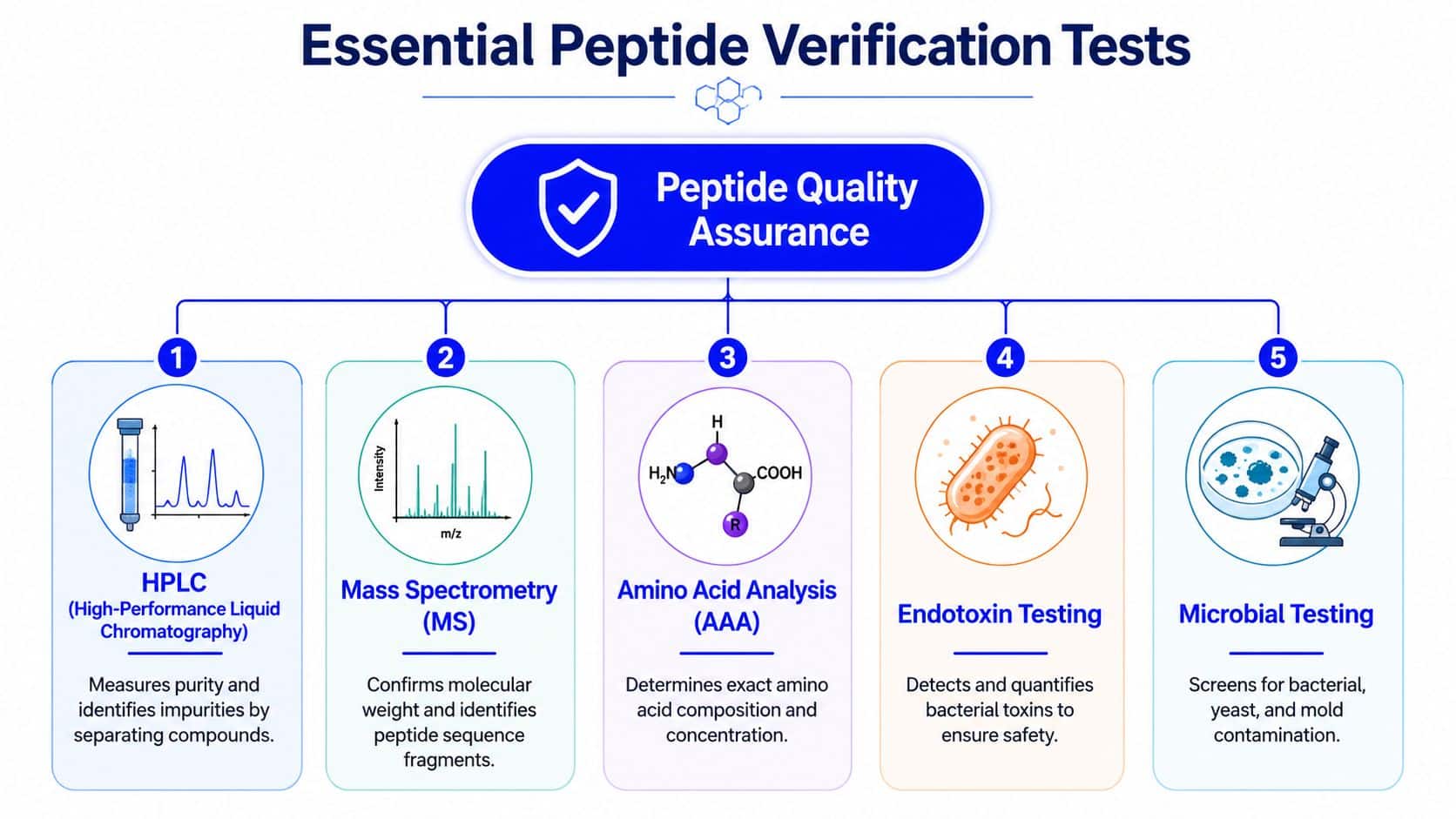
HPLC stands for High-Performance Liquid Chromatography. In plain language, it separates the components in a sample so the lab can estimate how much of the material is your target peptide versus something else.
Think of it as a controlled sorting process. If your sample contains the desired peptide plus related impurities, the method separates those components and records them as peaks. The resulting chromatogram lets the lab calculate purity.
For a buyer, the practical takeaway is straightforward:
Some suppliers report the purity percentage without showing the chromatogram. That’s better than nothing, but it’s weaker evidence than a full report.
If HPLC answers “How clean is it?”, mass spectrometry answers “Is it the peptide claimed on the label?”
MS measures molecular weight with very high precision. For peptide verification, that matters because a peptide can be relatively clean yet still be the wrong sequence or a closely related byproduct. Identity testing helps separate those possibilities.
The same analytical guide notes that MS confirms molecular weight within a very tight tolerance, and discusses how the observed m/z should align with the theoretical value for the intended peptide. For a new buyer, the lesson isn’t to memorize instrument theory. It’s to look for explicit identity confirmation, not just a purity number.
Before the next part, here’s a useful video overview for readers who want a more visual explanation of peptide verification workflows.
HPLC and MS carry most of the weight, but they aren’t the only tests worth asking about.
Some procurement decisions also involve:
Not every project needs the same level of supporting data. A discovery-stage bench workflow and a sensitive in vivo research context don’t ask identical questions. But every serious buyer should know the difference between identity, purity, and contamination screening.
Here’s the shorthand I teach new staff:
Purity tells you how much is target material. Identity tells you whether the target material is the correct molecule. Contamination screening checks for unwanted biological burden that purity testing doesn’t fully answer.
Once you think in those three buckets, COAs become much easier to read.
A COA should function like a traceable lab record, not a decorative PDF. The fastest way to evaluate one is to read it in layers, starting with traceability, then test method, then actual result.

Before you look at any purity figure, confirm the report belongs to the material in question.
Look for these basics first:
Product name
The peptide name on the COA should match the listing exactly, not loosely.
Lot or batch number
This is the backbone of traceability. If the seller can’t connect the product you’ll receive to the lot on the COA, the report has limited value.
Test date
You want recent, relevant documentation. An old generic report may describe a past production run, not current inventory.
Laboratory identification
The report should identify the lab that performed the analysis. If the lab is unnamed, hidden, or impossible to verify, treat that as a caution sign.
A common mistake is reading the purity line first and stopping there. Don’t. If the lot information is weak, the analytical detail doesn’t help much.
Once traceability checks out, move into the results.
A useful COA will usually show or clearly state:
When you read the HPLC result, ask yourself two questions. First, is the purity clearly stated? Second, is there enough context to show the value came from an actual run and not a copied template?
For peptide buyers who need a benchmark, GenScript notes that peptides above 95% purity are suitable for quantitative analysis, while 98%+ purity is offered for industrial applications, and it states that peptide quality is verified by both HPLC and mass spectrometry with QC data included at delivery (GenScript peptide purity guidance).
That doesn’t mean every project requires the highest possible purity. It means the COA should let you judge whether the product fits your use case instead of asking you to rely on marketing language.
If a report looks thin, ask direct questions. Good suppliers won’t struggle with them.
Use prompts like these:
Buyer’s check: A complete COA answers questions before you ask them. An incomplete one creates extra work and still leaves uncertainty.
One practical note. Some suppliers, including Peptide Warehouse USA, state that they provide batch-specific third-party COAs along with microbial and endotoxin documentation for research products. That’s the kind of document set a careful buyer should look for from any vendor, not just one brand.
By the time you know how to read a COA, the next challenge is figuring out whether the supplier is using documentation truthfully. That matters because the market includes sellers who borrow the language of quality control without providing the underlying proof.
Reporting summarized by Honest Peptide says the Baylor Sports Chemistry Group found that major online retailers such as Amazon and Alibaba host numerous unapproved peptide listings disguised as “research chemicals,” which exposes the gap between “lab-tested” claims and verifiable independent COAs (discussion of BSCG findings and marketplace listings).
That’s the problem in one sentence. A testing claim is easy to publish. Authentic documentation is harder to fake convincingly.
A real report is built for traceability. A trust prop is built for appearance.
Watch for these warning signs:
Generic COAs with no lot number
If the same PDF appears to cover every batch, it doesn’t support serious procurement.
Cropping out the lab identity
Sellers sometimes display only the result line and remove the rest of the report.
No method listed
“Purity verified” is not the same as “HPLC purity reported.”
Only a screenshot, never the full document
That often signals the seller wants the claim visible but not reviewable.
Refusal to answer basic verification questions
A supplier that becomes evasive when you ask about batch traceability is telling you something important.
Green flags tend to be operational, not flashy. Fast access to documents, consistent batch naming, clear lab attribution, and willingness to discuss methods usually matter more than polished branding.
| Green Flag (Signs of a Quality Supplier) | Red Flag (Signs of a Risky Supplier) |
|---|---|
| Batch-specific COA available and clearly tied to current inventory | One generic COA used for every listing |
| Independent lab identified on the report | No lab named or lab details removed |
| Purity and identity methods listed in readable form | Vague phrases like “lab-tested” with no methods |
| Chromatogram or supporting analytical detail available on request | Only a marketing graphic showing a purity percentage |
| Answers documentation questions directly before purchase | Delays, deflects, or pressures you to buy first |
| Traceability across lot number, label, and report | Batch mismatch between product and paperwork |
If the listing looks polished but the paperwork looks evasive, trust the paperwork.
That single habit will save you more trouble than any discount code ever will.
A lot of confusion in this market comes from mixing up three separate ideas: product quality, regulatory status, and intended use. They are related, but they are not interchangeable.
When a peptide is labeled research use only, the seller is identifying the intended channel and use context. That label should tell you the product is being supplied for laboratory, analytical, or preclinical work rather than for human use.
A reputable supplier should present that clearly. If a site uses RUO language in one place but markets the same product as if it were a consumer wellness item somewhere else, that inconsistency deserves scrutiny.
Many buyers often misunderstand the implications of third-party testing. Third-party testing can help establish that a peptide matches the stated material profile. It does not place the product on an FDA approval pathway or convert a research chemical into an approved human-use product.
Coverage of peptide market regulation notes that the FDA’s Category 2 restrictions, effective in September 2023, created a gray zone that reinforces the distinction between third-party quality testing and the separate pathway of FDA approval for human use.
That’s the practical takeaway for buyers. A clean COA answers a quality question. It does not answer every legal or regulatory question surrounding intended use, compounding, or market access.
A transparent supplier should make verification easier, not harder. That means documentation should be available, batch-linked, and understandable enough that a buyer can review it without chasing multiple departments.
At Peptide Warehouse USA, the standard is straightforward. Research products are sold for laboratory, analytical, and preclinical use only, and the documentation focus is on traceability and clarity rather than broad marketing claims.
That includes practices such as:
For a buyer, the point isn’t brand language. It’s whether the supplier gives you enough evidence to review the material on its merits. That’s what transparent procurement should feel like.
If you’ve been comparing peptide vendors and seeing the same vague promises repeated everywhere, use the checklist in this guide. Ask for the COA. Match the lot number. Check the methods. Verify that “third-party tested” means more than a badge on a webpage.
If you want a supplier that treats documentation as part of the product, not an afterthought, you can learn more at Peptide Warehouse USA and review the available research peptide options with traceability in mind.