No products in the cart.

A lot of buyers searching for an american peptide company are in the same spot. A project is moving, budgets are already committed, and the last thing the lab needs is a peptide lot that looks fine on paper but creates noisy data, repeat work, and procurement headaches.
That risk usually doesn’t start with one dramatic failure. It starts with small misses. A vague COA. A supplier who can’t answer basic handling questions. A shipment that arrives without any clear custody record. By the time a team realizes quality was weak, the experiment has already absorbed the cost.
The reliable way to vet a U.S. peptide supplier is to look past the product page. You need to verify the full chain: documentation, manufacturing controls, shipping conditions, storage practices, and the quality of support when you ask hard questions. That’s where strong suppliers separate themselves from risky operations.
A lab places a routine peptide order from a U.S. supplier because the listing looks professional, the lead time looks short, and the product page promises high purity. The shipment arrives on time, but procurement still does not know who made the material, how it was released, how long it sat in transit conditions, or whether anyone can answer a technical question before the next order. That is the modern problem.
When researchers search for an american peptide company, they usually mean a domestic supplier that can support repeatable research without turning the supply chain into a guessing exercise. The label “American” helps only if the quality chain is visible from manufacturing through fulfillment and support.
That distinction matters because the term also refers to a former company name in the U.S. peptide market. Buyers can get distracted by familiar branding or domestic marketing language and miss the harder question. Who controls the process, who handles the product after release, and who stands behind the lot when something looks off?
In procurement, a reputable supplier is one that reduces uncertainty at every handoff, not just one that posts polished documents. A strong U.S. peptide partner should be able to answer practical questions about production controls, inventory handling, shipping protection, and post-sale support without delay or evasive language.
Use a simple working standard:
A COA matters, but it does not close the case.
The suppliers worth keeping are the ones that can account for the full path from synthesis to your receiving bench. That is where research integrity and budget protection come from.
A peptide vendor earns credibility first through documents. Not marketing copy. Not branding. Not category pages listing dozens of compounds. The paperwork tells you whether the supplier runs a controlled process or just knows how to present one.

A Certificate of Analysis, or COA, should be tied to the exact lot you are buying. If the document looks generic, has no batch identifier, or appears to be the same file reused across products, it doesn’t give procurement much protection.
A practical COA review starts with a few basic checks:
If a supplier only posts a “sample COA,” ask for a current batch-specific file before ordering. Good vendors are used to that request.
Most buyers don’t need to interpret peptide analytics like an analytical chemist. They do need to know what each test is supposed to confirm.
HPLC is usually the first thing people look for because it gives a picture of purity. In plain terms, you’re checking whether the chromatogram supports the stated purity claim and whether the report is detailed enough to look real rather than decorative.
What helps:
What doesn’t help:
Mass spectrometry serves a different purpose. It helps confirm molecular identity by showing whether the measured mass aligns with the expected peptide. A vendor that supplies both HPLC and mass spec gives you a stronger basis for trusting that the material is both clean and correctly identified.
A polished PDF can still hide weak controls. The useful question is whether the report would survive scrutiny from a careful lab manager.
Many research buyers also ask about microbial and endotoxin testing. That question is smart because contamination risk isn’t always visible from purity reporting alone. If a supplier offers these reports alongside the COA, it usually signals a more mature release process and better lot traceability.
A quick explainer can help if your team is training junior buyers or new lab staff:
In-house testing has value. Any serious supplier should know what its own material looks like before release. But independent, third-party testing carries more weight because it reduces the conflict between selling the product and verifying the result.
That doesn’t mean every in-house report is unreliable. It means third-party confirmation gives procurement another layer of confidence when the material matters to an expensive study or a sensitive workflow.
Use this comparison when you’re screening suppliers:
| Verification type | What it tells you | What to watch for |
|---|---|---|
| In-house COA | The supplier tested the batch internally | Useful, but ask how often outside labs confirm results |
| Third-party COA or supporting reports | An independent lab verified key attributes | Stronger trust signal if batch-specific |
| No batch-specific documents | Very little | High risk for research procurement |
Send these before you place a first order:
A supplier that answers clearly is usually easier to work with across repeat purchases. A supplier that stalls, redirects, or sends mismatched files often creates more friction after payment than before it.
A peptide can arrive with a clean-looking COA and still create problems once it hits a real workflow. I have seen that happen when a supplier treats quality as a document package instead of a controlled manufacturing system.
That is the gap many buyers miss with an American peptide company. They check the paperwork, but they do not press on how the lot was made, reviewed, packaged for release, and handed off into domestic inventory. If those steps are weak, the COA only documents the end of an unstable process.
More suppliers are competing for U.S. peptide demand, as noted earlier. That makes manufacturing discipline a better filter than marketing language.
A serious supplier should be able to explain how a batch moves from synthesis to release without getting vague or defensive. You are not asking for proprietary formulas. You are checking whether the company runs a controlled operation or a patchwork process.
Start with the manufacturing flow:
Good manufacturers answer these questions in operational terms. Weak suppliers usually fall back on purity percentages and generic sales language.
One acceptable batch does not tell procurement much. Repeatability does.
Consistency shows up when a lab reorders three months later and gets material that behaves the same in assay development, method verification, or follow-up work. If the supplier cannot hold that line, your lab absorbs the cost through repeated qualification work, troubleshooting time, and study delays.
These are the signs I look for when screening vendors:
| Indicator | What it tells you in practice |
|---|---|
| Standardized batch records and document format | The release process is probably controlled, not assembled manually each time |
| Clear lot traceability | Your lab can investigate performance issues without guessing which batch changed |
| A direct explanation of process changes | The supplier understands how scale, resin choice, or purification adjustments affect output |
| Defined QA review authority | Quality decisions are being made by a process, not by whoever needs to ship the order |
A mature supplier also separates research-use material from GMP material clearly. If a company blurs that line, I treat it as a warning sign. The problem is not just wording. It suggests weak internal controls, loose documentation standards, or a sales team making claims the operation cannot support.
Manufacturing quality does not stop at synthesis. It includes what happens after final testing and before the box leaves the building.
Many “American” suppliers become hard to evaluate. A buyer may hear that the company is domestic, but get little detail on where batches are held, how release inventory is segregated, who controls relabeling, or whether the same site that sells the product also manages storage under defined conditions. That black box matters because poor internal handling can undermine a well-made peptide before transit even begins.
Ask practical questions that connect manufacturing to fulfillment:
Suppliers that can answer these cleanly are usually easier to trust across repeat orders. Suppliers that cannot explain the handoff between manufacturing, QA, and inventory control often create the exact domestic supply chain blind spot that buyers are trying to avoid.
A peptide can leave production in excellent condition and still reach your lab compromised. Many buyers overlook the primary risk. They verify the COA, place the order, and assume the quality problem is solved.
It isn’t solved until the material is stored, packed, shipped, received, and handled correctly.
One of the most useful warnings for buyers is that many peptide suppliers market themselves as “American” while saying very little about how products are handled once they are in domestic inventory. That lack of clarity around cold-chain management, warehouse controls, and end-to-end traceability is a major red flag.
That issue matters because the domestic leg is often the least documented. Buyers may know where a peptide was supposedly made, but not:
Good shipping and storage practices aren’t mysterious. Suppliers should be able to explain them in plain language.
Look for signs like these:
Weak suppliers stay vague. They rely on trust-building phrases like “handled carefully” or “stored appropriately” without defining what those terms mean operationally.
The best suppliers don’t treat shipping as a fulfillment task. They treat it as part of product quality control.
Even a strong supplier can’t control what happens after delivery. The receiving side matters too.
Use a simple intake process:
Labs that build this into receiving SOPs usually catch issues earlier and avoid confusing shipping damage with synthesis quality.
Some warning signs are so consistent that they should end the evaluation immediately. You don’t need a long due diligence process for every vendor. In many cases, a few obvious failures tell you enough.
If the paperwork is weak, the rest of the operation usually isn’t stronger.
Watch for these signs:
A good procurement habit is to ask one technical question and one administrative question before the first order. Weak vendors often fail one of them. They either can’t explain the testing, or they can’t explain the fulfillment and traceability process.
The website doesn’t need to look luxurious. It does need to look controlled and credible. Sloppy commercial behavior often reflects sloppy backend operations.
Here are the patterns I treat cautiously:
| Red flag | Why it matters |
|---|---|
| Vague claims like “USA-based” with no manufacturing clarity | Could mean branding is doing more work than operations |
| Direct medical or therapeutic claims for research products | Suggests poor compliance judgment |
| Support that dodges basic handling questions | Indicates weak training or weak systems |
| Payment methods that remove accountability | Increase procurement risk |
| Pop-culture or hype-heavy branding | Often a sign the company is targeting impulse buyers, not serious labs |
If a vendor sounds more like a lifestyle brand than a research supplier, review every claim twice.
Another common problem is overpromising. If every peptide is framed as premium, every lot is described as flawless, and every support reply is generic, you aren’t hearing operational detail. You’re hearing a script.
Buyers should also notice how a supplier responds when challenged. Serious vendors don’t get defensive when you ask for lot data, handling details, or release records. They expect those questions.
Many organizations do not need more theory. They need a checklist they can use while comparing vendors side by side. This one is built for practical screening, especially when you’re evaluating an american peptide company for repeat lab purchasing rather than a one-off trial order.
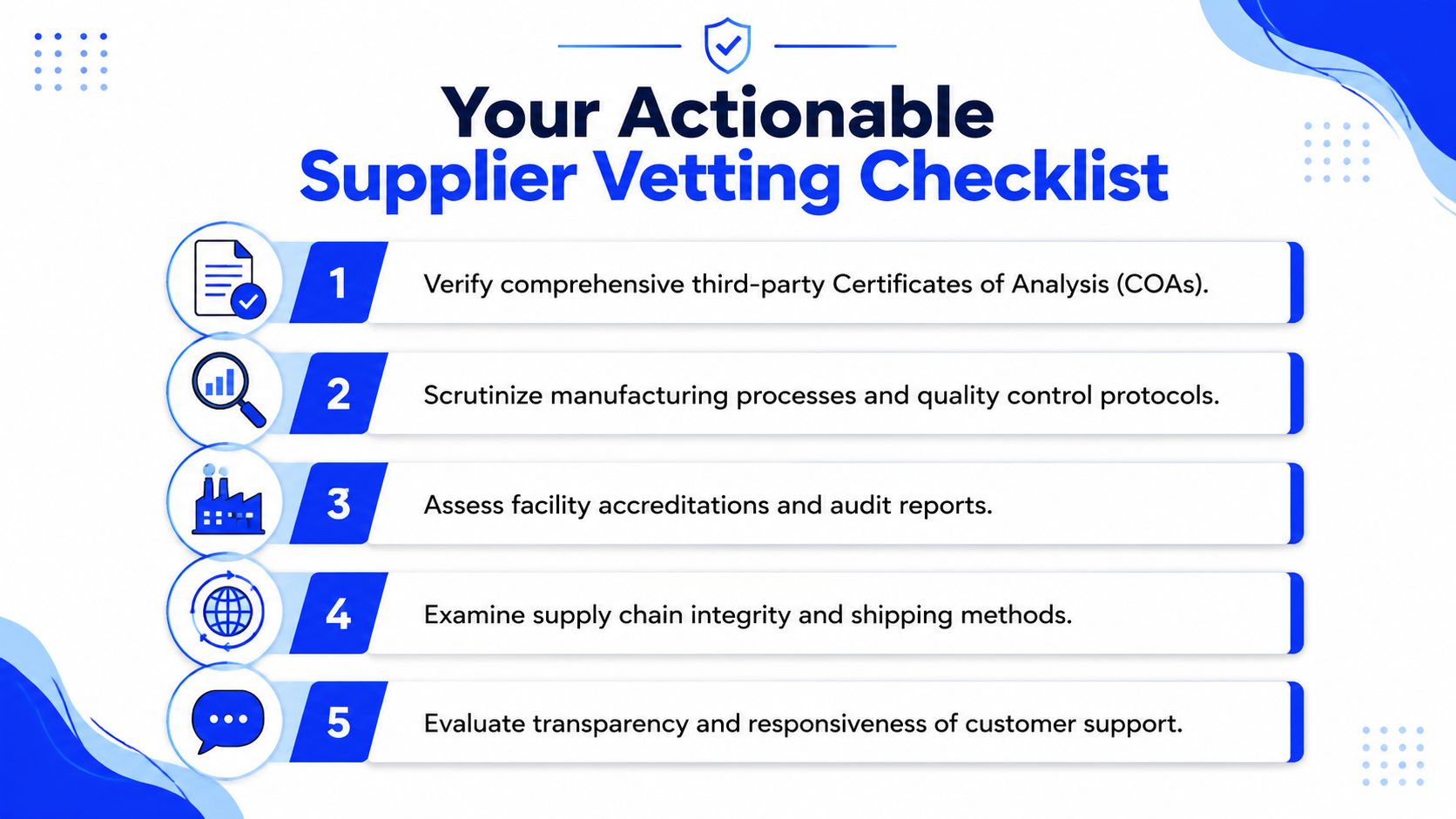
Use this table as a pass/fail worksheet during procurement review:
| Category | Verification Point | Pass/Fail |
|---|---|---|
| Documentation | Batch-specific COA is available before purchase | |
| Documentation | HPLC data is included or available for the exact lot | |
| Documentation | Mass spec or identity confirmation is available | |
| Documentation | Microbial and endotoxin reports can be provided when relevant | |
| Manufacturing | Supplier can explain synthesis and purification in plain language | |
| Manufacturing | QA review process is described clearly | |
| Manufacturing | Batch traceability exists across reorder cycles | |
| Facility | Company can discuss where material is produced and handled | |
| Facility | Storage and warehousing conditions are explained clearly | |
| Shipping | Packaging protects against environmental exposure | |
| Shipping | Fulfillment process ties shipped material to a documented lot | |
| Shipping | Carrier and transit practices are described clearly | |
| Support | Technical questions get direct, informed answers | |
| Support | Administrative questions about returns, tracking, and documentation are answered promptly | |
| Compliance | Product language stays within research-use boundaries |
Not every purchase needs a full vendor audit. For a first order, focus on the items that reveal whether the supplier operates with control:
You can also separate vendors into three practical buckets:
That keeps procurement decisions clear, especially when multiple people in a lab can place orders.
What works is boring, and that’s good. Clear batch records. Consistent documents. Stable communication. Defined shipping procedures. Support teams that answer without improvising.
What doesn’t work is buying on branding alone. A clean product page, a patriotic label, or a single purity claim doesn’t tell you enough about whether the material will hold up from synthesis through receipt.
If you want to compare a supplier against a documented, research-focused standard, learn more about Peptide Warehouse USA and explore options backed by transparent batch documentation, stated handling practices, and responsive support for laboratory buyers.