
No products in the cart.



You're reviewing a strange result from an otherwise familiar method. The instrument is calibrated, the analyst followed the procedure, and the sample preparation looks correct. Then someone asks the question that should have been answered before the run: Which grade of chemical did we use, and what impurities does its specification control?
That question captures the meaning of analytical grade chemicals. Analytical grade isn't just a container label or a promise of "high purity." It's a specification claim connected to assay requirements, impurity limits, test methods, and, in many cases, a defined compendial reference. The right choice can support reproducible titration, spectroscopy, chromatography, quality control, and calibration work. The wrong choice can introduce an impurity that matters more than the headline purity number.
A new researcher may reach for the bottle with the highest stated purity. That shortcut fails when a small amount of a particular contaminant can affect the method. In quantitative analysis, the relevant question is what the material controls, not just how impressive its assay appears.
A solvent may show a strong assay yet contain water, absorbing impurities, inorganic ions, trace metals, or residue that changes a measurement. A salt prepared for a standard can also appear suitable by chromatographic purity while moisture or residual solvent changes its effective analyte content. Fitness for purpose depends on the impurity that can interfere with the method, so the same grade may suit one procedure and require closer review for another.
The ACS Reagent Chemicals reference expresses this idea through compound-specific specifications. Requirements for the principal component are paired with limits for listed impurities and defined tests. Ask, “Does this lot meet the specification required by my method?” rather than relying on the label alone.
Analytical grade is often associated with very high purity. ACS-grade materials are commonly described as meeting or exceeding about 95% purity, while many analytical applications use reagents at 99.0% to 99.9% or higher, depending on the material and procedure (Lab Manager). These figures provide orientation, but they do not replace the applicable specification.
Consider a solvent used with a sensitive instrument. A product may meet its assay requirement while still needing limits for chloride, heavy metals, water, or residue because those impurities can affect the measurement. The impurity limit can therefore matter more than a small difference in the headline assay.
This guide serves two practical needs. For researchers learning grade terminology, it distinguishes analytical, ACS, AR, USP, reagent, laboratory, and technical designations. For laboratory buyers, it provides a way to compare product specifications, check a lot-specific Certificate of Analysis, and decide whether a material fits routine analysis, calibration, or method validation.
Practical rule: Use the grade name as the starting point. Use the product specification, relevant monograph, and lot-specific COA as the evidence.
A lab can receive two bottles with similar purity labels yet obtain different results. Early analytical work faced this problem because suppliers used different tests and controlled different impurities. Reliable comparison required shared specifications that laboratories could apply to a particular compound.
The American Chemical Society addressed that need through its Committee on Analytical Reagents. An earlier effort in 1903 focused on reagent purity, and the committee was established in 1917 to improve result comparability by publishing testable specifications and methods, as documented in ACS Reagent Chemicals.
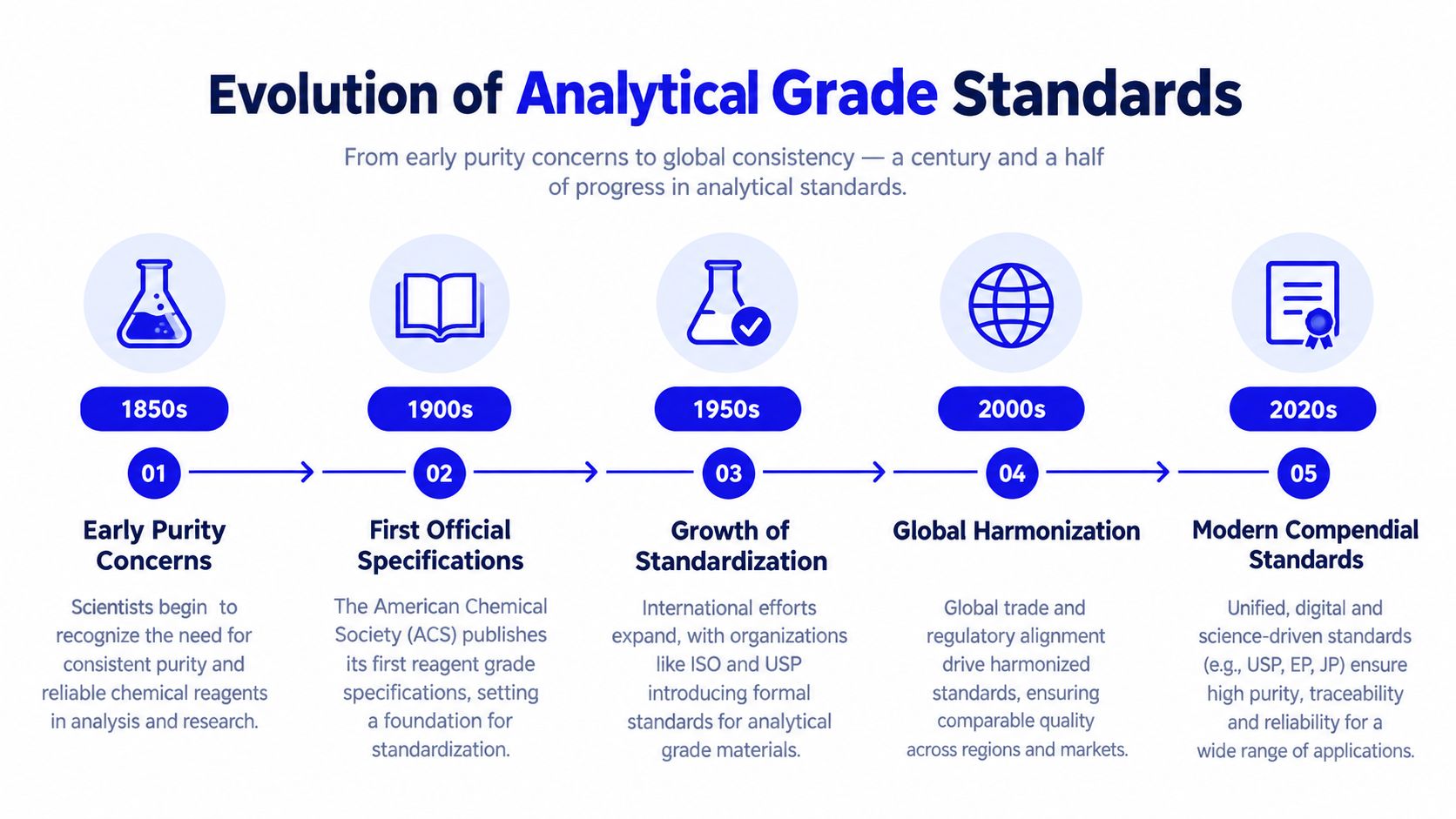
The first edition of Reagent Chemicals appeared by 1950. The reference developed alongside new instruments and analytical methods, and an online edition became available in 2017. It now covers almost 500 reagent chemicals and more than 500 standard-grade reference materials.
This history gives ACS grade a meaning beyond a general “high purity” statement. An ACS monograph defines the specification for a compound. It may include an assay requirement for the main component, along with limits or tests for chloride, sulfate, heavy metals, residue on ignition, water, or other impurities that could affect a method.
The practical lesson is that analytical grade is a specification system, not one universal purity number. The impurity that matters depends on the procedure. A trace chloride limit may matter for one analysis, while residue or water control may matter more for another.
Standardization does not make every reagent suitable for every application. It gives laboratories a shared baseline for judging suitability. Two labs using material that meets the same compound-specific requirements have stronger grounds for comparing results than labs relying only on broad supplier labels.
Modern purchasing connects that historical baseline to lot-level evidence. Identify the applicable monograph, determine which tests the method depends on, and compare those requirements with the lot-specific Certificate of Analysis. That check turns a grade name into a documented decision for receiving, quality control, and audits.
A bottle labeled ACS, USP, or AR does not tell you the whole quality story. ACS and USP are compendial designations, tied to published specifications for defined compounds. Terms such as reagent, lab, technical, and AR may depend more on the manufacturer, region, or product family. Two products with the same broad label can therefore have different impurity controls.
The lot-specific Certificate of Analysis, or COA, resolves much of that uncertainty. It records the tests applied to a particular batch and the measured results. If a method specifies ACS, compare the COA with the applicable ACS monograph. Do not treat “AR” or a purity percentage as an automatic substitute for that comparison.
| Grade | Definition Source | Typical Use Case |
|---|---|---|
| ACS | Published ACS specifications for a defined compound | Analytical testing, reagent preparation, and quantitative laboratory work |
| USP | Published United States Pharmacopeia requirements | Applications that require the applicable USP specification |
| AR | Commonly used analytical reagent designation, with exact criteria set by the supplier or applicable standard | Analytical testing, titration, QC, and routine laboratory procedures |
| Reagent | Often manufacturer-defined, with documented purity and impurity requirements | General analytical and research procedures |
| Lab | Usually manufacturer-defined and intended for less critical laboratory work | Teaching, preliminary work, cleaning, or procedures where trace impurities don't affect the result |
| Technical | Typically intended for process, industrial, or non-critical use | Large-scale preparation, production support, and applications where analytical traceability isn't central |
AR, or Analytical Reagent, grade generally refers to a high-purity material intended for analytical testing, titration, quality control, and routine laboratory procedures. Practical descriptions often place AR materials above 95% purity, although the exact requirement depends on the chemical and supplier (RCI Labscan). The label is a starting point, not proof that the product meets a particular ACS monograph.
Choose according to how a reagent could cause the method to fail, rather than selecting the most impressive-sounding label.
An AR product may fit a procedure that does not require ACS documentation. It should not automatically replace an ACS-specified reagent. Compare the supplier's criteria with the method, record the reasoning, and retain the COA with the batch documentation.
A specification answers two practical questions: How much of the intended compound is present, and what else is present? Assay addresses the first. The second is the impurity profile, which determines whether a reagent can affect a particular measurement. Analytical grade is therefore a specification system, not a single purity number. The relevant ACS monograph and the lot-specific COA define what must be checked.
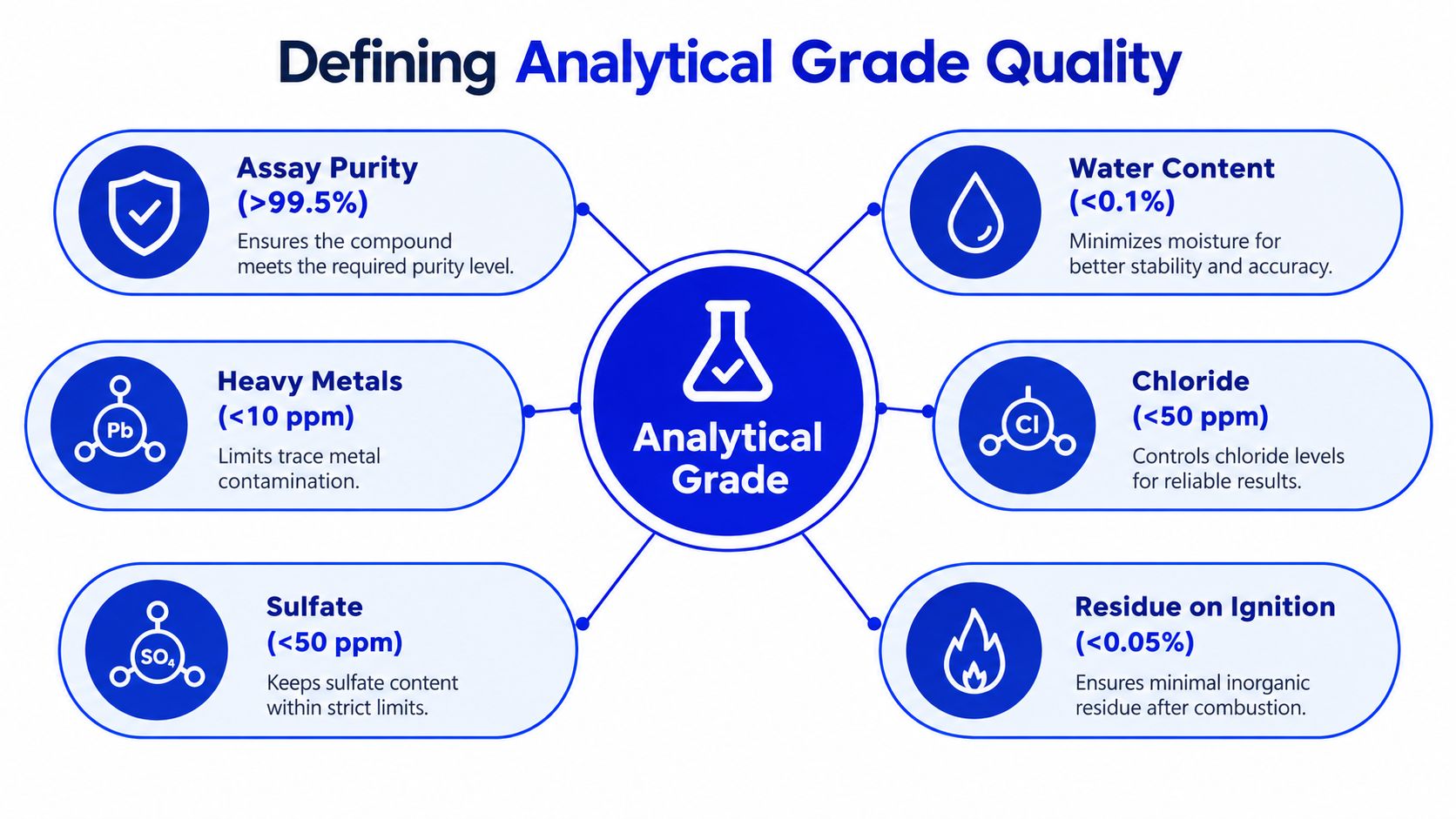
Assay measures the amount of the principal component under a specified test. A high assay supports predictable solution preparation, but it does not establish suitability for every instrument, reaction, or calibration task. Review the assay together with the limits for impurities that could influence the method.
For acetone and isopropyl alcohol, an ACS-grade solvent example lists ≥99.5% assay alongside separate controls for heavy metals and chloride (Lab Manager). The format matters. A reagent may meet its assay requirement while still failing a method-specific check because of one interfering contaminant.
Water can change effective concentration, reaction behavior, and the mass required to prepare a standard. Residual solvents create a related problem when the stated purity has not been corrected for their presence.
Guidance on reference-material quality explains that COAs can report purity, identity, content, and stability. Higher characterization tiers may also include water-content and residual-solvent corrections. If a standard is uncorrected for water or solvent, its effective analyte content may be overstated during quantitation (ChromaDex Reference Standards).
The impurity that matters depends on the procedure and its detection limits.
An ACS-grade solvent example lists heavy metals at ≤0.5 ppm and chloride at ≤0.3 ppm. These limits show why an assay value alone is incomplete. The remaining material must be characterized according to the method's vulnerability.
A chromatography method may respond to solvent background or water. A spectroscopy method may detect absorbing contaminants. A gravimetric or precipitation procedure may be affected by inorganic ions. Compare each specification with the ACS monograph and the method, then verify the corresponding result on the COA.
The important question isn't whether a reagent is pure enough in general. It's whether the impurity that remains can change your result.
A COA is the record for a particular lot. It should connect the product identity and batch to the tests performed, results obtained, acceptance criteria, and applicable documentation. A catalog page can describe the product family, but it doesn't tell you what your container tested at.
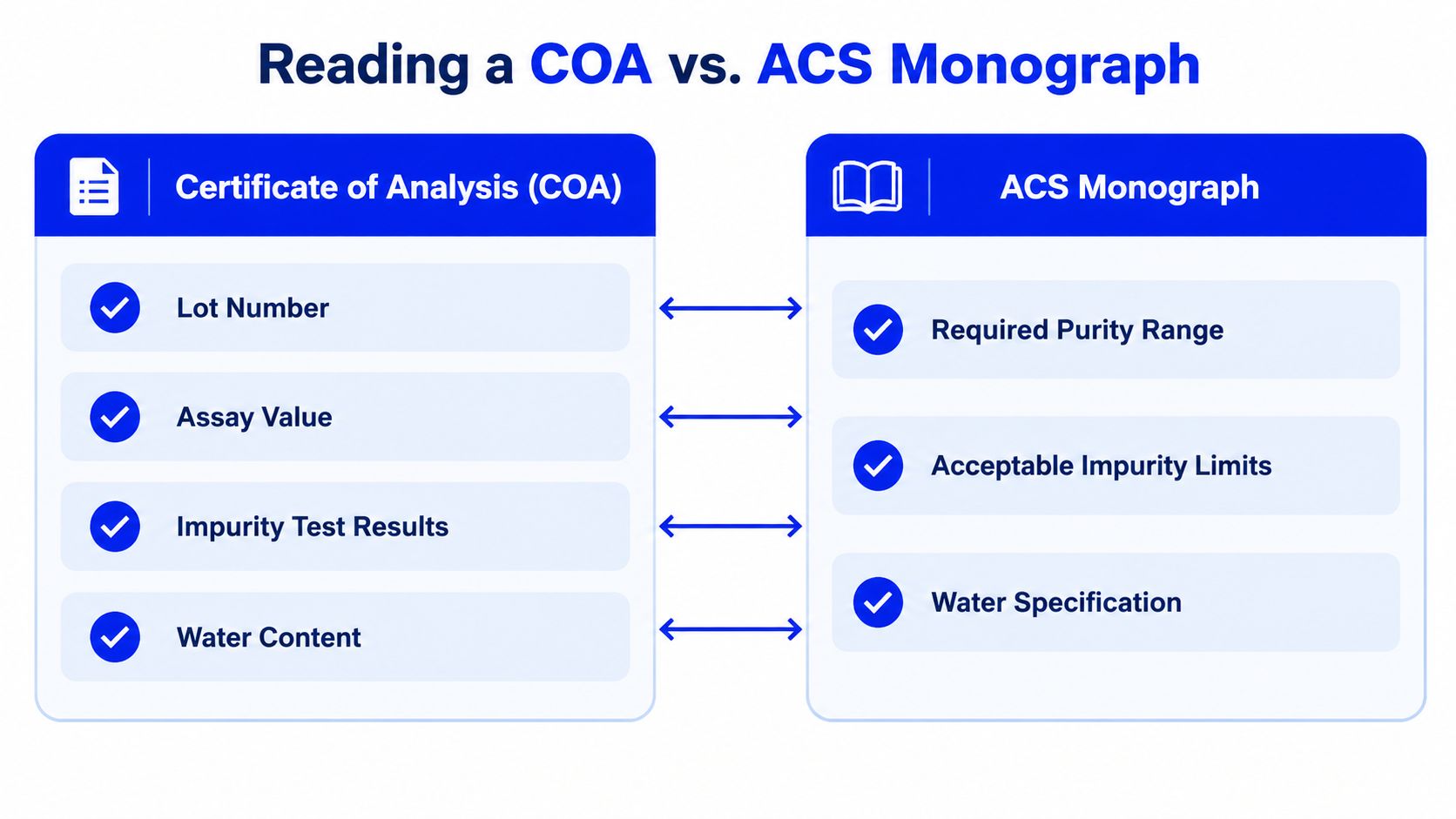
Match the COA to the container before reviewing the numbers.
The ACS Reagent Chemicals resource describes ACS coverage as published purity specifications for almost 500 reagent chemicals and more than 500 standard-grade reference materials. It also emphasizes that the compound-specific monograph, not the marketing grade name alone, is the authoritative reference for the required profile.
Chromatographic purity can be useful, but it doesn't automatically provide the correction information needed for quantitative preparation. Check whether the COA reports Karl Fischer water, residual solvents, stability, uncertainty, and any correction factors required by the product's intended use.
If water and solvent content aren't reported, ask whether the stated content is corrected. A batch record should preserve the answer, along with storage conditions, expiry or retest guidance, and the calculation used to prepare the standard. This creates a traceable link between the material received and the concentration used in the method.
Before acceptance, verify the lot, the specification, the test result, and the correction basis. A purity number without that context is incomplete.
For regulated or validated work, document deviations rather than making informal substitutions. If the method requires an ACS specification and the COA uses a different test panel, have the responsible technical or QC function determine whether equivalence has been demonstrated.
Choose a grade by asking how the experiment could fail. In a titration, a reactive contaminant can alter the measured endpoint. In chromatography, solvent background or changed retention can distort the result. In calibration work, water or residual solvent can change the analyte content delivered.

Analytical grade is a practical choice for quantitative titration when the reagent takes part directly in the measured reaction. The relevant question is whether the specification controls impurities that could react with the titrant, shift the endpoint, or change the sample matrix. Match the product to the procedure and its applicable monograph rather than treating the grade label as a complete approval.
If the method is sensitive to carbonate, chloride, sulfate, metals, or water, confirm that the COA reports those limits or provides an applicable test result. A reagent can look suitable while one uncontrolled impurity affects the result.
Pharmaceutical quality control, environmental testing, food testing, and industrial R&D use analytical chemistry methods in which small impurity differences can change measured outcomes (Lab Manager). Depending on the method, the laboratory may need an ACS-grade reagent, a method-specific solvent, a certified reference material, or more than one of these.
A general analytical reagent is not automatically a calibration standard. Quantitative reference materials require suitable identity, content, stability, uncertainty, and traceability information. Applicable frameworks can include ISO 17034, ISO/IEC 17025, and ISO Guide 31, as described in guidance from Sigma-Aldrich.
Spectroscopy and chromatography can reveal contaminants that visual inspection cannot. Solvent absorbance, trace metals, inorganic ions, water, and residue may each interfere differently, so the relevant impurity profile depends on the method.
Your SOP should identify the required grade, permitted substitutions, COA checks, and storage conditions. SOP documentation best practices can help document these decisions clearly. That record gives analysts a practical rule for accepting a product, instead of treating a familiar label as automatic approval.
A reagent may satisfy its specification at shipment yet become unsuitable after poor storage or repeated contamination. Hygroscopic materials can absorb moisture, while light, heat, oxygen, and evaporation can alter other products. Storage therefore protects the specification that the method and COA require, rather than preserving a label alone.
Before placing a container in active inventory, compare its physical condition with its records.
Use clean, dry tools, and never return unused material to the original container. Keep caps closed during weighing, reduce exposure to humid air, and use dedicated spatulas or pipettes when cross-contamination could affect the method.
Volatile liquids need minimal open-container time. For moisture-sensitive materials, document how the container was handled and consider whether its reported water content still represents the material after opening.
The batch record should capture purity, identity, water content where relevant, residual-solvent corrections, storage conditions, expiry or retest guidance, and uncertainty when supplied or required. These fields connect the container to the specification used for acceptance and later review.
Mark opened containers clearly. Define the conditions that require retesting or disposal, including excessive exposure to humidity, heat, light, or contamination. Quarantine any container held under unsuitable conditions until QC or the responsible technical owner decides whether it remains fit for the method.
Use this lookup when a method, product page, or COA leaves a specification unclear. Analytical grade is a specification system, not a single purity number. The relevant question is whether the impurity profile fits the method.
Ask these questions before placing an order:
The CASRAI guide to chemical grades explains why grade labels require context. Criteria can vary by chemical family, and analytical grade is not a universal highest-purity category. Compendial grades follow published specifications, while reagent, lab, and technical labels may be defined by the manufacturer. The COA records the tested results for the specific lot.
For reference-material work, use the traceability and documentation principles described earlier. For routine reagents, consult the applicable ACS monograph in the ACS Reagent Chemicals reference, then compare its requirements with the lot-specific COA.
Receiving rule for an SOP: Accept an analytical reagent only when its identity, relevant impurity limits, lot-specific COA, and required storage conditions match the method or approved specification.
Peptide Warehouse USA offers high-purity research peptides and related compounds for laboratory, analytical, and preclinical applications, with batch documentation such as Certificates of Analysis, microbial reports, and endotoxin reports. Visit Peptide Warehouse USA to review documented research-use options, product specifications, and intended-use information before procurement.
Leave a comment