No products in the cart.



It's legal to buy peptides online for laboratory research, but it's generally illegal to buy them online for personal human consumption unless the product is FDA-approved or legally compounded and dispensed through a licensed pharmacy with a valid prescription. That's the core rule most shoppers miss when they move from a research catalog to a checkout page.
If you're reading product listings for BPC-157, TB-500, Ipamorelin, or similar compounds, you're probably seeing a mix of science language, disclaimers, and marketing cues that don't line up cleanly. That confusion is normal. The online peptide market puts legitimate research supply and risky personal-use purchasing very close together, even though the law treats them very differently.
The practical question isn't just whether a website will sell to you. The primary question is whether the intended use, the seller's claims, the product category, and your state and import situation place the transaction inside or outside a lawful lane.
This guide breaks that down in plain English. You'll see where federal law draws the line, how state rules can add friction, what legitimate researchers should look for in a supplier, and which habits reduce legal and compliance risk. If you've searched are peptides legal to buy online, this is the framework you need to make sense of the answer.
Most readers land here in the same situation. You find a peptide online, the website looks polished, the product page says “research use only,” and you're left wondering whether that means safe to buy, legal to own, or legal to use. Those are not the same question.
The cleanest starting point is this: use decides legality. A peptide sold for laboratory, analytical, or preclinical work sits in a different legal category than the same compound sold or bought for self-administration. That's why sellers use careful disclaimers, age gates, testing documents, and restricted product language.
Practical rule: If a product is sold as a research chemical, treat it as a research chemical in every part of the transaction, from ordering to storage to documentation.
That distinction matters more now because the legal gray zone is getting narrower. State action and federal enforcement have both increased scrutiny, especially where sellers appear to market “research” peptides in ways that point toward personal use. If you follow regulatory issues in other online markets, the pattern is familiar. The rules often become clearer through enforcement before the average buyer notices, much like the broader issues discussed in understanding mugshot site laws, where legality turns on use, disclosure, and platform behavior rather than on a simple yes-or-no label.
A few misunderstandings cause most of the confusion:
For legitimate researchers, the practical path is narrower but clearer. Buy only within a genuine research context, use vendors that document identity and purity, keep records, and avoid any conduct that blurs the line into personal-use purchasing.
The most important concept in this entire topic is simple. The same molecule can sit in two completely different legal lanes depending on what it's for.
The situation is comparable to high-purity ethanol. A lab can buy it for solvent use under one set of rules. A consumer can't assume that makes it lawful as a beverage product. Peptides work in a similar way. The label, the seller's claims, the buyer's purpose, and the distribution channel all matter.
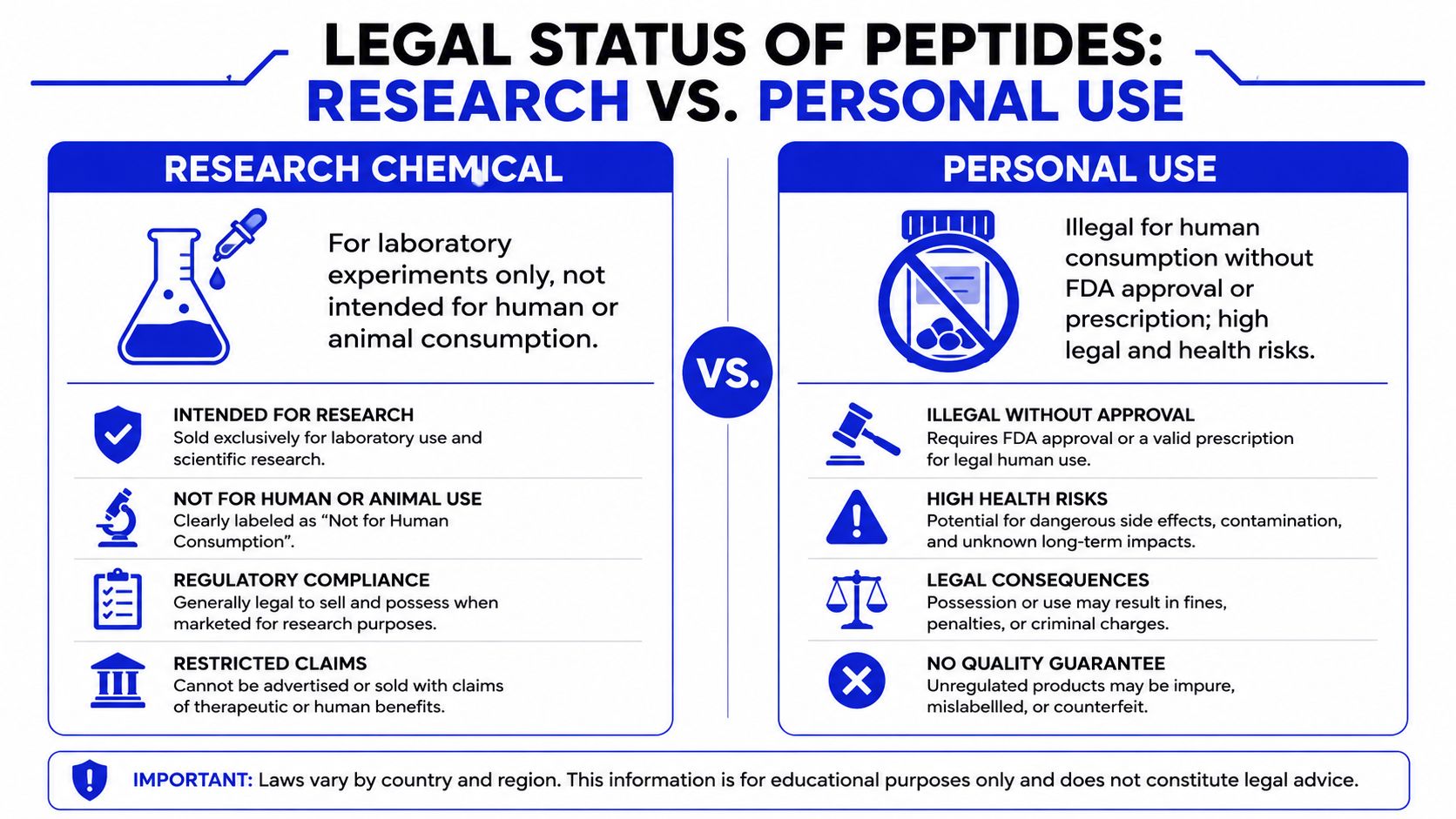
In the United States, the only peptides legally obtainable for online purchase and human consumption are those that are FDA-approved and dispensed through licensed pharmacies or valid compounding channels under Section 503A with a valid prescription; research peptides labeled 'not for human consumption' such as BPC-157, TB-500, and Ipamorelin are legally sold exclusively for laboratory use and are unlawful to market, sell, or dispense for human use regardless of 'research use only' labeling, as explained in this U.S. peptide legality guide.
That single rule answers most buyer questions.
If you're a researcher ordering a compound for laboratory or analytical work, the transaction may fit a lawful research-supply model. If you're buying the same vial because you intend to inject, ingest, or otherwise self-administer it, you've moved into a very different legal category.
Sellers and buyers both create risk when the facts around a transaction contradict the “research only” label.
This is why compliant suppliers avoid dosage instructions for people, disease claims, body-composition promises, and lifestyle marketing that points toward human use. Their job is to stay inside the research lane.
For people who deal with regulated online transactions in other industries, this kind of legal split is common. A useful comparison appears in this merchant cash advance legal guide, where the label on a product matters less than how courts and regulators classify the actual transaction.
Here's the simplest way to map the options:
| Pathway | Legal Status for Human Use | How to Obtain | Example |
|---|---|---|---|
| FDA-approved peptide through a licensed pharmacy | Legal | Valid prescription through lawful pharmacy channels | An FDA-approved peptide medication |
| Valid 503A compounding pathway with prescription | Legal only if the peptide is lawfully compoundable | Prescription through a licensed compounding pharmacy | A peptide that qualifies for lawful compounding |
| Research peptide sold as laboratory material | Not legal for human use | Purchase for laboratory, analytical, or preclinical work only | BPC-157, TB-500, or Ipamorelin sold as research material |
For a legitimate buyer, “for research use only” should change behavior, not just packaging.
That means:
If your real goal is personal use, the lawful route isn't a research store. It's a physician-directed prescription channel.
The FDA sits at the center of peptide legality in the United States. If you understand how the agency views online peptide sales, most of the market becomes easier to read.
At the federal level, the problem usually starts when a peptide intended for diagnosis, cure, mitigation, treatment, or prevention of disease is sold without FDA approval. Once sellers make human-use claims or structure the transaction around human use, the FDA can treat that product as an unapproved new drug under the Federal Food, Drug, and Cosmetic Act.
A lot of confusion comes from scientific language. People see terms like tissue repair, muscle building, anti-aging, or metabolic support and assume they're reading supplement-style marketing. But the FDA doesn't look only at the phrase on the bottle. It looks at intended use, claims, and the product's role in treatment or health outcomes.
By late 2026, only licensed compounding pharmacies can legally distribute peptides like BPC-157 or TB-500 for human use, and only if those peptides are on the FDA's approved compounding list. As of 2026, the FDA has not added new popular research peptides to this list, meaning online sales of these compounds for personal use violate federal law, according to this late-2026 peptide compounding summary.
That means a seller can't lawfully convert a research peptide into a consumer wellness item just by putting a disclaimer on the website. If the surrounding facts point to human use, the legal risk rises quickly.
A practical way to think about federal peptide rules is through three questions that compliance professionals use:
This is the point where many buyers get outdated information. They hear that “compounding pharmacies can make peptides,” then assume that applies broadly to popular research compounds. It doesn't.
Another complication is that some therapeutic peptides were reclassified as biologics between 2020 and 2023, which changed who could manufacture them and narrowed ordinary compounding options. That shift pushed many buyers toward a shrinking “research use only” market instead of a conventional pharmacy pathway.
Compliance view: Don't assume historical availability means current legality. In peptide law, old forum advice ages badly.
If you're trying to judge whether are peptides legal to buy online has a yes-or-no answer, federal law says it doesn't. The lawful path depends on approval status, compounding eligibility, prescription status, and how the product is marketed.
Federal scrutiny usually concentrates on conduct that makes a research listing look like a human-use drug offer. Examples include:
For a non-lawyer researcher, the takeaway is straightforward. Respect the category. If you need a research peptide, buy it as research inventory. If you need a medicine, use a lawful prescription route.
Federal law is only part of the answer. States can add their own restrictions, and international ordering creates a separate set of practical problems even before a package reaches your door.
That's why buyers who ask a single national question often get tripped up. A website may be accessible from every state, but that doesn't mean every sale presents the same legal exposure.
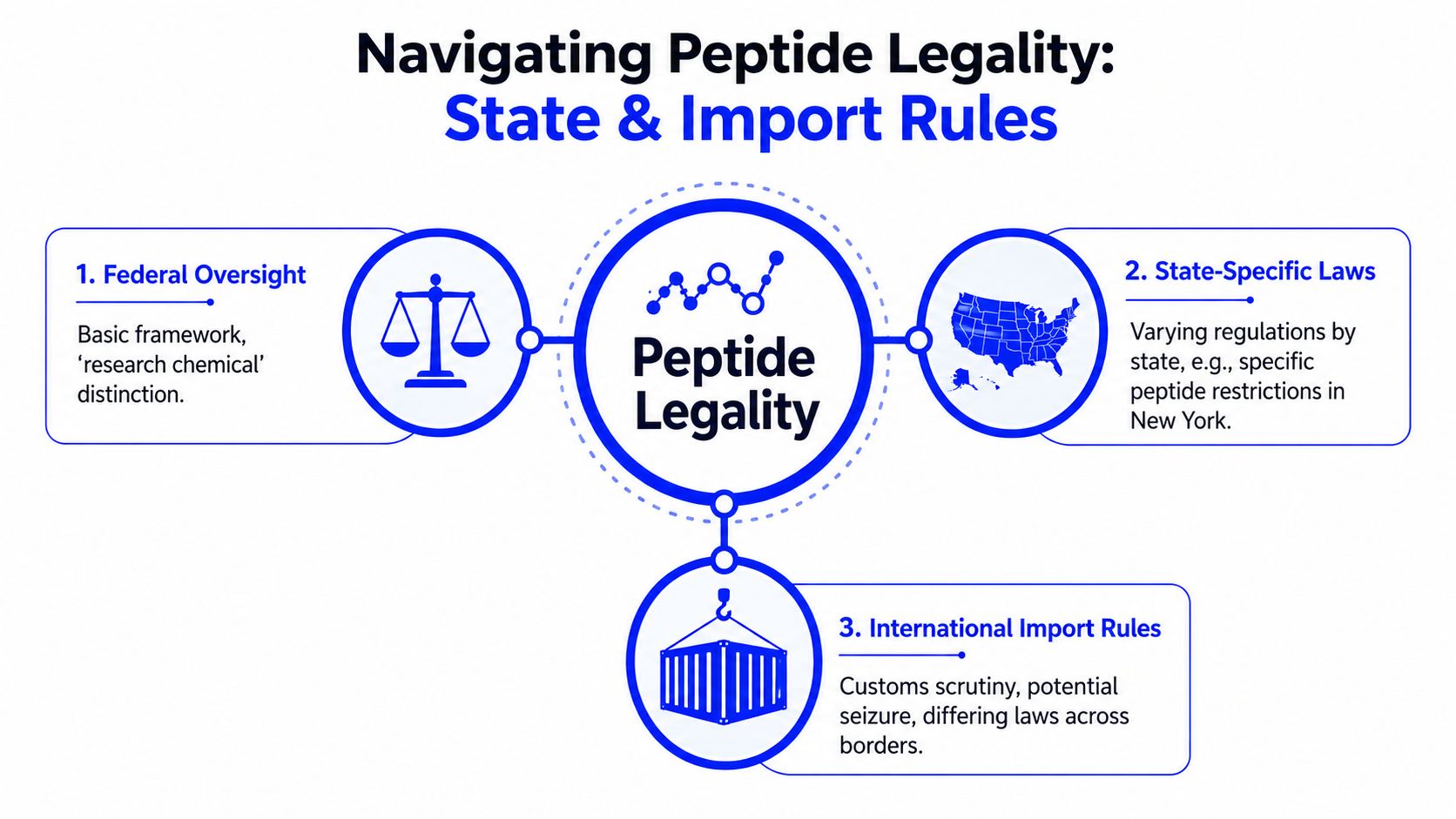
As of April 22, 2025, New York enacted a law prohibiting the sale of any product marketed for muscle building or weight loss to individuals under 18 years of age, affecting online peptide sales even when products are labeled “not for human consumption,” as described in this analysis of New York's 2025 peptide-related sales restriction.
That example matters for two reasons. First, it shows that states can regulate around marketing context, not just chemical identity. Second, it shows that disclaimers don't automatically override how regulators interpret a product's real-world purpose.
Importing peptides from overseas adds customs risk, labeling risk, and documentation risk.
A foreign seller may promise shipment into the United States, but that doesn't make the transaction lawful or low-risk. Customs officials can review inbound products, and a shipment that appears mislabeled, improperly declared, or intended for unlawful human use can create problems before the buyer ever sees the package.
For legitimate researchers, domestic sourcing usually reduces confusion because the supplier is more likely to understand U.S. labeling, batch documentation, and age-gate expectations.
Ordering from outside the country can turn one legal question into three: seller legality, import legality, and intended-use legality.
Use this screen before placing an order:
The broad lesson is simple. Even when federal law provides the main framework, local rules and import realities can tighten the path.
For legitimate researchers, the smartest move isn't finding the most aggressive seller. It's building a repeatable purchasing process that shows you bought a research product for research purposes and handled it like professional lab inventory.
That approach protects your work, your institution, and your procurement trail.
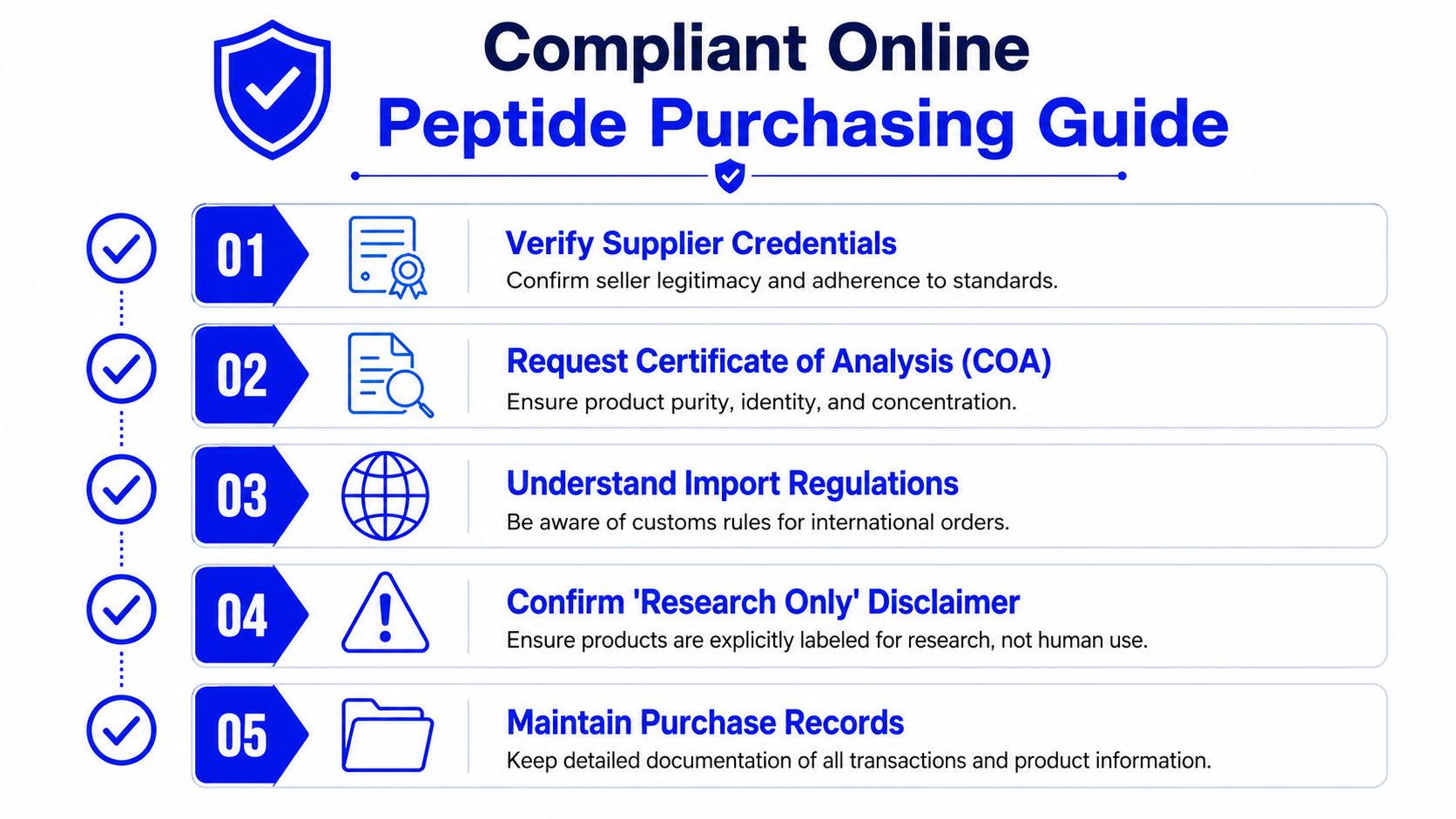
Early in the buying process, a visual checklist helps keep the basics straight.
By 2026, federal enforcement has focused primarily on companies making therapeutic health claims and unregistered compounding pharmacies, rather than on compliant research peptide suppliers who adhere to strict labeling, testing, and “research use only” standards, according to this 2026 overview of peptide sales enforcement priorities.
That gives researchers a useful filter. Look for suppliers that behave like research suppliers, not like disguised telehealth clinics or performance marketers.
A strong vetting process includes the following:
A compliant purchase doesn't end at checkout. Recordkeeping is part of the legal story.
Keep a file that includes:
Research habit: If you wouldn't be comfortable explaining the purchase to an internal compliance officer, tighten the process before you order.
A short educational overview can also help teams align around the basics before they buy:
Many researchers focus on purity and forget presentation risk. Both matter.
A seller with high-purity claims but sloppy legal framing can still create procurement problems. On the other hand, a supplier that uses age gates, FDA disclaimers, research-only language, and transparent testing documents is usually showing that it understands its lane.
When you evaluate options, give extra weight to:
That's how you reduce avoidable risk while still getting access to research materials that support legitimate work.
Many buyers assume the words “research only” act like a legal shield. They don't. Those words matter, but regulators look at the full transaction, not just one phrase on a label.
That's especially important because older compounding assumptions no longer fit today's market.

The FDA's reclassification of therapeutic peptides as biologics between 2020 and 2023 effectively banned compounding pharmacies from preparing popular peptides like BPC-157 and Ipamorelin, pushing users into a shrinking “research use only” gray zone under increased FDA and state enforcement, as outlined in this review of the peptide biologics transition and its legal impact.
That change created a market tension. Demand stayed high, but lawful human-use channels narrowed. As a result, some sellers started leaning harder on disclaimers while still signaling personal-use benefits of peptides to buyers. That's where risk grows.
For personal-use buyers, the main risks usually include:
For researchers, the risk picture is different but still real. A poor supplier can create documentation gaps, questionable traceability, or institutional compliance problems even when the purchase itself is meant for legitimate lab work.
The gray zone is smallest where conduct is clear. It gets larger and more dangerous when the buyer's purpose and the seller's presentation don't match the label.
If your true goal is personal health use, don't try to borrow the research market as a workaround. If your true goal is research, behave like a researcher at every stage of the order.
That distinction won't remove every risk, but it will remove the most avoidable ones.
A doctor can only lawfully prescribe within available legal channels. For human use, the key questions are FDA approval and lawful compounding status. If a peptide isn't approved or lawfully compoundable, a routine prescription path may not exist.
Possession questions depend on facts and context. The safer legal distinction is purchase and intended use. Buying research peptides for legitimate laboratory work is treated differently from obtaining them for self-administration.
The shipment may never complete delivery, and you may have limited practical recourse. Seizure risk is one reason serious researchers usually prefer suppliers that understand U.S. compliance expectations and domestic fulfillment realities.
That language helps define a research-only sale, but it doesn't make personal use lawful. The intended use still controls the answer.
Use a licensed pharmacy and prescription route for human consumption. Use a documentation-heavy, research-only supplier for laboratory use. Don't mix the two models.
The bottom line is simple. Online peptide legality isn't determined by convenience, website polish, or community chatter. It's determined by what the product is, how it's offered, and what you intend to do with it.
If you're a legitimate researcher looking for a U.S.-based source that operates strictly within the research-supply lane, Peptide Warehouse USA offers high-purity research peptides and related compounds for laboratory, analytical, and preclinical use only. You can learn more, review available documentation, and explore options that support a cleaner, more traceable procurement process.